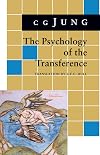
The Psychology of the Transference
by C. G. Jung
Jung Extracts (Extracts from Collected Works Vol. 16)
On This Page
Description
An authoritative account, based on a series of 16th century alchemical pictures, of Jung's handling of the transference between analyst and patient.Tags
Recommendations






















Member Reviews
The central matter of this book is Jung's exigesis of the illustrations to the "Rosarium Philosophorum," in keeping with his psychological reading of medieval alchemy. The sequence of illustrations with their original captions is worth sustained attention in its own right. Jung's explanations are sometimes mildly incoherent--a fact which he recognizes and excuses on the grounds that he is attempting to address inherently unconscious processes.
He is right to note that the "transference" process is not unique to the analyst-analysand relationship, but is common to the vast majority of spousal scenarios, and in a more general way to the experience of "objective" reality as a whole. And yet, despite his prefatory digression that "The show more Church would be an ideal solution for anyone seeking a suitable receptacle for the chaos of the unconscious, were it not that everything man-made, however refined, has its imperfections," (par. 392) he constrains his discussion of psychological projection in religious contexts to the doctrinally hypostasized figures of myth and doctrine, rather than treating the actual relationships among worshippers and religious officials. Perhaps he balked (unconsciously?) at making so plain the sacerdotal role of the psychoanalyst! show less
He is right to note that the "transference" process is not unique to the analyst-analysand relationship, but is common to the vast majority of spousal scenarios, and in a more general way to the experience of "objective" reality as a whole. And yet, despite his prefatory digression that "The show more Church would be an ideal solution for anyone seeking a suitable receptacle for the chaos of the unconscious, were it not that everything man-made, however refined, has its imperfections," (par. 392) he constrains his discussion of psychological projection in religious contexts to the doctrinally hypostasized figures of myth and doctrine, rather than treating the actual relationships among worshippers and religious officials. Perhaps he balked (unconsciously?) at making so plain the sacerdotal role of the psychoanalyst! show less
LA PSICOLOGIA DE LA TRANSFERENCIA
Este importante libro del profesor Jung que se publica ahora en una nueva edición en castellano es la aplicación de los últimos descubrimientos y tesis del gran psicólogo suizo al problema de la transferencia, con justa razón calificado como el más arduo de los problemas de la psicoterapia. Tal es el tema central del presente libro, donde se traza un paralelismo entre el moderno opus psychologicum y un típico ejemplo de procedimiento alquimista. Los procesos de la transferencia se ilustran e interpretan a la vez que una serie de figuras simbólicas, y se muestra que el vínculo entre médico y paciente es una función de la líbido de parentesco, de la cual depende un complicado sistema show more matrimonial en ciertas sociedades primitivas. show less
Este importante libro del profesor Jung que se publica ahora en una nueva edición en castellano es la aplicación de los últimos descubrimientos y tesis del gran psicólogo suizo al problema de la transferencia, con justa razón calificado como el más arduo de los problemas de la psicoterapia. Tal es el tema central del presente libro, donde se traza un paralelismo entre el moderno opus psychologicum y un típico ejemplo de procedimiento alquimista. Los procesos de la transferencia se ilustran e interpretan a la vez que una serie de figuras simbólicas, y se muestra que el vínculo entre médico y paciente es una función de la líbido de parentesco, de la cual depende un complicado sistema show more matrimonial en ciertas sociedades primitivas. show less
Sep 12, 2024Spanish
Ratings
Members
- Recently Added By
Lists

Favourite Books
1,817 works; 316 members

The Luca Guadagnino Universe
62 works; 1 member
Author Information

890+ Works 42,609 Members
Carl Gustav Jung was born in Switzerland on July 26, 1875. He originally set out to study archaeology, but switched to medicine and began practicing psychiatry in Basel after receiving his degree from the University of Basel in 1902. He became one of the most famous of modern psychologists and psychiatrists. Jung first met Sigmund Freud in 1907 show more when he became his foremost associate and disciple. The break came with the publication of Jung's Psychology of the Unconscious (1912), which did not follow Freud's theories of the libido and the unconscious. Jung eventually rejected Freud's system of psychoanalysis for his own "analytic psychology." This emphasizes present conflicts rather than those from childhood; it also takes into account the conflict arising from what Jung called the "collective unconscious"---evolutionary and cultural factors determining individual development. Jung invented the association word test and contributed the word complex to psychology, and first described the "introvert" and "extrovert" types. His interest in the human psyche, past and present, led him to study mythology, alchemy, oriental religions and philosophies, and traditional peoples. Later he became interested in parapsychology and the occult. He thought that unidentified flying objects (UFOs) might be a psychological projection of modern people's anxieties. He wrote several books including Studies in Word Association, Flying Saucers: A Modern Myth of Things Seen in the Skies, and Psychology and Alchemy. He died on June 6, 1961 after a short illness. (Bowker Author Biography) show less
Series

Belongs to Publisher Series
Common Knowledge
- Original title
- Die Psychologie der Übertragung
- Original publication date
- 1946
- Original language*
- Alemán
*Some information comes from Common Knowledge in other languages. Click "Edit" for more information.
Classifications
- Genres
- Nonfiction, General Nonfiction
- DDC/MDS
- 150.19 — Philosophy & psychology Psychology Emotions, Relationships, & Family Theory And Instruction Systems, schools, viewpoints
- LCC
- RC506 .J8613 — Medicine Internal medicine Internal medicine Neurosciences. Biological psychiatry. Neuropsychiatry Psychiatry Psychoanalysis
- BISAC
Statistics
- Members
- 206
- Popularity
- 158,326
- Reviews
- 2
- Rating
- (4.00)
- Languages
- 5 — English, French, German, Italian, Spanish
- Media
- Paper, Ebook
- ISBNs
- 14
- ASINs
- 4