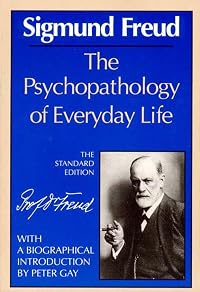
The Psychopathology of Everyday Life
by Sigmund Freud
On This Page
Description
Sigmund Freud explores the psychological mechanisms behind everyday phenomena such as forgetting names, misremembering, and errors in speech. The book delves into the unconscious motives and associations that influence these occurrences, suggesting that they are not random but follow predictable pathways. Freud's analysis demonstrates how displaced memories and thoughts can affect recall, leading to what he terms 'faulty memory.' The book is aimed at readers interested in psychoanalysis and show more psychology, providing insight into the complex workings of the mind and its influence on daily life. show lessTags
Recommendations



















Member Reviews
I approached this book with some scepticism, having not read Freud before but being under the impression that he was a sex-mad weirdo. Upon actually reading the book I was pleasantly surprised. The theories presented here are not outrageous and shocking, they are perfectly sensible, and indeed Freudian slips, which are the content of the longest chapter, are now widely accepted as acts of the unconscious. The style of the book is more along the lines of popular science than a textbook on psychoanalysis. It was an interesting introduction to some of the famous theories: briefly discussed and then explored using a series of short case studies, which were quite convincing. My only criticism is that many of the case studies in each chapter show more are very similar, but this book is definitely worth a read and will get you thinking whenever somebody cannot remember a word or replaces it with a different one. show less
Freud catalogues the various types of mistake (commonly known as Freudian Slips) made by normal people, which reveal more upon further inspection than they do at first glance. Among these are the misplacing and breaking of objects, forgetting names, words or intentions, and muddling actions or phrases. Each type is accompanied by the theory of its interpretation, many examples, and their analysis.
If you have read the introductory lectures then most of these will be familiar in concept, however this volume gives each a more exhaustive treatment and greater degree of illustration. This expanded edition contains extra material to Freud’s original publication, adding in examples sent to him by his readers (many of whom were also doctors), show more or that he experienced himself.
Behind nearly all of the types of misdoing or missaying we find repressed thoughts or feelings – be it related to an associated concept, name or action which our unconscious has a motive to forget or avoid. Though some of the examples are less convincing than others, and Freud admits himself that there are occasions of forgetting or misdoing etc that have other causes (such as due to memory in general, or clumsiness), most readers are likely to think of some examples of their own, or from those known to them. show less
If you have read the introductory lectures then most of these will be familiar in concept, however this volume gives each a more exhaustive treatment and greater degree of illustration. This expanded edition contains extra material to Freud’s original publication, adding in examples sent to him by his readers (many of whom were also doctors), show more or that he experienced himself.
Behind nearly all of the types of misdoing or missaying we find repressed thoughts or feelings – be it related to an associated concept, name or action which our unconscious has a motive to forget or avoid. Though some of the examples are less convincing than others, and Freud admits himself that there are occasions of forgetting or misdoing etc that have other causes (such as due to memory in general, or clumsiness), most readers are likely to think of some examples of their own, or from those known to them. show less
In Psychopathology of Everyday Life, Sigmund Freud explores the unconscious forces that influence our seemingly trivial daily behaviors―slips of the tongue, forgotten names, misreadings, and misplaced objects. With brilliant insight and wit, Freud demonstrates how these minor mental errors are not random but reveal deeper, hidden thoughts and desires.
Drawing from personal anecdotes and patient cases, this classic work offers a fascinating window into the human psyche. It remains a cornerstone of psychoanalytic theory and a captivating read for anyone intrigued by the mysteries of the mind.
Unlock the hidden meaning behind everyday mistakes.
Explore Freud’s revolutionary theory of unconscious motives in daily life
Delve into real-life show more examples of slips, forgetfulness, and dreams
Discover how everyday errors reflect deeper psychological processes
A seminal work in psychoanalysis that remains relevant today
Ideal for students, psychology enthusiasts, and curious readers
Themes Explored:
Unconscious mind and repressed desires
Freudian slips and memory lapses
Self-awareness through psychoanalysis
The intersection of normal behavior and neurosis
Symbolism and hidden meanings in daily actions show less
Drawing from personal anecdotes and patient cases, this classic work offers a fascinating window into the human psyche. It remains a cornerstone of psychoanalytic theory and a captivating read for anyone intrigued by the mysteries of the mind.
Unlock the hidden meaning behind everyday mistakes.
Explore Freud’s revolutionary theory of unconscious motives in daily life
Delve into real-life show more examples of slips, forgetfulness, and dreams
Discover how everyday errors reflect deeper psychological processes
A seminal work in psychoanalysis that remains relevant today
Ideal for students, psychology enthusiasts, and curious readers
Themes Explored:
Unconscious mind and repressed desires
Freudian slips and memory lapses
Self-awareness through psychoanalysis
The intersection of normal behavior and neurosis
Symbolism and hidden meanings in daily actions show less
A fundamental Freud text that touches on the themes, ideas, and concepts that intrigue him and cause him to wonder. While this was not as profound as some of the other Freud works that I have read, there is still something to be gained here by reading it. It was read in one sitting and Freud's conceptualizations of his ideas were original and linked to some of his other work. Overall, a decent book.
3.5 stars.
3.5 stars.
I read this as a required reading in one of my classes in graduate school (which may have something to do with how I rated it). At the end of the book I was left wondering if anyone would ever suggest this book if the authors name wasn't Freud.
Very interesting case collection – reader will most likely find himself in some of these cases (hopefully not those that can be considered as serious ones) because all cases presented are taken from the everyday life. Note this book is just that – interesting cases collection (many are contributed by Freud’s long-time colleagues) – author does not go into details and tries not to explain the causes of every case.
If you are interested in Freud’s work, this book is good starting point.
Recommended.
If you are interested in Freud’s work, this book is good starting point.
Recommended.
I tic, le dimenticanze, gli automatismi. Spesso non sono casuali ma il tratto evidente che la psiche va oltre la coscienza umana
Members
- Recently Added By
Lists

Psicología - Clásicos
165 works; 2 members

Read These Too
458 works; 9 members
Author Information

Sigmund Freud was the founder of psychoanalysis, simultaneously a theory of personality, a therapy, and an intellectual movement. He was born into a middle-class Jewish family in Freiburg, Moravia, now part of Czechoslovakia, but then a city in the Austro-Hungarian Empire. At the age of 4, he moved to Vienna, where he spent nearly his entire life. show more In 1873 he entered the medical school at the University of Vienna and spent the following eight years pursuing a wide range of studies, including philosophy, in addition to the medical curriculum. After graduating, he worked in several clinics and went to Paris to study under Jean-Martin Charcot, a neurologist who used hypnosis to treat the symptoms of hysteria. When Freud returned to Vienna and set up practice as a clinical neurologist, he found orthodox therapies for nervous disorders ineffective for most of his patients, so he began to use a modified version of the hypnosis he had learned under Charcot. Gradually, however, he discovered that it was not necessary to put patients into a deep trance; rather, he would merely encourage them to talk freely, saying whatever came to mind without self-censorship, in order to bring unconscious material to the surface, where it could be analyzed. He found that this method of free association very often evoked memories of traumatic events in childhood, usually having to do with sex. This discovery led him, at first, to assume that most of his patients had actually been seduced as children by adult relatives and that this was the cause of their neuroses; later, however, he changed his mind and concluded that his patients' memories of childhood seduction were fantasies born of their childhood sexual desires for adults. (This reversal is a matter of some controversy today.) Out of this clinical material he constructed a theory of psychosexual development through oral, anal, phallic and genital stages. Freud considered his patients' dreams and his own to be "the royal road to the unconscious." In The Interpretation of Dreams (1900), perhaps his most brilliant book, he theorized that dreams are heavily disguised expressions of deep-seated wishes and fears and can give great insight into personality. These investigations led him to his theory of a three-part structure of personality: the id (unconscious biological drives, especially for sex), the superego (the conscience, guided by moral principles), and the ego (the mediator between the id and superego, guided by reality). Freud's last years were plagued by severe illness and the rise of Nazism, which regarded psychoanalysis as a "Jewish pollution." Through the intervention of the British and U.S. governments, he was allowed to emigrate in 1938 to England, where he died 15 months later, widely honored for his original thinking. His theories have had a profound impact on psychology, anthropology, art, and literature, as well as on the thinking of millions of ordinary people about their own lives. Freud's daughter Anna Freud was the founder of the Hampstead Child Therapy Clinic in London, where her specialty was applying psychoanalysis to children. Her major work was The Ego and the Mechanisms of Defense (1936). (Bowker Author Biography) show less
Some Editions
Awards and Honors
Notable Lists
Series
Belongs to Publisher Series
Work Relationships
Common Knowledge
- Canonical title
- The Psychopathology of Everyday Life
- Original title
- Zur Psychopathologie des Alltagslebens
- Original publication date
- 1901
- First words
- While doing things, or in the interstices between doing things, we do other, less obvious things. - Introduction by Paul Keegan
In the 'Monatschrift fur Psychiatrie und Neurologie' for 1898, I published a brief article entitled 'On the Psychic Mechanism of Forgetfulness', and I will summarize its content here as my point of departure for further discu... (show all)ssion of the subject. - Last words
- (Click to show. Warning: May contain spoilers.)However, the common characteristic of both the mildest and most severe cases, a characteristic also shown by slips and fortuitous actions, lies in the fact that the phenomena can be traced back to incompletely suppressed psychic material which, although displaced from the conscious mind, is not, however, deprived of all ability to express itself.
Classifications
- Genres
- Nonfiction, General Nonfiction, Philosophy
- DDC/MDS
- 150.1952 — Philosophy & psychology Psychology Emotions, Relationships, & Family Theory And Instruction Systems, schools, viewpoints Psychoanalytic systems Freudian system
- LCC
- BF173 .F825 — Philosophy, Psychology and Religion Psychology Psychology Psychoanalysis
- BISAC
Statistics
- Members
- 1,683
- Popularity
- 13,259
- Reviews
- 10
- Rating
- (3.86)
- Languages
- 20 — Czech, Danish, Dutch, English, Estonian, Finnish, French, German, Hungarian, Italian, Lithuanian, Norwegian (Bokmål), Polish, Portuguese, Romanian, Serbian, Slovak, Slovenian, Spanish, Swedish
- Media
- Paper, Audiobook, Ebook
- ISBNs
- 118
- ASINs
- 88