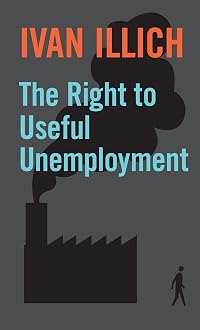
The Right to Useful Unemployment: And Its Professional Enemies
by Ivan Illich
On This Page
Description
In this postscript to Tools for Creativitiy, Illich calls for the right to useful unemployment: a positive, constructive, and even optimistic concept dealing with that activity by which people are useful to themselves and others outside the production of commodities for the market. Unfettered by managing professionals, unmeasured and unmeasureable by economists, these activities truly generate satisfaction, creativity, and freedom.Tags
Recommendations

















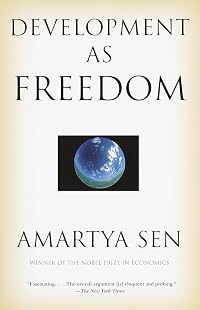
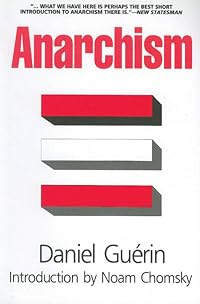

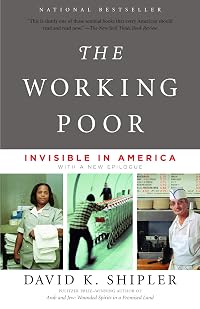







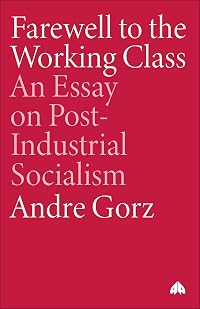










Member Recommendations
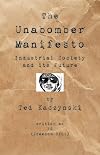
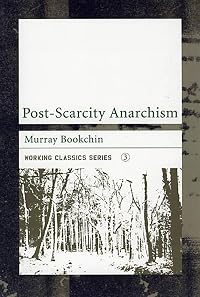
P_S_Patrick Criticism of similar problems in industrial societies, taken from different angles.
Member Reviews
This is a short volume intended as a post-script to one of the author’s other works. Here he puts forth the idea that society is over-run by purveyors of pre-packaged needs (be they educational, medical, edible, automotive etc), that are sold or forced upon people who act without real choice as to what they consume. This eventually disables individuals from being able to meet their own requirements by self-sufficiency (and removes the enjoyment they might have had from this process), creating a reliance on the providers of the packaged services. This causes a problem by over-inflating the involved industries, without benefitting consumers.
An example is the proliferation of mechanical transport (cars/trains etc), which though it show more initially allows us travel greater distances with ease, makes us reliant on these to get to work, see our family etc, as it becomes normal to live further away from everything. It creates a modern poverty, whereby transport by foot or bike (which aside from being good for us inherently, unlike driving a car) no longer is sufficient to fulfil the requirements of life created by a system of cars or trains. It thus creates a modern poverty of service addiction different and more insidious than the poverty of the past. This same principle applies to the growth of food, education, medical care, provision of housing etc. The process itself prevents people from being usefully employed in meeting their own needs directly, having to enter the labour market producing things that do not directly meet their needs (and only meet imagined needs of others) in order to be able to afford pre-packaged services that don’t properly meet their own needs. The real target of the author's venom is the professionals who create these systems, be they educators, doctors, lawyers, food or automotive professionals, or regulators of building standards, who create ever more complex, expensive, and wasteful systems that profit them, create service addiction, and take away autonomy and self determination from the user. These he calls “disabling professions”.
While some of his rhetoric is perhaps overblown in places, and a few of his targets of criticism unfair, in many places he has a very good point. Though this was published a few years ago now (1978), many of the points ring truer now than ever. On a similar topic, his volume "Deschooling Society" is somewhat more focused on this problem in the area of education, and is probably a better place to start with Illich. show less
An example is the proliferation of mechanical transport (cars/trains etc), which though it show more initially allows us travel greater distances with ease, makes us reliant on these to get to work, see our family etc, as it becomes normal to live further away from everything. It creates a modern poverty, whereby transport by foot or bike (which aside from being good for us inherently, unlike driving a car) no longer is sufficient to fulfil the requirements of life created by a system of cars or trains. It thus creates a modern poverty of service addiction different and more insidious than the poverty of the past. This same principle applies to the growth of food, education, medical care, provision of housing etc. The process itself prevents people from being usefully employed in meeting their own needs directly, having to enter the labour market producing things that do not directly meet their needs (and only meet imagined needs of others) in order to be able to afford pre-packaged services that don’t properly meet their own needs. The real target of the author's venom is the professionals who create these systems, be they educators, doctors, lawyers, food or automotive professionals, or regulators of building standards, who create ever more complex, expensive, and wasteful systems that profit them, create service addiction, and take away autonomy and self determination from the user. These he calls “disabling professions”.
While some of his rhetoric is perhaps overblown in places, and a few of his targets of criticism unfair, in many places he has a very good point. Though this was published a few years ago now (1978), many of the points ring truer now than ever. On a similar topic, his volume "Deschooling Society" is somewhat more focused on this problem in the area of education, and is probably a better place to start with Illich. show less
Ratings
Members
- Recently Added By
Author Information

78 Works 4,688 Members
Born in Vienna in 1926, Ivan Illich grew up in Europe. He studied theology, philosophy, history, and natural science. During the 1950s he worked as a parish priest among Puerto Ricans in the Hell's Kitchen section of New York City and then served as rector of the Catholic University of Puerto Rico. During the 1960s he founded centers for show more cross-cultural communication, first in Puerto Rico and then in Cuernavaca, Mexico. Since the late 1970s, he has divided his time among Mexico, the United States, and Germany. He is also a professor of Science, Technology, and Society at Penn State University. Illich's radical anarchist views first became widely known through a set of four books published during the early 1970s---Deschooling Society (1971), Tools for Conviviality (1973), Energy and Equity (1974), and Medical Nemesis (1976). Tools is the most general statement of Illich's principles; the other three expand on examples sketched in Today in order to critique what he calls "radical monopolies" in the technologies of education, energy consumption, and medical treatment. This critique applies equally to both the so-called developed and the developing nations but in different ways. Two subsequent collections of occasional pieces---Toward a History of Needs (1978) and Shadow Work (1981)---stress the distorting influence on society and culture of the economics of scarcity, or the presumption that economies function to remedy scarcities rather than to share goods. Toward a History of Needs also initiates a project in the history or archaeology of ideas that takes its first full-bodied shape in Gender (1982), an attempt to recover social experiences of female-male complementarity that have been obscured by the modern economic regime. H2O and the Waters of Forgetfulness (1985) extends this project into a history of "stuff." ABC:The Alphabetization of the Popular Mind (1988) carries Illich's project forward into the area of literacy, as does his most recent book, In the Vineyard of the Text (1993). In the Mirror of the Past (1992) is a collection of occasional essays and talks from the 1980s, linking his concerns with economics, education, history, and the new ideological meaning of life. Illich himself is a polymath who speaks at least six languages fluently and who writes regularly in three of these (English, Spanish, and German); his books have been translated into more than 15 other languages. (Bowker Author Biography) show less
Some Editions
Series
Belongs to Publisher Series
Ilmestyskirjasto (5)
Common Knowledge
- Original publication date
- 1978
- Quotations
- Money devalues what it cannot measure.
The crisis then is the same for all: the choice between more or less dependence on industrial commodities. More dependence means the rapid and complete destruction of cultures which determine the criteria for satisfying subsi... (show all)stence activities. Less means the variegated flowering of use-values in modern cultures of intense activity. Although hard to imagine for those already accustomed to living inside the supermarket, a structure different only in name from a ward for idiots, the choice is essentially the same for both rich and poor.
Used as a noun,”need” is the individual offspring of a professional pattern; it is a plastic foam replica of the mould in which professionals cast their staple; it is the advertised shape of the brood cells out of which c... (show all)onsumers are produced. To be ignorant or unconvinced of one’s own needs has become the unforgivable anti-social act. The good citizen is one who imputes standardised needs to himself with such conviction that he drowns out any desire for alternatives, much less the renunciation of need.
Classifications
- Genres
- Sociology, Economics, Nonfiction, Philosophy, General Nonfiction, History
- DDC/MDS
- 301.24 — Society, government, & culture Social sciences, sociology & anthropology Sociology and anthropology Formerly: Culture and cultural processes Cultural Anthropology
- LCC
- HC59 .I357 — Social sciences Economic history and conditions Economic history and conditions
- BISAC
Statistics
- Members
- 174
- Popularity
- 188,661
- Reviews
- 1
- Rating
- (3.88)
- Languages
- 10 — Danish, Dutch, English, Finnish, French, German, Italian, Norwegian (Bokmål), Norwegian, Spanish
- Media
- Paper, Ebook
- ISBNs
- 18
- ASINs
- 3