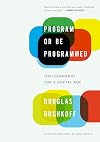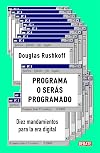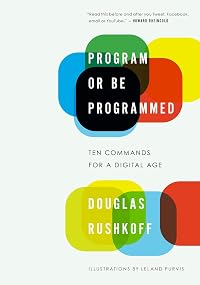
Program or Be Programmed: Ten Commands for a Digital Age
by Douglas Rushkoff
On This Page
Description
This book by Douglas Rushkoff explores the profound impact of technology on human society and individuals. It delves into how technologies, from the telephone to artificial intelligence, shape human behavior, communication, and values. Rushkoff argues that while technologies start as tools to serve human needs, they evolve to influence our worldview and societal norms. The book critiques the pervasive influence of digital platforms, highlighting issues like loss of autonomy and social show more media-induced depression. It emphasizes the importance of human agency in directing technological development to ensure that it promotes human well-being. The book is intended for a broad audience interested in technology's role in society and urges readers to reassess their relationship with digital tools. show lessTags
Recommendations







Member Recommendations
Member Reviews
This is the best book I've read about the promise, perils and ethics of living online. It's short and concise, but frequently profound in the conclusions it draws. Rushkoff has a deep sense of what it means to "be digital" and work extensively with thinking machines. He communicates what's at stake in terms of our relationships, connectedness and anxieties, without lapsing into crude "internet makes us stupid" scaremongering. Here is for example on the black magic of web searching: "With computers and networks, unlike our calculators, we don’t even know what we are asking our machines to do, much less how they are going to go about doing it. Every Google search is—at least for most of us—a Hail Mary pass into the datasphere, show more requesting something from an opaque black box. How does it know what is relevant? How is it making its decisions? Why can’t the corporation in charge tell us?" Highly recommended. show less
This book definitely makes more sense when read alongside the recent ones by Kevin Kelly and by Jaron Lanier. Like them, it's something of a correction on the tech-evangelism that has marked much of its author's earlier works. If Lanier's is a rangy diatribe, and Kelly's a concertedly developed argument, Rushkoff's is a list: it's 10 ideas, laid out plainly for a common reader. The last of these 10 ideas ("commands," a joke on the 10 commandments), the one from which the book takes its title, is the important one. The title pretty much says it all: in a world that is mediated increasingly by software, our lives are in many ways affected by the decision-making of the people who program the software. People who don't program are, in show more effect, to some degree or another, at the mercy of those who do. The answer? Learn to program. It sounds simplistic, and to some extent it is, but demystifying programming (it's not rocket science; it's the math equivalent of writing intelligently) is a valuable lesson. show less
It's all a bit motherhood and bleeding obvious, isn't it?
Yes, these are ten things that are probably true, but they are not particularly well argued. For example #2:Place ("Live in Person") builds a case for the digital media bias to dislocation but doesn't exactly tell us why the solution is "live in person".
Yes, these are ten things that are probably true, but they are not particularly well argued. For example #2:Place ("Live in Person") builds a case for the digital media bias to dislocation but doesn't exactly tell us why the solution is "live in person".
Rushkoff's book is essential reading for those who wish to develop a critical framework for dealing with our seemingly "always on" technology. The style is readable and compelling, and Rushkoff is very even-handed with his consideration of technology. He is no technophobe, but he refuses to give himself over to unthinking technophilia. His chapter on telling the truth is the main weakness in the book. I agree that we should, of course, tell the truth, but his reasoning is that media bias is toward "factual" information (whether it is really factual or not). I'm not sure I buy that particular argument.
It's all a bit motherhood and bleeding obvious, isn't it?
Yes, these are ten things that are probably true, but they are not particularly well argued. For example #2:Place ("Live in Person") builds a case for the digital media bias to dislocation but doesn't exactly tell us why the solution is "live in person".
Yes, these are ten things that are probably true, but they are not particularly well argued. For example #2:Place ("Live in Person") builds a case for the digital media bias to dislocation but doesn't exactly tell us why the solution is "live in person".
I have no idea why I forced myself to finish this substance-less punditry. It gets two stars because it has a list of good beginning programming resources in the back, and the book might be a good text for high school media studies or technology class.
Quite interesting. Not sure about some of his historical points though.
Members
- Recently Added By
Author Information

61+ Works 4,248 Members
Douglas Rushkoff was born on February 18, 1961. After graduating from Princeton University he received an MFA in Directing from California Institute of the Arts. He has written numerous magazine columns on topics including cyberculture and has been aired on CBS Sunday Morning and NPR's All Things Considered and published in The New York Times and show more Time magazine. Rushkoff has taught at the MaybeLogic Academy, NYU's Interactive Telecommunications Program, and the Esalen Institute, and he teaches media studies at the New School University. Rushkoff lectures around the world about media, art, society, and change at conferences and universities. He consults to museums, governments, synagogues, churches, universities, and companies on new media arts and ethics. Rushkoff won the first Neil Postman award for Career Achievement in Public Intellectual Activity. He is on the Boards of the Media Ecology Association, The Center for Cognitive Liberty and Ethics, Technorealism, The National Association for Media Literacy Education, MeetUp.com, and Hyperwords. His bestselling books include graphic novels, Cyberia, Media Virus, Playing the Future, Nothing Sacred: The Truth about Judaism, Get Back in the Box: Innovation from the Inside Out, Coercion, and Life Inc. (Bowker Author Biography) show less
Awards and Honors
Notable Lists
Classifications
Statistics
- Members
- 345
- Popularity
- 91,263
- Reviews
- 9
- Rating
- (3.63)
- Languages
- English, French, Spanish
- Media
- Paper, Audiobook, Ebook
- ISBNs
- 9
- ASINs
- 5