
Manuel Castells
Author of The Rise of the Network Society
About the Author
Manuel Castells is University Professor and Wallis Annenberg Chair of Communication Technology and Society at the University of Southern California, Los Angeles, as well as Professor Emeritus of Sociology and Planning at the University of California, Berkeley. He has been Distinguished Visiting show more Professor at M.I.T and Oxford University, and is Director of Research in the Department of Sociology, University of Cambridge. He has published 27 books including the trilogy The Information Age: Economy, Society, and Culture, translated in 22 languages, and Communication Power. He is a Fellow of the American Academy of Political and Social Science, the British Academy, Academia Europaea, the Mexican Academy of Sciences, and the Spanish Royal Academy of Economics. He was a founding board member of the European Research Council and of the European Institute of Innovation and Technology. He was awarded the 2011 Erasmus Medal, the 2012 Holberg Prize from the Parliament of Norway, and the 2013 Balzan Prize from the International Balzan Foundation. show less
Disambiguation Notice:
Full Spanish name: Manuel Castells Oliván
Series
Works by Manuel Castells
The Power of Identity: The Information Age: Economy, Society and Culture, Volume II (The Information Age) 2nd Edition (1997) 492 copies, 3 reviews
The Internet Galaxy: Reflections on the Internet, Business, and Society (2001) 359 copies, 6 reviews
The Information Age, Volumes 1-3: Economy, Society and Culture (Information Age Series) (v. 1-3) (1999) 11 copies
Redes de indignacion y esperanza: Los movimientos sociales en la era de Internet (Spanish Edition) (2012) 9 copies
A Questão Urbana 7 copies
Mujeres y hombres/ Women and Men: Un Amor Imposible?/ a Impossible Love (Spanish Edition) (2008) 5 copies
Jahrtausendwende : Das Informationszeitalter Wirtschaft, Gesellschaft, Kultur. Band 3 (2016) 3 copies
Tecnopolis del mundo / World Technopolis: La Formacion De Los Complejos Industriales Del Siglo Xxi (Libros Singulares) (Spanish Edition) (2001) 3 copies
Outra Economia e Possivel. Cultura e Economia em Tempos de Crise (Em Portugues do Brasil) (2019) 2 copies
The Apocalypse Of Freemasonry: A Constructive Scheme Of Interpretation Of The Symbolism Of The Masonic Lodge (2014) 2 copies
PIRACY CULTURES: How a Growing Portion of the Global Population is Building Media Relationships Through Alternate Channels of Obtaining Content (2013) 2 copies
cidade, democracia e socialismo 2 copies
Globalización, desarrollo y democracia: Chile en el contexto mundial (Spanish Edition) (2005) 1 copy
La question urbaine 1 copy
COMUNICACIÓN Y PODER 1 copy
Saperi e poteri 1 copy
Sociedade Digital 1 copy
L' età dell'informazione: economia, società, cultura. Vol. 1: La Nascita Della società in Rete. 1 copy
A Sociedade em rede 1 copy
Enformasyon çağı: ekonomi, toplum ve kültür : Ağ toplumunun yükselişi The rise of the network society / v. 1 = (2017) 1 copy
Capital multinacional, estados nacionales y comunidades locales (Arquitectura y urbanismo) (Spanish Edition) (1981) 1 copy
Canvi de mil·leni 1 copy
INTERNET Y LA SOCIEDAD RED 1 copy
Luttes urbaines (149) 1 copy
Associated Works
Connectivity in Antiquity: Globalization as a Long-Term Historical Process (2006) — Contributor — 6 copies
Tagged
Common Knowledge
- Canonical name
- Manuel Castells
- Legal name
- Manuel Castells Oliván
- Birthdate
- 1942-02-09
- Gender
- male
- Education
- University of Paris (Ph.D) (sociology)
- Occupations
- sociologist
- Organizations
- Université Paris X Nanterre
École des hautes études en sciences sociales
Open University of Catalonia, Barcelona
University of California
European Institute of Innovation and Technology
University of California, Berkeley - Nationality
- Spain (birth)
USA - Birthplace
- Hellin, Albacete, Spain
- Places of residence
- Hellín, Albacete, Spain (birthplace)
La Mancha, Spain
Barcelona, Catalonia, Spain - Map Location
- Spain
- Disambiguation notice
- Full Spanish name: Manuel Castells Oliván
Members
Reviews

This is little more than a pamphlet - an interview conducted by Bob Catterall, the urban theorist, with the sociologist Manuel Catells, one of the primary academic analysts of the so-called information age at the turn of this century.
Fifteen or so years is a long time in technology. The conversation seems dated even now. It is not a bad snapshot of intellectual thought at the time but also not a bad snapshot of how intellectuals were as much at sea as the rest of us in describing the show more phenomenon they were living through.
This is not to criticise - the attempt to impose some sort of intellectual order on the self-ordering chaos that is social existence is what intellectuals do. It is useful so long as we remain a little sceptical about any claims that they are describing reality.
In this case, Castells and Catterall struggle to place their reality within intellectual frameworks derived from the sort of attenuated Marxism that was fashionable during the decade before, in the now failed politics of the 'Third Way' and within a vague continental philosophical tradition.
Much of the implied prediction has proved fruitless not because they were not accurately identifying phenomena that were evident at that time but because those phenomena were often much more transient than they believed.
Any implicit extrapolation of the present into the future is always a dodgy business - as historians keep trying to tell sociologists, only to be ignored. The world of 2000/2001 was not an exception to this rule. Take two examples that jump to mind where others could be chosen.
At one point, there is excitement at the use of the internet for artistic experimentation. There was a similar excitement with officially sponsored urban art that died pretty well with austerity and was, in any case, largely a matter of top-down political manipulation.
I am sure there is internet art but the proliferation of interest in art has not been in the medium but in the medium allowing more traditional art (figurative and news schools like the 'occult') to muscle in alongside commercial (commoditised is the much loved word) art for billionaires.
Many interesting artistic experiments took place in the early days of the internet but, in the end, as the internet became a self-creating social tool for the masses, containing vast resources for access to imagery, it seemed to become an artistic dead end in itself except for marketing product.
One of the jokes of the internet is that everyone can become a conceptual artist now. The shock has happened. The gnomic aphorisms have been said (even when Nietzsche always said them better). The witty cat picture is not to be despised as perhaps our last word in conceptualism.
The other implied prediction is about the importance of social movements on which Castells has important things to say. He cannot be blamed, once again, for not predicting the future. He was not alone at that time in being excited by the proliferation of net-organised activism.
The mainstream bookshops were groaning with radical tomes about activism, environmentalism, changing the world and so on and so forth. Certainly every tin-pot single issue activist lunacy now has its place on Facebook, its angry proponents trolling Mr. and Mrs Ordinary.
He sets up a curious thesis-antithesis between the self-ordering inchoate collective radicalism of the social movements and the creative intense narcissistic innovatory world of the new technologies that betrays his debt to Marxism. He perhaps assumes some sort of future synthesis.
What actually happened? Well, he was half right. These were important forces but there were other important forces as well. His forces were to be checked, manipulated, changed by technology and destabilised by the events of the next fifteen years and no doubt more so by the next fifteen.
The social movements and networked politics were revolutionary and affected regimes and elites but their inchoate nature became much clearer as the next decade progressed. The wave either crashed on brute force and naivete or became absorbed into the international order.
Looking back on fifteen years, we now have a huge NGO industry half-manipulated by the Atlantic system, resentful emerging market elites able to react by managing the internet to their own advantage and consequent dangerous instabilities with death and mayhem all around.
The most recent result is idealistic liberals cutting their own throats by failing to have real world strategies for the very real world business model of so-called human trafficking and reduced, in Europe, to paying Turkgeld to stop a business fully enabled by the new technologies.
The other side of the coin has also proved less easy to predict. The innovatory networked strategies described by Castells at Cisco are real enough but what we also see is an educated mass of youth who cannot get on the gravy train and are turning to an angry radical populism instead.
To be fair, Castells does appear to predict this but perhaps he is not too clear on the instabilities even amongst the winners in the game. The next round of technologies seem to require much higher levels of long term investment and team-playing - the internet was an anomalous case
While Obama may have come to power on the manipulation of the internet, the disappointment in many of his supporters has shifted the best and brightest of them away from gestural politics through Change.Org (which merely causes embarrassment to elites) to focused organisation.
If you look at the election of Jeremy Corbyn in the UK Labour Party or the surprising victories of Bernie Sanders, self-styled democratic socialist, in the US primaries, you do not see a weird coalitional group-think of environmentalists, radicals, feminists and la-di-da liberals any more.
The intelligent began to understand what Eco pointed out about the Marxist terrorism of Italy in the 1970s - that action strengthened the State rather than weakened it and, of course, the State is good at appropriating the softest of its enemy through moderate reform, a victory of sorts but ...
On the contrary, you now see the return of 'ideology' in the sense of a value system which may incorporate these millenial concerns but which subordinates them to what amounts to a radical class-based on-the-ground real world message which is broadcast outwards.
We are back to a world where organisation redirects itself pragmatically to the acquisition of power rather than the performance art of self-expression in the squares of the world. A message about power is communicated now, not just breathless outrage or emoting about social justice.
The inchoate anti-capitalism of the social movements that Castells described went in two directions: into the global NGO-ocracy and into domestic political organisation that is surprisingly old school, treating the internet much as Goebbels treated radio - as a tool.
There is no simple thesis-antithesis of late capitalism but mounting complexity and chaos in which the new technological innovations change, as print did, relationships of power but only within sets of pre-existing human types and their struggles for power and resources.
The networked society has thus not followed a smooth trajectory of future change. Networks proved unstable, easily broken, often transitional, often one-dimensional and almost always means to ends grounded in actual meetings, traditional organisation and even armed struggle.
Endless Microsoft updates and incredibly short human attention spans do not help but the working model is still one of competing centres of power using new technologies to broadcast their will and private persons using it to enhance education, identity and occasionally resistance to power.
Above all, the theoreticians at the end of the twentieth century forgot that elites and peoples learn in competition with each other and that uncontrolled chaotic systems follow a logic that leads to periodic cataclysm - punctuated equilibrium - that resets the rules.
The dabbling of the West in the Middle East after 9/11 and the incompetently managed forward expansion of NATO are obvious enough. But did the 'strategists' not consider that their targets were as intelligent as they were, just as able to learn rapidly how to use the same tools creatively.
Similarly, the attempt by neo-liberals to ride the innovation market and let it rip led not only to periodic painful market adjustments (which is fine) but the exposure of the whole pack of cards to collapse in 2008 so that abstract 'social justice' inevitably became very real 'anti-austerity'.
The lesson of this pamphlet is to beware of intellectuals bearing explanatory gifts when it comes to the conditions in which we have to live our lives in practice. Technological changes (as after Gutenberg) are highly disruptive and unpredictable. It is best to add caveats to every claim.
Was the 'network society' created by technological innovation as Castells proposes? Yes, it was. He is right. But does he interpret correctly what a networked society would mean in practice? Not really.
And why? Because his theoretical model failed to take account of human ability to make any tool to hand into a tool for primal individual desires and needs and it underestimated the flexibility of existing centres of power in counteracting the effects of uncontrolled networks.
The networks, instead of transforming the human condition fundamentally, merely shuffled the cards, paradoxically undermining the global neo-liberal consensus but not in the way the 'social movements' hoped or predicted.
Networks created opportunities for chaos, cracks in the paradigm that are meeting up as we write. Eventually order will be restored but the world that ensues will almost certainly be nothing like that predicted in 2001. show less
Fifteen or so years is a long time in technology. The conversation seems dated even now. It is not a bad snapshot of intellectual thought at the time but also not a bad snapshot of how intellectuals were as much at sea as the rest of us in describing the show more phenomenon they were living through.
This is not to criticise - the attempt to impose some sort of intellectual order on the self-ordering chaos that is social existence is what intellectuals do. It is useful so long as we remain a little sceptical about any claims that they are describing reality.
In this case, Castells and Catterall struggle to place their reality within intellectual frameworks derived from the sort of attenuated Marxism that was fashionable during the decade before, in the now failed politics of the 'Third Way' and within a vague continental philosophical tradition.
Much of the implied prediction has proved fruitless not because they were not accurately identifying phenomena that were evident at that time but because those phenomena were often much more transient than they believed.
Any implicit extrapolation of the present into the future is always a dodgy business - as historians keep trying to tell sociologists, only to be ignored. The world of 2000/2001 was not an exception to this rule. Take two examples that jump to mind where others could be chosen.
At one point, there is excitement at the use of the internet for artistic experimentation. There was a similar excitement with officially sponsored urban art that died pretty well with austerity and was, in any case, largely a matter of top-down political manipulation.
I am sure there is internet art but the proliferation of interest in art has not been in the medium but in the medium allowing more traditional art (figurative and news schools like the 'occult') to muscle in alongside commercial (commoditised is the much loved word) art for billionaires.
Many interesting artistic experiments took place in the early days of the internet but, in the end, as the internet became a self-creating social tool for the masses, containing vast resources for access to imagery, it seemed to become an artistic dead end in itself except for marketing product.
One of the jokes of the internet is that everyone can become a conceptual artist now. The shock has happened. The gnomic aphorisms have been said (even when Nietzsche always said them better). The witty cat picture is not to be despised as perhaps our last word in conceptualism.
The other implied prediction is about the importance of social movements on which Castells has important things to say. He cannot be blamed, once again, for not predicting the future. He was not alone at that time in being excited by the proliferation of net-organised activism.
The mainstream bookshops were groaning with radical tomes about activism, environmentalism, changing the world and so on and so forth. Certainly every tin-pot single issue activist lunacy now has its place on Facebook, its angry proponents trolling Mr. and Mrs Ordinary.
He sets up a curious thesis-antithesis between the self-ordering inchoate collective radicalism of the social movements and the creative intense narcissistic innovatory world of the new technologies that betrays his debt to Marxism. He perhaps assumes some sort of future synthesis.
What actually happened? Well, he was half right. These were important forces but there were other important forces as well. His forces were to be checked, manipulated, changed by technology and destabilised by the events of the next fifteen years and no doubt more so by the next fifteen.
The social movements and networked politics were revolutionary and affected regimes and elites but their inchoate nature became much clearer as the next decade progressed. The wave either crashed on brute force and naivete or became absorbed into the international order.
Looking back on fifteen years, we now have a huge NGO industry half-manipulated by the Atlantic system, resentful emerging market elites able to react by managing the internet to their own advantage and consequent dangerous instabilities with death and mayhem all around.
The most recent result is idealistic liberals cutting their own throats by failing to have real world strategies for the very real world business model of so-called human trafficking and reduced, in Europe, to paying Turkgeld to stop a business fully enabled by the new technologies.
The other side of the coin has also proved less easy to predict. The innovatory networked strategies described by Castells at Cisco are real enough but what we also see is an educated mass of youth who cannot get on the gravy train and are turning to an angry radical populism instead.
To be fair, Castells does appear to predict this but perhaps he is not too clear on the instabilities even amongst the winners in the game. The next round of technologies seem to require much higher levels of long term investment and team-playing - the internet was an anomalous case
While Obama may have come to power on the manipulation of the internet, the disappointment in many of his supporters has shifted the best and brightest of them away from gestural politics through Change.Org (which merely causes embarrassment to elites) to focused organisation.
If you look at the election of Jeremy Corbyn in the UK Labour Party or the surprising victories of Bernie Sanders, self-styled democratic socialist, in the US primaries, you do not see a weird coalitional group-think of environmentalists, radicals, feminists and la-di-da liberals any more.
The intelligent began to understand what Eco pointed out about the Marxist terrorism of Italy in the 1970s - that action strengthened the State rather than weakened it and, of course, the State is good at appropriating the softest of its enemy through moderate reform, a victory of sorts but ...
On the contrary, you now see the return of 'ideology' in the sense of a value system which may incorporate these millenial concerns but which subordinates them to what amounts to a radical class-based on-the-ground real world message which is broadcast outwards.
We are back to a world where organisation redirects itself pragmatically to the acquisition of power rather than the performance art of self-expression in the squares of the world. A message about power is communicated now, not just breathless outrage or emoting about social justice.
The inchoate anti-capitalism of the social movements that Castells described went in two directions: into the global NGO-ocracy and into domestic political organisation that is surprisingly old school, treating the internet much as Goebbels treated radio - as a tool.
There is no simple thesis-antithesis of late capitalism but mounting complexity and chaos in which the new technological innovations change, as print did, relationships of power but only within sets of pre-existing human types and their struggles for power and resources.
The networked society has thus not followed a smooth trajectory of future change. Networks proved unstable, easily broken, often transitional, often one-dimensional and almost always means to ends grounded in actual meetings, traditional organisation and even armed struggle.
Endless Microsoft updates and incredibly short human attention spans do not help but the working model is still one of competing centres of power using new technologies to broadcast their will and private persons using it to enhance education, identity and occasionally resistance to power.
Above all, the theoreticians at the end of the twentieth century forgot that elites and peoples learn in competition with each other and that uncontrolled chaotic systems follow a logic that leads to periodic cataclysm - punctuated equilibrium - that resets the rules.
The dabbling of the West in the Middle East after 9/11 and the incompetently managed forward expansion of NATO are obvious enough. But did the 'strategists' not consider that their targets were as intelligent as they were, just as able to learn rapidly how to use the same tools creatively.
Similarly, the attempt by neo-liberals to ride the innovation market and let it rip led not only to periodic painful market adjustments (which is fine) but the exposure of the whole pack of cards to collapse in 2008 so that abstract 'social justice' inevitably became very real 'anti-austerity'.
The lesson of this pamphlet is to beware of intellectuals bearing explanatory gifts when it comes to the conditions in which we have to live our lives in practice. Technological changes (as after Gutenberg) are highly disruptive and unpredictable. It is best to add caveats to every claim.
Was the 'network society' created by technological innovation as Castells proposes? Yes, it was. He is right. But does he interpret correctly what a networked society would mean in practice? Not really.
And why? Because his theoretical model failed to take account of human ability to make any tool to hand into a tool for primal individual desires and needs and it underestimated the flexibility of existing centres of power in counteracting the effects of uncontrolled networks.
The networks, instead of transforming the human condition fundamentally, merely shuffled the cards, paradoxically undermining the global neo-liberal consensus but not in the way the 'social movements' hoped or predicted.
Networks created opportunities for chaos, cracks in the paradigm that are meeting up as we write. Eventually order will be restored but the world that ensues will almost certainly be nothing like that predicted in 2001. show less

El estilo es ágil y directo, sin presunción alguna. Seguir a Castells por los escenarios más variopintos del mundo, en tanto que participante, observador o consejero, resulta ameno y apasionante. El carácter del libro es muy amable con casi todos los actores que habitan la obra. Castells aparece como una persona al tiempo humilde, íntegra, comprometida y de intelecto penetrante. Se hace fácil imaginar que las mismas cualidades que impregnan el relato fueron evidentes para los numerosos show more políticos y estudiosos que buscaron la complicidad y la colaboración de Castells. show less
The Internet Galaxy: Reflections on the Internet, Business, and Society (Clarendon Lectures in Management Studies) by Manuel Castells
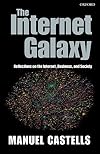
I originally got this book for a science, technology, and society class I took in college. At the time, it was very up to date; now it is about 6 years old, but still a worthwhile read because it is one of the most research based books on the Internet and its interactions with society that I have read. Catells makes heavy use of studies and surveys done by himself and many others to try to cut through the hype that always surrounds musing on the Internet. I will highlight a few of the most show more interesting chapters.
Castells discusses e-business and the new economy. His claim is that the biggest impact of the Internet on the economy is not the .com's; it is normal business extending onto the online world and adopting networked models of interaction. For example, many networked businesses do not provide the technology behind the products they sell under their name. Castells gives the example of Cisco; Cisco itself was the main node in a network of companies that do the actual manufacturing and shipping of their hardware. Such arrangements bring up issues of liability and accountability. Is it Cisco's responsibility to make sure that the companies they work with operate according to the values and standards they want? In principle, yes, but how much can they really be held responsible given the difficulty of monitoring everything? (I am reminded of the recent pet food contamination.)
In the chapter on community, Castells discussed how studies have found that, despite popular intuition, internet participation does not, in general, decrease one's connections with those one knows in real life. In fact, technologies like email (and today blogs and photo sites, I would guess) tend to bring people closer together. Studies have also found that Internet users, on average, participate more in their local community than non-users. This may be because internet use tends to replace television watching (thus not decreasing time available for community participation) while providing a means to find out how to get more involved in the community.
Castells also makes some observations on the digital divide. Although studies show that there is a large disparity in Internet use between different economic groups and races (in the US) and between countries, these gaps were (in 2001) closing. Internet use by under represented groups was increasing at a higher rate than that of other groups. However, not all is rosy and hopeful. In under represented countries, the technological infrastructure needed for Internet access was not being built on public infrastructure because it was not modern enough. Instead, companies would build their own infrastructure. Corporate money going into infrastructure that could be shared with the public was considered likely to delay the propagation of the Internet in those countries.
Although a bit old now, this book is still a worthwhile read. I certainly got more out of it this time around than I did the first time (it was one of six classes; I was busy!). show less
Castells discusses e-business and the new economy. His claim is that the biggest impact of the Internet on the economy is not the .com's; it is normal business extending onto the online world and adopting networked models of interaction. For example, many networked businesses do not provide the technology behind the products they sell under their name. Castells gives the example of Cisco; Cisco itself was the main node in a network of companies that do the actual manufacturing and shipping of their hardware. Such arrangements bring up issues of liability and accountability. Is it Cisco's responsibility to make sure that the companies they work with operate according to the values and standards they want? In principle, yes, but how much can they really be held responsible given the difficulty of monitoring everything? (I am reminded of the recent pet food contamination.)
In the chapter on community, Castells discussed how studies have found that, despite popular intuition, internet participation does not, in general, decrease one's connections with those one knows in real life. In fact, technologies like email (and today blogs and photo sites, I would guess) tend to bring people closer together. Studies have also found that Internet users, on average, participate more in their local community than non-users. This may be because internet use tends to replace television watching (thus not decreasing time available for community participation) while providing a means to find out how to get more involved in the community.
Castells also makes some observations on the digital divide. Although studies show that there is a large disparity in Internet use between different economic groups and races (in the US) and between countries, these gaps were (in 2001) closing. Internet use by under represented groups was increasing at a higher rate than that of other groups. However, not all is rosy and hopeful. In under represented countries, the technological infrastructure needed for Internet access was not being built on public infrastructure because it was not modern enough. Instead, companies would build their own infrastructure. Corporate money going into infrastructure that could be shared with the public was considered likely to delay the propagation of the Internet in those countries.
Although a bit old now, this book is still a worthwhile read. I certainly got more out of it this time around than I did the first time (it was one of six classes; I was busy!). show less

Honestly, the book could be half as long. The author repeats the same concept a lot and they reference themselves A LOT.
Lists
Awards


You May Also Like


Associated Authors
Statistics
- Works
- 119
- Also by
- 4
- Members
- 3,136
- Popularity
- #8,142
- Rating
- 3.6
- Reviews
- 27
- ISBNs
- 299
- Languages
- 20
- Favorited
- 4