
Thomas L. Friedman
Author of The World Is Flat: A Brief History of the Twenty-First Century
About the Author
Journalist Thomas L. Friedman was born in 1953 in Minneapolis, Minnesota. Friedman graduated from Brandeis University with a degree in Mediterranean Studies and earned a graduate degree from Oxford in Modern Middle East Studies. His reporting on the war in Lebanon won the George Polk Award, the show more Pulitzer Prize, and the Livingston Award for Young Journalists. He won a second Pulitzer for his work in Israel. Friedman began his career as a correspondent for United Press International and later served as bureau chief for the New York Times in Beirut and Jerusalem. He moved to the op-ed page of The New York Times as a foreign affairs columnist. In 2002, Friedman won his third Pulitzer Prize, this time for Commentary. Friedman wrote about his experiences as a Jewish-American reporter in the Middle East in From Beirut to Jerusalem, which won the National Book Award in 1989. The bestselling Lexus and the Olive Tree won the 2000 Overseas Press Club Award for best nonfiction book on foreign policy. He wrote Longitudes and Attitudes: Exploring the World After September 11 and The World Is Flat, which received the first Financial Times and Goldman Sachs Business Book of the Year Award. His other works include Hot, Flat, and Crowded, Hot, Flat, and Crowded 2.0, and That Used to Be Us which made The New York Times Best Seller List for 2012. His title, Thank You for Being Late, made the New York Times Best Seller List in 2016. (Bowker Author Biography) show less
Image credit: Thomas L. Friedman, Apil 2016
Works by Thomas L. Friedman
Hot, Flat, and Crowded: Why We Need a Green Revolution and How It Can Renew America (2008) 3,568 copies, 61 reviews
Thank You for Being Late: An Optimist's Guide to Thriving in the Age of Accelerations (2016) 1,265 copies, 26 reviews
That Used to Be Us: How America Fell Behind in the World It Invented and How We Can Come Back (2011) 767 copies, 20 reviews
The Energy Mandate (Article) 1 copy
Associated Works
Tagged
Common Knowledge
- Canonical name
- Friedman, Thomas L.
- Legal name
- Friedman, Thomas Lauren
- Birthdate
- 1953-07-20
- Gender
- male
- Education
- Brandeis University (BA ∙ Mediterranean studies ∙ 1975)
University of Minnesota
St Antony's College, University of Oxford (M.Phil ∙ 1978 | Middle Eastern studies)
American University in Cairo
St. Louis Park High School - Occupations
- journalist
columnist
author
golf caddy
professor
political commentator - Organizations
- The New York Times
United Press International
Pulitzer Prize Board - Awards and honors
- Marshall Scholar
Pulitzer Prize (International Reporting, 1983)
Pulitzer Prize (International Reporting, 1988)
Pulitzer Prize (Commentary, 2002)
Overseas Press Club Award for lifetime achievement (2004)
Order of the British Empire (Officer, 2004) (show all 11)
George Polk Award (1982)
Overseas Press Club Award (2000)
American Philosophical Society (2003)
Golden Plate Award (2003)
National Book Award (1989) - Relationships
- Friedman, Ann Bucksbaum (wife)
- Nationality
- USA
- Birthplace
- St. Louis Park, Minnesota, USA
- Places of residence
- St. Louis Park, Minnesota, USA
Kibbutz Hahotrim, Israel
Bethesda, Maryland, USA
Beirut, Lebanon - Associated Place (for map)
- USA
Members
Discussions
Thomas Friedman's argument for "Geo-Greenism" in Pro and Con (September 2008)
Reviews
Hot, Flat, and Crowded: Why We Need a Green Revolution--and How It Can Renew America by Thomas L. Friedman
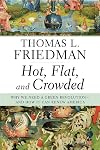
The world is in trouble. There's some debate about how much trouble, what time frame we have before the point of no return, and what we ought to do about it. Friedman's Hot, Flat and Crowded tackles all of these questions with an inspiring and practical vision of America as the world leader in what is shaping up to be the next big thing.
Friedman's analysis deals with systems of systems - how massively interconnected systems affect each other and how we can understand and control them. As a show more system engineer, I really got into that part of the discussion. He makes it pretty clear that solving the energy/climate/ecology problem isn't just about those particular issues. Instead these problems ripple into so many other things. As a small example, the US Army is moving to solar arrays to power forward field posts instead of diesel generators, thus eliminating the cost (in dollars and in human lives) of hauling diesel fuel through dangerous territory. But this "greening" of the Army also has the effect of pushing civilian technology forward and provides the market base for reducing the cost of the technology to reasonable levels. Even if readers are skeptical of ecological and climate change arguments, it's hard to find fault with Friedman's discussions of energy supply and the growth of the middle class. But fortunately, as he points out so well, solving one problem often gives you other solutions for free.
Highly recommended, but fair warning - you may find yourself running around the house turning off lights and changing bulbs to compact fluorescents! show less
Friedman's analysis deals with systems of systems - how massively interconnected systems affect each other and how we can understand and control them. As a show more system engineer, I really got into that part of the discussion. He makes it pretty clear that solving the energy/climate/ecology problem isn't just about those particular issues. Instead these problems ripple into so many other things. As a small example, the US Army is moving to solar arrays to power forward field posts instead of diesel generators, thus eliminating the cost (in dollars and in human lives) of hauling diesel fuel through dangerous territory. But this "greening" of the Army also has the effect of pushing civilian technology forward and provides the market base for reducing the cost of the technology to reasonable levels. Even if readers are skeptical of ecological and climate change arguments, it's hard to find fault with Friedman's discussions of energy supply and the growth of the middle class. But fortunately, as he points out so well, solving one problem often gives you other solutions for free.
Highly recommended, but fair warning - you may find yourself running around the house turning off lights and changing bulbs to compact fluorescents! show less
The World Is Flat : A Brief History of the Twenty-First Century Updated and Expanded by Thomas L. Friedman

In 2006, Time named "You" its Person of the Year - an acknowledgment that user-generated content is increasingly driving the decentralization and spread of information today. Technology has empowered everyone who is connected to be a provider, not just passive consumer, of their own information. And it is from this equidistance and legitimation by technology, Friedman argues, that the world has become flat.
He's wrong, of course, and he's too in love with his own free market capitalist show more narrative of a flat world to be able to see so. Perhaps a more honest title would be 'The Market is Flat,' or 'First World Industrialized Countries are Flat.' He brushes off such criticisms in the introduction with "I know the world is not actually flat," but proceeds without actually keeping this in mind. The world is not flat because only countries and industries who are already engaged in and validated by the global market get to participate; with an increasingly competitive global market, emerging and developing nations and industries have an even more narrow gap into which to enter.
And even within the countries and industries who are participants in the global market, the world is not flat because so many of these enterprises are built upon such bald-faced exploitation of individuals. Friedman's two favorite examples of the flattening of the world are Walmart and China. (Actually, that alone should tell you a ton about this book.) He presents the flat world as being empowering, somehow, but under such ruthless systems of capitalism, individuals are becoming increasingly more commodified and fungible. Maybe everything and everyone looks flat from the view at the top, but it is a horrifying viewpoint to espouse that the world's flattening is a good thing because people can now be exploited and dehumanized more efficiently than ever.
Friedman also comes across as surprisingly conservative with regards to America's place in the global market: he is traditionally competitive and concerned with how America will continue to fare, with strong undertones of an Us versus Them mentality. And I wish that he had exhibited the self-awareness to recognize this, as it raises the question of whether 'America' (both the nation and the idea) is even relevant anymore to Friedman's flat world idealization. He apparently thinks it is; I don't know how he continues to justify that. Unless he takes pleasure in the idea that the world is becoming increasingly flatter in order to accommodate America's hyper-capitalist growth (eg, America's use of India for customer service). Ultimately, Friedman seems to be in love with the idea of a new Cold War between China and America, competing for who can slash prices fastest and own the world first. Unfortunately, he seems to lose sight of other values - humanity, for one. The confirmation bias and privilege inherent in his hypothesis that the world is flat are amazingly myopic and egregiously offensive. show less
He's wrong, of course, and he's too in love with his own free market capitalist show more narrative of a flat world to be able to see so. Perhaps a more honest title would be 'The Market is Flat,' or 'First World Industrialized Countries are Flat.' He brushes off such criticisms in the introduction with "I know the world is not actually flat," but proceeds without actually keeping this in mind. The world is not flat because only countries and industries who are already engaged in and validated by the global market get to participate; with an increasingly competitive global market, emerging and developing nations and industries have an even more narrow gap into which to enter.
And even within the countries and industries who are participants in the global market, the world is not flat because so many of these enterprises are built upon such bald-faced exploitation of individuals. Friedman's two favorite examples of the flattening of the world are Walmart and China. (Actually, that alone should tell you a ton about this book.) He presents the flat world as being empowering, somehow, but under such ruthless systems of capitalism, individuals are becoming increasingly more commodified and fungible. Maybe everything and everyone looks flat from the view at the top, but it is a horrifying viewpoint to espouse that the world's flattening is a good thing because people can now be exploited and dehumanized more efficiently than ever.
Friedman also comes across as surprisingly conservative with regards to America's place in the global market: he is traditionally competitive and concerned with how America will continue to fare, with strong undertones of an Us versus Them mentality. And I wish that he had exhibited the self-awareness to recognize this, as it raises the question of whether 'America' (both the nation and the idea) is even relevant anymore to Friedman's flat world idealization. He apparently thinks it is; I don't know how he continues to justify that. Unless he takes pleasure in the idea that the world is becoming increasingly flatter in order to accommodate America's hyper-capitalist growth (eg, America's use of India for customer service). Ultimately, Friedman seems to be in love with the idea of a new Cold War between China and America, competing for who can slash prices fastest and own the world first. Unfortunately, he seems to lose sight of other values - humanity, for one. The confirmation bias and privilege inherent in his hypothesis that the world is flat are amazingly myopic and egregiously offensive. show less
Thank You for Being Late: An Optimist's Guide to Thriving in the Age of Accelerations by Thomas L. Friedman
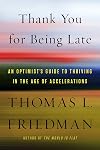
This book was an intellectual slog for me. I initially took it out of the Library during the holiday season…I should know better. I had very little time to read, especially connected time to digest a book about technology. But once the holiday was over, I knuckled down and was determined to read it with comprehension. I’ve enjoyed Friedman’s recent books and this is no exception. He thoroughly covers current technological advances (having fact-checked his text right before publication) show more and interviews some of the greatest minds about future endeavors. The reader does feel a bit breathless as the descriptions of what’s coming spin faster and faster. He discusses the challenges that we (society) face as we are ever more empowered by technology. I particularly glommed on to this quote
“ …as a species, we have never before stood at this moral fork in the road—where one of us could kill all of us and all of us could fix everything if we really decided to do so. Therefore, properly exercising the powers that have been uniquely placed in the hands of our generation will require a degree of moral innovation that we leaders lack.” Pg 342
A few pages later, after a discussion of unintended consequences of algorithms Dov Seidman is quoted "Technology creates possibilities for new behaviors and experiences and connection ..but it takes human beings to make the behaviors principled the experience meaningful and connections deeper and rooted in shared values and aspirations." Pg 345
Friedman does extensive research including many interviews with current thinkers as well as making liberal use of pop culture references to make some of his points. I particularly liked the section of the book in which Friedman uses Mother Nature as a political mentor. His metaphor was well-explained and made sense as he created his list for rethinking our systems. My only disappointment with the book was the last two chapters. I think the author took the liberty of writing a memoir as part of,what is said to be, his last book. Although it was interesting, for me it took the punch out of the rest of his chapters. I am very glad I read the book and would recommend it to people interested in thinking more deeply about the future of our world. show less
“ …as a species, we have never before stood at this moral fork in the road—where one of us could kill all of us and all of us could fix everything if we really decided to do so. Therefore, properly exercising the powers that have been uniquely placed in the hands of our generation will require a degree of moral innovation that we leaders lack.” Pg 342
A few pages later, after a discussion of unintended consequences of algorithms Dov Seidman is quoted "Technology creates possibilities for new behaviors and experiences and connection ..but it takes human beings to make the behaviors principled the experience meaningful and connections deeper and rooted in shared values and aspirations." Pg 345
Friedman does extensive research including many interviews with current thinkers as well as making liberal use of pop culture references to make some of his points. I particularly liked the section of the book in which Friedman uses Mother Nature as a political mentor. His metaphor was well-explained and made sense as he created his list for rethinking our systems. My only disappointment with the book was the last two chapters. I think the author took the liberty of writing a memoir as part of,what is said to be, his last book. Although it was interesting, for me it took the punch out of the rest of his chapters. I am very glad I read the book and would recommend it to people interested in thinking more deeply about the future of our world. show less
The World Is Flat [Updated and Expanded]: A Brief History of the Twenty-first Century by Thomas L. Friedman
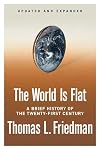
I tried to plow through this book, but Thomas Friedman is the most brain-dead parrot of the ruling class I have ever known, so I couldn't finish it.
His view of globalization is that now, thanks to the paternalistic global order constructed by US multinational corporations, there is cultural and monetary things of worth out there in the vast unexplored jungles of savagery called "not the United States." As an ahistorical text that ignores the fact that elites have been trading from Occident show more to and from Orient for hundreds of years, the book ignores entirely the poor.
How wonderful it is to be ruling class in this new era, where poor people from all over the world can service the rich like Friedman. What an asshole.
Recommended for: fireplaces, doors that need stopping, houses without coasters, etc. show less
His view of globalization is that now, thanks to the paternalistic global order constructed by US multinational corporations, there is cultural and monetary things of worth out there in the vast unexplored jungles of savagery called "not the United States." As an ahistorical text that ignores the fact that elites have been trading from Occident show more to and from Orient for hundreds of years, the book ignores entirely the poor.
How wonderful it is to be ruling class in this new era, where poor people from all over the world can service the rich like Friedman. What an asshole.
Recommended for: fireplaces, doors that need stopping, houses without coasters, etc. show less
Lists
Favourite Books (2)
Climate Change (1)
Obama Reads (1)
Reading list (1)
My List (1)
Middle East (1)
Unread books (1)
Awards


You May Also Like


Associated Authors
Statistics
- Works
- 19
- Also by
- 5
- Members
- 28,939
- Popularity
- #691
- Rating
- 3.7
- Reviews
- 344
- ISBNs
- 241
- Languages
- 21
- Favorited
- 38


