
Fareed Zakaria
Author of The Post-American World
About the Author
Fareed Zakaria was born in Mumbai, India on January 20, 1964. He received a B.A. from Yale University and a Ph.D. in political science in 1993 from Harvard University. He was the managing editor of Foreign Affairs before becoming the editor of Newsweek International in 2000. He writes a weekly show more foreign affairs column in the publication and also has a weekly show on CNN called Fareed Zakaria GPS. Prior to that he worked as a news analyst from 2002 to 2007 on ABC's This Week with George Stephanopoulos and hosted the weekly show Foreign Exchange with Fareed Zakaria on PBS. He is the author of several books including The Future of Freedom, The Post-American World, and In Defense of a Liberal Education. (Bowker Author Biography) show less
Image credit: Credit: Larry D. Moore, Oct. 30, 2007, Las Vegas, Nevada
Works by Fareed Zakaria
The Self-Doubting Superpower: America Shouldn't Give Up on the World It Made [journal article] 1 copy
Populism on the March 1 copy
عالم ما بعد أمريكا 1 copy
Associated Works
Tagged
Common Knowledge
- Canonical name
- Zakaria, Fareed
- Legal name
- Zakaria, Fareed Rafiq
- Birthdate
- 1964-01-20
- Gender
- male
- Education
- Harvard University (PhD | Government | 1993)
Yale College (AB | 1986) - Occupations
- journalist
political commentator - Organizations
- Foreign Affairs
Newsweek
The Washington Post
CNN
Time - Agent
- Tina Bennett
- Relationships
- Huntington Samuel P. (teacher)
Hoffmann, Stanley (teacher)
Throckmorton, Paula (wife) - Nationality
- India (birth)
USA (naturalized) - Birthplace
- Mumbai, India
- Places of residence
- New Haven, Connecticut, USA
Cambridge, Massachusetts, USA
New York, New York, USA - Map Location
- USA
Members
Reviews

Fareed Zakaria writes well. He is often persuasive and sometimes very informative. He is not always right.
He rushed this book to publication and makes many good points, some fair criticisms, a number of excellent observations, some wise judgements and some conclusions that he may come to regard as embarrassing in the near future.
He makes the statement that "The United States and Great Britain are the first major countries to open up and begin entering a post-pandemic world." This is show more respectfully, palpable nonsense. He is unapologetically partisan in his views and I share a lot of them but his lauding of the current administration's handling of the pandemic is rose-tinted at best.
Of his ten lessons some of them are obvious. Globalisation, how do we approach future events, how to rebuild, listening to the science and the inevitable bipolarity of superpower-dom.
He equates an opposition to globalisation to selfishness but I think that that is flawed and simplistic. I agree with him that globalisation cannot be reversed but it can be sent sideways. We have allowed globalisation to be moved to manufacturing monopoly in favour of the distinctly repressive Chinese administration and that is the most urgent thing for the West to address TOGETHER. He correctly, if grudgingly credits Trump with looking to challenge this and just as correctly, but less grudgingly, criticises him for trying to address it alone and with an excess of hubris.
I am a glass-half-full man and I don't hold with the doom-sayers who think Western renewal is beyond us all but a concerted effort is needed to work together on a multi-national level to ensure that the world's supply chains are not ever as dependent on a single state again. Localised Globalisation is the oxymoron that must prevail if we are to thrive more than survive and it makes ecological sense too.
The main lesson that I have taken from this pandemic is that governments and its servants are not to be trusted - whether it is with our freedoms and certainly not with the truth. Politicians and scientists have never been trusted by the populace less than today and rightly so. That trust will take a generation perhaps to recover.
He also makes no mention of the rampant inflation that the world will need to face down as it looks at ways to rebuild and, of course, which he avoids as it may appear critical to his constituency. Personally I don't blame Johnson, Biden or other leaders entirely for the inflation that the pandemic has brought upon us - it is a result of 35 years of failed policies that imbalanced the world economy and an inevitable outcome of such a pandemic when economies are locked down in an unprecedented manner.
Given the present John Hopkins and other studies on the failures of lockdowns, Zakaria, makes a very prescient point:
Was it worth it? These are difficult decisions, but one cannot but think that in many developing countries, not enough thought was given to the calamities that would follow a lockdown.
Is this limited to the developing world? (whatever that is these days - and I believe that the populations of many countries such as the one I reside in have more faith in their government's decision making and are more apt to follow their directives without civil unrest). Statistics can be used to tell us anything if we are biased enough to interpret them in keeping with our prejudices and not every country reported hospitalisations and deaths with the same parameters as others, but studies do need to be made objectively as to whether the approach of Florida was more effective than that of, say New York or Illinois, without politics intruding into the discussion too profusely. I don't know the answer to the question but it is one we need to ask ourselves.
Finally he does not give any thought in a meaningful way of the real origins of the virus, accepting the rather increasingly suspicious dismissal that it evolved naturally in Wuhan. One lesson that should be learned from the pandemic is that the scientists should be watched and we shouldn't be throwing money at experimenting with our existence is such a cavalier manner. show less
He rushed this book to publication and makes many good points, some fair criticisms, a number of excellent observations, some wise judgements and some conclusions that he may come to regard as embarrassing in the near future.
He makes the statement that "The United States and Great Britain are the first major countries to open up and begin entering a post-pandemic world." This is show more respectfully, palpable nonsense. He is unapologetically partisan in his views and I share a lot of them but his lauding of the current administration's handling of the pandemic is rose-tinted at best.
Of his ten lessons some of them are obvious. Globalisation, how do we approach future events, how to rebuild, listening to the science and the inevitable bipolarity of superpower-dom.
He equates an opposition to globalisation to selfishness but I think that that is flawed and simplistic. I agree with him that globalisation cannot be reversed but it can be sent sideways. We have allowed globalisation to be moved to manufacturing monopoly in favour of the distinctly repressive Chinese administration and that is the most urgent thing for the West to address TOGETHER. He correctly, if grudgingly credits Trump with looking to challenge this and just as correctly, but less grudgingly, criticises him for trying to address it alone and with an excess of hubris.
I am a glass-half-full man and I don't hold with the doom-sayers who think Western renewal is beyond us all but a concerted effort is needed to work together on a multi-national level to ensure that the world's supply chains are not ever as dependent on a single state again. Localised Globalisation is the oxymoron that must prevail if we are to thrive more than survive and it makes ecological sense too.
The main lesson that I have taken from this pandemic is that governments and its servants are not to be trusted - whether it is with our freedoms and certainly not with the truth. Politicians and scientists have never been trusted by the populace less than today and rightly so. That trust will take a generation perhaps to recover.
He also makes no mention of the rampant inflation that the world will need to face down as it looks at ways to rebuild and, of course, which he avoids as it may appear critical to his constituency. Personally I don't blame Johnson, Biden or other leaders entirely for the inflation that the pandemic has brought upon us - it is a result of 35 years of failed policies that imbalanced the world economy and an inevitable outcome of such a pandemic when economies are locked down in an unprecedented manner.
Given the present John Hopkins and other studies on the failures of lockdowns, Zakaria, makes a very prescient point:
Was it worth it? These are difficult decisions, but one cannot but think that in many developing countries, not enough thought was given to the calamities that would follow a lockdown.
Is this limited to the developing world? (whatever that is these days - and I believe that the populations of many countries such as the one I reside in have more faith in their government's decision making and are more apt to follow their directives without civil unrest). Statistics can be used to tell us anything if we are biased enough to interpret them in keeping with our prejudices and not every country reported hospitalisations and deaths with the same parameters as others, but studies do need to be made objectively as to whether the approach of Florida was more effective than that of, say New York or Illinois, without politics intruding into the discussion too profusely. I don't know the answer to the question but it is one we need to ask ourselves.
Finally he does not give any thought in a meaningful way of the real origins of the virus, accepting the rather increasingly suspicious dismissal that it evolved naturally in Wuhan. One lesson that should be learned from the pandemic is that the scientists should be watched and we shouldn't be throwing money at experimenting with our existence is such a cavalier manner. show less

As with the major plagues, wars, natural disasters, and economic collapses of the past, the COVID-19 pandemic stands to change (or accelerate) the course of history, fundamentally altering our political economy and society. In the midst of this change, Fareed Zakaria offers us Ten Lessons for a Post-Pandemic World to guide us as we look to construct a better, fairer, and more stable world in the wake of the pandemic.
Zakaria’s ten lessons can be arranged to cover the following four show more overarching lessons (as I’m interpreting them) for the United States as it navigates the post-pandemic world.
1. Embrace globalization and restore international collaboration
Global trade, travel, and the economic and demographic interconnectedness of nations is an unstoppable force. We cannot isolate ourselves from the wider world—even if we wanted to; we can only work to take advantage of globalization’s benefits (or else fall behind to other countries) while better preparing for its risks and compensating those that lose out. We should also remember that post-World War II international collaboration has a strong track record: 75 years (and counting) of relative peace among the great powers.
The US response to the pandemic, however—being rooted in isolationism and nationalism—has been puzzling. As Zakaria wrote:
“From a historical perspective, it is strange to watch this crisis make leaders so narrow-minded and nationalistic. The pain of the pandemic is real and deep, but it doesn’t quite compare to the period between 1914 and 1945—a great war that ripped Europe apart, a pandemic far deadlier than COVID, a global depression, the rise of totalitarianism, another world war that destroyed Europe yet again and laid waste to Japanese cities with nuclear weapons—all told, over 150 million dead. And yet, after those hellish crises, leaders pushed for more international collaboration. Having witnessed the costs of unbridled nationalism and narrow self-interest, the warriors and statesmen who survived believed that they had a duty to create a world that did not lapse back into nihilistic competition.”
This should all be obvious, namely that the prospects of cooperation among nations holds far greater promise than perpetual conflict. The alternative to international collaboration is unrestricted nationalistic competition, the perils of which have apparently been forgotten and are greatly underrated.
The US response this past year has just made no sense. For example, in response to the World Health Organization’s (WHO’s) mishandling of the pandemic response, the US withdrew from the organization, as if allowing the organization to wither away is the better alternative. The proper response would be to recognize that the WHO is underfunded and understaffed and to increase funding and to become more involved in the restructuring of an indispensable organization.
If the US continues to turn away from the wider world, this is going to (1) create chaos and disorder and/or (2) allow other countries to fill the void and collectively outpace the US in several areas.
2. Reduce inequality and restore the dignity or work
Inequality in the US is rampant and unacceptable. In addition to high levels of inequality in income and wealth (which can only be addressed through more progressive taxation), the pandemic has highlighted the inequality of access to health care, demonstrated by the fact that the wealthy received priority access to COVID-19 testing along with the latest and best treatments. It’s time that the US follows other developed nations and adopts some form of universal health care. (The United States is the only one of 33 developed countries to not have universal health care.)
On the job front, the pandemic has made clear the value of “essential workers” to the proper functioning of society, and has highlighted the fact that all jobs have value and contribute to the common good, regardless of the economic value the market assigns to them. Grocery clerks, sanitation workers, teachers, and nurses—while not earning the exorbitant salaries of society's elites (e.g., hedge fund managers)—provide tangible benefits to society that should be better recognized and rewarded. The tax system should be restructured to better reward these tangible, productive positions by shifting the tax burden away from work and onto consumption, wealth, and financial speculation.
3. Demand better government, not less government
Free market fundamentalism—the modern version of the “divine right of kings”—is dangerous and outdated. It cedes over ultimate authority to the market, which consistently undervalues social goods and creates inequality and resentment. Other countries have more effective governments because its citizens know that the question is not the size of government, but rather the quality of government in providing efficient and valuable services to its citizens. The governments of several countries around the world handled the COVID-19 crisis far better than the US—along with much else—and it is about time we started to learn from them.
Several Northern European countries (Denmark being the crowning example) have largely applied most of Zakaria’s ten lessons with great success. How did they do it?
Not by resorting to communism or socialism (using the historical definition of socialism as state control of the means of production), but rather through better-regulated, progressive capitalism. These countries are reaping the benefits of free trade, competition, and private ownership (capitalism) while taking active steps to reduce inequality.
Take Denmark as an example. Zakaria demonstrates how the citizens of Denmark have much higher tax rates compared to the US but receive better services and access to health care and education. As Zakaria wrote:
“Imagine that you’re an average family. You and your spouse have a child, and make the mean household income. You could choose to live in either America or Denmark. In high-tax Denmark, your disposable income after taxes and transfers would be around $15,000 lower than in the States. But in return for your higher tax bill, you would get universal health care (one with better outcomes than in the US), free education right up through the best graduate schools, worker retraining programs on which the state spends seventeen times more as a percentage of GDP than what is spent in America, as well as high-quality infrastructure, mass transit, and many beautiful public parks and other spaces. Danes also enjoy some 550 more hours of leisure time a year than Americans do. If the choice were put this way—you can take the extra $15,000 but have to work longer hours, take fewer vacation days, and fend for yourself on health care, education, retraining, and transport—I think most Americans would choose the Danish model.”
Note that the Danish do not have less freedom due to higher taxes, nor do they live under the oppression of state-controlled communism. Quite the contrary: they live under a robust capitalist system with the freedom to pursue the life and career of their own choosing (and are rewarded in the market for their efforts). But they do so with a greater sense of the common good and under a government that provides valuable services to all and that provides more equal opportunity to all, so that there is less inequality and greater overall social mobility. What rational individual (who isn’t already wealthy and privileged) would pick the US model over this?
Denmark has combined capitalism with a more robust social safety net, better services, and greater redistribution schemes to ensure greater equality of opportunity and income. As a result, its citizens trust their government, trust in science and institutions, and are ultimately happier (Denmark ranked 2nd in the World Happiness Report 2020).
The US, by contrast, has extreme levels of inequality, low social mobility, intense political polarization, and an unhappy population (the US ranked 18th in the same World Happiness Report 2020). This is the result of overreliance on the market and the demonization of government. As Zakaria wrote:
“For four decades, America has largely been run by people who openly pledge to destroy the very government they lead. Is it any wonder that they have succeeded?”
In the wake of the pandemic, we can only hope that four decades of market fundamentalism comes to an end and a new era of progressive capitalism—built on the Scandanavian model—is pursued. Whether or not this will happen is an open question, and considering the country’s past, it is far from guaranteed, especially considering just how deeply money has infiltrated politics and elections.
4. Reform our educational system to change our culture
The hard reality is that the US population is largely scientifically illiterate, overly skeptical of experts, and prone to conspiracy theories. This is nothing if not a failure of our schools to teach the appropriate critical thinking skills and scientific literacy. By teaching to the test and over-relying on rote learning, students are told what to think but not how to think. In a world moving fast into the digital era with major advances in science and technology, a scientifically illiterate population resistant to change will spell disaster for the country.
While I mostly agree with Zakaria’s assessment of the impact of technology on our society—including the possibility of artificial intelligence (AI) replacing jobs and creating massive levels of unemployment and inequality if we do not implement some kind of retraining programs or universal basic income schemes—his views on general AI posing an existential threat to humanity are overblown. He mentions more than once the possibility of humanity being overwhelmed by general AI in some sort of apocalyptic sci-fi scenario. This, as far as I can tell, is pure fantasy.
As psychologist Steven Pinker and others have pointed out—in addition to being very far away from developing general AI—intelligence does not necessarily translate to evil, and that if we become smart enough to build these incredible machines, we should be smart enough to test them and to employ the appropriate safeguards before giving them control of the world. It simply makes no sense to say that these machines will be smart enough to take over the world but dumb enough to do so by accident, and we forget that implementing safety protocols into our technology is a key part of the engineering profession.
Finally, the complexity of the human brain makes it difficult to get robots to do the simplest of tasks—Pinker uses the example of lifting a glass without crushing it. So something any four-year-old can do becomes a near-impossible engineering problem. The human brain is a product of millions of years of evolution and it is just not realistic to think that we can build a machine from scratch with the complexity to think in the same way that humans can.
----------------------------------------------------
Ultimately, the question is, will we take advantage of this opportunity to change society for the better? The COVID-19 pandemic has highlighted the aspects of our society that require change and the possibility of the government stepping in to create that change. But nothing is inevitable or written in stone. Our future is entirely dependent on our actions, choices, and votes, and it seems that we are likely to take one of two paths forward: (1) toward a nationalistic, individualistic society characterized by growing levels of inequality and resentment, or else (2) toward a more open, equal, inclusive, and collaborative society re-integrated into the larger world. show less
Zakaria’s ten lessons can be arranged to cover the following four show more overarching lessons (as I’m interpreting them) for the United States as it navigates the post-pandemic world.
1. Embrace globalization and restore international collaboration
Global trade, travel, and the economic and demographic interconnectedness of nations is an unstoppable force. We cannot isolate ourselves from the wider world—even if we wanted to; we can only work to take advantage of globalization’s benefits (or else fall behind to other countries) while better preparing for its risks and compensating those that lose out. We should also remember that post-World War II international collaboration has a strong track record: 75 years (and counting) of relative peace among the great powers.
The US response to the pandemic, however—being rooted in isolationism and nationalism—has been puzzling. As Zakaria wrote:
“From a historical perspective, it is strange to watch this crisis make leaders so narrow-minded and nationalistic. The pain of the pandemic is real and deep, but it doesn’t quite compare to the period between 1914 and 1945—a great war that ripped Europe apart, a pandemic far deadlier than COVID, a global depression, the rise of totalitarianism, another world war that destroyed Europe yet again and laid waste to Japanese cities with nuclear weapons—all told, over 150 million dead. And yet, after those hellish crises, leaders pushed for more international collaboration. Having witnessed the costs of unbridled nationalism and narrow self-interest, the warriors and statesmen who survived believed that they had a duty to create a world that did not lapse back into nihilistic competition.”
This should all be obvious, namely that the prospects of cooperation among nations holds far greater promise than perpetual conflict. The alternative to international collaboration is unrestricted nationalistic competition, the perils of which have apparently been forgotten and are greatly underrated.
The US response this past year has just made no sense. For example, in response to the World Health Organization’s (WHO’s) mishandling of the pandemic response, the US withdrew from the organization, as if allowing the organization to wither away is the better alternative. The proper response would be to recognize that the WHO is underfunded and understaffed and to increase funding and to become more involved in the restructuring of an indispensable organization.
If the US continues to turn away from the wider world, this is going to (1) create chaos and disorder and/or (2) allow other countries to fill the void and collectively outpace the US in several areas.
2. Reduce inequality and restore the dignity or work
Inequality in the US is rampant and unacceptable. In addition to high levels of inequality in income and wealth (which can only be addressed through more progressive taxation), the pandemic has highlighted the inequality of access to health care, demonstrated by the fact that the wealthy received priority access to COVID-19 testing along with the latest and best treatments. It’s time that the US follows other developed nations and adopts some form of universal health care. (The United States is the only one of 33 developed countries to not have universal health care.)
On the job front, the pandemic has made clear the value of “essential workers” to the proper functioning of society, and has highlighted the fact that all jobs have value and contribute to the common good, regardless of the economic value the market assigns to them. Grocery clerks, sanitation workers, teachers, and nurses—while not earning the exorbitant salaries of society's elites (e.g., hedge fund managers)—provide tangible benefits to society that should be better recognized and rewarded. The tax system should be restructured to better reward these tangible, productive positions by shifting the tax burden away from work and onto consumption, wealth, and financial speculation.
3. Demand better government, not less government
Free market fundamentalism—the modern version of the “divine right of kings”—is dangerous and outdated. It cedes over ultimate authority to the market, which consistently undervalues social goods and creates inequality and resentment. Other countries have more effective governments because its citizens know that the question is not the size of government, but rather the quality of government in providing efficient and valuable services to its citizens. The governments of several countries around the world handled the COVID-19 crisis far better than the US—along with much else—and it is about time we started to learn from them.
Several Northern European countries (Denmark being the crowning example) have largely applied most of Zakaria’s ten lessons with great success. How did they do it?
Not by resorting to communism or socialism (using the historical definition of socialism as state control of the means of production), but rather through better-regulated, progressive capitalism. These countries are reaping the benefits of free trade, competition, and private ownership (capitalism) while taking active steps to reduce inequality.
Take Denmark as an example. Zakaria demonstrates how the citizens of Denmark have much higher tax rates compared to the US but receive better services and access to health care and education. As Zakaria wrote:
“Imagine that you’re an average family. You and your spouse have a child, and make the mean household income. You could choose to live in either America or Denmark. In high-tax Denmark, your disposable income after taxes and transfers would be around $15,000 lower than in the States. But in return for your higher tax bill, you would get universal health care (one with better outcomes than in the US), free education right up through the best graduate schools, worker retraining programs on which the state spends seventeen times more as a percentage of GDP than what is spent in America, as well as high-quality infrastructure, mass transit, and many beautiful public parks and other spaces. Danes also enjoy some 550 more hours of leisure time a year than Americans do. If the choice were put this way—you can take the extra $15,000 but have to work longer hours, take fewer vacation days, and fend for yourself on health care, education, retraining, and transport—I think most Americans would choose the Danish model.”
Note that the Danish do not have less freedom due to higher taxes, nor do they live under the oppression of state-controlled communism. Quite the contrary: they live under a robust capitalist system with the freedom to pursue the life and career of their own choosing (and are rewarded in the market for their efforts). But they do so with a greater sense of the common good and under a government that provides valuable services to all and that provides more equal opportunity to all, so that there is less inequality and greater overall social mobility. What rational individual (who isn’t already wealthy and privileged) would pick the US model over this?
Denmark has combined capitalism with a more robust social safety net, better services, and greater redistribution schemes to ensure greater equality of opportunity and income. As a result, its citizens trust their government, trust in science and institutions, and are ultimately happier (Denmark ranked 2nd in the World Happiness Report 2020).
The US, by contrast, has extreme levels of inequality, low social mobility, intense political polarization, and an unhappy population (the US ranked 18th in the same World Happiness Report 2020). This is the result of overreliance on the market and the demonization of government. As Zakaria wrote:
“For four decades, America has largely been run by people who openly pledge to destroy the very government they lead. Is it any wonder that they have succeeded?”
In the wake of the pandemic, we can only hope that four decades of market fundamentalism comes to an end and a new era of progressive capitalism—built on the Scandanavian model—is pursued. Whether or not this will happen is an open question, and considering the country’s past, it is far from guaranteed, especially considering just how deeply money has infiltrated politics and elections.
4. Reform our educational system to change our culture
The hard reality is that the US population is largely scientifically illiterate, overly skeptical of experts, and prone to conspiracy theories. This is nothing if not a failure of our schools to teach the appropriate critical thinking skills and scientific literacy. By teaching to the test and over-relying on rote learning, students are told what to think but not how to think. In a world moving fast into the digital era with major advances in science and technology, a scientifically illiterate population resistant to change will spell disaster for the country.
While I mostly agree with Zakaria’s assessment of the impact of technology on our society—including the possibility of artificial intelligence (AI) replacing jobs and creating massive levels of unemployment and inequality if we do not implement some kind of retraining programs or universal basic income schemes—his views on general AI posing an existential threat to humanity are overblown. He mentions more than once the possibility of humanity being overwhelmed by general AI in some sort of apocalyptic sci-fi scenario. This, as far as I can tell, is pure fantasy.
As psychologist Steven Pinker and others have pointed out—in addition to being very far away from developing general AI—intelligence does not necessarily translate to evil, and that if we become smart enough to build these incredible machines, we should be smart enough to test them and to employ the appropriate safeguards before giving them control of the world. It simply makes no sense to say that these machines will be smart enough to take over the world but dumb enough to do so by accident, and we forget that implementing safety protocols into our technology is a key part of the engineering profession.
Finally, the complexity of the human brain makes it difficult to get robots to do the simplest of tasks—Pinker uses the example of lifting a glass without crushing it. So something any four-year-old can do becomes a near-impossible engineering problem. The human brain is a product of millions of years of evolution and it is just not realistic to think that we can build a machine from scratch with the complexity to think in the same way that humans can.
----------------------------------------------------
Ultimately, the question is, will we take advantage of this opportunity to change society for the better? The COVID-19 pandemic has highlighted the aspects of our society that require change and the possibility of the government stepping in to create that change. But nothing is inevitable or written in stone. Our future is entirely dependent on our actions, choices, and votes, and it seems that we are likely to take one of two paths forward: (1) toward a nationalistic, individualistic society characterized by growing levels of inequality and resentment, or else (2) toward a more open, equal, inclusive, and collaborative society re-integrated into the larger world. show less

I am so in love with this book. First of all, I had a different impression of what a "liberal education" was when I picked the book. I thought of it in the "not conservative" way and not so much the liberal arts degree that Zakaria was actually going for. I was always going to be an easy sell on that, having an English degree and all, but now I can talk to others about it better. I really do hate the question of what I plan to do with an English degree.
I listened to the audiobook which was a show more short three hours and read by the author. Honestly, I can listen to him talk about this for days. I loved the research that he did and a lot of the conclusions. I think my favorite was that even the best technical degree these days was only useful for so long before all the information you learned was outdated. Tech has gotten a bit crazy and I can't imagine trying to decide on a degree that will be obsolete soon while pressured to not get something in the liberal arts.
As I was paying for my degree on my own, my family didn't get to weigh in on what I was getting it in but that doesn't mean it didn't keep them from commenting. They always wondered how I would make good on the expense and investment and then sigh and figure I could always teach if I couldn't be a writer or something. I absolutely do want to become a published author one day but it's not the only reason to get an English degree, neither is teaching. I had never thought of it in terms of learning to think and how lateral learning helps us see the world through a wider lens. It makes sense, though, because my trade is technological and I do feel like I've had some help along the way with how to form an argument and how to describe the problem from some of my English classes.
My favorite thing about the book is Zakaria's defense of the millennial generation. There are so many articles and books out there calling them all sorts of things and he totally tears those ideas to shreds. And he does it be quoting ancient Greeks, which is kind of the best part about it.
Anyone about to go to college should read this book and it wouldn't hurt for those about to send their children to college either. There are some great points to be made and a great value for liberal arts education. show less
I listened to the audiobook which was a show more short three hours and read by the author. Honestly, I can listen to him talk about this for days. I loved the research that he did and a lot of the conclusions. I think my favorite was that even the best technical degree these days was only useful for so long before all the information you learned was outdated. Tech has gotten a bit crazy and I can't imagine trying to decide on a degree that will be obsolete soon while pressured to not get something in the liberal arts.
As I was paying for my degree on my own, my family didn't get to weigh in on what I was getting it in but that doesn't mean it didn't keep them from commenting. They always wondered how I would make good on the expense and investment and then sigh and figure I could always teach if I couldn't be a writer or something. I absolutely do want to become a published author one day but it's not the only reason to get an English degree, neither is teaching. I had never thought of it in terms of learning to think and how lateral learning helps us see the world through a wider lens. It makes sense, though, because my trade is technological and I do feel like I've had some help along the way with how to form an argument and how to describe the problem from some of my English classes.
My favorite thing about the book is Zakaria's defense of the millennial generation. There are so many articles and books out there calling them all sorts of things and he totally tears those ideas to shreds. And he does it be quoting ancient Greeks, which is kind of the best part about it.
Anyone about to go to college should read this book and it wouldn't hurt for those about to send their children to college either. There are some great points to be made and a great value for liberal arts education. show less
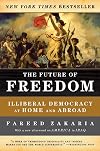
Zakaria builds an analytical approach to the viability of democracy as government elected by the majority of its people and often a constitutional liberalism codifying the rule of law, separation of powers, institutional check and balances, and most importantly individual rights around property, contracts, etc. This analysis suggests a sweet spot around GDP, a lack of a natural resource-based economy (full duplex integration with the global economy), and other basic elements such as a show more healthy middle class. You cannot have a true, liberal democracy without the rule of law. Examples of “illiberal” democracies are democratically elected autocrats as have happened in Egypt, Venezuela, etc.
This opus begins with a The History of Human Liberty from when first in Rome in created the rule of law. Actually, Zakaria finds Rome more important to the growth of democracy as know it than Greece. As the scholarly analysis of the lifespan of democracy and what are its fertile grounds proceeds, it becomes most thought provoking and surprising toward the end with a Too Much Democracy chapter.
Zakaria speaks to the general public discontent with the democratization of political process in the U.S. such as how the most democratic branch, Congress, is loathed, while non-democratic parts like the military and Supreme Court are. He speaks to how American (all?) democracy unchecked tends to commercialize and thus deplete the effectiveness of democracy leading to rampant referendum hijacking, constant fund-raising, and—most disconcerting—an absence of priority of public service by leading citizens. show less
This opus begins with a The History of Human Liberty from when first in Rome in created the rule of law. Actually, Zakaria finds Rome more important to the growth of democracy as know it than Greece. As the scholarly analysis of the lifespan of democracy and what are its fertile grounds proceeds, it becomes most thought provoking and surprising toward the end with a Too Much Democracy chapter.
Zakaria speaks to the general public discontent with the democratization of political process in the U.S. such as how the most democratic branch, Congress, is loathed, while non-democratic parts like the military and Supreme Court are. He speaks to how American (all?) democracy unchecked tends to commercialize and thus deplete the effectiveness of democracy leading to rampant referendum hijacking, constant fund-raising, and—most disconcerting—an absence of priority of public service by leading citizens. show less
Lists
Awards


You May Also Like


Associated Authors
Statistics
- Works
- 26
- Also by
- 4
- Members
- 4,717
- Popularity
- #5,341
- Rating
- 3.8
- Reviews
- 93
- ISBNs
- 110
- Languages
- 14
- Favorited
- 11
