

Joseph S. Nye, Jr. (1937–2025)
Author of Understanding Global Conflict and Cooperation: An Introduction to Theory and History
About the Author
Joseph S. Nye, Jr. is University Distinguished Service Professor Emeritus and former Dean at Harvard's Kennedy School of Government.
Image credit: Official Department of Defence Portrait by Scott Davis, 11 Oct. 1994
Works by Joseph S. Nye, Jr.
Understanding Global Conflict and Cooperation: An Introduction to Theory and History (1993) 400 copies, 5 reviews
The Paradox of American Power: Why the World's Only Superpower Can't Go It Alone (2002) 386 copies, 2 reviews
Presidential Leadership and the Creation of the American Era (The Richard Ullman Lectures) (2013) 19 copies
Soft Power and Great-Power Competition: Shifting Sands in the Balance of Power Between the United States and China (China and Globalization) (2023) 6 copies
Global Cooperation After the Cold War: A Reassessment of Trilateralism : A Task Force Report to the Trilateral Commission (Triangle Papers) (1991) 5 copies
The Global Economic Crisis and Potential Implications for Foreign Policy and National Security (2010) 4 copies
The Democracy Deficit in the Global Economy: Enhancing the Legitimacy and Accountability of Global Institutions (Triangle Papers) (2003) 4 copies
Associated Works
Tagged
Common Knowledge
- Canonical name
- Nye, Joseph S., Jr.
- Legal name
- Nye, Joseph Samuel, Jr.
- Birthdate
- 1937-01-19
- Date of death
- 2025-05-06
- Gender
- male
- Education
- Princeton University (BA summa cum laude∙ 1958)
- Occupations
- professor
government official
United States Assistant Secretary of Defense for International Security Affairs (1994-1995)
Chairman of the United States National Intelligence Council (1993-1994) - Organizations
- Jimmy Carter administration (1977-1979)
Bill Clinton administration (1993-1995) - Awards and honors
- Rhodes Scholar
- Nationality
- USA
- Birthplace
- South Orange, New Jersey, USA
- Associated Place (for map)
- New Jersey, USA
Members
Reviews

Buyer beware! This is an old lecture. Older than the 98 copyright provided in the material, the lecturer is clearly performing this before the fall of the Soviet Union judging by the content. That means it's significantly dated at this point. That said it’s a good presentation and the historical perspective of how the napoleonic, first and second world wars changed the political game still holds up and are views you will encounter even today.
It has some historical value as a US positive show more presentation of its time, predicting that the information economy will spell the end of the Soviet Union along with nationalistic awakenings. Perhaps especially prescient are the thoughts about the diffusion of technology and the worries of the future being transnational issues including terrorism.
Good lecture, just 3 decades out of date. show less
It has some historical value as a US positive show more presentation of its time, predicting that the information economy will spell the end of the Soviet Union along with nationalistic awakenings. Perhaps especially prescient are the thoughts about the diffusion of technology and the worries of the future being transnational issues including terrorism.
Good lecture, just 3 decades out of date. show less
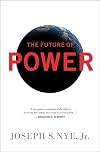
This is a sophisticated analysis of power. The scholarship behind the analysis is impressive: Nye seems to have a real example for every variation of power that he examines. At times going through the nuances gets a little tedious. The chapter on possible American decline which includes discussions of other powers gets more interesting. Also the summing up of "smart power" and the recommendations for the United States going forward. He identifies various risk areas such as immigration, show more overreaction to terrorism, economic problems. So while the book was written before the shock of the Trump Administration, the framework and the specific observations are very relevant to what has happened in the first year of that Administration. Well worth reading to understand what is happening to American power today. show less
The Paradox of American Power: Why the World's Only Superpower Can't Go It Alone by Jr. Joseph S. Nye
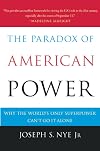
Nye’s treatise on the declining influence of today’s hegemony is quite timely given the contentious political landscape of our times. Indeed, The Paradox of American Power: Why the World’s Only Superpower Can’t Go it Alone attempts to contextualise the consequences of the Bush Administration’s unilateralist policies and reminds the reader the subtle benefits of soft power. This book reminds me of former Canadian foreign minister, Lloyd Axworthy’s venture into the same fray a show more couple of years ago. Admittedly, I enjoyed the latter’s thoughts to a greater degree, but that can be attributed to my nationalist bias and my peculiar interests in the policies and ideals that Axworthy espouses. Overall, Nye’s treatise is eloquent as well as informative, yet the book contains some noticeable typos that distracted this reader from the argument at hand.
Nonetheless, Nye presents his hypothesis in a comprehensive fashion which serves the reader (and non-academics) to warm up to his thoughts and hopefully, to partake the author’s poignant advice. Overall, Nye believes that the U.S. should be mindful of emerging economic scions and to employ isolationist and unilateralist policies only as a last-chance measure. However, there are times when his point of view becomes almost simplistic, particularly when the author attempts to justify the Bush Administration’s unequivical denouncement of the Kyoto Protocol. All in all, Nye’s eloquence and pertinent framework would be well-placed to be the catalyst for many fiery political debates and discussions. show less
Nonetheless, Nye presents his hypothesis in a comprehensive fashion which serves the reader (and non-academics) to warm up to his thoughts and hopefully, to partake the author’s poignant advice. Overall, Nye believes that the U.S. should be mindful of emerging economic scions and to employ isolationist and unilateralist policies only as a last-chance measure. However, there are times when his point of view becomes almost simplistic, particularly when the author attempts to justify the Bush Administration’s unequivical denouncement of the Kyoto Protocol. All in all, Nye’s eloquence and pertinent framework would be well-placed to be the catalyst for many fiery political debates and discussions. show less
Este livro é uma excelente compilação de como o poder se transfere dos Estados para as cidades e as organizações com capacidade de projeção global.
Para isso, o recurso a infra estruturas e plataformas digitais e o envolvimento de recursos humanos com diversidade cultural e com elevada qualificação é uma necessidade absoluta.
confesso que muito do que é dito, está alinhado com o meu próprio pensamento e o lucro da leitura, vem precisamente do autor ser especialista em questões show more diversas das minhas, pelo que acrescenta uma visão que complementa a que possuo. Especialista em questões internacionais e de Estado, discute qual o papel das instituições e dos Estados na regulação das mudanças.
Um livro interessante, também para os interessados nas questões de cibersegurança e cheio de material útil para compreender melhor a complexidade e imprevisibilidade dos tempos que se aproximam. show less
Para isso, o recurso a infra estruturas e plataformas digitais e o envolvimento de recursos humanos com diversidade cultural e com elevada qualificação é uma necessidade absoluta.
confesso que muito do que é dito, está alinhado com o meu próprio pensamento e o lucro da leitura, vem precisamente do autor ser especialista em questões show more diversas das minhas, pelo que acrescenta uma visão que complementa a que possuo. Especialista em questões internacionais e de Estado, discute qual o papel das instituições e dos Estados na regulação das mudanças.
Um livro interessante, também para os interessados nas questões de cibersegurança e cheio de material útil para compreender melhor a complexidade e imprevisibilidade dos tempos que se aproximam. show less
Lists
Awards


You May Also Like


Associated Authors
Statistics
- Works
- 47
- Also by
- 2
- Members
- 2,011
- Popularity
- #12,799
- Rating
- 3.6
- Reviews
- 16
- ISBNs
- 152
- Languages
- 12
- Favorited
- 3