On This Page
Description
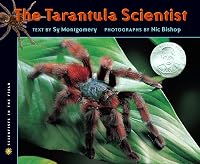
Describes the research that Samuel Marshall and his students are doing on tarantulas, including the largest spider on earth, the Goliath birdeating tarantula.Tags
Recommendations

Member Reviews
Design points: loose tarantulas on the pages--shudder! Graphically captivating layout if rather horrific photos. But that's the appeal to young readers. Plenty of wow facts to keep kids reading. Informal tone, excitement of the science. Describes science in an unstuffy way...storing spiders in salad and candy containers, using paint from Wal-Mart to mark spiders, poking sticks into holes and Sam talking to the spiders.
Booktalk: How many of you love tarantulas? (Show best picture from book.) Let me tell you about a man who is so passionate about tarantulas that his job is to get up close and personal with them and study how they behave, where they live, what they eat. Sam Marshall is a spider scientist who works in a spider lab full of show more containers holding five hundred live tarantulas. But he doesn't just work in a lab. Sam also travels to countries wehre lots of tarantulas live. In a South American rainforest Sam will poke into burrows in the ground trying to get tarantulas to come running out so he can capture them. Now this may not be your idea of a good time. But by studying tarantulas, Sam has learned a lot of interesting things about them. Such as tarantulas bites don't kill people. And that tarantulas would rather hide than attack you. And if a tarantula's leg is injured, it will pull it off and eat it! And although you might think a tarantula is a pretty scary creature, it might someday save your life. There are studies looking into whether a tarantula's venom might help heart attack victims or stop the growth of brain tumors...(finish somehow) show less
Booktalk: How many of you love tarantulas? (Show best picture from book.) Let me tell you about a man who is so passionate about tarantulas that his job is to get up close and personal with them and study how they behave, where they live, what they eat. Sam Marshall is a spider scientist who works in a spider lab full of show more containers holding five hundred live tarantulas. But he doesn't just work in a lab. Sam also travels to countries wehre lots of tarantulas live. In a South American rainforest Sam will poke into burrows in the ground trying to get tarantulas to come running out so he can capture them. Now this may not be your idea of a good time. But by studying tarantulas, Sam has learned a lot of interesting things about them. Such as tarantulas bites don't kill people. And that tarantulas would rather hide than attack you. And if a tarantula's leg is injured, it will pull it off and eat it! And although you might think a tarantula is a pretty scary creature, it might someday save your life. There are studies looking into whether a tarantula's venom might help heart attack victims or stop the growth of brain tumors...(finish somehow) show less
Boys will be fascinated with this account of hunting tarantulas in South America as told by Sy Montgomery. Photographs accompany every page, and Montgomery intersperses dramatic confrontations with tarantulas with useful scientific information. This book would also be great to read excerpts from for a science unit.
This book is packed with information and incredible photographs. After reading it, I still don’t want to hold a tarantula, but I do have a newfound respect for them. The text in this book is fairly dense, enough so that I think a young reader would probably need to already have a fairy strong interest in tarantulas to make it through. However, the aforementioned pictures and their captions help make it accessible to those who want just a taste.
Something I found unique about the book’s design is the way the author wove together facts about tarantulas with the story of Sam, the tarantula scientist. For me, this made the book more interesting because there were two narratives running together. The information about the tarantulas helps show more you understand Sam’s fascination with them, and Sam’s story is compelling on its own. He used to do poorly in school, until he did a project on tarantulas, and now he is one of only four or five scientists in the world who study on tarantulas. A real strength of the book is the strong voice of Sam, with lots of direct quotes and anecdotes from his studies.
This book has several features commonly found in information books, including photos, captions, maps, headings, and a fact section at the end. It does not contain other features we are used to seeing, most notably a table of contents. I would have found a table of contents helpful, but the absence of one points in a way to the more narrative style of the book (in terms of Sam’s story).
I would present this book to preservice teachers to help them think about features of nonfiction books, the purpose of these features, and also to help them think about how to use this book in the classroom. For example, would this book be appropriate for a read aloud? For a class inquiry? For an individual or small group inquiry? Or what could teachers pull from this book to serve as writing models for students writing their own information texts? What is the role of the photographs, both for further explaining the topic and for helping sustain reader interest? show less
Something I found unique about the book’s design is the way the author wove together facts about tarantulas with the story of Sam, the tarantula scientist. For me, this made the book more interesting because there were two narratives running together. The information about the tarantulas helps show more you understand Sam’s fascination with them, and Sam’s story is compelling on its own. He used to do poorly in school, until he did a project on tarantulas, and now he is one of only four or five scientists in the world who study on tarantulas. A real strength of the book is the strong voice of Sam, with lots of direct quotes and anecdotes from his studies.
This book has several features commonly found in information books, including photos, captions, maps, headings, and a fact section at the end. It does not contain other features we are used to seeing, most notably a table of contents. I would have found a table of contents helpful, but the absence of one points in a way to the more narrative style of the book (in terms of Sam’s story).
I would present this book to preservice teachers to help them think about features of nonfiction books, the purpose of these features, and also to help them think about how to use this book in the classroom. For example, would this book be appropriate for a read aloud? For a class inquiry? For an individual or small group inquiry? Or what could teachers pull from this book to serve as writing models for students writing their own information texts? What is the role of the photographs, both for further explaining the topic and for helping sustain reader interest? show less
This is part of the "Scientists in the Field" series published by Houghton Mifflin. It follows an arachnologist from Ohio into the rainforest of French Guiana in South America. The text is written with personality and humor, but remains informative and factual. Plenty of great, close-up photographs of tarantulas and people studying them. Besides appealing to the "gross" factor, this book gives insight into what real scientists look like and do while they work. Although the text is not difficult to understand, there is a fair amount of it, so this book is more appropriate for middle to upper elementary ages. I would recommend this title for a school library or public children's collection.
Extensive, detailed information about Sam Marshall's study of Tarantulas. This book is captivating for a spider-enthusiast. Photographs capture every detail, and almost appear to jump from the page. The text is heavy and wordy but attempts to be accessible for a young reader. Although informative, it is occasionally too detailed -- and as a reader I am tempted to skip over it and read the photo captions.
summary:
An amazing attribute to earth's biggest and hairiest spider, the tarantula. Sam Marshall, is a spider scientist and this book follows him while he explores a rain forest n French Guiana. without fear and never being bit, he searches the forest floor for tarantula burrows trying to get a closer look.
Personal Reaction:
I do not like spiders and was shocked at myself that I chose this book! These spiders are very interesting. The pictures are amazing. This a perfect example of how someone followed their passion and made a career out of it.
Classroom Extension Ideas:
1. Find pictures of one of the different tarantulas mentioned in the text, cut out and post on poster board with information on that particular species.
2. Write a story show more about what you would do if you ever ran in to a Goliath Bird Eater (largest spider on Earth). show less
An amazing attribute to earth's biggest and hairiest spider, the tarantula. Sam Marshall, is a spider scientist and this book follows him while he explores a rain forest n French Guiana. without fear and never being bit, he searches the forest floor for tarantula burrows trying to get a closer look.
Personal Reaction:
I do not like spiders and was shocked at myself that I chose this book! These spiders are very interesting. The pictures are amazing. This a perfect example of how someone followed their passion and made a career out of it.
Classroom Extension Ideas:
1. Find pictures of one of the different tarantulas mentioned in the text, cut out and post on poster board with information on that particular species.
2. Write a story show more about what you would do if you ever ran in to a Goliath Bird Eater (largest spider on Earth). show less
Sam Marshall is a tarantula scientist. He observes and studies the various types of tarantulas. This book explains the different types of tarantulas and their habitation. Sam explores to find these tarantulas and the book explains their history and provides a good amount of information about them.
I would use this book in some types of science class, possibly some type of animal biology. I would ask students to pick which tarantula interests them the most and do some more research on it. I would then ask them to present what they found to the class. I would also have students discuss how they would like to have Sam Marshall’s jobs and what they think would be the hardest part about it.
This book was very informative. It is not very show more pleasurable to read, but would be great for classroom purposes. However, some people may be more interested in learning about tarantula than I am. It may just be the subject that I am not too fond of. show less
I would use this book in some types of science class, possibly some type of animal biology. I would ask students to pick which tarantula interests them the most and do some more research on it. I would then ask them to present what they found to the class. I would also have students discuss how they would like to have Sam Marshall’s jobs and what they think would be the hardest part about it.
This book was very informative. It is not very show more pleasurable to read, but would be great for classroom purposes. However, some people may be more interested in learning about tarantula than I am. It may just be the subject that I am not too fond of. show less
Members
- Recently Added By
Lists

Robert F. Sibert Informational Book Medal
102 works; 1 member
Author Information

52+ Works 11,014 Members
Sy Montgomery was born on February 7, 1958 in Frankfurt, Germany. She is a 1979 graduate of Syracuse University, a triple major with dual degrees in Magazine Journalism from the S.I. Newhouse School of Public Communications and in French Language and Literature and in Psychology from the College of Arts and Sciences. She was awarded an Honorary show more Doctorate of Humane Letters from Keene State College in 2004, and an Honorary Doctorate of Humane Letters from Franklin Pierce University and also from Southern New Hampshire University in 2011. Montgomery is a naturalist. She is an author, and scriptwriter. Her most popular book, The Good Good Pig, is a memoir of her life with her pig, Christopher Hogwood. The book became listed on the New York Times bestseller list in 2015. How to be a Good Creature: A Memoir in Thirteen Animals was published in September 2018. Her other notable titles include Journey of the Pink Dolphins, Spell of the Tiger, and Search for the Golden Moon Bear. (Bowker Author Biography) show less
Awards and Honors
Awards
Distinctions
Series

Common Knowledge
- Canonical title
- The Tarantula Scientist
- Original title
- The Tarantula Scientist
- Original publication date
- 2004-03-23
- Important places
- French Guiana
Classifications
Statistics
- Members
- 386
- Popularity
- 81,027
- Reviews
- 15
- Rating
- (3.90)
- Languages
- English
- Media
- Paper, Ebook
- ISBNs
- 9
- UPCs
- 1
- ASINs
- 2