
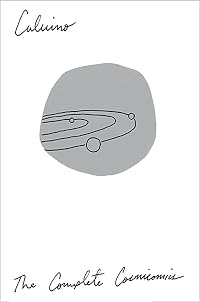
The Complete Cosmicomics
by Italo Calvino
On This Page
Description
"We were peering into this darkness, crisscrossed with voices, when the change took place: the only real, great change I've ever happened to witness, and compared to it the rest is nothing." -from The Complete Cosmicomics Italo Calvino's beloved cosmicomics cross planets and traverse galaxies, speed up time or slow it down to the particles of an instant. Through the eyes of an ageless guide named Qfwfq, Calvino explores natural phenomena and tells the story of the origins of the universe. show more Poignant, fantastical, and wise, these thirty-four dazzling stories-collected here in one definitive anthology-relate complex scientific and mathematical concepts to our everyday world. They are an indelible (and unfailingly delightful) literary achievement. show lessTags
Recommendations









Member Reviews
In 1965 Italo Calvino published a volume of twelve short stories which combined exotic scientific facts with the most mundane of human thoughts and behaviours, to produce a wonderfully quirky brand of fiction. This was the original Cosmicomics.
The only possible way of getting across their oddness is with examples. In ‘All at one Point’ the science is the suggestion that, back at the beginning of the Universe before it began expanding, before even space and time existed, everything was concentrated in a single point. Which is fair enough, except that this is all being described to us by Qfwfq, who lives there—along with his various neighbours and a cleaning lady (who, as you can imagine, had a pretty easy time of it). In show more ‘At Daybreak’ the scientific fact is that, before the Sun condensed from the primordial nebula and began to shine, the Solar System was dark. So we get: ‘Pitch-dark it was—old Qfwfq confirmed—I was only a child, I can barely remember it. We were there, as usual, with Father and Mother, Granny Bb’b, some uncles and aunts who were visiting…’ Other stories take a fact and exaggerate it to the limit; for instance, early in the Earth’s history the Moon was much nearer than it is today—which is true: even as late as the Mesozoic when dinosaurs roamed the planet, it looked bigger in their Jurassic skies than it does in ours; so in ‘The Distance of the Moon’, a story of unrequited love, we see it so close that Qfwfq and his neighbours could row a boat out underneath, prop a ladder against it and climb up. And ‘The Light-Years’ is a magnificent display of pompous self-regard and rampant paranoia on a (literally) cosmological scale.
All twelve are like this; and while some knowledge of science might be helpful, it’s not essential: each story has a short preface, outlining the fact or theory it’s about to stretch to breaking point. The style is dense, crammed with equivocations and clarifications; Calvino’s favourite phrases include ‘In other words…’, ‘Or, rather,…’ and ‘In short…’
It’s hard to say what happened between 1965 and 1967 when a second batch, of eleven stories this time, was published—but they’re definitely not quite the same. One of these—‘Mitosis’, a description of a single cell dividing in two, narrated by the cell itself and done as a sort of love story—is astonishing; but overall, as with a third batch the following year, they’re less quirky and more single-minded, more relentless in pursuing an idea, just as clever but (to my mind anyway) less entertaining. This volume contains all thirty-one, plus some extras—the later ones interesting enough, but those first twelve strange, funny, original. show less
The only possible way of getting across their oddness is with examples. In ‘All at one Point’ the science is the suggestion that, back at the beginning of the Universe before it began expanding, before even space and time existed, everything was concentrated in a single point. Which is fair enough, except that this is all being described to us by Qfwfq, who lives there—along with his various neighbours and a cleaning lady (who, as you can imagine, had a pretty easy time of it). In show more ‘At Daybreak’ the scientific fact is that, before the Sun condensed from the primordial nebula and began to shine, the Solar System was dark. So we get: ‘Pitch-dark it was—old Qfwfq confirmed—I was only a child, I can barely remember it. We were there, as usual, with Father and Mother, Granny Bb’b, some uncles and aunts who were visiting…’ Other stories take a fact and exaggerate it to the limit; for instance, early in the Earth’s history the Moon was much nearer than it is today—which is true: even as late as the Mesozoic when dinosaurs roamed the planet, it looked bigger in their Jurassic skies than it does in ours; so in ‘The Distance of the Moon’, a story of unrequited love, we see it so close that Qfwfq and his neighbours could row a boat out underneath, prop a ladder against it and climb up. And ‘The Light-Years’ is a magnificent display of pompous self-regard and rampant paranoia on a (literally) cosmological scale.
All twelve are like this; and while some knowledge of science might be helpful, it’s not essential: each story has a short preface, outlining the fact or theory it’s about to stretch to breaking point. The style is dense, crammed with equivocations and clarifications; Calvino’s favourite phrases include ‘In other words…’, ‘Or, rather,…’ and ‘In short…’
It’s hard to say what happened between 1965 and 1967 when a second batch, of eleven stories this time, was published—but they’re definitely not quite the same. One of these—‘Mitosis’, a description of a single cell dividing in two, narrated by the cell itself and done as a sort of love story—is astonishing; but overall, as with a third batch the following year, they’re less quirky and more single-minded, more relentless in pursuing an idea, just as clever but (to my mind anyway) less entertaining. This volume contains all thirty-one, plus some extras—the later ones interesting enough, but those first twelve strange, funny, original. show less
I have read two other books by Italo Calvino ([Invisible Cities] and [If on a Winter’s Night a Traveller]), but that hardly seems to matter when trying to coral one’s thoughts into a review of one of his books, each book being such an idiosyncratic achievement. The same may be even more true of The Complete Cosmicomics. Written over twenty years, and scattered across several collections, these stories defy categorisation other than Calvino’s own: they are “cosmic” stories that contain an element of the “comic”. But Calvino could as easily have called them cosmitragics, or romanticomics. The stories contain their fair share of tragedy, and almost each one contains a yearning for an other, usually female, counterpart who show more almost always remains beyond the reach of the protagonist.
Most of the stories are related by Qfwfq (yes, that is spelled correctly) who appears in various guises. He is a bit of a cosmic trickster figure, sometimes human, sometimes animal, always absurd and beyond understanding. Not that Calvino’s stories are unintelligible; they are highly lucid ruminations on cosmic subjects. Calvino uses science to ground his stories, but he goes far beyond the bounds of proven facts to hypothesise about the universe, time, death, and everything in-between. Usually, saying “everything in-between” would be a bit of cop-out in a review, but in this case, I am being completely honest: Calvino writes about things that seem inconceivable, such as the origin of the universe, in a format that is immediately recognisable, that is, the short story. And all of his musings are stories, no matter how esoteric and unbelievable they become.
I must admit, the more cosmic the stories, the less interesting they seemed to me. Not uninteresting, note. They just seemed a bit hard to connect with, these stories about the inexpressible vastness of space and time. That said, in hands other than Calvino’s, they would have been a shambles. Calvino manages to avoid science-fiction while still engaging with science-fact. He is simply brilliant at exploiting the possibilities of theoretical knowledge for his own ends. If this paragraph seems a bit, well, nebulous, that is because it is hard to describe Calvino’s method without spoiling a story. I deal in commonplaces and inexactness to give the flavour of Calvino’s achievement, while probably missing the heart of his accomplishment. And there is certainly heart to Calvino’s writing. Lesser writers would have turned these stories into stylistic exercises, conceits meant to show off their versatility. Calvino, although experimental, keeps his stories grounded in narrative plausibility and character. Some of the stories are not as successful as others, but the best ones are incomparable.
My favourite story is a bit of an idiosyncratic choice in itself, but I guess that goes with the territory. In his re-working of [The Count of Monte Cristo] called, audaciously enough, The Count of Monte Cristo, Calvino depicts a prisoner (Edmond Dantès) trying to escape the Château d’If. But, in fact, he does not attempt to escape. Instead, he listens as another prisoner, Abbé Faria, digs through the prison walls. These walls, however, are not merely stone and mortar. Rather, the Château d’If resembles an M.C. Escher drawing, with the dimension of time added to increase the confusion. Faria continually digs through the walls, only to emerge back where he has come from, sometimes years later (or earlier), sometimes upside down, and sometimes from the same hole that he exits. Edmond, meanwhile, attempts to think through the problem of the prison. As an added twist, he is also aware of a writer, one Alexandre Dumas, trying to write a book called, of all things, The Count of Monte Cristo. Not only does Faria dig through the prison; sometimes he arrives in Dumas’s writing room… I will not reveal the conclusion to this story, but the whole construction is so brilliant and mind-wrenching, that I just had to outline it here.
I have yet to read anything by Calvino that could be described as “conventional” or “boring”. I loved this collection of all the Cosmicomic tales. There is much more that I could relate (the stories’ recurring motif of the moon, a pre-occupation of Italian writers since Dante, for example), but there is an excellent Introduction by Martin McLaughlin included in the volume that deals with most of these considerations. Besides, the hour grows late, and I can hear the scrape-scrape of a shovel echoing through my room… show less
Most of the stories are related by Qfwfq (yes, that is spelled correctly) who appears in various guises. He is a bit of a cosmic trickster figure, sometimes human, sometimes animal, always absurd and beyond understanding. Not that Calvino’s stories are unintelligible; they are highly lucid ruminations on cosmic subjects. Calvino uses science to ground his stories, but he goes far beyond the bounds of proven facts to hypothesise about the universe, time, death, and everything in-between. Usually, saying “everything in-between” would be a bit of cop-out in a review, but in this case, I am being completely honest: Calvino writes about things that seem inconceivable, such as the origin of the universe, in a format that is immediately recognisable, that is, the short story. And all of his musings are stories, no matter how esoteric and unbelievable they become.
I must admit, the more cosmic the stories, the less interesting they seemed to me. Not uninteresting, note. They just seemed a bit hard to connect with, these stories about the inexpressible vastness of space and time. That said, in hands other than Calvino’s, they would have been a shambles. Calvino manages to avoid science-fiction while still engaging with science-fact. He is simply brilliant at exploiting the possibilities of theoretical knowledge for his own ends. If this paragraph seems a bit, well, nebulous, that is because it is hard to describe Calvino’s method without spoiling a story. I deal in commonplaces and inexactness to give the flavour of Calvino’s achievement, while probably missing the heart of his accomplishment. And there is certainly heart to Calvino’s writing. Lesser writers would have turned these stories into stylistic exercises, conceits meant to show off their versatility. Calvino, although experimental, keeps his stories grounded in narrative plausibility and character. Some of the stories are not as successful as others, but the best ones are incomparable.
My favourite story is a bit of an idiosyncratic choice in itself, but I guess that goes with the territory. In his re-working of [The Count of Monte Cristo] called, audaciously enough, The Count of Monte Cristo, Calvino depicts a prisoner (Edmond Dantès) trying to escape the Château d’If. But, in fact, he does not attempt to escape. Instead, he listens as another prisoner, Abbé Faria, digs through the prison walls. These walls, however, are not merely stone and mortar. Rather, the Château d’If resembles an M.C. Escher drawing, with the dimension of time added to increase the confusion. Faria continually digs through the walls, only to emerge back where he has come from, sometimes years later (or earlier), sometimes upside down, and sometimes from the same hole that he exits. Edmond, meanwhile, attempts to think through the problem of the prison. As an added twist, he is also aware of a writer, one Alexandre Dumas, trying to write a book called, of all things, The Count of Monte Cristo. Not only does Faria dig through the prison; sometimes he arrives in Dumas’s writing room… I will not reveal the conclusion to this story, but the whole construction is so brilliant and mind-wrenching, that I just had to outline it here.
I have yet to read anything by Calvino that could be described as “conventional” or “boring”. I loved this collection of all the Cosmicomic tales. There is much more that I could relate (the stories’ recurring motif of the moon, a pre-occupation of Italian writers since Dante, for example), but there is an excellent Introduction by Martin McLaughlin included in the volume that deals with most of these considerations. Besides, the hour grows late, and I can hear the scrape-scrape of a shovel echoing through my room… show less
Poetic exploration of the galaxy, from the Big Bang to Mitosis. The main character "Qfwfq" resides in the chapters exploring the scientific, fantastic, and his own emotions at various states in the cosmos. The chapter, World Memory, was like an Edgar Allen Poe story crossed with Philip K Dick, the protagonist collecting memories and world history for prosperity, in order to preserve the human experience for eternity, but altering the recorded parts he did not like about himself to an extent that it affected reality. I enjoyed the inclusion of mythology, Eurydice and Pluto, (the true terrestrials of Earth); and Calvino's own play on language, sometimes forcing the reader's mind to visualise his stories in the form of a comic strip. show more Overall fiction akin to Flatland by Edwin A. Abbott. show less
Calvino is a favorite author, but these stories are too much for me. They are at the same time simplistic and demanding, asking me to pay attention to vast details while I'm trying to find some grounding for each different tale. I'm alternately feeling interested in some phrase, and then bored at the continuing slow development of - something. They exhaust me, so I have read a scattered few to ponder over, considering whether I'm done with them or maybe will return for another try, but not until some later time.
Calvino is brilliant. Having said that, this book would be better if it was shorter. There is beautiful language. Wonderfully presented philosophical ideas. A strong call out to physics and science. But, it does start to feel redundant. If you're the kind of person who can do this sort of thing, I think it'd be perfect to keep on your night stand and read a story every so often.
Kind of amazingly beautiful and haunting mash-up of science, fiction, and fantasy into a new(ish) form. Lyrically stunning. {Pre-publication review copy via Nook download}
The Complete Cosmicomics is a mixed bag of pleasures. Its initial idea is a simple, but ingenious one. The author takes one scientific "fact", and his main character, Qfwfq spins a yarn about his adventures regarding the mentioned fact. The tales of Qfwfq are very much akin to those of Baron von Münchhausen, they are very narcissistic and absurd. Some of the best describe, for example, how our hero experienced the moon detaching from the earth, being one of the last dinosaurs, and drawing the first markers into space to measure how large it is.
The tales are of varying lengths, from couple-page reads to almost novella-lengths. The longer ones seem to be better thought-out and usually more interesting than the smaller, which are in many show more cases very forgettable. The first half of the book is previously compiled in Cosmicomics, and the latter half is previously unpublished material. Both halves seem to get their share of good and mediocre stories.
If the number of stories was cut in half, this would be a remarkable milestone in absurd literature. With all of them in it, it is still a very pleasurable passtime and makes you chuckle numerous times. The Finnish translation was very good, and used the language inventively and colourfully. show less
The tales are of varying lengths, from couple-page reads to almost novella-lengths. The longer ones seem to be better thought-out and usually more interesting than the smaller, which are in many show more cases very forgettable. The first half of the book is previously compiled in Cosmicomics, and the latter half is previously unpublished material. Both halves seem to get their share of good and mediocre stories.
If the number of stories was cut in half, this would be a remarkable milestone in absurd literature. With all of them in it, it is still a very pleasurable passtime and makes you chuckle numerous times. The Finnish translation was very good, and used the language inventively and colourfully. show less
Members
- Recently Added By
Lists

Top Five Books of 2013
1,562 works; 721 members

Italian Literature
556 works; 41 members

Reiny
17 works; 2 members

Favorite Books in Translation
320 works; 133 members

To read
39 works; 1 member
Author Information

387+ Works 69,888 Members
Italo Calvino 1923-1984 Novelist and short story writer Italo Calvino was born in Cuba on October 15, 1923, and grew up in Italy, graduating from the University of Turin in 1947. He is remembered for his distinctive style of fables. Much of his first work was political, including Il Sentiero dei Nidi di Ragno (The Path of the Nest Spiders, 1947), show more considered one of the main novels of neorealism. In the 1950s, Calvino began to explore fantasy and myth as extensions of realism. Il Visconte Dimezzato (The Cloven Knight, 1952), concerns a knight split in two in combat who continues to live on as two separates, one good and one bad, deprived of the link which made them a moral whole. In Il Barone Rampante (Baron in the Trees, 1957), a boy takes to the trees to avoid eating snail soup and lives an entire, fulfilled life without ever coming back down. Calvino was awarded an honorary degree from Mount Holyoke College in 1984 and died in 1985, following a cerebral hemorrhage. At the time of his death, he was the most translated contemporary Italian writer and a contender for the Nobel Prize for Literature. (Bowker Author Biography) show less
Some Editions
Awards and Honors
Distinctions
Notable Lists
Series
Belongs to Publisher Series
Work Relationships
Contains
Common Knowledge
- Canonical title*
- Kosmikomische verhalen (2de, uitgebreide dr.) (2de, uitgebreide dr.)
- Original title
- Tutte le cosmicomiche
- Original publication date
- 1964-1984 (serials and other collections) (serials and other collections); 1997
- Important places
- Moon
- Important events
- Big Bang
- Original language
- Italian
- Disambiguation notice
- "The Complete Cosmicomics" contains almost twice as much material as the original 1965 edition "Cosmicomics". Please keep the two editions separate.
*Some information comes from Common Knowledge in other languages. Click "Edit" for more information.
Classifications
- Genres
- Fiction and Literature, General Fiction, Science Fiction
- DDC/MDS
- 853.914 — Literature & rhetoric Italian, Romanian & related literatures Italian fiction 1900- 20th Century 1945-1999
- LCC
- PQ4809 .A45 .C6513 — Language and Literature French, Italian, Spanish and Portuguese literatures Italian literature Individual authors, 1900-1960
- BISAC
Statistics
- Members
- 1,384
- Popularity
- 17,061
- Reviews
- 16
- Rating
- (4.08)
- Languages
- 13 — Catalan, Danish, Dutch, English, Finnish, French, German, Italian, Polish, Portuguese, Russian, Spanish, Turkish
- Media
- Paper, Audiobook, Ebook
- ISBNs
- 36
- ASINs
- 15