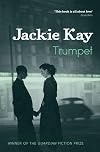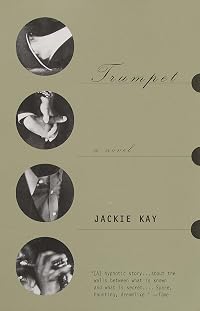
Trumpet
by Jackie Kay
On This Page
Description
After dying, a jazz musician in Scotland is discovered to be a woman. The novel describes the way Joss Moody, a black trumpet player, manages to maintain her charade as husband and father.Tags
Recommendations




























Member Reviews
“When the love of your life dies, the problem is not that some part of you dies too, which it does, but that some part of you is still alive.”
The opening sentence of this novel reads "I pull back the curtains an inch and see their heads bent together." but who are what are they? We soon learn that the speaker is a woman and the heads she views are members of the press camped outside her home. So what great crime has she committed to afford this attention? She spent many years married to a famous Jazz trumpeter called Joss Moody who despite being born a woman has lived most of her life as a man. A fact only discovered by everyone else on his deathbed.
However this isn't Joss's story. Instead it is the story of those his death has show more left behind namely his widow, Millie, and his adopted son, Colman. It is the story about identify and how people are seen by a wider audience. Joss was black, Millie white, both Scots who lived most of their lives and brought up their son in London. The book is actually based on a true story that of Billy Tipton a famous American jazz musician in the 1940's.
Most of the novel is based around Millie whose grieving is movingly portrayed. Colman in contrast feels betrayed by both his parents as he had no idea that Joss was really a woman until being shown by a funeral parlour owner and perhaps understandably is angry. In his anger he is befriended by an unscrupulous journalist seeking to write an expose about Joss the woman. She sees Joss as a sort of freak that will excite the public in the process making her rich yet to his friends and fellow band members although they at least profess ignorance (it is never quite clear whether or not they secretly knew) are happy to purely accept Joss at face value which ultimately is what Colman also does.
Racism both actual and implied are also touched upon but quite sensitively. At one stage Colman boards a train expecting there to be an issue with his seat or his ticket purely of his colour because that is what he has been conditioned to believe from past experience at the hands of whites.
Therefore this is a book about love, gender, grief, race and honesty but mainly it is a book about identity. Identity for all of of us is what we chose it to be rather than what others think that it should be. For a first novel it was a very admirable one that had plenty going for it. show less
The opening sentence of this novel reads "I pull back the curtains an inch and see their heads bent together." but who are what are they? We soon learn that the speaker is a woman and the heads she views are members of the press camped outside her home. So what great crime has she committed to afford this attention? She spent many years married to a famous Jazz trumpeter called Joss Moody who despite being born a woman has lived most of her life as a man. A fact only discovered by everyone else on his deathbed.
However this isn't Joss's story. Instead it is the story of those his death has show more left behind namely his widow, Millie, and his adopted son, Colman. It is the story about identify and how people are seen by a wider audience. Joss was black, Millie white, both Scots who lived most of their lives and brought up their son in London. The book is actually based on a true story that of Billy Tipton a famous American jazz musician in the 1940's.
Most of the novel is based around Millie whose grieving is movingly portrayed. Colman in contrast feels betrayed by both his parents as he had no idea that Joss was really a woman until being shown by a funeral parlour owner and perhaps understandably is angry. In his anger he is befriended by an unscrupulous journalist seeking to write an expose about Joss the woman. She sees Joss as a sort of freak that will excite the public in the process making her rich yet to his friends and fellow band members although they at least profess ignorance (it is never quite clear whether or not they secretly knew) are happy to purely accept Joss at face value which ultimately is what Colman also does.
Racism both actual and implied are also touched upon but quite sensitively. At one stage Colman boards a train expecting there to be an issue with his seat or his ticket purely of his colour because that is what he has been conditioned to believe from past experience at the hands of whites.
Therefore this is a book about love, gender, grief, race and honesty but mainly it is a book about identity. Identity for all of of us is what we chose it to be rather than what others think that it should be. For a first novel it was a very admirable one that had plenty going for it. show less
[b:Trumpet|195733|Trumpet|Jackie Kay|https://i.gr-assets.com/images/S/compressed.photo.goodreads.com/books/1403185988l/195733._SY75_.jpg|647113] is an exquisitely written novel about grief, death, and being trans. I read it all in one go on a Sunday afternoon, which I don't recommend as it left me in an odd headspace. The plot revolves around Joss Moody, a famous jazz trumpeter who has recently died. During his life only his wife knew he was trans. After his death his friends, son, and the public find out and react in a variety of ways. The narrative ranges across different points of view, including his son, his wife, a journalist writing a sensationalist book about him, his cleaner, and the registrar who signs his death certificate. show more These perspectives built up a rich picture of Joss' life and death. I found the funeral director's chapter particularly powerful and unsettling. I hadn't read anything else by Jackie Kay and am very impressed that this was her first novel. It is deftly structured, deeply evocative, and emotionally resonant. The characters, living and dead, are vividly drawn and the depiction of grief is utterly convincing:
I dry my hands and pour the water down the sink. I must remember things. I look out of the kitchen window. It has been raining. Tiny beads of rain have been painted on the window pane when I wasn't looking. It is a fine Impressionists' rain. Next door's rowan tree is still quite still, not at all flamboyant; it is not the season for flamboyance. I can see Elsa at her kitchen window peeling potatoes. The intimacy startles me. Seeing me staring, she waves at me. I wave back, suddenly glad of the human contact. If I pin myself down and remember the ordinary things, I will be able to manage. To get up each day and get washed and eat and sleep. To live a life without my companion. To live this life where I am exhausted with my own company, terrible thoughts spinning morning to night in my head. Maybe this is what people mean when they say they are lonely. Maybe they mean they are exhausted even with their own company. If I could just say I am lonely how lovely and ordinary that sounds.show less
"When the love of your life dies, the problem is not that some part of you dies too, which it does, but that some part of you is still alive."
What makes up identity?
Is it your family?
You accent?
Where you're born?
Where you're raised?
Is it what you do?
Is it how you do it?
Is it the clothes you wear?
Is it your age?
Is your gender?
Is it who you fall in love with?
Is it who you respect?
Trumpet is a beautiful investigation into the question of how people derive a sense of identity under circumstances which seem to strip the members of the Moody family of all of the certainties they may have once held to be indestructible.
Jackie Kay wrote this poetic novel around Joss Moody, a fictional jazz musician, whose death leaves his family at a loss show more after a lifetime of constructing their own image of themselves in relation to Joss, their respective husband and father.
More than that, Kay beautifully describes how their grieving process helps them to figure out who they are.
"I was a traditional boy in an untraditional house. I was always going about the place freaked out and embarrassed. My parents were not like other people’s parents. Whenever they came to my school they stuck out like a sore thumb. I don’t know what it was. A different life makes people look different. Even their skin. Their clothes were more glamorous. They didn’t look like they worked a nine to five. I wanted parents that looked like they worked a nine to five. It was bad enough with all that jazz never mind this. My life was unconventional. A lot of my childhood was spent on the road. Touring. Place to fucking place. I’d have been happier at home watching Star Trek with a bowl of cornflakes. Too much, it was. All that razzamatazz. Other kids envied me and I envied other kids. That’s it." show less
What makes up identity?
Is it your family?
You accent?
Where you're born?
Where you're raised?
Is it what you do?
Is it how you do it?
Is it the clothes you wear?
Is it your age?
Is your gender?
Is it who you fall in love with?
Is it who you respect?
Trumpet is a beautiful investigation into the question of how people derive a sense of identity under circumstances which seem to strip the members of the Moody family of all of the certainties they may have once held to be indestructible.
Jackie Kay wrote this poetic novel around Joss Moody, a fictional jazz musician, whose death leaves his family at a loss show more after a lifetime of constructing their own image of themselves in relation to Joss, their respective husband and father.
More than that, Kay beautifully describes how their grieving process helps them to figure out who they are.
"I was a traditional boy in an untraditional house. I was always going about the place freaked out and embarrassed. My parents were not like other people’s parents. Whenever they came to my school they stuck out like a sore thumb. I don’t know what it was. A different life makes people look different. Even their skin. Their clothes were more glamorous. They didn’t look like they worked a nine to five. I wanted parents that looked like they worked a nine to five. It was bad enough with all that jazz never mind this. My life was unconventional. A lot of my childhood was spent on the road. Touring. Place to fucking place. I’d have been happier at home watching Star Trek with a bowl of cornflakes. Too much, it was. All that razzamatazz. Other kids envied me and I envied other kids. That’s it." show less
A trans jazz trumpeter is outed after his death; this novel follows his widow and his adopted son as they come to terms with both events, and introduces various incidental characters (the undertaker, the registrar, the cleaner...) in one-off scenes. This was beautiful and harrowing, a portrait of grief made more difficult than it needed to be because of the prurient rubbernecking of strangers. (And in these days of increasing transphobia from the press, it was satisfying to see the journalist/ghostwriter presented as a thoroughly nasty piece of work.)
Well this was just beautiful.
As I understand Jackie Kay is a Scottish poet and this is her first (and only?) full length prose novel.
It is a fiction story that is based on the real life story of the jazz musician Billy Tipton. While the story's premise is the 'discovery' that a famous fictional male jazz trumpet player called Joss Moody is biologically female, this did not appear to be the main theme of the novel. Instead what Kay appears to be getting at is the dichotomy between 'public and private' and the way in which people can often use the excuse of 'the truth' to justify trespassing into other's lives. The story also examines other themes such as the different forms that grief takes, race and racism in Britain and of course show more sexuality and the perception of self to a certain extent.
This story was a dream to read, not only for the gentle delicacy that Kay used to tell this story but also in the sensual use of language. It causes my heart to warm just thinking about it. show less
As I understand Jackie Kay is a Scottish poet and this is her first (and only?) full length prose novel.
It is a fiction story that is based on the real life story of the jazz musician Billy Tipton. While the story's premise is the 'discovery' that a famous fictional male jazz trumpet player called Joss Moody is biologically female, this did not appear to be the main theme of the novel. Instead what Kay appears to be getting at is the dichotomy between 'public and private' and the way in which people can often use the excuse of 'the truth' to justify trespassing into other's lives. The story also examines other themes such as the different forms that grief takes, race and racism in Britain and of course show more sexuality and the perception of self to a certain extent.
This story was a dream to read, not only for the gentle delicacy that Kay used to tell this story but also in the sensual use of language. It causes my heart to warm just thinking about it. show less
(Original review posted on my livejournal account: http://intoyourlungs.livejournal.com/37206.html)
Why I Read It: Assigned for my Religious Themes in Literature class.
Like Mootoo Shati's [b:Cereus Blooms at Night|111653|Cereus Blooms at Night|Shani Mootoo|http://photo.goodreads.com/books/1171652264s/111653.jpg|819885], Jackie Kay's Trumpet explores the complexity of sexuality and gender. The novel follows the aftermath of the great jazz trumpeter Joss Moody, and follows his wife as she deals with the grief that comes with losing him. We also follow his son Colman, as he struggles with the revelation that his father was in fact born with a female body.
What Kay addresses beautifully in this novel is how people have the tendency to show more conflate sexuality and gender identity. Joss' wife Millicent knew from before they were married that Joss had a female body bu she didn't care. She loved JOSS, who identified as a man and thus they both still identified as straight. But in the aftermath of Joss's death and the revelation of the gender he was born with, people assume that Millie is a lesbian. This lack of understanding, or willingness to understand drives Millie crazy and she's forced to retreat to her summer home to get away.
Colman was interesting character because despite his disgust at his father's choices he was still a sympathetic character, even when HE himself wasn't making the best choices. It's understandable that he would question his own gender identity when he identifies as male and modeled his masculinity after someone who turns out to NOT be biologically male. That's got to be mind-boggling, especially when you're not expecting and you're already reeling from grief. His reactions to his father's death also displayed an incredible level of complexity with the exploration of his grief and anger.
Reading Sophie's bits were easily the hardest parts to read as she was easily the most frustrating and unlikable character (though she's obviously meant to be). Her desperate search for the REASON for Joss's choice of identifying as male was angering: she pegged it on Joss's wanting to be a famous trumpeter and not being able to do it as a female, on the death of Joss's father at a young age, and on the fact that Joss was obviously just a pervert who got a kick out of tricking people. We as readers KNOW this is all bullshit of course, but unfortunately it's the attitude a lot of people adopt when it comes to transgendered people which is really sad.
Kay's writing is also worth noting; along with addressing very complex issues, she's an incredibly talented and crafty writer. Throughout the novel, she utilizes several points-of-view from several different characters and uses them all to great effect: We have a first-person POV of Colman when he's being interviewed by Sophie, one where he's NOT being interviewed by her, a third-person POV from him, a first-person POV from Millie, first-person from Sophie, as well as at least three more first-person POVs from other adjacent characters. In under 300 pages that's A LOT of POVs and when written down like that, it sounds like way too much. But Kay pulls it off. Each different POV draws out something different from the story and it never comes off as messy.
Oh, and I don't want to reveal too much, but I also loved the ending. Essentially, you're lead to believe that it's going to be one thing, but it ends being something completely different, and for that I was really happy -- it could have taken the obvious route, but then it would have undermined everything it had set out to do. Again, Kay is a great writer who obviously knows what's she doing.
Final Verdict: I loved this book and thinks it's a wonderful example of GLBTQ lit with a focus on transgendered people. Kay explores the complexities of gender identity and sexuality with a deft hand and this is a book I think I could read over and over again and get more out of it every time. The psychology of the characters is spot-on and they are just as complex as the subject matter of the book. The writing was also excellent and Kay displays an incredible handle on POV as she uses A LOT throughout the course of this relatively short novel and pulls it off magnificently. show less
Why I Read It: Assigned for my Religious Themes in Literature class.
Like Mootoo Shati's [b:Cereus Blooms at Night|111653|Cereus Blooms at Night|Shani Mootoo|http://photo.goodreads.com/books/1171652264s/111653.jpg|819885], Jackie Kay's Trumpet explores the complexity of sexuality and gender. The novel follows the aftermath of the great jazz trumpeter Joss Moody, and follows his wife as she deals with the grief that comes with losing him. We also follow his son Colman, as he struggles with the revelation that his father was in fact born with a female body.
What Kay addresses beautifully in this novel is how people have the tendency to show more conflate sexuality and gender identity. Joss' wife Millicent knew from before they were married that Joss had a female body bu she didn't care. She loved JOSS, who identified as a man and thus they both still identified as straight. But in the aftermath of Joss's death and the revelation of the gender he was born with, people assume that Millie is a lesbian. This lack of understanding, or willingness to understand drives Millie crazy and she's forced to retreat to her summer home to get away.
Colman was interesting character because despite his disgust at his father's choices he was still a sympathetic character, even when HE himself wasn't making the best choices. It's understandable that he would question his own gender identity when he identifies as male and modeled his masculinity after someone who turns out to NOT be biologically male. That's got to be mind-boggling, especially when you're not expecting and you're already reeling from grief. His reactions to his father's death also displayed an incredible level of complexity with the exploration of his grief and anger.
Reading Sophie's bits were easily the hardest parts to read as she was easily the most frustrating and unlikable character (though she's obviously meant to be). Her desperate search for the REASON for Joss's choice of identifying as male was angering: she pegged it on Joss's wanting to be a famous trumpeter and not being able to do it as a female, on the death of Joss's father at a young age, and on the fact that Joss was obviously just a pervert who got a kick out of tricking people. We as readers KNOW this is all bullshit of course, but unfortunately it's the attitude a lot of people adopt when it comes to transgendered people which is really sad.
Kay's writing is also worth noting; along with addressing very complex issues, she's an incredibly talented and crafty writer. Throughout the novel, she utilizes several points-of-view from several different characters and uses them all to great effect: We have a first-person POV of Colman when he's being interviewed by Sophie, one where he's NOT being interviewed by her, a third-person POV from him, a first-person POV from Millie, first-person from Sophie, as well as at least three more first-person POVs from other adjacent characters. In under 300 pages that's A LOT of POVs and when written down like that, it sounds like way too much. But Kay pulls it off. Each different POV draws out something different from the story and it never comes off as messy.
Oh, and I don't want to reveal too much, but I also loved the ending. Essentially, you're lead to believe that it's going to be one thing, but it ends being something completely different, and for that I was really happy -- it could have taken the obvious route, but then it would have undermined everything it had set out to do. Again, Kay is a great writer who obviously knows what's she doing.
Final Verdict: I loved this book and thinks it's a wonderful example of GLBTQ lit with a focus on transgendered people. Kay explores the complexities of gender identity and sexuality with a deft hand and this is a book I think I could read over and over again and get more out of it every time. The psychology of the characters is spot-on and they are just as complex as the subject matter of the book. The writing was also excellent and Kay displays an incredible handle on POV as she uses A LOT throughout the course of this relatively short novel and pulls it off magnificently. show less
Promising plot waylaid by too much introspection excusing all the years of lies.
For no good reason, trumpeterJoss Moody and Millie drop their major betrayal on their adopted son, Colman.
Readers may well wish he just took the richly well deserved money for the book and relaxed into a new life.
Sophie Stone's exploitation of his grief translates into a release from his desire for revenge.
The many perspectives of Moody's death are pretty depressing, with Big Red the outstanding character.
While we wonder why Joss never retuned to fully care for his aging Mother,
we may still hope that Colman goes back to help her instead of placating his Mother .
Readers will want to hear that storybook TRUMPET play!!!
Descriptions of house and dark and land show more and sea and moon and wind in Torr are compelling. show less
For no good reason, trumpeterJoss Moody and Millie drop their major betrayal on their adopted son, Colman.
Readers may well wish he just took the richly well deserved money for the book and relaxed into a new life.
Sophie Stone's exploitation of his grief translates into a release from his desire for revenge.
The many perspectives of Moody's death are pretty depressing, with Big Red the outstanding character.
While we wonder why Joss never retuned to fully care for his aging Mother,
we may still hope that Colman goes back to help her instead of placating his Mother .
Readers will want to hear that storybook TRUMPET play!!!
Descriptions of house and dark and land show more and sea and moon and wind in Torr are compelling. show less
Members
- Recently Added By
Lists

Top Five Books of 2014
1,064 works; 397 members

International IMPAC Dublin Literary Award
179 works; 6 members

This is the Canon: Decolonize Your Bookshelf in 50 Books
51 works; 5 members

Transgender Characters
91 works; 5 members

Good LGBT fiction for LGBT folk and friends
551 works; 55 members

Banging Book Club
36 works; 1 member

BBC World Book Club
265 works; 5 members

World Book Club (BBC World Service)
212 works; 1 member
Author Information

36+ Works 1,674 Members
Some Editions
Awards and Honors
Awards
Notable Lists
Common Knowledge
- Canonical title
- Trumpet
- Original publication date
- 1998
- People/Characters
- Joss Moody; Colman Moody; Millicent Moody; Josephine Moore
- Important places
- Scotland, UK
- Epigraph
- The way you wear your hat;
The way you sip your tea,
The memory of all that -
No, no! They can't take that away from me!
- - - George Gershwin - Dedication
- For Carol Ann Duffy
- First words
- I pull back the curtain an inch and see their heads bent together.
- Blurbers
- Emck, Katy; Patterson, Christina; Moggach, Lottie; Jackson, Tina; Anderson, Carol; Farry, Eithne
Classifications
Statistics
- Members
- 697
- Popularity
- 41,050
- Reviews
- 16
- Rating
- (3.86)
- Languages
- 9 — Dutch, English, German, Hebrew, Italian, Japanese, Portuguese, Spanish, Turkish
- Media
- Paper, Audiobook, Ebook
- ISBNs
- 30
- ASINs
- 8