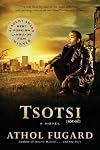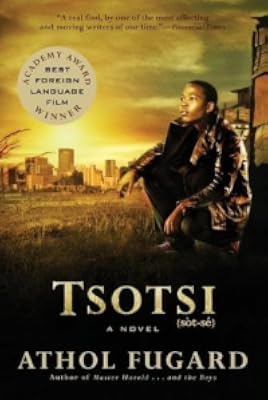
Tsotsi
by Athol Fugard
On This Page
Description
In the Johannesburg township of Soweto, a young black gangster in South Africa, who leads a group of violent criminals, slowly discovers the meaning of compassion, dignity, and his own humanity. Athol Fugard is renowned for his relentless explorations of personal and political survival in apartheid South Africa -- which include his now classic plays Master Harold and the Boys and The Blood Knot. Fugard has written a single novel, Tsotsi, which director Gavin Hood has made into a feature film show more that is South Africa's official entry for the 2006 Academy Awards. Set amid the sprawling Johannesburg township of Soweto, where survival is the primary objective, Tsotsi traces six days in the life of a ruthless young gang leader. When we meet Tsotsi, he is a man without a name (tsotsi is Afrikaans for "hoodlum") who has repressed his past and now exists only to stage and execute vicious crimes. When he inadvertently kidnaps a baby, Tsotsi is confronted with memories of his own painful childhood, and this angry young man begins to rediscover his own humanity, dignity, and capacity to love. ....Publisher Marketing show lessTags
Recommendations


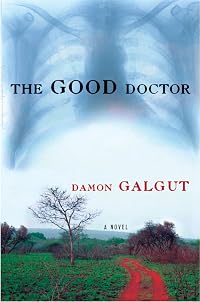
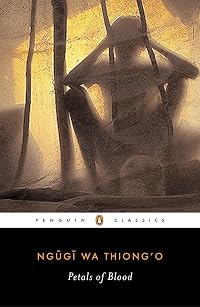
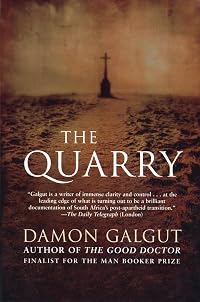

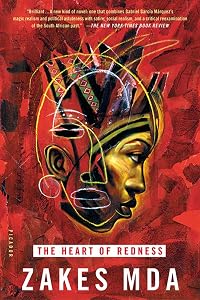








Member Reviews
A heartbreaking book. One cannot help but grieve for this beautiful young man with delicate hands, whose life has been trampled on to the point that he does not even remember his own name, and whose aims in life are only to steal and kill. One cannot help but suffer because what has reduced him to this state, making him an outlaw above all in his own eyes (because that lack of memory is nothing but removal) is the terror and injustice imposed by the white colonialist. One day, however, he makes an involuntary gesture of redemption, and this gesture brings back the memory: of the happy time and its terrible end. All this, of course, he cannot survive, neither as a human being nor as a literary creature.
This was a book that I read for a RL book group, although I had already purchased it for myself.
It is set in South Africa during apartheid in a township outside Johannesburg. The township, Sophiatown, was destroyed in the 50s, to make way for the white city to expand. The townships are the only place near the city where blacks can live.
The buildings are flimsy shacks made of odds and ends and the roads aren't paved. There is a communal water standpipe that blocks and blocks of people have to share. The only people who should be living there are those who work in the white city and have a pass. If they don't have a pass they are supposed to be go to black homelands, that have even less of the necessities of life.
Periodically the police show more conduct pass raids and pull people out of their beds, not even letting them get their pass to prove they belong. Mothers are torn from children, and old people are given no slack. Demolition gangs also come in and start destroying shacks, even if they are inhabited, the people with no place to live are carted off.
In this setting the POV character lives. He is a young man, early 20s and he is a criminal. A tough, vicious, thug who preys on those who try to eke out a poor life in the township. These young men are called Tsotsi as a group. Because the POV was a street child he has no past, no parents and no memories -- not even his name. He takes Tsotsi as his name.
He runs with 3 others like him. But one is a time-bomb that will soon shake Tsotsi's life. Boston is not just a thug, but a thinker, and a formerly decent man with a conscious. He infects Tsotsi with questions about his past, and his cruel actions currently.
Tsotsi ends up with a baby when the woman he is trying to rape, shoves a shoe box at him and runs off. Tsotsi has begun to change because he keeps the baby and tries to care for it. It triggers his memories of life before the streets. He makes further changes by breaking with his gang.
The end is quite devastating.
The writing is very simple and it works so well for the characters who are not educated, and who grapple with just trying to live and survive.
There are terrible heartbreaking scenes of the struggles the decent characters have, that show their humanity and dignity. Their world is comprised of simple pleasures: food, shelter, safety, love of family, a moment of peace.
The thugs are shown lazing, drinking, and abusing women while they wait for dark and plan their next job. Their lives are empty regardless of the money and free time they have.
Through it all are the oppressive laws and police that try to force the blacks into the shape the whites want, while denying them the basic status of humans.
Tsotsi's memories show the direct impact of the whites in their lives and of how people are broken and families destroyed all for the crime of being black. show less
It is set in South Africa during apartheid in a township outside Johannesburg. The township, Sophiatown, was destroyed in the 50s, to make way for the white city to expand. The townships are the only place near the city where blacks can live.
The buildings are flimsy shacks made of odds and ends and the roads aren't paved. There is a communal water standpipe that blocks and blocks of people have to share. The only people who should be living there are those who work in the white city and have a pass. If they don't have a pass they are supposed to be go to black homelands, that have even less of the necessities of life.
Periodically the police show more conduct pass raids and pull people out of their beds, not even letting them get their pass to prove they belong. Mothers are torn from children, and old people are given no slack. Demolition gangs also come in and start destroying shacks, even if they are inhabited, the people with no place to live are carted off.
In this setting the POV character lives. He is a young man, early 20s and he is a criminal. A tough, vicious, thug who preys on those who try to eke out a poor life in the township. These young men are called Tsotsi as a group. Because the POV was a street child he has no past, no parents and no memories -- not even his name. He takes Tsotsi as his name.
He runs with 3 others like him. But one is a time-bomb that will soon shake Tsotsi's life. Boston is not just a thug, but a thinker, and a formerly decent man with a conscious. He infects Tsotsi with questions about his past, and his cruel actions currently.
Tsotsi ends up with a baby when the woman he is trying to rape, shoves a shoe box at him and runs off. Tsotsi has begun to change because he keeps the baby and tries to care for it. It triggers his memories of life before the streets. He makes further changes by breaking with his gang.
The end is quite devastating.
The writing is very simple and it works so well for the characters who are not educated, and who grapple with just trying to live and survive.
There are terrible heartbreaking scenes of the struggles the decent characters have, that show their humanity and dignity. Their world is comprised of simple pleasures: food, shelter, safety, love of family, a moment of peace.
The thugs are shown lazing, drinking, and abusing women while they wait for dark and plan their next job. Their lives are empty regardless of the money and free time they have.
Through it all are the oppressive laws and police that try to force the blacks into the shape the whites want, while denying them the basic status of humans.
Tsotsi's memories show the direct impact of the whites in their lives and of how people are broken and families destroyed all for the crime of being black. show less
this was hard for me, but it got easier toward the end. it took me almost 4 days to get through the first 40 pages, because the writing is so tough, not because of the content. i don't know if i just got more used to the writing or if it changed a bit, but it did get easier. the story is hard, too, but more abstractly so, i thought, because of the way it's written. also, probably, because of how removed tsotsi is from his own life, so the reader doesn't care a whole lot, either. as he comes into more of an ability to care and to evaluate, to question and to remember, the reader becomes more involved and interested as well, and the writing becomes clearer and less abstruse. i'm a little uncomfortable with what seems like maybe a show more religious/christian epiphany thing happening at the end, although it ins't (like much of the book) entirely clear.
i really liked that this edition had fugard's notes in the back, so i could see the meaning he was intending behind some aspects of the story.
"The ache in his legs was no worse than a ten-day-old knife wound." i find a statement like this to be both totally unrelateable and totally fascinating. to choose to use that comparison, when virtually no reader will understand it, is really interesting to me. what he's saying about this character's experience and how outside most readers' understanding it is. show less
i really liked that this edition had fugard's notes in the back, so i could see the meaning he was intending behind some aspects of the story.
"The ache in his legs was no worse than a ten-day-old knife wound." i find a statement like this to be both totally unrelateable and totally fascinating. to choose to use that comparison, when virtually no reader will understand it, is really interesting to me. what he's saying about this character's experience and how outside most readers' understanding it is. show less
This book covers 6 days in the life of a young gang leader in the township of Soweto. He is brutal and regularly commits vicious and senseless crimes. When he inadvertently kidnaps a baby during the course of committing a crime, he begins to remember his own childhood, and, almost against his will, begins to care for the baby.
This book so convincingly conveyed the life of a street child growing up in a hopeless environment, subsisting on a life of crime, living the hardships of the slums of Soweto, that I was amazed to learn that South African writer Athol Fugard is white.
The book was made into a highly-regarded movie (which was the impetus for my reading this book), which I also highly recommend.
This book so convincingly conveyed the life of a street child growing up in a hopeless environment, subsisting on a life of crime, living the hardships of the slums of Soweto, that I was amazed to learn that South African writer Athol Fugard is white.
The book was made into a highly-regarded movie (which was the impetus for my reading this book), which I also highly recommend.
Tsotsi is a novel set in a South African township in the late Seventies, where a young nameless thug (the 'tsotsi' of the title) finds himself with a newborn to care for. I feel that this might have made a better drama or movie than it did a novel (indeed, it was made into a movie a few years ago); some of the characters are two-dimensional/symbolic enough on the page that I think they might have worked better in that medium. I've also seen some commentary online saying that this isn't a very accurate depiction of life for young black man in the Soweto of the time, singling out in particular that Fugard has Tsotsi and his gang talking in Afrikaans to one another, but as I'm far from an expert on South Africa I can't speak to the show more accuracy of that critique. Still, it's mostly well-written (apart from one scene towards the end set in the grounds of a church that had all the subtlety of an anvil dropping), even if I don't know that I'll find it especially memorable. show less
i picked this up in the airport because i accidentally left my book at home. unfortunately, i already owned every other book in the store that i was remotely interested in reading, so i was stuck with this one. lucky for me, it turned out to be pretty good. its about a boy, or maybe a man (you never really find out), that is the leader of a small local gang. he has no recollection of his past, where he came from, what his name is, how old he is. an infant is dropped into his arms, abandoned and alone, and he somehow finds memory of his childhood in the baby. its a great story of youth and individual transformation. however, if graphic violence bothers you, this book has a few moments that are american psycho-ish.apparently, this one has show more also been made into a movie and has won tons of awards in the film circle as a more independent syle film (not mainstream i guess). i'll have to see if i can find it. show less
Tsotsi is a gang leader in Sophiatown, one of the more depressing townships in South-Africa. He doesn't know his past, he seems to have no conscience. He kills and rapes like a machine. One day, when he is about to rape a young woman, she manages to force a shoe box onto him, containing a baby. That baby changes his life, he takes care of it as well as he can (which is not well at all), it brings back memories of his own past, brings back a conscience. No matter how rude the society, there will always be hope, is what fugard seems to say. Then, near the end, Fugard, surprises you in the most macabre way possible.
This book will never leave you as you were.
This book will never leave you as you were.
Members
- Recently Added By
Lists

Big Jubilee List
70 works; 3 members

Books Read in 2025
4,128 works; 98 members
Author Information

54+ Works 2,501 Members
Born in Cape Town and educated at Port Elizabeth Technical College and Cape Town University, Athol Fugard is a leading white South African playwright. After finishing his education, Fugard worked as a seaman and journalist before becoming an actor, director, and playwright. His commitment to the antiapartheid struggle through his plays and other show more dramatic productions is as long as it is effective in portraying the traumas of racial tensions in the lives of both white and black South Africans. The setting of his plays is contemporary South Africa, but the bleakness and frustrations of life they present, especially for those on the fringes of society, raise the plays to the level of universal human tragedy. Because of their subject, his plays have sometimes met with official opposition. Blood Knot (1960), about two coloured brothers, one light-skinned and one dark-skinned, was censored, and some of his other works have only been published abroad. Fugard has frequently collaborated in his productions with black playwrights and actors, like John Kani and Winston Ntsona, with whom he produced the highly acclaimed and frequently produced plays, Siswe Bansi Is Dead (1973) and Statements (1972). His work is quite popular in England, and later plays, Master Harold and the Boys (1982), The Road to Mecca (1984), and A Place With the Pigs (1987), have been staged at the National Theatre. Fugard has also written screenplays and a novel, Tsotsi (1980) which was adapted to the screen in 2005 and received an Academy Award for Best Foreign Language Film. His recent works are Exits and Entrances (2004), Booitjie and the Oubaas (2006), Victory (2007), Coming Home (2009), Have you seen Us (2009), and The Train Driver (2010). (Bowker Author Biography) show less
Some Editions
Awards and Honors
Notable Lists
The Big Jubilee Read (1972-1981 – 1980)
Series
Belongs to Publisher Series
detebe (23565)
Common Knowledge
Classifications
Statistics
- Members
- 354
- Popularity
- 89,363
- Reviews
- 9
- Rating
- (3.74)
- Languages
- 11 — Chinese, Dutch, English, German, Italian, Norwegian (Bokmål), Norwegian, Polish, Portuguese, Croatian, Swedish
- Media
- Paper, Ebook
- ISBNs
- 27
- ASINs
- 6