On This Page
Description
A scrapbook traces the development of the comic strip about life in corporate America, including the creator's thoughts about the formation of his character's lives and personalities.Tags
Recommendations













Member Reviews
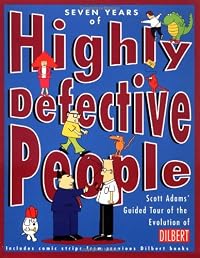
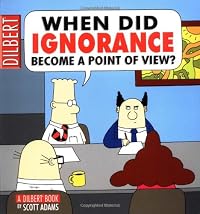
After seven years of making the Dilbert comic strip, Scott Adams decided to put together a retrospective that focused on the various characters that had been developed to populate his depiction of the life of a nerdy engineer living in cubicle hell. Seven Years of Highly Defective People is the result.
The book starts off by introducing Dilbert and the formative strips that went into creating him. The strips about Dilbert cover the various issues relating to the character such as his relationship with Dogbert and his own ego, his troubles with technology and work, his fumbling attempts to meet and date women, and of course, his somewhat temporary death. Throughout the book Adams has included side comments on many strips giving insights show more into his thinking behind some strips, discussing reactions the comics evoked, and the origins of many characters and strip ideas.
The book then moves on to Dogbert, showing his transformation from a somewhat sarcastic pet dog to the evil scheming dictator in waiting that he has become. The book moves on from the inflated ego of Dogbert to the nonexistent self-esteem of Ratbert. Later sections cover the most intelligent garbage man in the world, Liz, the one woman on Earth who seems to want to date Dilbert, Dilbert's Mom (and absent Dad), Bob the Dinosaur, Catbert, and Phil of Insufficient Light.
Just as the strip did, the book then turns to focus primarily on the characters related to Dilbert's workplace. Asok the clueless intern, Tina the Tech Writer (and her opposite Antnia), the pointy-haired boss (who wavers between active evil and simple cluelessness), Alice, Wally, and Carol. Even the Elbonians and Ted the generic guy get a chapter, as do the random creatures that show up (who aren't Dogbert, Catbert, Ratbert, or Bob). Each chapter shows how the character in question developed from an idea into the form they have taken today - in many cases what is now a single character developed out of a category of characters.
The strips are all great, which should be no surprise. The commentary provided by Adams is funny and often illuminating. (My favorite element to the commentary is seeing how many times Adams killed off side characters simply because he was bored with the story line they were in). The book even has a chapter titled "Dogbert in Hats", and any book that features an entire segment about headgear for an evil dog is definitely worth reading.
The only thing about the book that amounts to something of a flaw is that by grouping the strips by character, some of the context of the original story lines in which the strips appeared in is lost - a problem shared with Dilbert Gives You the Business. Because these strips focus on characters and character development, however, there is much less of a disjointed feeling than shows up in that volume. For someone wanting an introduction to the skewed world of Dilbert, this would be a good start. For someone who is a fan of the series, this is an exceptionally fun book to read due to the author commentary. This is simply a great collection of comics from a great strip.
This review has also been posted to my blog Dreaming About Other Worlds. show less
The book starts off by introducing Dilbert and the formative strips that went into creating him. The strips about Dilbert cover the various issues relating to the character such as his relationship with Dogbert and his own ego, his troubles with technology and work, his fumbling attempts to meet and date women, and of course, his somewhat temporary death. Throughout the book Adams has included side comments on many strips giving insights show more into his thinking behind some strips, discussing reactions the comics evoked, and the origins of many characters and strip ideas.
The book then moves on to Dogbert, showing his transformation from a somewhat sarcastic pet dog to the evil scheming dictator in waiting that he has become. The book moves on from the inflated ego of Dogbert to the nonexistent self-esteem of Ratbert. Later sections cover the most intelligent garbage man in the world, Liz, the one woman on Earth who seems to want to date Dilbert, Dilbert's Mom (and absent Dad), Bob the Dinosaur, Catbert, and Phil of Insufficient Light.
Just as the strip did, the book then turns to focus primarily on the characters related to Dilbert's workplace. Asok the clueless intern, Tina the Tech Writer (and her opposite Antnia), the pointy-haired boss (who wavers between active evil and simple cluelessness), Alice, Wally, and Carol. Even the Elbonians and Ted the generic guy get a chapter, as do the random creatures that show up (who aren't Dogbert, Catbert, Ratbert, or Bob). Each chapter shows how the character in question developed from an idea into the form they have taken today - in many cases what is now a single character developed out of a category of characters.
The strips are all great, which should be no surprise. The commentary provided by Adams is funny and often illuminating. (My favorite element to the commentary is seeing how many times Adams killed off side characters simply because he was bored with the story line they were in). The book even has a chapter titled "Dogbert in Hats", and any book that features an entire segment about headgear for an evil dog is definitely worth reading.
The only thing about the book that amounts to something of a flaw is that by grouping the strips by character, some of the context of the original story lines in which the strips appeared in is lost - a problem shared with Dilbert Gives You the Business. Because these strips focus on characters and character development, however, there is much less of a disjointed feeling than shows up in that volume. For someone wanting an introduction to the skewed world of Dilbert, this would be a good start. For someone who is a fan of the series, this is an exceptionally fun book to read due to the author commentary. This is simply a great collection of comics from a great strip.
This review has also been posted to my blog Dreaming About Other Worlds. show less
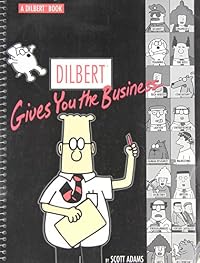
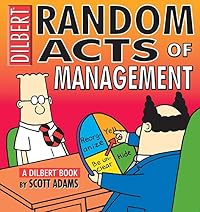
The creator/author of DILBERT, begun in 1989, presents a compilation of the strips with red-inked holographic explanations or "guides" on this tour of the business cartoons which reflect modern corporate management issues. This is meta-fiction -- or reality.
The strip can be located at www.unitedmedia.com .
While selecting examples is arbitrary, here is a set:
In three panels, a suit announces the following monologue: "Starting today, the company will begin random drug testing." "Although it would be illegal to search your car or home for illegal drugs..." " we have found no ethical problem with sucking the blood out of your body. Results will be posted in the cafeteria."
The handwritten red-ink comment: "I'm amazed that this is legal in show more the USA." [30]
In the next strip, Dilbert is counseling at home with Dogbert. "It's an ethical dilemma...I support my company's goal of discouraging drug use, but the random drug testing policy is a violation of my constitutional rights." "I'll get fired if I refuse the test. What is the ethical thing to do?" Dogbert: "Hack into their computer and change your boss's test results."
The final panel, Dilbert: "Sometimes the straightest path is through the mud." Dogbert: "Good, rationalize it with an obtuse metaphor". The comment is "A good metaphor can make any bad idea sound good."
Scott Adams delivers insight across the most important management issues using few words. show less
The strip can be located at www.unitedmedia.com .
While selecting examples is arbitrary, here is a set:
In three panels, a suit announces the following monologue: "Starting today, the company will begin random drug testing." "Although it would be illegal to search your car or home for illegal drugs..." " we have found no ethical problem with sucking the blood out of your body. Results will be posted in the cafeteria."
The handwritten red-ink comment: "I'm amazed that this is legal in show more the USA." [30]
In the next strip, Dilbert is counseling at home with Dogbert. "It's an ethical dilemma...I support my company's goal of discouraging drug use, but the random drug testing policy is a violation of my constitutional rights." "I'll get fired if I refuse the test. What is the ethical thing to do?" Dogbert: "Hack into their computer and change your boss's test results."
The final panel, Dilbert: "Sometimes the straightest path is through the mud." Dogbert: "Good, rationalize it with an obtuse metaphor". The comment is "A good metaphor can make any bad idea sound good."
Scott Adams delivers insight across the most important management issues using few words. show less
This compiles some of the best Dilbert strips, and includes some wonderful commentary by Scott Adams. It's well worth reading his thoughts on this strips and on the characters he created.
Histerical! Even though I have already read the comics in previous collected volumes, the artist comments by Scott Adams really sold this book. I never failed to laugh.
Histerical! Even though I have already read the comics in previous collected volumes, the artist comments by Scott Adams really sold this book. I never failed to laugh.
Histerical! Even though I have already read the comics in previous collected volumes, the artist comments by Scott Adams really sold this book. I never failed to laugh.
Histerical! Even though I have already read the comics in previous collected volumes, the artist comments by Scott Adams really sold this book. I never failed to laugh.
Members
- Recently Added By
Author Information

199+ Works 34,778 Members
Scott Adams, Cartoonist Scott Adams was born and raised in Windham, New York in the Catskill Mountains. He received a B.A. in economics from Hartwick College, Oneonta, NY and an MBA from the University of California, Berkeley. He is also a certified hypnotist. Adams worked in a bank for eight years and, while a bank teller, was robbed twice at show more gunpoint. He also worked for Pacific Bell for nine years and describes both jobs as "humiliating and low paying jobs." It was during this time, that Adams created the character Dilbert. He was entertaining himself during meetings by drawing insulting cartoons of his co-workers and bosses. In 1988, he mailed some sample comic strips featuring Dilbert to some major cartoon syndicates. He was offered a contract and Dilbert was launched in approximately fifty papers in 1989. Adams began working on Dilbert full time as well as speaking, writing, doing interviews, and designing artwork for licensed products. Dilbert is published in over 1,200 newspapers and has a hard cover business book called "The Dilbert Principle." (Bowker Author Biography) show less
Series

Common Knowledge
- Canonical title
- Seven Years of Highly Defective People
- Original publication date
- 1997
- People/Characters
- Dilbert; Pointy-Haired Boss; Wally; Alice; Dogbert
Classifications
- Genre
- Graphic Novels & Comics
- DDC/MDS
- 741.5973 — Arts & recreation Drawing & decorative arts Drawing Comic books, graphic novels, fotonovelas, cartoons, caricatures, comic strips History, geographic treatment, biography North American United States (General)
- LCC
- PN6727 .A3 .D55286 — Language and Literature Literature (General) Literature (General) Collections of general literature Comic books, strips, etc.
- BISAC
Statistics
- Members
- 1,358
- Popularity
- 17,494
- Reviews
- 11
- Rating
- (3.90)
- Languages
- English
- Media
- Paper, Ebook
- ISBNs
- 4
- UPCs
- 2
- ASINs
- 4