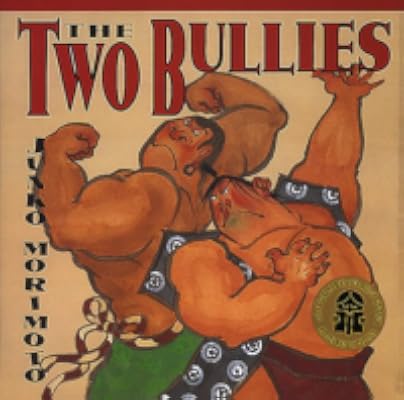
The Two Bullies
by Junko Morimoto, Isao Morimoto (Translator)
On This Page
Description
Two bullies, one from China and one from Japan, inadvertently intimidate one another before meeting face to face and never fight as a result.Tags
Recommendations
















Member Reviews
Ni-ou is the strongest man in Japan, but he wants to prove he is stronger than Dokkoi, the strongest man in China.
This is a really fun book. It is a nice take on wits winning over brains, especially since brains only win out by accident. The story is quite amusing. The reader knows that the main characters will never ace an I.Q. test, but will find them endearing anyway.
The illustrations are detailed and quite funny. They also really invoke Japan, especially in the fabric and the waves. A lot of the humor comes from the calm, rational tone of the text in contrast with the pictures. For example, the text reads, "He climbed out the window," but we can see that in fact, Ni-ou crashed through the wall. It is also great how the story starts show more before the title page.
This is a great book for any collection. It's funny, interesting and different from a lot of other picture books out there. show less
This is a really fun book. It is a nice take on wits winning over brains, especially since brains only win out by accident. The story is quite amusing. The reader knows that the main characters will never ace an I.Q. test, but will find them endearing anyway.
The illustrations are detailed and quite funny. They also really invoke Japan, especially in the fabric and the waves. A lot of the humor comes from the calm, rational tone of the text in contrast with the pictures. For example, the text reads, "He climbed out the window," but we can see that in fact, Ni-ou crashed through the wall. It is also great how the story starts show more before the title page.
This is a great book for any collection. It's funny, interesting and different from a lot of other picture books out there. show less
Illustrated in a style with more than a passing nod to traditional Japanese illustration, this is the story of two giants - Ni-ou and Dokkoi. While the title would suggest they are bullies, there is no real evidence of that in the story. Ni-ou sets out from Japan and rows his boat to China to find Dokkoi and see if he is the more powerful of the two giants. Scared off by the sounds of the approaching Chinese giant, Ni-ou runs away. Dokkoi attemtps to drag Ni-ou's boat back to the shore but Ni-ou escapes. Both giants believe the other is more powerful.
I am assuming this is based on a traditional Japanese tale, and therefore there might be some traditional cultural relevance that I am not picking up on with this story. That said, my three show more year old son really likes this book! show less
I am assuming this is based on a traditional Japanese tale, and therefore there might be some traditional cultural relevance that I am not picking up on with this story. That said, my three show more year old son really likes this book! show less
This translation of a Japanese stories tells of two strong men, one from China and one from Japan, who challenge each other but never actually fight. The two names of the giant men are now, the end of the story explains, exclamations given by people in their respective countries when lifting heavy things.
With large, clearly inked illustrations, this picture book would be a good read-along for first through third graders, and could spark a conversation about the etymology of other exclamations. The story is refreshingly un-didactic - students have no obvious moral lesson, other than not challenging someone to a fight when their prowess is unknown.
With large, clearly inked illustrations, this picture book would be a good read-along for first through third graders, and could spark a conversation about the etymology of other exclamations. The story is refreshingly un-didactic - students have no obvious moral lesson, other than not challenging someone to a fight when their prowess is unknown.
Without context it makes no sense. "Translated from an original Japanese story..." is ambiguous... is it traditional or not? And the strong men are not bullies; they're just young men proud of their strength.
This is a story of the Ni-ou statue at the gates of Hachiman's temple. Each one starts off thinking they are stronger and when they almost meet they each end up glad they didn't face each other. I love the illustrations.
Genre: Myth and Legend
Critique: This is a good example of Myth and Legend because of how it exaggerates the story and is set long ago. It has been passed on from generation to generation and it's character's are unrealistic in that they are stronger and bigger than any person could be.
Critique: This is a good example of Myth and Legend because of how it exaggerates the story and is set long ago. It has been passed on from generation to generation and it's character's are unrealistic in that they are stronger and bigger than any person could be.
Japanese picture book tells fable of Japan and China arguing over Japan. VPRC
Members
- Recently Added By
Lists

A Child's Book Tour of Japan
58 works; 4 members
Author Information

13+ Works 544 Members
Awards and Honors
Common Knowledge
- Original publication date
- 1997
- Important places
- Japan
Classifications
- Genres
- Children's Books, Picture Books
- DDC/MDS
- 398.20952 — Society, government, & culture Customs, etiquette & folklore Folklore & Folktales Folk literature History, geographic treatment, biography Asian folktales Japanese folklore
- LCC
- PZ7 .M826747 .T — Language and Literature Fiction and juvenile belles lettres Fiction and juvenile belles lettres Juvenile belles lettres
- BISAC
Statistics
- Members
- 106
- Popularity
- 305,512
- Reviews
- 11
- Rating
- (3.34)
- Languages
- English
- Media
- Paper
- ISBNs
- 4
- ASINs
- 1