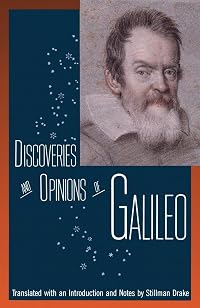
Discoveries and Opinions of Galileo
by Galileo Galilei  , Stillman Drake (Translator and editor)
On This Page
Description
Directing his polemics against the pedantry of his time, Galileo, as his own popularizer, addressed his writings to contemporary laymen. His support of Copernican cosmology, against the Church's strong opposition, his development of a telescope, and his unorthodox opinions as a philosopher of science were the central concerns of his career and the subjects of four of his most important writings. Drake's introductory essay place them in their biographical and historical context.Tags
Recommendations

















Member Recommendations


by anonymous user

by anonymous user
Member Reviews
Galileo really missed his era - he wanted to be a blogger. The genius had such a loquacious side that even the editors of this edition excise several days of Galileo's moon diary since the avalanche of words offers no additional insights. Much of Galileo's insights are powerful arguments as he poularized new discoveries seen in the heavens. It is possible his incredible amount of verbiage made him too tempting and too open for attack from his powerful, clerical detractors. Galileo certainly knew how to "flame" in the media of his time.
One bit of his sagacity really struck me: " "Long experience has taught me this about the status of mankind with regard to matters requiring thought: the less people know and understand about them, the show more more positively they attempt to argue concerning them, while on the other hand to know and understand a multitude of things renders men cautious in passing judgement upon anything new." (from 'The Assayer')
Here is his attack on the popular opinion, though he is rather being a jerk in how he says it: "If reasoning were like hauling I should agree that several reasoners would be worth more than one, just as several horses can haul more sacks of grain than one can. But reasoning is like racing and not like hauling, and a single Barbary steed can outrun a hundred dray horses." show less
One bit of his sagacity really struck me: " "Long experience has taught me this about the status of mankind with regard to matters requiring thought: the less people know and understand about them, the show more more positively they attempt to argue concerning them, while on the other hand to know and understand a multitude of things renders men cautious in passing judgement upon anything new." (from 'The Assayer')
Here is his attack on the popular opinion, though he is rather being a jerk in how he says it: "If reasoning were like hauling I should agree that several reasoners would be worth more than one, just as several horses can haul more sacks of grain than one can. But reasoning is like racing and not like hauling, and a single Barbary steed can outrun a hundred dray horses." show less
This is a fascinating collection of Gailileo's writings on his discovery of Jupiter's moons and his observation and speculations on the nature of sunspots, as well as his defense of the veracity of his observations in the face of heavy censure from the Church. Any amateur astronomer who remembers seeing Jupiter's moons for the first time through a telescope and witnessing the change in their configuration from night to night will get a thrill out of reading this first account and Galileo's extraordinary reasoning as to why they must be satellites of the planet Jupiter and why this confirms the heliocentric model. Galileo was an excellent rhetorician who also surprisingly had a sense of humor when dealing with the absurdity of his show more critics' claims. I thoroughly loved this book and recommend it to anyone even mildly interested in the history of astronomy. show less
Incredibly well-edited selection of writings, invaluable for understanding the history of science, rhetoric, theology, and cosmology.
Galileo's wit and sarcasm made this interesting book absolutely fun. Except for all the bits about prejudice and really stubborn people who wouldn't look at ideas in a clear light.
Edition: // Descr: viii, 301 p. 20.5 cm. // Series: Call No. { } Translated with an Introduction and Notes by Stillman Drake Contains Appendices and Index. // //
Ratings
Members
- Recently Added By
Lists

Best Science Books for Non-Scientists
113 works; 57 members
Author Information

247+ Works 3,861 Members
Galileo Galilei, the great astronomer and physicist whose researches played so crucial a role in the history of science, also occupies an important place in the history of philosophy for his part in overthrowing the predominant Aristotelian concept of the nature of the universe. Galileo considered himself a philosopher and referred to himself as show more such on the title pages of his most influential works. Much recent research has been devoted to examining both the philosophical background of Galileo's scientific achievements and the philosophical implications of his scientific method. Born in Pisa, the eldest son of a famous music theorist, Galileo entered on the study of medicine at the University of Pisa but quickly shifted his interest to mathematics. From 1589 to 1592, he taught mathematics at Pisa while studying independently with Jacopo Mazzoni, a distinguished professor of philosophy. His earliest scientific works, directed against Aristotle's account of freely falling bodies, date from this period. In 1592 he moved to Padua, where he lectured on mathematics and astronomy, and by 1597 he was defending the Copernican helicocentric theory of the universe in a letter to his friend Mazzoni. When in 1609, he learned of the invention of the telescope in Holland, Galileo quickly designed an improved version of the instrument for his own astronomical observations. His startling discoveries---including the satellites of Jupiter---were revealed in 1610 in his Starry Messenger (Sidereus nuncius), which led to his appointment as mathematician and philosopher to the Grand Duke of Tuscany. On a visit to Rome in 1611, he demonstrated the power of his instrument and defended the Copernican worldview in learned circles. Church authorities were divided on the question of whether the Copernican theory was consistent with scriptural accounts of the cosmos, and Galileo's position was attacked on theological grounds. He defended himself eloquently in his famous Letter to the Grand Duchess Christina (1615), arguing for the independence of scientific inquiry from theological constraints. Nevertheless, in the following year, he was forbidden to hold or teach the Copernican view. Retiring to Florence to pursue his scientific researches, Galileo let the Copernican question lie until a new pope, Urban VIII, seemed to offer a more favorable reception to his views. In 1632 he brought out his great Dialogue Concerning the Two Chief World Systems, a presentation of the Ptolemaic-Aristotelian and Copernican systems heavily weighted in favor of the scientific superiority of the latter. In spite of the support of his Florentine and Roman friends, Galileo was tried and forced to recant his defense of helicocentrism under the threat of torture; the Dialogue was placed on the Index of Prohibited Books and its author sentenced to house arrest for life. Galileo's last years were spent in scientific investigations that culminated in the publication of his Discourses on Two New Sciences (1638). Galileo's legacy as a philosopher lies in his outspoken defense of the autonomy of scientific investigation from philosophical and theological authority, and his conviction that mathematical proofs can and should be sought in physical science, that celestial and terrestrial phenomena can be accounted for by a single set of scientific laws, and that scientific explanations cannot be divorced from direct empirical observation of phenomena. (Bowker Author Biography) show less
Galileo Galilei has a Legacy Library. Legacy libraries are the personal libraries of famous readers, entered by LibraryThing members from the Legacy Libraries group.

Some Editions
Series
Belongs to Publisher Series
Anchor Books (94)
Common Knowledge
- Canonical title
- Discoveries and Opinions of Galileo
- Original title
- Discoveries and Opinions of Galileo
- Original publication date
- 1957
- People/Characters
- Galileo Galilei
- Important places
- Florence, Tuscany, Italy; Rome, Italy
- Important events
- Invention of the telescope; Copernican revolution
- Dedication
- To
Frank de Bellis
dauntless in the cause
of Italian culture - First words
- Intro:
A century ago Giacomo Leopardi, in an essay of fame, remarked that continual progress in science obscures the achievements of men who have devoted the lives to it.
Surely a distinguished public service has been rendered by those who have protected from envy the noble achievements of men who had excelled in virtue, and have thus preserved from oblivion and neglect those names which... (show all) deserve immortality. - Last words
- (Click to show. Warning: May contain spoilers.)And truly I hope that is what will take place.
(Click to show. Warning: May contain spoilers.)Epilogue:
By that time he was seventy-five years old and totally blind, but four more years went by before, in January, 1642, his indomitable spirit succumbed to death. - Original language
- English
Classifications
Statistics
- Members
- 765
- Popularity
- 36,598
- Reviews
- 5
- Rating
- (3.54)
- Languages
- English, French
- Media
- Paper, Ebook
- ISBNs
- 1
- ASINs
- 12