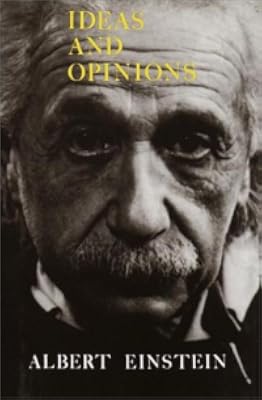
Ideas and Opinions
by Albert Einstein
On This Page
Description
A collection of Albert Einstein's popular writings, gathered under the supervision of Einstein himself. The selections range from his earliest days as a theoretical physicist to his death in 1955; from such subjects as relativity, nuclear war or peace, and religion and science, to human rights, economics, and government.Tags
Recommendations









Member Recommendations

by anonymous user
Member Reviews
It seems blasphemous to say this, but I found the ideas and opinions expressed in this book so darned reasonable that ... ultimately, I got bored.
But this is Einstein!
Einstein's science was revolutionary, controversial, exciting, world-shaking. As a citizen of the world he was -- at least as far as this Commie pinko leftie is concerned -- a champion of many of the best causes, some of which are to this day crucial to understand. The lack of surprise left this reader enervated.
Your mileage may vary, of course.
But this is Einstein!
Einstein's science was revolutionary, controversial, exciting, world-shaking. As a citizen of the world he was -- at least as far as this Commie pinko leftie is concerned -- a champion of many of the best causes, some of which are to this day crucial to understand. The lack of surprise left this reader enervated.
Your mileage may vary, of course.
A collection of essays, speeches, letters, and other random bits of Albert Einstein's writing, first published in 1954, but compiled from previously published material.
The book is divided into five sections: "Ideas and Opinions" (a catch-all category with several subheadings), "On Politics, Government, and Pacifism," "On the Jewish People," "On Germany," and "Contributions to Science."
Not surprisingly, the science section is the longest, and contains the most substantial material, covering not just relativity and its implications for our conception of space and time, but also other historical scientific breakthroughs and some quite extensive musings on the relationship, both philosophical and practical, between mathematics, show more theoretical physics, and reality. Many of these pieces cover more or less the same ground, so they can get a bit repetitive, but I generally found them interesting. They could often be hard going, though; I must confess that my rusty, twenty-year-old physics degree and I got lost more than once.
Most of the rest of the book is dominated by Einstein's political ideas, particularly his devotion to the causes of pacifism, disarmament, international government, and the establishment of a homeland for the Jewish people. These parts are more of a hodgepodge than the science section, with quite a few pieces consisting only of a paragraph or three without much in the way of useful context. And, like the science essays, they tend to be somewhat repetitious. Some pieces, certainly, are well worth reading in their own right. (I was particularly interested in Einstein's discussion of his thoughts on religion, which are complicated, subtle, and idiosyncratic -- much more so than you'd think from the out-of-context quotes that theists and atheists alike enjoy trotting out in attempts to claim him as one of their own.) But I think that, overall, this volume is likely to appeal mostly to people who already have a specific personal interest in Einstein, or in the history of the causes he espoused. It did, however, make an interesting "further reading" companion to Walter Isaacson's excellent bio, Einstein: His Life and Universe, which I read a few months ago. And it did impress me strongly with just how much of an idealist Einstein truly was. Whether that idealism might be more fairly called visionary or naive, I can't really say -- probably a bit of both -- but I do have a lot of respect for it. show less
The book is divided into five sections: "Ideas and Opinions" (a catch-all category with several subheadings), "On Politics, Government, and Pacifism," "On the Jewish People," "On Germany," and "Contributions to Science."
Not surprisingly, the science section is the longest, and contains the most substantial material, covering not just relativity and its implications for our conception of space and time, but also other historical scientific breakthroughs and some quite extensive musings on the relationship, both philosophical and practical, between mathematics, show more theoretical physics, and reality. Many of these pieces cover more or less the same ground, so they can get a bit repetitive, but I generally found them interesting. They could often be hard going, though; I must confess that my rusty, twenty-year-old physics degree and I got lost more than once.
Most of the rest of the book is dominated by Einstein's political ideas, particularly his devotion to the causes of pacifism, disarmament, international government, and the establishment of a homeland for the Jewish people. These parts are more of a hodgepodge than the science section, with quite a few pieces consisting only of a paragraph or three without much in the way of useful context. And, like the science essays, they tend to be somewhat repetitious. Some pieces, certainly, are well worth reading in their own right. (I was particularly interested in Einstein's discussion of his thoughts on religion, which are complicated, subtle, and idiosyncratic -- much more so than you'd think from the out-of-context quotes that theists and atheists alike enjoy trotting out in attempts to claim him as one of their own.) But I think that, overall, this volume is likely to appeal mostly to people who already have a specific personal interest in Einstein, or in the history of the causes he espoused. It did, however, make an interesting "further reading" companion to Walter Isaacson's excellent bio, Einstein: His Life and Universe, which I read a few months ago. And it did impress me strongly with just how much of an idealist Einstein truly was. Whether that idealism might be more fairly called visionary or naive, I can't really say -- probably a bit of both -- but I do have a lot of respect for it. show less
Many of Einstein's early writings contained within these pages, including pre-war social and political commentary, show him to be an insightful humanitarian and a diverse thinker. Here are his thoughts on Bertrand Russell, Zionism, Curie, Capitalism, the atomic bomb, pacifism, politics, education, religion,and much more. There are also explanations of relativity, and other theories of physics. The articles and excerpts span four decades.
IDEAS AND OPINIONS contains essays by eminent scientist Albert Einstein on subjects ranging from atomic energy, relativity, and religion to human rights, government, and economics. Previously published articles, speeches, and letters are gathered here to create a fascinating collection of meditations by one of the world's greatest minds.
I just dipped into this one - could not get into it as this one of those books with bits and pieces of thought, some more interesting than others.
In this book will finde the philosophical thinking of Alber Einstein, his moral and some of his greatest ideas.
Einstein was a witty and insightful man
Members
- Recently Added By
Lists

Donald J. Trump Favorites
31 works; 1 member

Modern Library 100 Best Nonfiction Books
100 works; 8 members
Author Information

366+ Works 16,427 Members
Albert Einstein was born on March 14, 1879 in Ulm. He spent his childhood in Munich where his family owned a small machine shop. By the age of twelve, Einstein had taught himself Euclidean Geometry. His family moved to Milan, where he stayed for a year, and he used it as an excuse to drop out of school, which bored him. He finished secondary show more school in Aarau, Switzerland and entered the Swiss Federal Institute of Technology in Zurich. Einstein graduated in 1900, by studying the notes of a classmate since he did not attend his classes out of boredom, again. His teachers did not like him and would not recomend him for a position in the University. For two years, Einstein worked as a substitute teacher and a tutor before getting a job, in 1902, as an examiner for a Swiss patent office in Bern. In 1905, he received his doctorate from the University of Zurich for a theoretical dissertation on the dimension of molecules. Einstein also published three theoretical papers of central importance to the development of 20th Century physics. The first was entitled "Brownian Motion," and the second "Photoelectric Effort," which was a revolutionary way of thinking and contradicted tradition. No one accepted the proposals of the first two papers. Then the third one was published in 1905 and called "On the Electrodynamics of Moving Bodies." Einstein's words became what is known today as the special theory of relativity and said that the physical laws are the same in all inertial reference systems and that the speed of light in a vacuum is a universal constant. Virtually no one understood or supported Einstein's argument. Einstein left the patent office in 1907 and received his first academic appointment at the University of Zurich in 1909. In 1911, he moved to a German speaking university in Prague, but returned to Swiss National Polytechnic in Zurich in 1912. By 1914, Einstein was appointed director of the Kaiser Wilhelm Institute of Physics in Berlin. His chief patron in those early days was German physicist Max Planck and lent much credibility to Einstein's work. Einstein began working on generalizing and extending his theory of relativity, but the full general theory was not published until 1916. In 1919, he predicted that starlight would bend in the vicinity of a massive body, such as the sun. This theory was confirmed during a solar eclipse and cause Einstein to become world renowned after the phenomenon. Einstein received be Nobel Prize in Physics in 1921. With his new fame, Einstein attempted to further his own political and social views. He supported pacifism and Zionism and opposed Germany's involvement in World War I. His support of Zionism earned him attacks from both Anti-Semitic and right wing groups in Germany. Einstein left Germany for the United States when Hitler came into power, taking a position at the Institute for Advanced Study in Princeton, New Jersey. Once there, he renounced his stand on pacifism in the face of Nazi rising power. In 1939 he collaborated with other physicists in writing a letter to President Franklin D. Roosevelt informing him of the possibility that the Nazis may in fact be attempting to create an atomic bomb. The letter bore only Einstein's signature but lent credence to the letter and spurred the U.S. race to create the bomb first. Einstein became an American citizen in 1940. After the war, Einstein was active in international disarmament as well as world government. He was offered the position of President of Israel but turned the honor down. Albert Einstein died on April 18, 1955 in Princeton, New Jersey. (Bowker Author Biography) show less
All Editions
Some Editions
Awards and Honors
Notable Lists
Series
Belongs to Publisher Series
Conjeturas (9)
Work Relationships
Common Knowledge
- Original title
- Ideas and Opinions
- Original publication date
- 1934
- Original language
- German
Classifications
- Genres
- Science & Nature, Nonfiction, Philosophy, General Nonfiction, Biography & Memoir
- DDC/MDS
- 081 — Computer science, information & general works Anthologies and Quotations General collections in American English
- LCC
- AC35 .E526 — General Works Collections. Series. Collected works Collections. Series. Collected works Collections of monographs, essays, etc. Other languages
- BISAC
Statistics
- Members
- 2,183
- Popularity
- 9,313
- Reviews
- 10
- Rating
- (3.87)
- Languages
- 5 — Danish, English, German, Italian, Spanish
- Media
- Paper, Audiobook, Ebook
- ISBNs
- 23
- ASINs
- 30