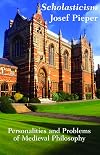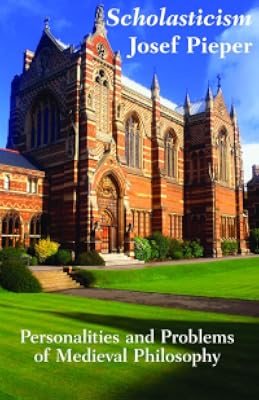
Scholasticism: Personalities and Problems of Medieval Philosophy
by Josef Pieper
On This Page
Description
No better guide over the thousand-year period called the Middle Ages could be found than Josef Pieper. In this amazing tour de monde medievale, he moves easily back and forth between the figures and the doctrines that made medieval philosophy unique in Western thought. After reflecting on the invidious implications of the phrase "Middle Ages," Pieper turns to the fascinating personality of Boethius whose contribution to prison literature, The Consolation of Philosophy, is second only to the show more Bible in the number of manuscript copies. The Neo-Platonic figures - Dionysius and Eriugena - are the occasion for a discussion of negative theology. The treatment of Anselm of Canterbury's proof of God's existence involves later voices, e.g., Kant. Like other historians, Pieper is enamored of the twelfth century, which is regularly eclipsed by accounts of the thirteenth century. Pieper does justice to both. His account of the rivalry between Peter Abelard and Bernard of Clairvaux is masterful, nor does he fail to give John of Salisbury the space he deserves. The account is broken by the gradual replacement of the synthesis of faith and reason that had been achieved in the early Middle Ages by a new one that made use of Aristotle. Pieper gives a thorough and lively account of the struggle between Aristotelians and anti-Aristotelians, and the famous condemnations that put the effort of Saint Thomas Aquinas at risk. But the Summa theologiae is regarded by Pieper as the unique achievement of the period. If the early centuries, the medieval period, can be seen as moving toward the thirteenth and Thomas's unique achievement, subsequent centuries saw the decline of scholasticism and theappearance of harbingers of modern philosophy. The book closes with Pieper's thoughts on the permanent philosophical and theological significance of scholasticism and the Middle Ages. Once again, wearing his learning lightly, writing with a clarity that delights, Josef Pieper has taken the field from stuffier and more extended accounts. show lessTags
Recommendations















Member Reviews
More an existential plea on behalf of its subject (and the general value of school in dark times) than a history per se. I know nil about the author or the subject, but he gets five stars after 50 pages for his conviction alone. Soon I, too, was weeping over the death of Boethius, cheering for "the great schoolmasters Alcuin and Hrabanus Maurus," and genuinely perplexed by "one of the weirdest events in the history of culture," namely, the gullible reception of Pseudo-Dionysius. This is not a comprehensive history and does not pretend to be. It entirely omits, for example, Aquinas. Who cares? It is the nature of school that the persons matter less than the enterprise, and this book lucidly conveys why that enterprise as a whole show more (translation, analysis, argumentation) matters, even if it is in a certain sense doomed. show less
This an elegantly written book that in short space gives insightful introductions to several major players in Medieval, Christian philosophy. The central thesis is that these philosophers set out to join in a synoptic vision the "truth" of Christian revelation and the "truth" of reason. Pieper sees this project as necessary whenever an individual accepts the "revelation". Personally, I think this project was doomed then and doomed now. And Pieper would not totally disagree that there is and was and inevitable tension. I see hints in his exposition of a polemic against some form of pragmatism/neo-pragmatism and he see dark threats of totalitarianism in abandoning the project.
Ratings
Members
- Recently Added By
Author Information

108+ Works 6,891 Members
Series
Belongs to Publisher Series
Common Knowledge
- Original title
- „Scholastik“. Gestalten und Probleme der mittelalterlichen Philosophie
- Original publication date
- 1960
- People/Characters
- Boethius (Anicius Manlius Torquatus Severinus, ca. 480-ca. 524); Pseudo-Dionysius the Areopagite (late 5th early 6th century); Thomas Aquinas (Saint, 1225-1274); Anselm of Canterbury (1033-1109); Peter Abelard (1079-1142); Bernard of Clairvaux (show all 8); Albertus Magnus ("Albert of Cologne" 1193-1280); William of Ockham
- Original language
- German
Classifications
- Genres
- Philosophy, Nonfiction, Religion & Spirituality, History, General Nonfiction
- DDC/MDS
- 189.4 — Philosophy & psychology Ancient, medieval & eastern philosophy Medieval western philosophy Scholastic: Scotus, Aquinas, Anselm, Abelard
- LCC
- B734 .P513 — Philosophy, Psychology and Religion Philosophy (General) By period Medieval
- BISAC
Statistics
- Members
- 243
- Popularity
- 134,122
- Reviews
- 3
- Rating
- (4.14)
- Languages
- 5 — Czech, Dutch, English, German, Spanish
- Media
- Paper
- ISBNs
- 7
- ASINs
- 6