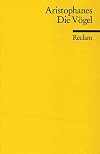
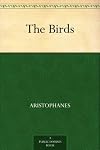
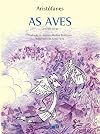
The Birds [in translation]
by Aristophanes
On This Page
Description
The Birds is a comic play by the Greek playwright Aristophanes. It garnered awards in 141 BC when it was first performed, and continues to be critically received today. A middle-aged Athenian convinces the world's birds to build a new city between the heavens and the earth. This position fortuitously allows them to intercept all communication of gods and men. The Athenian is transformed into a bird-like figure and with the help of his winged friends - and others - he replaces Zeus as the show more master of heaven and earth. show lessTags
Recommendations













Member Reviews
This is a great play in any translation, but Arrowsmith's decision to use various dialects (such as Brooklynese) for some of the characters (to reproduce the effect the use of various Greek dialects would have had on the original audience) is brilliant. This is inspired nonsense that holds up even after 2000 years. If you think Greek plays aren't for you, try this one.
Nephelococcygia, a metropolis in air,
Zeus' cloudy nightmare,
Unlikely a bedroom scare
From a sparrow’s wild rare.
A respite between heaven and earth,
“An avian heaven”, says Pisthetaerus,
Flirting with the nightingale’s mirth
Hoopoe consents ; what a fucking putz!
Sacred chants float over the lustral waters,
The birds join the jubilant choir,
The peacock dancing in a tutu simply backfires,
It’s not an ass-whooping Le Ballet Noir!
The pelican, the spoon-bill, the horned-owl, the teal, the stormy petrel and the titmouse,
Solemnized the laws of the land,
Harboring the Olympians grouse,
I rather be chained and canned.
Messiah to Bitch Dependency,
“Birds over bitches!” proclaims a pimp called Slickback,
Pleading for wings is a bitch show more tendency,
Cloud-cuckoo town- a two-cent hustler.
Rainbows descent on womanly divinity,
“That’s a bitch!” , yelps Slickback,
Iris, messenger of Gods, heart of Zeus’ affinity,
“That bitch’s gonna fuck y’all".
Perching on twigs, the birds laud the forgotten heroes,
A choral interlude, a cry for pigeons,
Howl the pigeons preening their Afros,
“You came to the wrong neighborhood, motherfucking wigeons!”
A cry of an amateur,
Verses may not rationally click
Least an award clincher,
I care a fuck ; I just blasted a stick! show less
Masterful translation of a witty play. I'm not sure of the meaning of the play, but I can see where elements of low humor today were birthed in ancient times. I appreciated the translator's notes and glossary. They explained many obscure [to us] references--cultural and topical in Aristophanes' day. I read this to compare it with Braunfels' treatment of the story in his opera "Die Vogel" based on the same play.
This was an entertaining, and widely imaginative, play by Aristophanes. The comedy was at times witty and at times slapstick. Overall, I enjoyed it and feel that those interested in comedies, and ancient Greek drama, will enjoy reading this.
3 stars.
3 stars.
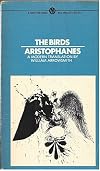
The important thing to note about this review is that I'm reading the version of the Birds that's subtitled "A Modern Translation by William Arrowsmith." If you read a translation by someone else it's likely you'll have a different experience - but then, a lot of your enjoyment of Aristophanes will depend on the translator's own sense of humor.
This is a text where it's critical to read the notes - not just for explanations but to get an idea of what Aristophanes is trying to make a joke about, but also to enjoy Arrowsmith. The man writes some delightful notes.
You can read the plot on wikipedia, but the short version is that two Athenians go to the birds and convince them to set up a kingdom so that the Athenians don't have to go back to show more Athens, where there are too many taxes and fees, and other annoyances. Here one of the characters tells the beginning of why they left, p. 19. I've added the notes from the back of the book (for this quote, p 135-136) - this is a good example of the translator giving you background and also letting you know when he's substituted words:
Another point I'll toss in here (for lack of a good transition elsewhere) is that the word/concept Cloudcuckooland (that has been tossed about in pop culture in various places) comes from this play. It's the name of the new kingdom/city that one of our Athenians (Pisthetairos) convinces the birds to build in the clouds.
Many times Arrowsmith will explain what specific Greek he translated, how he modernized it into a joke we'd understand, and what the original was.
[I was going to add an example quote here, but ran out of time on my trip and had to leave the book with my father - because he enjoys reading Aristophanes every now and then - and now don't have it to quote. So you'll just have to believe me when I say that Arrowsmith does this more than once.]
I suggest that you be sure to read the Introduction after you've read the play - not because it spoils anything but because it explains a lot, and specifically gives reasons for how Arrowsmith has chosen to translate the play.
p 13, Introduction:
p 71-72, for those who haven't read Aristophanes, an example of his rude/obscene/however-you-categorize-it moments (not at first, I left in the comedy build up to it):
This is a text where it's critical to read the notes - not just for explanations but to get an idea of what Aristophanes is trying to make a joke about, but also to enjoy Arrowsmith. The man writes some delightful notes.
You can read the plot on wikipedia, but the short version is that two Athenians go to the birds and convince them to set up a kingdom so that the Athenians don't have to go back to show more Athens, where there are too many taxes and fees, and other annoyances. Here one of the characters tells the beginning of why they left, p. 19. I've added the notes from the back of the book (for this quote, p 135-136) - this is a good example of the translator giving you background and also letting you know when he's substituted words:
Euelpides:Euelpides goes on to give specifics about what made them leave Athens: "legal locusts" - by which he means lawyers. Here's the section in the Notes on that reference, p. 136:
...Think of it man:
here we are dying to go tell it to the Birds,*
and then, by god, we can't even find the way.
To the Audience.
Yes, dear people, we confess we're completely mad.
But it's not just like Sakas'* madness. Not a bit.
For he, poor dumb foreigner, wants in, while we,
born and bread Athenians both, true blue,
true citizens, not afraid of any man,
want out.
Yes, we've spread our little feet
and taken off. Not that we hate Athens -
heavens, no. And not that dear old Athens
isn't grand, that blessed land where men are free -
to pay their taxes.*
Relevant text from the Notes section:
Sakas: [via note on text p. 18] "From the frequent allusions in the play to men who, technically ineligible, had somehow managed to get themselves enrolled as Athenian citizens, it's tempting to believe that proposals to revise the citizenship lists were in the air or had recently been carried out. The climax of these allusions comes in the final scene of the play, in which Posthetairos attempts to prove that Herakles is technically a bastard (and hence can not inherit Zeus' estate) since his mother was an ordinary mortal, i.e., of foreign stock.
"to pay their taxes": A slight modernization of the Greek which says: "to pay fines."
"because of legal locusts": Aristophanes favorite complaint against Athens, and one which the entire Wasps is devoted. But although Aristophanes here develops Athens' love of litigation as the major source of dissatisfaction, elsewhere throughout the play other grievances emerge: the restless and mischievous Athenian character (called [Greek word I can't type!]); the plague of informers; the victimization of the Allies; the ambition for power, an ambition which knows no limits and whose only goal is World Mastery ([another word in Greek]).
Another point I'll toss in here (for lack of a good transition elsewhere) is that the word/concept Cloudcuckooland (that has been tossed about in pop culture in various places) comes from this play. It's the name of the new kingdom/city that one of our Athenians (Pisthetairos) convinces the birds to build in the clouds.
Many times Arrowsmith will explain what specific Greek he translated, how he modernized it into a joke we'd understand, and what the original was.
[I was going to add an example quote here, but ran out of time on my trip and had to leave the book with my father - because he enjoys reading Aristophanes every now and then - and now don't have it to quote. So you'll just have to believe me when I say that Arrowsmith does this more than once.]
I suggest that you be sure to read the Introduction after you've read the play - not because it spoils anything but because it explains a lot, and specifically gives reasons for how Arrowsmith has chosen to translate the play.
p 13, Introduction:
...For fidelity's sake, this is also a poetic version. A prose Aristophanes is to my mind as much a monstrosity as a limerick in prose paraphrase. And for much the same reasons. If Aristophanes is visibly obscene, farcical, and colloquial, he is also lyrical, elegant, fantastic, and witty. And a translation which, by flattening incongruities and tensions, reduces one dimension necessarily reduces the other. Bowdlerize Aristophanes and you sublimate him into something less vital and whole; prose him and you cripple his wit, dilute his obscenity and slapstick, and weaken his classical sense of the wholeness of human life.
p 71-72, for those who haven't read Aristophanes, an example of his rude/obscene/however-you-categorize-it moments (not at first, I left in the comedy build up to it):
Chorus:This is actually pretty mild stuff (for our day and age, not the Victorians), there's plenty of more racy, phalus-oriented material elsewhere. However this speech is being spoken by a chorus of birds (actors dressed humorously as birds, that is), and a good example of the weirdness/humor in this play. show less
Friends, you haven't really lived till you've tried a set of FEATHERS!
Think, spectators.
Imagine yourself with a pair of wings!
The sheer joy of it! Not having to sit those tragedies out!
No getting bored. You merely flap your little wings and fly off home.
You have a snack, then make it back to catch the COMIC play.
Or again, suppose your're overtaken by a sudden need to crap.
Do you do it in your pants?
Not a bit.
You just zoom off,
fart and shit to your heart's content and whizz right back.
Or perhaps you're having an affair - I won't name any names.
You spot the lady's husband attending some meeting or other.
Up you soar, flap your wings, through the window and into bed!
You make it a quickie, of course, then flutter back to your seat.
So what do you say?
Aren't wings the most wonderful things?
Two men who go to the birds to set up a utopian city in the clouds so they can "oust" the gods from Olympus. Supposedly the birds were created before the Titans and were more worthy of being worshipped than the Olympians.
I guess this is supposed to be a parody of utopianism. It is funny in places, though some of it was bawdy. I'm glad I read this play because it's a "classic", but I probably wouldn't recommend it to others. I do think it's cool that a play can survive over 2000 years after it was written, though.
I guess this is supposed to be a parody of utopianism. It is funny in places, though some of it was bawdy. I'm glad I read this play because it's a "classic", but I probably wouldn't recommend it to others. I do think it's cool that a play can survive over 2000 years after it was written, though.
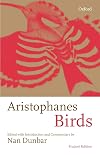
This is a brilliant commentary. It was more or less the work of a lifetime. Nan Dunbar became a bird watcher in order to understand the bird lore properly. The commentary is very detailed and explains pretty well everything.
Members
- Recently Added By
Lists

The League of Extraordinary Gentlemen
87 works; 4 members

Greatest Books, allegedly
484 works; 9 members

Next Plays to Watch
50 works; 1 member

Next Plays / 2025
352 works; 1 member

My Play Collection
769 works; 3 members

Recommended Reading : 600 Classics Reviewed, Editors of Salem Press, 2015
634 works; 6 members

The Well-Educated Mind, Susan Wise Bauer, 2016
179 works; 3 members

New Lifetime Reading Plan by Fadiman and Major
225 works; 5 members

Books Read in 2010
631 works; 11 members

Well-Educated Mind
150 works; 3 members

Truly old classics
63 works; 6 members
1:28 p.m.'s 350 Stage Plays Challenge
94 works; 3 members

Books Read in 2021
5,361 works; 113 members
The Well-Educated Mind Reading Challenge
75 works; 7 members
100 Books to Read in a Lifetime (That Are Older Than 200 Years)
415 works; 174 members

Favourite Greek Books
97 works; 1 member

Favourite Books
1,820 works; 311 members

Harold Bloom - The Western Canon: A. The Theocratic Age
97 works; 13 members

Works Cited in The Life and Death of Democracy by John Keane
278 works; 1 member
Author Information

540 Works 20,849 Members
Aristophanes, 448 b.c. - 385 b.c. Aristophanes is considered to be one of the greatest comedic writers ever to have taken to the stage. He was born in Athens, Greece, in the town of Cydathenaeum. Aristophanes is believed to have been well educated, which would explain his propensity towards words. It is also believed that he owned land on the show more island of Aegina. Aristophanes was first a satirist, he was well known for attacking anything from politics to poets, mainly the war between Sparta and Athens and the poet Euripides. He wrote more than 40, eleven of which are still being acted today. "The Acharnians" was his first play, written in 425, B.C.. This was the first of his plays in reaction to the war, as well as the play "Peace." But perhaps Aristophanes most famous play, Lysistrata, made his true feelings of the war known. In this play, the women seek peace by claiming celibacy until the fighting is stopped. It is the play that he is most famous for, for capturing the feeling of the people in a way that was both lighthearted and poignant. Aristophanes died three years after the war ended, in 385, B.C.,but left behind a legacy that has lasted to the present day. (Bowker Author Biography) show less
All Editions
Some Editions
Awards and Honors
Series
Belongs to Publisher Series
Work Relationships
Is contained in
6 Plays: Birds / Lysistrata / Women at the Thesmophoria / Frogs / Assembly-Women / Wealth by Aristophanes
8 Plays: Assembly-Women / Birds / Clouds / Frogs / Lysistrata / Peace / Wasps / Women at the Thesmophoria by Aristophanes
Is retold in
Has the adaptation
Has as a student's study guide
Common Knowledge
- Canonical title
- The Birds [in translation]
- Original title
- Ὄρνιθες (Órnithes) (Órnithes)
- Alternate titles
- Aves
- Original publication date
- 414 BCE (premiere performance) (premiere performance); ca. 425 BCE (Greek ed.) (Greek ed.); 1953 (Nederlandse ed.) (Nederlandse ed.)
- Important places
- the Academy; Attica, Greece
- Related movies
- Common Birds (2019 | IMDb)
- Original language*
- Klassiek Grieks
- Disambiguation notice
- ISBN 0871294966 is NOT by Emily Thomas; it is a full-length play by Aristophanes
*Some information comes from Common Knowledge in other languages. Click "Edit" for more information.
Classifications
- Genre
- Fiction and Literature
- DDC/MDS
- 882.01 — Literature & rhetoric Classical & modern Greek literatures Classical Greek dramatic poetry and drama standard subdivisions; collections; history, description, critical appraisal; Specific periods Ancient period to ca. 499
- LCC
- PA3877 .A8 — Language and Literature Greek language and literature. Latin language and literature Greek literature Individual authors
- BISAC
Statistics
- Members
- 666
- Popularity
- 43,432
- Reviews
- 13
- Rating
- (3.21)
- Languages
- 11 — Danish, Dutch, English, French, German, Greek (Ancient), Greek, Italian, Portuguese, Russian, Spanish
- Media
- Paper, Audiobook, Ebook
- ISBNs
- 70
- UPCs
- 1
- ASINs
- 37