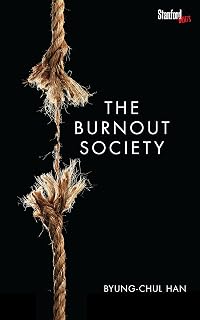
The Burnout Society
by Byung-Chul Han
On This Page
Description
Our competitive, service-oriented societies are taking a toll on the late-modern individual. Rather than improving life, multitasking, "user-friendly" technology, and the culture of convenience are producing disorders that range from depression to attention deficit disorder to borderline personality disorder. Byung-Chul Han interprets the spreading malaise as an inability to manage negative experiences in an age characterized by excessive positivity and the universal availability of people show more and goods. Stress and exhaustion are not just personal experiences, but social and historical phenomena as well. Denouncing a world in which every against-the-grain response can lead to further disempowerment, he draws on literature, philosophy, and the social and natural sciences to explore the stakes of sacrificing intermittent intellectual reflection for constant neural connection. show lessTags
Recommendations



































Member Recommendations

Member Reviews
Han's argument is that we have transitioned from a disciplinary society in which we are pressured to conform by external forces, into an achievement society in which we are pressured to conform by the introjected requirement to "live your best life", and so exploit ourselves in the impossible task of seeking ever-receding, pointless and illusory life goals, set by Capital. Consumerism requires that we are never satisfied, and so we can only fail to achieve, expending our energy in a fruitless aspirational quest for a sense of worth and self-fulfillment deliberately withheld from us, resulting in burnout, and the descent into depression. That "being happy" has become a requirement makes unhappiness a personal failing, rather than an show more appropriate response to adverse circumstance, further eroding self-worth. My takeaway message: Give yourself a break, you are good enough as you are. show less
"too alive to die, and too dead to live," (p55) Han summing up his theory of what ails modern society. A series of short essays, this slim column packs a bit of a wallop (at least for me). I found Beyond Neuronal Power, Disciplinary Society, and Burnout Society to be the most compelling essays of the bunch. The "excess of positivity" is an idea that resonates with my own feeling of confused despair at the state of our over-indulged, over-stimulated, and hyperactive culture. Han's theorizing of our move from a disciplinary-society to an acheivment-society is fascinating and apt. "The complaint of the depressive individual, "Nothing is possible," can only occur in a society that thinks, "Nothing is impossible." (p11) "Disciplinary society show more is still governed by *no.* Its negativity produces madmen and criminals. In contrast, achievement society creates depressives and losers. (p9) show less
Han's diagnosis of why rates of depression, anxiety, and hyperactivity are increasing is convincing, even if its mostly based on vibes rather than concrete data. Han takes it as a given that we know what he's talking about when he terms ours a "burnout" society. He explains that the cohort of modern neuroses mentioned above aren't simply a result of "excess freedom" as some thinkers have theorized; rather it is a development of modern capital to turn the boss from someone that yells at you at your job into someone who yells at you inside your own head. Han compellingly makes the argument that this is a natural development of capitalist forces which are constantly seeking greater efficiency; the most effective boss is one you carry show more around with you. This pressure from what Han terms your "ego ideal" to constantly strive for a better version of yourself dooms you to be disappointed when your impossible standards collide with reality.
Han's book is light on what to do about this dire situation. He does advocate for greater laziness and boredom as a kind of rebellion against the compulsion to constantly be improving and building. In moments of quiet repose that often come with laying around and not doing much, Han finds the the opportunity for people to contemplate the kinds of things that make life more meaningful. show less
Han's book is light on what to do about this dire situation. He does advocate for greater laziness and boredom as a kind of rebellion against the compulsion to constantly be improving and building. In moments of quiet repose that often come with laying around and not doing much, Han finds the the opportunity for people to contemplate the kinds of things that make life more meaningful. show less
If you have ever thought of yourself as “burned out,” you owe it to yourself to read this short, brilliant argument about connection between burnout and the hyperactive compulsion for self-improvement and achievement that we have become acculturated to.
"The achievement-subject competes with itself; it succumbs to the destructive compulsion to outdo itself over and over, to jump over its own shadow" (p.46)
More broadly, the author traces a line between burnout, depression, ADHD, and other mental health issues to a fundamental shift in our world orientation toward a toxicity positivity, in which we are not encouraged to say “no” but instead to say “yes” to all the things we can do. The number of “cans” around us present us show more with endless opportunities to improve ourselves, we can acquire new hobbies, meet new people, travel, gain new certifications, etc. And these come at us in a world build up around “shoulds” like performance reports, health, and images of The Good Life. All of the “shoulds” say that we should be accomplishing things. However, it is not that we should achieve so much as we should be achieving, which sends us back to all the “cans” – the opportunities (a buzzword of this cultural mindset, I think) to be endlessly achieving.
The solution is to cultivate saying “no” and to allow room for being bored and contemplative. Be slow and not instantaneous. I agree, but my concern with this argument is that the author does not give enough weight to the influence of culture, many spheres of which are pathologically obsessed with efficiency so that it becomes a mark of bad character to waste anything but especially time, energy, youth, etc. If you are not taking advantage (another buzzword) of the opportunities before you, it’s a defect in your orientation to life. In other words, I do not care for the author’s characterization of this dedication to hyper-achievement as a “belief” – that makes it sound like individuals can just choose not to believe. If that were the case, why would burnout and other mental health problems be such a pernicious problem?
Regardless, I quite like the basic point of this argument and plan to read more by the author. show less
"The achievement-subject competes with itself; it succumbs to the destructive compulsion to outdo itself over and over, to jump over its own shadow" (p.46)
More broadly, the author traces a line between burnout, depression, ADHD, and other mental health issues to a fundamental shift in our world orientation toward a toxicity positivity, in which we are not encouraged to say “no” but instead to say “yes” to all the things we can do. The number of “cans” around us present us show more with endless opportunities to improve ourselves, we can acquire new hobbies, meet new people, travel, gain new certifications, etc. And these come at us in a world build up around “shoulds” like performance reports, health, and images of The Good Life. All of the “shoulds” say that we should be accomplishing things. However, it is not that we should achieve so much as we should be achieving, which sends us back to all the “cans” – the opportunities (a buzzword of this cultural mindset, I think) to be endlessly achieving.
The solution is to cultivate saying “no” and to allow room for being bored and contemplative. Be slow and not instantaneous. I agree, but my concern with this argument is that the author does not give enough weight to the influence of culture, many spheres of which are pathologically obsessed with efficiency so that it becomes a mark of bad character to waste anything but especially time, energy, youth, etc. If you are not taking advantage (another buzzword) of the opportunities before you, it’s a defect in your orientation to life. In other words, I do not care for the author’s characterization of this dedication to hyper-achievement as a “belief” – that makes it sound like individuals can just choose not to believe. If that were the case, why would burnout and other mental health problems be such a pernicious problem?
Regardless, I quite like the basic point of this argument and plan to read more by the author. show less
Difícil resenhar um livro de filosofia tão bom, curto e certeiro, mas com tantas questões filosóficas esmiuçadas e comparadas com o estado atual que vivemos.
Ele não dá nenhuma solução para nos transformarmos, apenas apresenta o que nos tornamos enquanto sociedade e nos coloca em profundo mal estar. Só por isso já merece ser lido:
"A sociedade do século XXI não é mais a sociedade disciplinar, mas uma sociedade de desempenho. Também seus habitantes não se chamam mais “sujeitos de obediência”, mas sujeitos de desempenho e produção. São empresários de si mesmos”. Enfim, não deixe de ler e pensar sobre
Ele não dá nenhuma solução para nos transformarmos, apenas apresenta o que nos tornamos enquanto sociedade e nos coloca em profundo mal estar. Só por isso já merece ser lido:
"A sociedade do século XXI não é mais a sociedade disciplinar, mas uma sociedade de desempenho. Também seus habitantes não se chamam mais “sujeitos de obediência”, mas sujeitos de desempenho e produção. São empresários de si mesmos”. Enfim, não deixe de ler e pensar sobre
An excellent book for giving insight into socio-cultural forces and the psychological shift in how society approaches work. It suffers from too much jargon but atleast I can understand it and apply it unlike Heraclitus. It showed me the effects of consumerism on the soul, and how one becomes a workaholic even if you may be chastized by philosophers. Good stuff!
In terms of presenting some fascinating ideas, I'd give the book a much higher rating. In terms of the presentation of those ideas, however, I can't. For writing style, it's terrible. It read like a series of intellectual essays written for publication in tiny print on thick paper in a magazine that the general population has never heard of.
The translator could have done a much better job. There's a difference between a noun and an adjective. There's no point using words that aren't in the dictionary unless you define them first. Sentences should flow and paragraphs be cohesive. Otherwise, your poor reader gets lost trying to identify which confusing concept is the subject of the verb.
Furthermore, I don't speak German and as such I show more felt there were too many German words scattered in the book - whole phrases which I was never going to understand and which irritated me.
Plus, no intellectual should ever start a sentence with 'As everyone knows...'. Sorry, but we plebs don't know.
That said, the themes of the book led to a fascinating conversation with one of my students. show less
The translator could have done a much better job. There's a difference between a noun and an adjective. There's no point using words that aren't in the dictionary unless you define them first. Sentences should flow and paragraphs be cohesive. Otherwise, your poor reader gets lost trying to identify which confusing concept is the subject of the verb.
Furthermore, I don't speak German and as such I show more felt there were too many German words scattered in the book - whole phrases which I was never going to understand and which irritated me.
Plus, no intellectual should ever start a sentence with 'As everyone knows...'. Sorry, but we plebs don't know.
That said, the themes of the book led to a fascinating conversation with one of my students. show less
Members
- Recently Added By
Published Reviews
Philosophie der Erschöpfung
Byung-Chul Hans „ Müdigkeitsgesellschaft“: Wirklich Neues bietet der Essay wenig, bestechend aber ist die skrupellose Zusammenschau. Wie die Ausbreitung der neuronalen Erkrankungen, das Ende des Kalten Kriegs und die Deregulierung der Erwerbsbiografien zusammengedacht und wie bei einem Kartentrick neu gemischt werden
Byung-Chul Hans „ Müdigkeitsgesellschaft“: Wirklich Neues bietet der Essay wenig, bestechend aber ist die skrupellose Zusammenschau. Wie die Ausbreitung der neuronalen Erkrankungen, das Ende des Kalten Kriegs und die Deregulierung der Erwerbsbiografien zusammengedacht und wie bei einem Kartentrick neu gemischt werden
added by GI_Riga
Die Debatte um Migranten ist völlig hysterisch. Das ahnt, wer das Buch »Müdigkeitsgesellschaft« liest. Sein Autor, der in Karlsruhe lehrende Philosoph Byung-Chul Han, erkennt in uns überforderte Individuen
added by GI_Riga
La società della stanchezza è quella società la quale, asservita all’imperativo categorico della prestazione a ogni costo, alla efficienza e alla competenza dell’individuo, soggiace a una iperestesia degli stimoli e a una iperattività maniacale, precipitando l’anima che consuma se stessa in una catatonia spirituale. È la società del doping. Che in fondo è una prestazione senza show more prestazione, nella quale l’individuo assume sostanze che aumentano progressivamente le sue attività prestazionali in modo prettamente chimico, e non a partire da uno sforzo di volontà e dalle sue proprie risorse.
L’anima diviene consunta nella continua deinteriorizzazione delle proprie funzioni complesse, come la riflessione, la contemplazione, l’immaginazione, declinate queste nelle mere prestazioni funzionali al sistema positivizzato. C’è così l’effetto di una stanchezza atomizzata, solipsistica, impotente, la quale produce un isolamento e una separazione dei soggetti, i quali, esaurite le loro energie nel tentativo sempre fallimentare di superare se stessi, ricadono sfiancati all’interno del proprio io. Un io incapace sia di guardare l’altro, sia di ascoltarlo. L’io positivizzato occupa tutto lo spazio mondano disponibile, non ha tempo né di ascoltare né di ascoltarsi. Deve produrre se stesso oltre se stesso. Ricadendo nuovamente, infine, al di qua del mondo, nelle proprie mura difensive costituite di impotenza. show less
L’anima diviene consunta nella continua deinteriorizzazione delle proprie funzioni complesse, come la riflessione, la contemplazione, l’immaginazione, declinate queste nelle mere prestazioni funzionali al sistema positivizzato. C’è così l’effetto di una stanchezza atomizzata, solipsistica, impotente, la quale produce un isolamento e una separazione dei soggetti, i quali, esaurite le loro energie nel tentativo sempre fallimentare di superare se stessi, ricadono sfiancati all’interno del proprio io. Un io incapace sia di guardare l’altro, sia di ascoltarlo. L’io positivizzato occupa tutto lo spazio mondano disponibile, non ha tempo né di ascoltare né di ascoltarsi. Deve produrre se stesso oltre se stesso. Ricadendo nuovamente, infine, al di qua del mondo, nelle proprie mura difensive costituite di impotenza. show less
added by AntonioGallo
Lists

Books Read in 2020
4,379 works; 124 members

Books Read in 2018
4,360 works; 110 members

Books in the Bibliography of Digital Lethargy by Tung-Hui Hu
151 works; 3 members
Author Information

121+ Works 5,464 Members
Byung-Chul Han is a Korean-born Professor of Philosophy and Cultural Studies who teaches at the University of the Arts (UdK) in Berlin.
Some Editions
Awards and Honors
Notable Lists
Series
Belongs to Publisher Series
Work Relationships
Inspired
Common Knowledge
- Canonical title
- The Burnout Society
- Original title
- Müdigkeitsgesellschaft
- Original publication date
- 2010
- Original language
- German
Classifications
- Genres
- Philosophy, Sociology, Nonfiction, General Nonfiction
- DDC/MDS
- 302.1 — Society, government, & culture Social sciences, sociology & anthropology Mass Communication & Media General topics of social interaction
- LCC
- BF482 .H35513 — Philosophy, Psychology and Religion Psychology Psychology Consciousness. Cognition
- BISAC
Statistics
- Members
- 1,040
- Popularity
- 24,847
- Reviews
- 24
- Rating
- (3.64)
- Languages
- 13 — Catalan, Dutch, English, French, German, Hungarian, Italian, Korean, Portuguese, Croatian, Spanish, Swedish, Turkish
- Media
- Paper, Audiobook, Ebook
- ISBNs
- 37
- ASINs
- 12