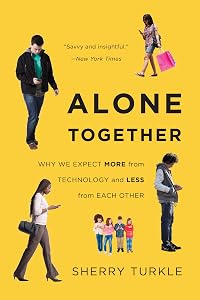
Alone Together: Why We Expect More from Technology and Less from Each Other
by Sherry Turkle
On This Page
Description
In "Alone Together," MIT technology and society professor Sherry Turkle explores the power of our new tools and toys to dramatically alter our social lives. It's a nuanced exploration of what we are looking for--and sacrificing--in a world of electronic companions and social networking tools, and an argument that, despite the hand-waving of today's self-described prophets of the future, it will be the next generation who will chart the path between isolation and connectivity.Tags
Recommendations













Member Reviews
When I was giving birth to my daughter, the OB kept trying to talk me into a Caesarean. He always stood on the side of the bed closest to the door. If I was lying with my back to the door, he spoke to my rear-end. Even when he happened to be facing me he always stood, forcing me to look up at him as he spoke.
Every time he suggested surgery, I confirmed with him that there was no medical need for it, and continued to refuse the surgery. During one of my refusals, the nurse had sat near the wall doing paperwork. After the doctor left, she pulled up a chair, sat down, and looked me in the eye.
"I avoided an unnecessary C-section," she said. "If you're going to do this, you're going to have to be strong." I started crying.
"Why are you show more crying?" she asked.
"Because you're the first person to treat me like I was really here," I said.
Several years ago, I read about a new invention that would monitor contraction duration, strength and frequency; mother's heart rate, temperature, and blood pressure; and baby's heart rate. A nurse could keep track of many patients at once from the nurses' station, reducing the need to go into patients' rooms and helping deal with the nursing shortage.
On the surface, it kind of seems like it makes sense. There are too few nurses to attend to all of the patients, so let's fill the void with technology. The assumption is that the choice is between what's essentially robotic care and no care. When seen this way, it makes sense to go with technology. This, however, diminishes the role of the nurse to that of a machine, and it reduces the birthing woman to an object to be monitored, a problem to be addressed. This solution ignores the human role in caring for other humans as well as the patient's humanity (which often gets lost in the U.S. medical system anyway).
Humans do make mistakes. It was a human doctor who was pushing for a surgery that was not medically indicated. Had I been monitored by machines, maybe the issue of a surgical birth wouldn't even have come up. But it's not the doctor that these inventions would take out of the equation. If that nurse hadn't been in my room to care for me, if she had been monitoring me remotely via machines to which I was attached, would I have ended up with unnecessary surgery? Maybe. But even if I'd ended up with a surgical birth (which I didn't, incidentally), the personal care that nurse gave me could not have been replaced by a machine. She was the only person at that hospital up to that point who made me feel like I was seen as a human being rather than just a meat sack with a baby inside. Even almost thirteen years later, I still start crying at the memory of her sitting next to me, speaking quietly but firmly while looking me in the eye, showing me that she was there for me, not just as a medical professional, but as a fellow human being.
This is the crux of the argument Turkle makes in this book. Technology provides us with some phenomenal, life-enhancing tools, but it's easy to get caught up in the novelty and lose sight of what we're replacing. We are primates. We need social interaction; we need human touch and connection to thrive. It might be expedient to relegate some of the less emotionally or physically pleasant tasks to machines, but what are we giving up in the process?
It's like when parents are cautioned against too much screen time for their children. Research suggests it's not the addition of the screen time that's damaging, but the absence of what that screen time replaces. An electronic babysitter is helpful for a parent who is overwhelmed by the emotionally and physically draining constant need to attend to a young child's needs, but we neglect to ask why we need it in the first place. Why is it that parents are so overwhelmed that they aren't able to offer their children their attention and emotional presence? This question isn't an indictment of parents by any stretch. I have been there---I'm still there---and I know that the problem doesn't originate with one parent or one family, but with our society's expectations for us at a time when in-person community is often difficult to find. Not only are the children lacking connection, but their parents are, too, and both are trying to meet that need through machines. But why do we turn to a machine rather than addressing the actual problem? As some of the children in Turkle's book ask when faced with the idea of robot pets to provide companionship to grandparents in nursing homes: "Don't we have people for these jobs?"
That's one aspect of Turkle's argument. Another is how Internet interactions might be changing our interactions "in the real." When we're online, we don't interact with a whole person, and we don't interact as our whole selves. Either by developing an avatar or by curating photos, likes, dislikes, on social media, or by pre-editing our responses on texts and instant messaging, we project the image we want to project as we interact with others who are also projecting the image they want to project. We can't know for sure who's on the other end of our communications. We can't know for sure what is accurate, what is real, and what is a show. We risk losing the patience and practice for dealing with complete human beings. Even if we crave in-person interaction---and can find others who are also willing to set aside their devices---will we have the skills to engage with people in real life when we've been socialized online? While this is likely more of an issue for net natives than for those of us who spent our childhoods and teen years without the constant connection of Internet and cell phones, I also see it in myself and other people of my generation and older as we choose to avoid the potential discomfort of interacting with people we can't turn off or ignore in a socially acceptable way if things get too intense.
While I really enjoyed the major points of Turkle's book, there are also a couple of things I see as flaws. First, except for her studies with children's reactions to My Real Baby, she appears to rely primarily on people from middle- to upper middle-class backgrounds for her research, and as far as I can tell, exclusively on people along the East Coast of the United States. I wonder if she would have seen different reactions had she taken her studies to the Midwest, South, or West.
Second, the book was somewhat repetitive. She has some really great points, but they risk getting lost because she says them so many times, I am tempted to skim because I'm bored. But maybe this is just a result of my being programmed for online reading.
In the end, Turkle isn't arguing that we turn away from technology, but rather that we use it with our eyes wide open to both the benefits and the potential risks. show less
Every time he suggested surgery, I confirmed with him that there was no medical need for it, and continued to refuse the surgery. During one of my refusals, the nurse had sat near the wall doing paperwork. After the doctor left, she pulled up a chair, sat down, and looked me in the eye.
"I avoided an unnecessary C-section," she said. "If you're going to do this, you're going to have to be strong." I started crying.
"Why are you show more crying?" she asked.
"Because you're the first person to treat me like I was really here," I said.
Several years ago, I read about a new invention that would monitor contraction duration, strength and frequency; mother's heart rate, temperature, and blood pressure; and baby's heart rate. A nurse could keep track of many patients at once from the nurses' station, reducing the need to go into patients' rooms and helping deal with the nursing shortage.
On the surface, it kind of seems like it makes sense. There are too few nurses to attend to all of the patients, so let's fill the void with technology. The assumption is that the choice is between what's essentially robotic care and no care. When seen this way, it makes sense to go with technology. This, however, diminishes the role of the nurse to that of a machine, and it reduces the birthing woman to an object to be monitored, a problem to be addressed. This solution ignores the human role in caring for other humans as well as the patient's humanity (which often gets lost in the U.S. medical system anyway).
Humans do make mistakes. It was a human doctor who was pushing for a surgery that was not medically indicated. Had I been monitored by machines, maybe the issue of a surgical birth wouldn't even have come up. But it's not the doctor that these inventions would take out of the equation. If that nurse hadn't been in my room to care for me, if she had been monitoring me remotely via machines to which I was attached, would I have ended up with unnecessary surgery? Maybe. But even if I'd ended up with a surgical birth (which I didn't, incidentally), the personal care that nurse gave me could not have been replaced by a machine. She was the only person at that hospital up to that point who made me feel like I was seen as a human being rather than just a meat sack with a baby inside. Even almost thirteen years later, I still start crying at the memory of her sitting next to me, speaking quietly but firmly while looking me in the eye, showing me that she was there for me, not just as a medical professional, but as a fellow human being.
This is the crux of the argument Turkle makes in this book. Technology provides us with some phenomenal, life-enhancing tools, but it's easy to get caught up in the novelty and lose sight of what we're replacing. We are primates. We need social interaction; we need human touch and connection to thrive. It might be expedient to relegate some of the less emotionally or physically pleasant tasks to machines, but what are we giving up in the process?
It's like when parents are cautioned against too much screen time for their children. Research suggests it's not the addition of the screen time that's damaging, but the absence of what that screen time replaces. An electronic babysitter is helpful for a parent who is overwhelmed by the emotionally and physically draining constant need to attend to a young child's needs, but we neglect to ask why we need it in the first place. Why is it that parents are so overwhelmed that they aren't able to offer their children their attention and emotional presence? This question isn't an indictment of parents by any stretch. I have been there---I'm still there---and I know that the problem doesn't originate with one parent or one family, but with our society's expectations for us at a time when in-person community is often difficult to find. Not only are the children lacking connection, but their parents are, too, and both are trying to meet that need through machines. But why do we turn to a machine rather than addressing the actual problem? As some of the children in Turkle's book ask when faced with the idea of robot pets to provide companionship to grandparents in nursing homes: "Don't we have people for these jobs?"
That's one aspect of Turkle's argument. Another is how Internet interactions might be changing our interactions "in the real." When we're online, we don't interact with a whole person, and we don't interact as our whole selves. Either by developing an avatar or by curating photos, likes, dislikes, on social media, or by pre-editing our responses on texts and instant messaging, we project the image we want to project as we interact with others who are also projecting the image they want to project. We can't know for sure who's on the other end of our communications. We can't know for sure what is accurate, what is real, and what is a show. We risk losing the patience and practice for dealing with complete human beings. Even if we crave in-person interaction---and can find others who are also willing to set aside their devices---will we have the skills to engage with people in real life when we've been socialized online? While this is likely more of an issue for net natives than for those of us who spent our childhoods and teen years without the constant connection of Internet and cell phones, I also see it in myself and other people of my generation and older as we choose to avoid the potential discomfort of interacting with people we can't turn off or ignore in a socially acceptable way if things get too intense.
While I really enjoyed the major points of Turkle's book, there are also a couple of things I see as flaws. First, except for her studies with children's reactions to My Real Baby, she appears to rely primarily on people from middle- to upper middle-class backgrounds for her research, and as far as I can tell, exclusively on people along the East Coast of the United States. I wonder if she would have seen different reactions had she taken her studies to the Midwest, South, or West.
Second, the book was somewhat repetitive. She has some really great points, but they risk getting lost because she says them so many times, I am tempted to skim because I'm bored. But maybe this is just a result of my being programmed for online reading.
In the end, Turkle isn't arguing that we turn away from technology, but rather that we use it with our eyes wide open to both the benefits and the potential risks. show less
I found 'Alone Together' hugely thought-provoking. The methods used are anthropological and grounded in the ideas of psychoanalysis, which made for an interesting change. The specific points within each theme are introduced and explained through case studies. Such an approach differs from the kind of social science I am used to, which I found powerful as Turkle’s methods displayed no cross-contamination from economics. Most quantitative and some qualitative work regurgitates the assumptions of economics in a manner I find hugely frustrating. On the other hand, it is difficult to generalise from a small sample, or indeed generalise very far at all when you’re dealing with matters of psychology. Nonetheless, it is important to study show more how rapid changes in technology impact upon people. Turkle’s book is fascinating as a starting point. As I read it I could not help but evaluate the roles of the internet and mobile phones in my life and contemplate how I could establish different boundaries with them.
The book begins with children and their interaction with robotic toys. I am of the generation that first experienced such things; I had an off-brand tamagotchi as a tweenager but never wanted a furby. Those weird chattery things have always freaked me out. Turkle expounds on how very young children interact with these toys, at an age when they are still finding out how to categorise objects. To me it seems odd to contemplate that children try to understand whether a furby is alive like an animal, whether it has feelings, whether it can die. That was strange, but the section about elderly people interacting with robotic baby dolls and Paro the robot seal was heart-breaking. In particular, the insight that the elderly people studied got much more from interactions with the researchers than the robots. The robots were better company than no-one, but not a substitute for real people. Turkle also confronts the social assumption that robots are needed to look after the elderly because young people cannot, for some reason.
The latter part of the book covers changes of communication patterns amongst (presumably American) teenagers and working age people. I found this eye-opening; how can anyone send hundreds of texts a day?! It takes a fairly negative approach to the always-connected ethic of smartphones, which I certainly agree with. I don’t have a smartphone because I don’t like them. It seems a little baffling to me that so many people keep them despite finding the attendant anxiety and obsessive behaviour upsetting. Then again, smartphones didn’t exist when I was teenager, although mobile phones did. Growing up with the assumption of constant connection by social networking and texting must be intensely stressful. Despite it being based in specific cases, I found Turkle’s argument for the negative side effects of recently-adopted technologies convincing. It certainly made a pleasant change from the constant barrage of phone advertising. Why should it be strange to not want a smartphone? Constant connection to the internet is neither necessary nor desirable for every single person.
That said, I wonder to what extent I was convinced by the book because it espoused views that I already held. I am somewhat wary of psychoanalytical theory, as my efforts to gain a basic understanding of it have left me dubious. I would have also liked the book to contain more evidence on the actual uptake of technologies and how it breaks down demographically, even if only for America. How does internet/smartphone use vary along gender, wealth, and age lines? A few numbers here and there would have been nice. Moreover, the massive American bias of the whole thing is not actually mentioned. Although similar trends can be observed in other rich developed nations, most likely, the cultural and demographic contexts will definitely differ. Which will change the impacts of technology, in no doubt very interesting ways.
The book also raises, without delving into, the huge and difficult question of capitalism and authenticity. In the twenty-first century of multinational company-controlled neoliberal capitalism, what is authentic experience? Are texts and emails less authentic forms of communication than letters and face-to-face conversations? If going out to a concert, film, or meal is punctuated by texting, tweeting, and posting photos online, do these attempts to capture the authenticity of the moment diminish it? I was at the cinema a few days ago and noticed at the edge of my vision a blue glow - someone was checking their phone in the middle of an exciting action film. Just the awareness that someone was doing that distracted me from the film. When considering these massive, abstract questions about everyday material experience, it is always tempting to resort to anecdote, so I can sympathise with Turkle.
That said, it is not the case that people are freely adopting fancy new phones, tablets, etc in a neutral environment. These are extremely profitable products, pushed relentlessly upon us by massive companies using sophisticated marketing techniques. As well as the unintended effects, it is worth considering the history behind this rapid technological upheaval and this is definitely something I’d like to read more about. As for authenticity, I once read a book that tried to define it ([b:Authenticity: Brands, Fakes, Spin And The Lust For Real Life|1667416|Authenticity Brands, Fakes, Spin And The Lust For Real Life|David Boyle|https://images.gr-assets.com/books/1186591176s/1667416.jpg|1662303]), without making much headway. It is one of those things that can scarcely be put into words, yet you know it when you feel it. The main difficulty is that everyone surely experiences it differently. Then, when different people label an experience authentic or otherwise, the disagreement often takes an exclusionary tone of snobbery or trendiness. It is also a snake that eats its own tail, as authenticity seems only available at incredibly high cost or for no money at all. What was once seen as new, original, and innovative is rapidly co-opted for profit and becomes mainstream, thus somehow its authenticity is degraded. Authenticity has itself become a commodity, likely by changing what the words means to people. Which is practically impossible to pin down, making this tangent rather futile. (Although it did remind me to think further about whether irony and authenticity are mutually exclusive.)
On a more pragmatic note, Turkle concludes with a set of personal anecdotes from which I inferred the need to find your comfort level with technology and re-negotiate a compact with it. She could perhaps have made this clearer, although doing so would not necessarily fit with the ethos of the book. Anthropological case study-based methods do not lend themselves to generalisable policy proscriptions. During and after reading this book, though, I contemplated how I use my laptop, my phone, and social media and decided to make some tweaks. I was also reminded of the very frustrating inconsistency of my concentration levels. When reading a book, I can easily concentrate without interruption for three or four hours, basically until I get too hungry. I can’t work for anywhere near that long on an internet-connected computer without being distracted. My PhD work is all being done on a laptop, which is a total procrastination machine. If I can read a book for so long, why is my concentration so pathetically poor with the internet just a click away? I would love to disconnect the wireless but cannot when so many of my research materials are online. It’s maddening. I love the internet, but do not feel adequately in control of my use of it. This worries me. I imagine I’m not the only one. show less
The book begins with children and their interaction with robotic toys. I am of the generation that first experienced such things; I had an off-brand tamagotchi as a tweenager but never wanted a furby. Those weird chattery things have always freaked me out. Turkle expounds on how very young children interact with these toys, at an age when they are still finding out how to categorise objects. To me it seems odd to contemplate that children try to understand whether a furby is alive like an animal, whether it has feelings, whether it can die. That was strange, but the section about elderly people interacting with robotic baby dolls and Paro the robot seal was heart-breaking. In particular, the insight that the elderly people studied got much more from interactions with the researchers than the robots. The robots were better company than no-one, but not a substitute for real people. Turkle also confronts the social assumption that robots are needed to look after the elderly because young people cannot, for some reason.
The latter part of the book covers changes of communication patterns amongst (presumably American) teenagers and working age people. I found this eye-opening; how can anyone send hundreds of texts a day?! It takes a fairly negative approach to the always-connected ethic of smartphones, which I certainly agree with. I don’t have a smartphone because I don’t like them. It seems a little baffling to me that so many people keep them despite finding the attendant anxiety and obsessive behaviour upsetting. Then again, smartphones didn’t exist when I was teenager, although mobile phones did. Growing up with the assumption of constant connection by social networking and texting must be intensely stressful. Despite it being based in specific cases, I found Turkle’s argument for the negative side effects of recently-adopted technologies convincing. It certainly made a pleasant change from the constant barrage of phone advertising. Why should it be strange to not want a smartphone? Constant connection to the internet is neither necessary nor desirable for every single person.
That said, I wonder to what extent I was convinced by the book because it espoused views that I already held. I am somewhat wary of psychoanalytical theory, as my efforts to gain a basic understanding of it have left me dubious. I would have also liked the book to contain more evidence on the actual uptake of technologies and how it breaks down demographically, even if only for America. How does internet/smartphone use vary along gender, wealth, and age lines? A few numbers here and there would have been nice. Moreover, the massive American bias of the whole thing is not actually mentioned. Although similar trends can be observed in other rich developed nations, most likely, the cultural and demographic contexts will definitely differ. Which will change the impacts of technology, in no doubt very interesting ways.
The book also raises, without delving into, the huge and difficult question of capitalism and authenticity. In the twenty-first century of multinational company-controlled neoliberal capitalism, what is authentic experience? Are texts and emails less authentic forms of communication than letters and face-to-face conversations? If going out to a concert, film, or meal is punctuated by texting, tweeting, and posting photos online, do these attempts to capture the authenticity of the moment diminish it? I was at the cinema a few days ago and noticed at the edge of my vision a blue glow - someone was checking their phone in the middle of an exciting action film. Just the awareness that someone was doing that distracted me from the film. When considering these massive, abstract questions about everyday material experience, it is always tempting to resort to anecdote, so I can sympathise with Turkle.
That said, it is not the case that people are freely adopting fancy new phones, tablets, etc in a neutral environment. These are extremely profitable products, pushed relentlessly upon us by massive companies using sophisticated marketing techniques. As well as the unintended effects, it is worth considering the history behind this rapid technological upheaval and this is definitely something I’d like to read more about. As for authenticity, I once read a book that tried to define it ([b:Authenticity: Brands, Fakes, Spin And The Lust For Real Life|1667416|Authenticity Brands, Fakes, Spin And The Lust For Real Life|David Boyle|https://images.gr-assets.com/books/1186591176s/1667416.jpg|1662303]), without making much headway. It is one of those things that can scarcely be put into words, yet you know it when you feel it. The main difficulty is that everyone surely experiences it differently. Then, when different people label an experience authentic or otherwise, the disagreement often takes an exclusionary tone of snobbery or trendiness. It is also a snake that eats its own tail, as authenticity seems only available at incredibly high cost or for no money at all. What was once seen as new, original, and innovative is rapidly co-opted for profit and becomes mainstream, thus somehow its authenticity is degraded. Authenticity has itself become a commodity, likely by changing what the words means to people. Which is practically impossible to pin down, making this tangent rather futile. (Although it did remind me to think further about whether irony and authenticity are mutually exclusive.)
On a more pragmatic note, Turkle concludes with a set of personal anecdotes from which I inferred the need to find your comfort level with technology and re-negotiate a compact with it. She could perhaps have made this clearer, although doing so would not necessarily fit with the ethos of the book. Anthropological case study-based methods do not lend themselves to generalisable policy proscriptions. During and after reading this book, though, I contemplated how I use my laptop, my phone, and social media and decided to make some tweaks. I was also reminded of the very frustrating inconsistency of my concentration levels. When reading a book, I can easily concentrate without interruption for three or four hours, basically until I get too hungry. I can’t work for anywhere near that long on an internet-connected computer without being distracted. My PhD work is all being done on a laptop, which is a total procrastination machine. If I can read a book for so long, why is my concentration so pathetically poor with the internet just a click away? I would love to disconnect the wireless but cannot when so many of my research materials are online. It’s maddening. I love the internet, but do not feel adequately in control of my use of it. This worries me. I imagine I’m not the only one. show less
I've been feeling a becoming-less-vague dislike of social media and portable connectivity for a while now, but had chalked those up to Luddite impulses that I should get over. This book has made me reevaluate whether those feelings are actually good. Things like my partner being on his phone constantly during meals (I feel lonely), browsing aimlessly through Facebook and feeling more and more insecure about the image I get of other people's lives compared to my own, and wishing I kept in touch with more people by phone and letters. These are all normal results of having the illusion of closer connections to people, when really they are elsewhere or only sharing an inauthentic version of themselves to the masses, rather than just me.
It show more makes me want to quit FB. I'm not going to do that (curiosity about people who are only there in my life), but I've started only logging on to check notifications and then getting out. I think it's better for my brain. I've never got into Twitter and couldn't come up with a really good justification for why not; I'm just not interested. Now I realize that it's because while it would connect me to a lot of people, those would all be superficial connections to people who didn't actually care about me, might not be there tomorrow, and of whom I couldn't expect a whole lot. I don't want 1000 followers; I want 10 friends that I talk to and see regularly.
This book also made me think a lot about parenting, and how I hope my kid(s) don't grow up with the assumption that they have no privacy and no space to themselves without other people expecting them to respond. Good lord; ten years ago I could spend a whole day out and about and only have pay phones to use! I don't want to be always on, always available. I don't want to be the parent that bans cell phones, and I also don't want to spend their adolescence constantly arguing about how I resist things that everyone else already does. It's too much for one person to fight. Step one, though, I'm getting from Turkle, would be to put away *my* phone and computer, and just pay attention to them. Duh. They'll learn manners by watching me. (Duh!) show less
It show more makes me want to quit FB. I'm not going to do that (curiosity about people who are only there in my life), but I've started only logging on to check notifications and then getting out. I think it's better for my brain. I've never got into Twitter and couldn't come up with a really good justification for why not; I'm just not interested. Now I realize that it's because while it would connect me to a lot of people, those would all be superficial connections to people who didn't actually care about me, might not be there tomorrow, and of whom I couldn't expect a whole lot. I don't want 1000 followers; I want 10 friends that I talk to and see regularly.
This book also made me think a lot about parenting, and how I hope my kid(s) don't grow up with the assumption that they have no privacy and no space to themselves without other people expecting them to respond. Good lord; ten years ago I could spend a whole day out and about and only have pay phones to use! I don't want to be always on, always available. I don't want to be the parent that bans cell phones, and I also don't want to spend their adolescence constantly arguing about how I resist things that everyone else already does. It's too much for one person to fight. Step one, though, I'm getting from Turkle, would be to put away *my* phone and computer, and just pay attention to them. Duh. They'll learn manners by watching me. (Duh!) show less
An exceptionally well researched book that explore technology and the unintended effects it's having on how we interact with others and ourselves. Broken into two parts, the first half explores the robotic movement and the second half discusses networking online. I really wish there was a new updated edition (this was published in 2010) because so much has already changed. Advances in social media, online privacy (or lack thereof), and robotic developments. Turkle does a wonderful job discussing the pros and cons of our technological advancements and brings forth many soul searching questions. Is our morality changing? Our we becoming less satisfied with our lives? How do we present ourselves online? Is social media what determines our show more happiness? Are we becoming more fake and competitive? Wonderful and depressing read, a little outdated even though it's only 7 years old, jus goes to show how fast technology is advancing! show less
Best critique of technology I've read in AGES. Turkle observes and records but does not judge. This, in my mind, sets her far above Carr and Morozov. Her insight, rigor, and methodology are impressive and the book is truly a must read for those concerned about the effect (affect) that networked technology has on our selves.
I found the second half to be much more powerful than the first. The book is split into two separate long-term studies. One of personable robots and the other of networked communications.
What makes this critique stand out is that Turkle is methodical and disciplined in her approach. Like McLuhan, she may have strong suspicion of the technologies she investigates, but she prioritizes understanding above judgement. She show more wants to know what it means for humans to talk to robots and for humans to communicate over networks. She has suspicions about the effects of these media and technologies, but she does not set out to prove her suspicions.
I've read other reviews that make the claim "Turkle hates technology." These clearly are missing something. She is critical of unexamined surrender to technology, but is very intentional (and correct IMHO) to point out that technology is not the problem, it is how we use and relate to technology. The root of a lot of these problems is this very tendency to humanize technology.
One of Turkle insights (shared w/ J. Lanier) is that when we attempt to talk about "artificial intelligence" or "human machines" we tend to change our definitions of intelligence and humanity, lowering our standards in order to anthropomorphize the machines. This is a mistake. Our tools are really freaking cool, there is no reason to pretend they are something more than tools. show less
I found the second half to be much more powerful than the first. The book is split into two separate long-term studies. One of personable robots and the other of networked communications.
What makes this critique stand out is that Turkle is methodical and disciplined in her approach. Like McLuhan, she may have strong suspicion of the technologies she investigates, but she prioritizes understanding above judgement. She show more wants to know what it means for humans to talk to robots and for humans to communicate over networks. She has suspicions about the effects of these media and technologies, but she does not set out to prove her suspicions.
I've read other reviews that make the claim "Turkle hates technology." These clearly are missing something. She is critical of unexamined surrender to technology, but is very intentional (and correct IMHO) to point out that technology is not the problem, it is how we use and relate to technology. The root of a lot of these problems is this very tendency to humanize technology.
One of Turkle insights (shared w/ J. Lanier) is that when we attempt to talk about "artificial intelligence" or "human machines" we tend to change our definitions of intelligence and humanity, lowering our standards in order to anthropomorphize the machines. This is a mistake. Our tools are really freaking cool, there is no reason to pretend they are something more than tools. show less
"Alone together" is Sherry Turkle's look back at her research career exploring the psychological aspects of growing up with modern technology. Some of what she draws out of her bag is wonderful, especially when she observes kids exploring various generations of robot toys from tamagotchi to My Real Baby to AIBOs, some of which is just plain bad. One has to agree with some Spanish boys on chatroulette who greet her "Hi, old woman!" Her nostalgic love towards old communication technologies and simpler times are quite strange. Despite younger people pointing out benefits of the new technology and pitfalls of the old, she vehemently clings to only the good elements of the outdated technology. It is true that the one could be off the radar show more for extended periods of time to explore without interruption. On the negative side, during the same time off the radar, one could not be contacted even in emergencies. Turkle would probably have argued for preserving horse transportation, as metal could never fully replace the connection with a sweaty animal.
This persistent nostalgia apart, the main problem I have with the book is her unwillingness to look beyond psychology. Economics and sociology have developed answers to many of the issues Turkle raises but can not answer properly. Erving Goffman's impression management would have been helpful in discussing the different roles presented online. Economics would have shown that many of her questions rely on opportunity cost and imperfect substitutions. While a personal service may continue to be highly valued, most people will refuse the high price those services cause and choose the cheap machines. Some if not most will already prefer the machine. Turkle's cherished talk with the cash teller for example is something I find the ATM superior: faster and available around the clock. The same holds for her preference for telephone conversations. She underestimates the disruptive and productivity killing qualities of a phone call. Asynchronous communication is superior and for truly emotional events, the phone can not replace a face to face communication. The second part of her book is thus seriously flawed and not fully thought through.
The value of the book lies in its first part. It is a joy to read about how children explain the workings of these robotic toys and how they grow to love these not so simple machines. Humanity has come a long way from Konrad Lorenz tricking geese to senior citizens caring for robot babies. The law of simplicity and economics dictates that we will see specialist robots fulfilling partial human roles and functions. Just like any other kind of technology, its use is a social decision. Turkle only hints at the pampered lives most of the robot owners live. The harsher reality shines through when she tells about some kids saying that the MIT snack is their best daily meal they get. On the other end of the social scale, kids of professionals see their quality time with parents replaced with a friendly robot. No wonder these shattered kids inflict punishment on their innocent robots. The removal of the expression of pain from My Real Baby due to the kids' sadistic pleasure on torturing the robot baby hints at the darker hidden corners of the human soul. The modern Milgram's experimenters torture robots ...
"Alone together" adds a sliver of information to the "Bowling alone" thesis. Strong physical, longterm and local ties are replaced with weak, virtual and quick relationships. The main effect will be the multiplier effect of technology. Robots and communication technology will assist those already at the center of power, while those at the periphery will struggle to equalize the power differential. show less
This persistent nostalgia apart, the main problem I have with the book is her unwillingness to look beyond psychology. Economics and sociology have developed answers to many of the issues Turkle raises but can not answer properly. Erving Goffman's impression management would have been helpful in discussing the different roles presented online. Economics would have shown that many of her questions rely on opportunity cost and imperfect substitutions. While a personal service may continue to be highly valued, most people will refuse the high price those services cause and choose the cheap machines. Some if not most will already prefer the machine. Turkle's cherished talk with the cash teller for example is something I find the ATM superior: faster and available around the clock. The same holds for her preference for telephone conversations. She underestimates the disruptive and productivity killing qualities of a phone call. Asynchronous communication is superior and for truly emotional events, the phone can not replace a face to face communication. The second part of her book is thus seriously flawed and not fully thought through.
The value of the book lies in its first part. It is a joy to read about how children explain the workings of these robotic toys and how they grow to love these not so simple machines. Humanity has come a long way from Konrad Lorenz tricking geese to senior citizens caring for robot babies. The law of simplicity and economics dictates that we will see specialist robots fulfilling partial human roles and functions. Just like any other kind of technology, its use is a social decision. Turkle only hints at the pampered lives most of the robot owners live. The harsher reality shines through when she tells about some kids saying that the MIT snack is their best daily meal they get. On the other end of the social scale, kids of professionals see their quality time with parents replaced with a friendly robot. No wonder these shattered kids inflict punishment on their innocent robots. The removal of the expression of pain from My Real Baby due to the kids' sadistic pleasure on torturing the robot baby hints at the darker hidden corners of the human soul. The modern Milgram's experimenters torture robots ...
"Alone together" adds a sliver of information to the "Bowling alone" thesis. Strong physical, longterm and local ties are replaced with weak, virtual and quick relationships. The main effect will be the multiplier effect of technology. Robots and communication technology will assist those already at the center of power, while those at the periphery will struggle to equalize the power differential. show less
Sherry Turkle mixes together personal anecdotes, professional research, and philosophical rumination to address the link between technology and human relationships. In the first half of the book, Turkle draws on her work with three successive generations of children to examine the consequences of increased robotic integration on both childhood development and eldercare. The second half of the book tackles how cellular and online social networks are shaping our individual and collective psychology.
Turkle is an adamant skeptic in a time of almost overwhelming technical triumphalism. However, far from being a Luddite or a scold, she takes great pains to carefully tease out the ways in which an unquestioned devotion to the tools of show more robotics and/or the Internet lessens our ability and willingness to have authentic relationships. What makes this book outstanding isn't the simple acknowledgement that technology has unintended drawbacks, rather, it's the depth of knowledge that she brings to the subject. Turkle doesn't waste the readers' time. She has done the heavy lifting and presents only the questions that are worth asking. It's a refreshing pleasure to read and provides plenty of food for thought. show less
Turkle is an adamant skeptic in a time of almost overwhelming technical triumphalism. However, far from being a Luddite or a scold, she takes great pains to carefully tease out the ways in which an unquestioned devotion to the tools of show more robotics and/or the Internet lessens our ability and willingness to have authentic relationships. What makes this book outstanding isn't the simple acknowledgement that technology has unintended drawbacks, rather, it's the depth of knowledge that she brings to the subject. Turkle doesn't waste the readers' time. She has done the heavy lifting and presents only the questions that are worth asking. It's a refreshing pleasure to read and provides plenty of food for thought. show less
Members
- Recently Added By
Lists

Non-Fiction Worth Reading
1,016 works; 256 members

Mind Expanding Books by hackerkid
581 works; 8 members

Books in the Bibliography of Digital Lethargy by Tung-Hui Hu
151 works; 3 members
Author Information

12+ Works 4,217 Members
Sherry Turkle is the Abby Rockefeller Mauz Professor of the Social Studies of Science and Technology at MIT, the founder and director of the MIT Initiative on Technology and Self, and a licensed clinical psychologist. She is the author of The Second Self and Life on the Screen, with which Alone Together forms a trilogy, and most recently show more Reclaiming Conversation. Turkle is the recipient of the Harvard Centennial Medal and is a fellow of the American Academy of Arts and Sciences. show less
Awards and Honors
Distinctions
Series
Belongs to Publisher Series
Common Knowledge
- Canonical title*
- Insieme ma soli: perché ci aspettiamo sempre più dalla tecnologia e sempre meno dagli altri
- Original title
- Alone Together: Why We Expect More from Technology and Less from Each Other
- Epigraph
- "Everything that deceives may be said to enchant."
- Plato, The Republic
"I'm done with smart machines. I want a machine that's attentive to my needs. Where are the sensitive machines?"
- Tweet available at dig_natRT @tigoe via @ramonapringle - Dedication
- TO REBECCA
My letter to you, with love - First words
- Thirty years ago, when I joined the faculty at MIT to study computer culture, the world retained a certain innocence.
*Some information comes from Common Knowledge in other languages. Click "Edit" for more information.
Classifications
Statistics
- Members
- 1,460
- Popularity
- 16,030
- Reviews
- 39
- Rating
- (3.52)
- Languages
- English, French, German, Italian
- Media
- Paper, Audiobook, Ebook
- ISBNs
- 20
- ASINs
- 12