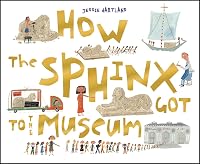
How the Sphinx Got to the Museum
by Jessie Hartland
On This Page
Description
Follows the history of the sphinx of Pharaoh Hatshepsut from its creation in ancient Egypt to New York City's Metropolitan Museum.Tags
Recommendations


















Member Reviews
I picked this because we've been reading a lot about ancient Egypt lately, but it turns out this book is really more about how artifacts make their way from their point of origin to being on display in a museum - and I promise, it's more interesting than it sounds! Told in a cute way that's reminiscent of the game "I'm going on a picnic..." it goes through the many steps, from the pharaoh Hatshepsut ordering the Sphinx to be made, all the way through the archaeologist, art movers, curator, conservators, artist, photographer (and more!) so that it can be enjoyed at the Metropolitan Museum of Art in NY. Makes me appreciate all the hard work that goes into museums!
What an interesting story about the Sphinx of Hatshepsut! This book uncovers the history of how this amazing structure was build, why it was broken and buried, how it was later found and eventually moved into the museum! Jessie Hartland uses a repetitive, cumulative style of writing to introduce vocabulary such as, “pharaoh,” “sculptor,” “archaeologist,” and “curator.” Additionally, these words are each printed in a different font so that they stand out from the rest of the text, which helps readers remember the words. I thought the story was very interesting and this approach to telling it is great for students in grades 1-4. The illustrations are cartoon drawn in a style that almost looks like a talented child could show more have painted them. I loved the little, subtle details in the pictures. Very cute story! show less
This story tells of how the Hatsheput sphinx statue traveled from Egypt to New York. The story is told in "The House That Jack Built" style, a predictable book, with key ideas in the steps being repeated. The book is also very interesting because you learn about the many people behind the scenes that are responsible for putting together museum displays.
This book does a great job of linking ancient history to present day school kids through the story of how one artifact was created through to it being displayed at the Metropolitan Museum of Art. My only wish was that a photograph of the actual sphinx have been included.
I thought this was a pretty cool book to read. I like how it went in-depth about how the Sphinx came to be and its history. I like how the book mentions that they were destroyed by the succeeding pharaoh and then put back together archeologists, something I did not know happened.
In this book, a teacher takes her class to a museum where there is a sphinx and the students pose the question of how the sphinx got to the museum. She takes the student on a journey of how the statue came to be. She tells it was ordered by the pharaoh Hatshepsut, built by sculptors, admired by priests, destroyed by her stepson, discovered by archeologists, given to the museum by the Department of antiques, moved by the art movers, an exhibit set up by the show more curator, put together by conservators, moved by riggers, painted by an artist, photographed by a photographer, and numbered by the registrar. Then the teacher then says that is lastly enjoyed by the public and that is how the sphinx got to the museum. show less
In this book, a teacher takes her class to a museum where there is a sphinx and the students pose the question of how the sphinx got to the museum. She takes the student on a journey of how the statue came to be. She tells it was ordered by the pharaoh Hatshepsut, built by sculptors, admired by priests, destroyed by her stepson, discovered by archeologists, given to the museum by the Department of antiques, moved by the art movers, an exhibit set up by the show more curator, put together by conservators, moved by riggers, painted by an artist, photographed by a photographer, and numbered by the registrar. Then the teacher then says that is lastly enjoyed by the public and that is how the sphinx got to the museum. show less
A little art history, a little Egyptian history, and a nice cumulative touch.
Ratings
Members
- Recently Added By
Lists

Mensa for Kids Excellence in Reading Award Program (Nonfiction)
54 works; 4 members
Author Information

15+ Works 1,030 Members
Common Knowledge
- Canonical title
- How the Sphinx Got to the Museum
- Original publication date
- 2010
- Important places
- Metropolitan Museum of Art, New York, New York, USA
- First words
- Thousands of years ago, a pharaoh ruled Egypt.
- Original language
- English
Classifications
Statistics
- Members
- 117
- Popularity
- 279,003
- Reviews
- 6
- Rating
- (3.90)
- Languages
- English
- Media
- Paper
- ISBNs
- 2