On This Page
Description
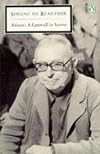
From the Dust Jacket: In Adieux: A Farewell to Sartre, Simone de Beauvoir uses Jean-Paul Sartre's last ten years as a focus for understanding his entire life. Through her eyes, we see an intimate portrait of the man who was widely recognized as one of the greatest thinkers of the twentieth century-the foremost philosopher of existentialism, a Nobel Prize-winning playwright, and a central figure in almost every major philosophical, political, literary, and social issue of our time. De show more Beauvoir was Sartre's closet friend, his intellectual companion, and, intermittently, his lover, from his early twenties until his death. It is she who tells his story in Adieux. She begins with a year-by-year memoir of Sartre's last decade: his political involvements, his work on Flaubert, his friendships, his relationship with her, his slow demise. The second and longer part of the book is a conversation between Sartre and De Beauvoir about his entire life and work. Unguarded, lucid, and incisive, Sartre talks about the origins of his philosophy, the inspiration for his fiction, and the conviction behind his activism. But more than a philosophical book, Adieux is a personal dialogue of astonishing candor. Sartre openly discusses his relationships with women-a subject which seems to pain De Beauvoir even now; his ugliness; his fear of passion. And in one of the most moving passages in Adieux, De Beauvoir anticipates Sartre's death. She knows he is dying, but she cannot tell him. Existentialism's acceptance of death does not console her. Adieux reveals the inner Sartre and the inner De Beauvoir, and illuminates one of the most extraordinary relationships of our century. show lessTags
Recommendations



























Member Recommendations

JuliaMaria Abschied von Ihrer Mutter bzw. von ihrem Lebens- und Geistesgefährten
Member Reviews
The first part reads like an extended preface to the second. It's an overarching chronicle of Sartes last years and his political & personal affiliations and, his deteriorating mental and physical condition. His behavior may be typical of one reaching the end of his life: sharply alternating between hopeful optimism, denial, apathy and self-loathing but it's clear that Sarte had a passion for life and his maintained lucidity and penetrating intellect remained almost completely intact. De Beauvoir is sweet and uncritical (almost to a fault) as she presents Sarte it's a frank and touching eulogy to a close friend, from one of the 20th century's most prominent intellectuals to another.
The second part is the bulk of the book and consists of show more interviews with Sarte during 1974, 6 years before he died. Those who are familiar with Sarte won't find anything here that's new or shocking but it was nice to read him speaking so candidly. De Beauvoir was quite engaging as well in these conversations.
I think I'll reread Being & Nothingness next as this book has put me in the mood for Sarte and I'm ACTUALLY GOING TO HAVE TIME TO READ now that the summer is beginning. show less
The second part is the bulk of the book and consists of show more interviews with Sarte during 1974, 6 years before he died. Those who are familiar with Sarte won't find anything here that's new or shocking but it was nice to read him speaking so candidly. De Beauvoir was quite engaging as well in these conversations.
I think I'll reread Being & Nothingness next as this book has put me in the mood for Sarte and I'm ACTUALLY GOING TO HAVE TIME TO READ now that the summer is beginning. show less
"Quando éramos jovens e, ao final de uma discussão apaixonada, um de nós triunfava ostensivamente, dizia ao outro: 'Você está enclausurado!' Você está enclausurado; não sairá daí e eu não me juntarei a você: mesmo que me enterrem ao seu lado, de suas cinzas para meus restos não haverá nenhuma passagem.
Este você que emprego é um engodo, um artifício retórico. Ninguém me ouve; não falo com ninguém. Na realidade, dirijo-me aos amigos de Sartre: àqueles que desejam conhecer melhor seus últimos anos. Relatei-os tal como os vivi."A Editora Nova Fronteira, conhecida e reconhecida por ser a casa dos grandes clássicos da literatura, comemora 50 anos. É muita história já contada e muita ainda por contar. Para festejar show more essa data tão importante, lançamos a Coleção 50 Anos, com vinte títulos imperdíveis e obrigatórios em qualquer estante.Em A cerimônia do adeus, Simone de Beauvoir faz um relato pungente sobre os dez últimos anos de vida de Sartre, baseado no diário pessoal da autora e em vários testemunhos que recolheu. Simone fala sobre os problemas de saúde do companheiro e de seus últimos trabalhos, num tom ao mesmo tempo distante e comovente.Jean-Paul Sartre foi um dos maiores pensadores do século XX. Poucos intelectuais na história ousaram tanto e deixaram obra tão eclética. Ainda jovem, conheceu Simone de Beauvoir na Escola Normal Superior, em Paris, e logo a identificação foi total. Desde então, até a morte do escritor, em 1980, Simone foi sua companheira inseparável.O livro traz também um rico material de entrevistas realizadas por Simone com Sartre em diferentes épocas. Uma obra arrebatadora, verdadeira homenagem a um homem fascinante feita por uma das escritoras mais brilhantes de seu tempo. show less
Este você que emprego é um engodo, um artifício retórico. Ninguém me ouve; não falo com ninguém. Na realidade, dirijo-me aos amigos de Sartre: àqueles que desejam conhecer melhor seus últimos anos. Relatei-os tal como os vivi."A Editora Nova Fronteira, conhecida e reconhecida por ser a casa dos grandes clássicos da literatura, comemora 50 anos. É muita história já contada e muita ainda por contar. Para festejar show more essa data tão importante, lançamos a Coleção 50 Anos, com vinte títulos imperdíveis e obrigatórios em qualquer estante.Em A cerimônia do adeus, Simone de Beauvoir faz um relato pungente sobre os dez últimos anos de vida de Sartre, baseado no diário pessoal da autora e em vários testemunhos que recolheu. Simone fala sobre os problemas de saúde do companheiro e de seus últimos trabalhos, num tom ao mesmo tempo distante e comovente.Jean-Paul Sartre foi um dos maiores pensadores do século XX. Poucos intelectuais na história ousaram tanto e deixaram obra tão eclética. Ainda jovem, conheceu Simone de Beauvoir na Escola Normal Superior, em Paris, e logo a identificação foi total. Desde então, até a morte do escritor, em 1980, Simone foi sua companheira inseparável.O livro traz também um rico material de entrevistas realizadas por Simone com Sartre em diferentes épocas. Uma obra arrebatadora, verdadeira homenagem a um homem fascinante feita por uma das escritoras mais brilhantes de seu tempo. show less
This was very strange. A book in 2 parts, the first being her description of sartre's final years, including his decline and health issues. the second being a series of transcripts of conversations she recorded with him. I found the first section to be inexplicable - I if he was supposed to be the love of her life, then why would you want to describe their decline in this detial - makes no sense to me. the second section was, to my mind, pretentious twaddle. Maybe I won't ever make a philosopher, but I can live with that, if I never have to read smething like this again.
this is simone de beauvoir story to the last years of statre's life. she loved him deeply but she was also true to you she was. it is both sad and joyful. this is your last sentence of the book: "his death does separate us. my death will not bring us together again. that is how things are. it is itself splendid that we were able to live our lives in harmony for so long."
GB-5
Oct 23, 2020Catalan
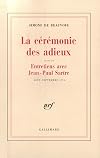
Gespräche mit Jean-Paul Sartre: August - September 1974
Nov 26, 2014German
Ratings
Members
- Recently Added By
Author Information

235+ Works 28,908 Members
Simone de Beauvoir, 1908 - 1986 Simone de Beauvoir was born January 9, 1908 in Paris, France to a respected bourgeois family. Her father was a lawyer, her mother a housewife, and together they raised two daughters to be intelligent, inquisitive individuals. de Beauvoir attended the elementary school Cours Desir in 1913, then L'Institute Sainte show more Nary under the tutelage of Robert Garric, followed by the Institute Catholique in Paris, before finally attending the Sorbonne, where she graduated from in 1929. It was there that she met the man who would become her life long friend and companion, John Paul Sartre, who contributed to her philosophy of life. She is perhaps best know for her novel entitled "The Second Sex", which describes the ideal that women are an indescribable "other", something "made, not born", and a declaration of feminine independence. After graduating from the Sorbonne, de Beauvoir went on to teach Latin at Lycee Victor Duruy, philosophy at a school in Marseilles, and a few other teaching positions before coming to teach at the Sorbonne. During the course of her twelve years of teaching, from 1931 to 1943, de Beauvoir developed the basis for her philosophical thought. She used her formal philosophy background to also comment on feminism and existentialism. Her personal philosophy was that freedom of choice is man's utmost gift of value. Acts of goodness make one more free, acts of evil decrease that selfsame freedom. In 1945, de Beauvoir and Sartre founded and edited Le Temps Modernes, a monthly review of philosophical thought and trends. In 1943, with the money she had earned from teaching, de Beauvoir turned her full attention to writing, producing first "L'Envitee", then "Pyrrhus et Cineas" in 1944. In 1948, she wrote perhaps her most famous philosophical work, "The Ethics of Ambiguity". "The Second Sex", regarded by many as the seminal work in the field of feminism, is her most famous work. Other works include "The Coming of Age", which addresses society's condemnation of old age, the award winning novel "The Mandarins", "A Very Easy Death", about the death of her mother and a four part biography. In "The Woman Destroyed", a collection of two long stories and one short novel, de Beauvoir discusses middle age. One of her last novels was in the form of a diary recording; it told of the slow death of her life-long compatriot, Jean Paul Sartre. On April 14, 1986, Simone de Beauvoir, one of the mothers of feminism, passed away in her home in Paris. (Bowker Author Biography) show less
Some Editions
Series

Belongs to Publisher Series
Gallimard, Folio (1805)
Common Knowledge
- Canonical title*
- Die Zeremonie des Abschieds
- Original title
- La céremonie des adieux
- Original publication date
- 1981
- People/Characters
- Jean-Paul Sartre; Simone de Beauvoir
*Some information comes from Common Knowledge in other languages. Click "Edit" for more information.
Classifications
- Genre
- Biography & Memoir
- DDC/MDS
- 848.91409 — Literature & rhetoric French Literature French miscellaneous writings 1900- 1900-1999 1945-1999 Individual authors
- LCC
- PQ2637 .A82 .Z56413 — Language and Literature French, Italian, Spanish and Portuguese literatures French literature Modern literature 1900-1960
- BISAC
Statistics
- Members
- 505
- Popularity
- 59,358
- Reviews
- 6
- Rating
- (3.59)
- Languages
- 11 — Chinese, Czech, Dutch, English, French, German, Italian, Japanese, Portuguese, Spanish, Swedish
- Media
- Paper, Ebook
- ISBNs
- 31
- ASINs
- 10