Waiting for the Biblioburro
by Monica Brown
On This Page
Description
When a man brings to a remote village two burros, Alfa and Beto, loaded with books the children can borrow, Ana's excitement leads her to write a book of her own as she waits for the BibliBurro to return. Includes glossary of Spanish terms and a note on the true story of Columbia's BiblioBurro and mobile libraries in other countries.Tags
Recommendations


Member Reviews
Monica Brown, whose many picture-book biographies of celebrated Latin American authors include My Name Is Gabito/Me Llamo Gabito: The Life of Gabriel Garcia Marquez/La Vida de Gabriel Garcia Marquez and Me Llamo Gabriela/My Name Is Gabriela: La Vida de Gabriela Mistral/The Life of Gabriela Mistral, turns here to another kind of literary hero: the librarian. Told from the perspective of Ana, a fictional Colombian girl who loves reading (and telling!) stories, but who has access to only one book - given to her by the local teacher, who went away, and was never replaced - Waiting for the Biblioburro is a tribute to Luis Soriano Bohórquez, a real-life teacher and book-lover who became an itinerant librarian, loading up his burros, Alfa and show more Beto, and bringing the precious gift of reading to the isolated country villages and towns of his country...
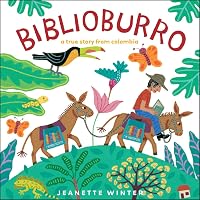
Waiting for the Biblioburro was chosen as one of our March selections, over in The Picture-Book Club to which I belong, where our theme this month is "Libraries," and I'm so glad that it was! Having already read Jeanette Winter's Biblioburro: A True Story from Colombia, which profiles the same figure, I might otherwise have passed it by, which would have been a shame, since I enjoyed Brown's book even more than Winter's. By focusing on Ana, the author here really brings home the enormously positive impact that Luis Soriano Bohórquez and his biblioburros had on rural Colombian children. The artwork, done in acrylic, in a folk-motif style, really appealed to me - they were just gorgeous! Highly recommended to all young bibliophiles and library-lovers, as well as to anyone who complains about the services available to them from their local library. show less
Waiting for the Biblioburro was chosen as one of our March selections, over in The Picture-Book Club to which I belong, where our theme this month is "Libraries," and I'm so glad that it was! Having already read Jeanette Winter's Biblioburro: A True Story from Colombia, which profiles the same figure, I might otherwise have passed it by, which would have been a shame, since I enjoyed Brown's book even more than Winter's. By focusing on Ana, the author here really brings home the enormously positive impact that Luis Soriano Bohórquez and his biblioburros had on rural Colombian children. The artwork, done in acrylic, in a folk-motif style, really appealed to me - they were just gorgeous! Highly recommended to all young bibliophiles and library-lovers, as well as to anyone who complains about the services available to them from their local library. show less
Waiting for the Biblioburro (with a wonderful and evocative text by Monica Brown and lovingly illustrated by John Parra) is an inspiring and thought-provoking story about a librarian in Colombia, who delivers and distributes his library books, not from the distribution desk of a building, not even from a motorised bookmobile, but using his two trusted mules, Alfa and Beto. And of course, this book is also about a little girl named Ana, who loves stories (cuentos) and patiently waits for the biblioburro to return, bearing gifts of books, new ideas, new cuentos, tales she can read for herself and then share with her little brother.
Considering that so many of us (both children and adults, and especially in North America and Western Europe) show more seem to take books and the ready availability of books, of libraries very much for granted, Waiting for the Biblioburro is a good story to demonstrate that, even today, in many parts of the word, books are not only considered special and precious, they are often quite expensive and difficult to obtain, both for purchasing and borrowing. Many, if not most of us simply order our books at the local library and then go and pick them up a few days, sometimes even just a few hours later (but for children like Ana, there are no libraries, no books readily available, and these children must depend on brave and resourceful librarians to personally deliver precious library books on horseback, astride mules, on foot etc.).
Waiting for the Biblioburro feels both authentic and realistic (the use of Spanish throughout the text increases that perception of authenticity, and also provides some basic Spanish language instruction in a fun and unobtrusive way). The reader empathises with Ana, feeling and appreciating her longing for books and more and more books (I almost felt like I was Ana, patiently waiting for the biblioburro to return). And of course, one also empathises with the librarian (his love for books, learning and teaching, for delivering the joy of reading, the gift of education to the children, to the people of Ana's village, is almost palpable, a warm, pleasant, delightful sensation).
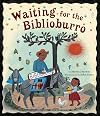
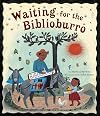
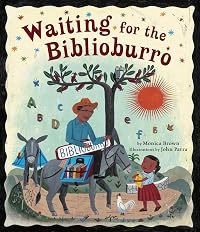
I don't think that on their own, John Parra's folk art illustrations would be personal favourites (and the oversized heads of the human figures are definitely a bit off-putting). However, in conjunction with and to the narrative, the illustrations provide an almost perfect complement to the text, providing a warm and authentic feel for Colombian life and culture. show less
Considering that so many of us (both children and adults, and especially in North America and Western Europe) show more seem to take books and the ready availability of books, of libraries very much for granted, Waiting for the Biblioburro is a good story to demonstrate that, even today, in many parts of the word, books are not only considered special and precious, they are often quite expensive and difficult to obtain, both for purchasing and borrowing. Many, if not most of us simply order our books at the local library and then go and pick them up a few days, sometimes even just a few hours later (but for children like Ana, there are no libraries, no books readily available, and these children must depend on brave and resourceful librarians to personally deliver precious library books on horseback, astride mules, on foot etc.).
Waiting for the Biblioburro feels both authentic and realistic (the use of Spanish throughout the text increases that perception of authenticity, and also provides some basic Spanish language instruction in a fun and unobtrusive way). The reader empathises with Ana, feeling and appreciating her longing for books and more and more books (I almost felt like I was Ana, patiently waiting for the biblioburro to return). And of course, one also empathises with the librarian (his love for books, learning and teaching, for delivering the joy of reading, the gift of education to the children, to the people of Ana's village, is almost palpable, a warm, pleasant, delightful sensation).
I don't think that on their own, John Parra's folk art illustrations would be personal favourites (and the oversized heads of the human figures are definitely a bit off-putting). However, in conjunction with and to the narrative, the illustrations provide an almost perfect complement to the text, providing a warm and authentic feel for Colombian life and culture. show less
I greatly enjoyed this book, though I confess an obvious bias since it features a librarian. The historical nature of the true story of the biblioburro mixed with the very whimsical nature of Ana's dreams made for a fun read. I also enjoyed the fact the book was bilingual, which gave it a sense of authencity, and heightened its use as an instructional text. The main message of the book was that literacy can change a child's life, and create whole new worlds for the child.
This picture book is about a little girl in Colombia who has only one book and dreams of more. Luckily, her town is visited one day by the Biblioburro, a traveling library on the backs of two burros named Alfa and Beto (get it, alfabeto? Alphabet?). The bright, colorful, naive-ish Latin American-inspired illustrations are nice to look at. The librarian with the Biblioburro is real; this is based on a true story. I enjoyed this, and it's nice to see a library-related picture book that is from Latin America. Both author and illustrator are latines.
Ana loves stories but she only has one book that she cherishes and reads so many times that she has it memorized. Ana loves fantastical stories and often makes them up to tell her little brother so that he can fall asleep at night. As she helps her family with chores around their farm, she often imagines stories of enchantment and wishes for more books. One day she hears the clip-clop of burros hooves that carry a man with many books. He's a travelling librarian and he shares the magic of his books with Ana and her neighbors. As Ana grows impatient for his return, she decides to write a story of her own. This is a sweet and inspiring story based on a real life librarian, Luis Soriano Bohoraquez, who travelled through the small villages show more of Columbia to bring literacy and culture to many people. It is written mostly in English with a smattering of Spanish words that are immersed throughout the text so that their meanings are obvious due to context. show less
I really liked this book for many reasons. The book touched on so many elements of a story but I found the plot to be one of the strongest. The text was very informative and detailed including multiple Spanish words represented on nearly every page, which I enjoyed. The story follows a girl who loves to read but sadly doesn’t attend school because her teacher left the village. She has a great imagination and really enjoys telling stories to her little brother as she completes chores around the house. One day man on a donkey comes to town and introduces the children to a traveling library that they can borrow and read books from. The little girl becomes so fascinated that she reads many books and eventually writes her own book to show more donate to the library. I loved the idea of the “biblioburro” and the plot is neatly organized with conflict, a climax and resolution for all interested readers.
Another reason why I loved this book was the unique and impressive illustrations. Every page is so colorful, while the pictures match up to what is being said in the text, making things very visually clear. In one scene the girl is having a dream that she is riding on a butterfly scattering words and letters over the village for the children. The dream scene in the book was very well illustrated and brought out the imagination of the character. The main message of the story, is that through determination anyone can follow their passions, and doing what you love can take you places you may never thought you would go. show less
Another reason why I loved this book was the unique and impressive illustrations. Every page is so colorful, while the pictures match up to what is being said in the text, making things very visually clear. In one scene the girl is having a dream that she is riding on a butterfly scattering words and letters over the village for the children. The dream scene in the book was very well illustrated and brought out the imagination of the character. The main message of the story, is that through determination anyone can follow their passions, and doing what you love can take you places you may never thought you would go. show less
This book was really great in my opinion. I thought the content was perfect for the age group, and had nice illustrations to go along with it. I think the whole idea of it was very different and realistic, because in some towns in other countries the houses are more spread out like that and they don't have libraries in every town or cars. The idea of a traveling library, to me, seems old school and I love it. The children have something to look forward to all the time and the anticipation grows on them waiting for him to come and share his new books. I think it's great he lets them take the books home with them and his character is very realistic. What stood out to me was that the little girl in the story was so inspired that she wrote show more her own book "Waiting for the Biblioburro" in the book "Waiting for the Biblioburro"! That was really cool to me. This book definitely pushes readers to think about tough issues, because they need to realize that not everyone has access to a library every day or even at all. From the book, this is supported because this area doesn't have one and this man travels on his donkeys and brings books wherever he goes for others to be exposed and read. The main idea was to expose children to traveling libraries, because some don't live in an area with one and to inspire the readers to write about their experiences. show less
Members
- Recently Added By
Lists

At the Library ::: Children's Picture Books about Libraries
103 works; 6 members

A Child's Book Tour of the Andes ::: Argentina, Chile, Colombia, Ecuador
24 works; 3 members
Author Information

25 Works 6,728 Members
Awards and Honors
Distinctions
Notable Lists
Classifications
Statistics
- Members
- 692
- Popularity
- 41,410
- Reviews
- 34
- Rating
- (4.34)
- Languages
- English, French
- Media
- Paper, Audiobook, Ebook
- ISBNs
- 14
- ASINs
- 1