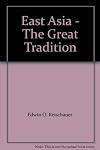
East Asia, The Great Tradition: A History of East Asian Civilization
by Edwin O. Reischauer (Author), John K. Fairbank (Author)
On This Page
Tags
Recommendations















Member Reviews
An excellent panoramic history of East Asian civilization up to the eve of its transformation to modern society. A broad selection of different topics are discussed thoroughly and clearly. Good comprehensive histories of China and Japan in English are still surprisingly hard to find. This one is getting a bit old but it's still the best one I've read.
Ratings
Members
- Recently Added By
Author Information

Edwin O. Reischauer was born in Japan in 1910, the son of Protestant educational-missionary parents, founders of Japan's first school for the deaf. After being educated in Japanese and American schools, he received his B.A. from Oberlin College in 1931 and his M.A. from Harvard in 1932. Four years later he received a Ph.D. in Far Eastern Languages show more from Harvard. In 1938 he joined the faculty at Harvard, where he rose to the position of professor and acted for an extensive period as director of the Harvard-Yenching Institute. His academic career was interrupted by World War II, during which he served as an intelligence officer in the U.S. Army, and he held civilian posts first in the War Department and later in the Department of State. In 1961 he again took leave from Harvard to accept a position for which he had been hand-picked by President John F. Kennedy---ambassador to Japan. The Japanese accepted him as one of their own; one editorial writer welcomed him by writing that he was well informed about Japan, "having no equal among foreigners on that point." Another remarked how satisfying it would be to "write an editorial and know that the American Ambassador will actually be able to read it." Reischauer was a prolific writer and an energetic speaker who saw his role as introducing Japan to America. In his writings and in his activities in other media such as film, he was committed to reaching as broad an audience as possible. At Harvard he led in training the first generation of true American scholars of Japan. As U.S. ambassador to Japan, however, his role became reversed as he sought to educate Japanese about America and Americans. In the wake of the war in the Pacific, Reischauer hoped to show Americans and Japanese that the two countries could and should be close allies and friends. His assessment of Japan's history emphasized the nonrevolutionary character of its modern history and its outward-looking development. In his view Japanese war and aggression were aberrations in a long emerging liberal tradition. His positivist interpretation has been a leading influence in defining America's postwar vision of Japan. (Bowker Author Biography) show less
Common Knowledge
- Canonical title
- East Asia, The Great Tradition: A History of East Asian Civilization
- Original publication date
- 1960
- Important places
- East Asia; China; Japan; Korea; Vietnam
- Dedication
- To Haru and Wilma
- First words
- 1. The Setting of East Asian History
The Objectives of This Study
When Europeans traveled far to the east to reach Cathay, Japan and the Indies, they naturally gave those distant regions the general name "Far East." - Last words
- (Click to show. Warning: May contain spoilers.)It is not surprising that the much greater speed of Japan's start proved a decisive factor during the first century of modernization in East Asia.
- Original language
- English
Classifications
Statistics
- Members
- 93
- Popularity
- 344,458
- Reviews
- 2
- Rating
- (3.50)
- Languages
- English
- Media
- Paper
- ISBNs
- 3
- ASINs
- 7