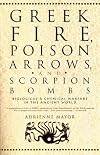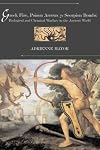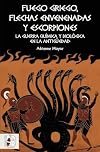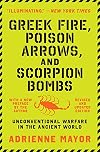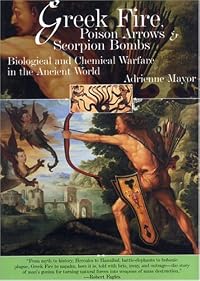
Greek Fire, Poison Arrows, and Scorpion Bombs: Biological and Chemical Warfare in the Ancient World
by Adrienne Mayor 
On This Page
Description
"A history of the ways in which ancient cultures developed and used biological, chemical, and other unconventional warfare, drawing on myth, science, and history and told Mayor's scrupulous, yet entertaining style"--Tags
Recommendations






Member Recommendations

Member Reviews
It's somewhat saddening to realise that although the earliest mythological stories about the use of biochemical weapons came with the moral "too dangerous and inhumane to use", they're still in use today, and causing all the same tragic misery.
Despite this chastening theme, this is an engrossing book. The author makes her points well and is clear about what is known and and what is speculation and opinion.
Anybody interested in mythology, ancient history or military tactics should find this a rewarding read.
Despite this chastening theme, this is an engrossing book. The author makes her points well and is clear about what is known and and what is speculation and opinion.
Anybody interested in mythology, ancient history or military tactics should find this a rewarding read.
Weapons of biological and chemical warfare have been in use for thousands of years, and Greek Fire, Poison Arrows & Scorpion Bombs, Adrienne Mayor's exploration of the origins of controversial weaponry, draws extraordinary connections between the mythical worlds of Hercules and the Trojan War, the accounts of Herodotus and Thucydides, and modern methods of war and terrorism.
Drawing on sources ancient and modern, Mayor describes ancient recipes for arrow poisons, booby traps rigged with plague, petroleum-based combustibles, choking gases, and the deployment of dangerous animals and venomous snakes and insects. She also explores the ambiguous moral implications inherent in this kind of warfare: Are these nefarious forms of weaponry show more ingenious or cowardly? Admirable or reprehensible?
With the news full of talk about bio-terrorism and chemical weapons, Mayor's exploration of the origins of biological and unethical warfare is an attention-grabber that follows through with fascinating illustrative episodes.
A fascinating read, if you have the stomach for it. I recommend this book highly. There really is nothing new about using biology and chemistry as weapons in war. show less
Drawing on sources ancient and modern, Mayor describes ancient recipes for arrow poisons, booby traps rigged with plague, petroleum-based combustibles, choking gases, and the deployment of dangerous animals and venomous snakes and insects. She also explores the ambiguous moral implications inherent in this kind of warfare: Are these nefarious forms of weaponry show more ingenious or cowardly? Admirable or reprehensible?
With the news full of talk about bio-terrorism and chemical weapons, Mayor's exploration of the origins of biological and unethical warfare is an attention-grabber that follows through with fascinating illustrative episodes.
A fascinating read, if you have the stomach for it. I recommend this book highly. There really is nothing new about using biology and chemistry as weapons in war. show less
A very interesting book on an extremely overlooked topic of ancient warfare, ancient WMD's, chemical and biological weapons. I appreciated the explanation of the various biblical phenomenons that were attributed to 'spirits' but were actually clever scientific tricks. I also appreciated the author exploring the down hill slide that these things have created and how it effects our modern attitude towards them.
Biological and chemical weapons are terrifying. Their ability to wreak havoc on the battlefield is bad already, and the sheer panic and chaos they create is enough to devastate any army. They are truly a testament to the strength and versatility of modern science and technology, right? Wrong. There is nothing modern about biological and chemical weapons.
Greek Fire, Poison Arrows, and Scorpion Bombs shows us that 'biochemical' weapons have been a horror for thousands of years. Whether it's the ever-popular poisoning of wells and arrows with toxic plants and animal venom or pouring molten mixtures of sticky chemical fires on an enemy's heads, humans have been using biology and chemistry on the battlefield for some time.
The book was show more certainly enlightening at times. In the beginning I had issues with it because the author insisted on naming Greek legends as the originators of these types of weapons. She claims Hercules was the first person to poison arrows for example, and while I agree that these myths can be looked at as indicators that such weapons were used in real life, she frequently refers to them as if they actually happened. There are also some more questionable 'real' stories, such as Archimedes' Mirror, to cast further doubt of the book's validity for me as I read the book.
The book is also a bit repetitive. If I have to hear about Hercules and his hydra-venom arrows or Philoctetes and his damn foot again anytime in the near future, I think I'll set fire to my own head with naphtha. While each individual chapter is interesting, they are all littered with repetitious commentary that becomes tiresome after awhile.
Still, despite my grumblings, I found enough intriguing stories and anecdotes to encourage me to keep reading. There is definitely a good book here, you just have to dig a little to find it. It's probably not one that I would recommend very highly, but it is certainly an interesting read. show less
Greek Fire, Poison Arrows, and Scorpion Bombs shows us that 'biochemical' weapons have been a horror for thousands of years. Whether it's the ever-popular poisoning of wells and arrows with toxic plants and animal venom or pouring molten mixtures of sticky chemical fires on an enemy's heads, humans have been using biology and chemistry on the battlefield for some time.
The book was show more certainly enlightening at times. In the beginning I had issues with it because the author insisted on naming Greek legends as the originators of these types of weapons. She claims Hercules was the first person to poison arrows for example, and while I agree that these myths can be looked at as indicators that such weapons were used in real life, she frequently refers to them as if they actually happened. There are also some more questionable 'real' stories, such as Archimedes' Mirror, to cast further doubt of the book's validity for me as I read the book.
The book is also a bit repetitive. If I have to hear about Hercules and his hydra-venom arrows or Philoctetes and his damn foot again anytime in the near future, I think I'll set fire to my own head with naphtha. While each individual chapter is interesting, they are all littered with repetitious commentary that becomes tiresome after awhile.
Still, despite my grumblings, I found enough intriguing stories and anecdotes to encourage me to keep reading. There is definitely a good book here, you just have to dig a little to find it. It's probably not one that I would recommend very highly, but it is certainly an interesting read. show less
Adrienne Mayor looks at how the ancients weaponised nature through the use of animal and vegetable poisons, disease, animals, and various forms of petrol and other flammable substances.
Fascinating, full of interesting tidbits. There really is nothing new under the sun.
Fascinating, full of interesting tidbits. There really is nothing new under the sun.
Модерната война е нищо в сравнение с войните, водени в историята и страданието и разрухата, които тя носи днес рядко могат да се сравняват с изпитаните от цивилни и войници в предишни столетия и хилядолетия.
Благородните рицари и блестящите фаланги са главно в приказките и историческите романи, докато стрели, намазани с лайна за да предизвикат инфекции и хвърлянето на разложени животни в единствения show more водоизточник на селото, за да заболеят обитателите му от чума са в реалната история.
Примери за биологична и химична война има доста, но за съжаление авторката се е ограничила в изследванията си само до античния период, от когато има останали сравнително малко данни и сведения. Поради това тя се опитва да запълни книгата си с какво ли не, примерно първите 25% от нея са уводи и предговори и първата глава, която не е нищо друго, от пространен преразказ на легендите за Херкулес (защото натопил стрелите си в кръвта на Хидра) и Одисей.
Нататък има интересна информация, но тя е залята с още и още авторови интерпретации, предположения и чисти празни приказки до степен да се налага активно да се опитвам да отлича историческата истина (за която имаме конкретни сведения) от художествената интерпретация на авторката. Така не се пише научно-популярна книга. show less
Благородните рицари и блестящите фаланги са главно в приказките и историческите романи, докато стрели, намазани с лайна за да предизвикат инфекции и хвърлянето на разложени животни в единствения show more водоизточник на селото, за да заболеят обитателите му от чума са в реалната история.
Примери за биологична и химична война има доста, но за съжаление авторката се е ограничила в изследванията си само до античния период, от когато има останали сравнително малко данни и сведения. Поради това тя се опитва да запълни книгата си с какво ли не, примерно първите 25% от нея са уводи и предговори и първата глава, която не е нищо друго, от пространен преразказ на легендите за Херкулес (защото натопил стрелите си в кръвта на Хидра) и Одисей.
Нататък има интересна информация, но тя е залята с още и още авторови интерпретации, предположения и чисти празни приказки до степен да се налага активно да се опитвам да отлича историческата истина (за която имаме конкретни сведения) от художествената интерпретация на авторката. Така не се пише научно-популярна книга. show less
A very interesting book on an extremely overlooked topic of ancient warfare, ancient WMD's, chemical and biological weapons. I appreciated the explanation of the various biblical phenomenons that were attributed to 'spirits' but were actually clever scientific tricks. I also appreciated the author exploring the down hill slide that these things have created and how it effects our modern attitude towards them.
Members
- Recently Added By
Published Reviews
Adrienne Mayor excels at presenting the Greco-Roman world in ways that are creative, engaging, and irresistible. The revised edition of Greek Fire, Poison Arrows, and Scorpion Bombs is no exception. As she points out in the new preface, the volume, which outlines examples of biological, chemical, and unconventional warfare in antiquity, has influenced television shows, documentaries, museum show more exhibits, films, and even international summits on biosecurity. Mayor herself highlights the continued relevance and importance of the subject in a post-9/11 and post-COVID world, arguing that “one can only hope that a deeper understanding of toxic warfare’s mythic origins and earliest historic realities might help divert the drive to transform all nature into a deadly arsenal, redirecting it into the search for better ways to heal” (p. 288). show less
added by cinaedus
Author Information

8+ Works 2,331 Members
Adrienne Mayor is a research scholar in classics and history of science at Stanford University, and the author of The Poison King: The Life and Legend of Mithradates, Rome's Deadliest Enemy (Princeton), which was a finalist for the National Book Award.
Adrienne Mayor is a LibraryThing Author, an author who lists their personal library on LibraryThing.
Some Editions
Common Knowledge
- Canonical title
- Greek Fire, Poison Arrows, and Scorpion Bombs: Biological and Chemical Warfare in the Ancient World
- Original publication date
- 2008
Classifications
- Genres
- History, Nonfiction, General Nonfiction, Science & Nature
- DDC/MDS
- 358.309 — Social sciences Public administration & military science Air and other specialized forces and warfare; engineering and related services Other technical services
- LCC
- UG447.8 .M335 — Military Science Military engineering. Air forces Military engineering Attack and defense. Siege warfare
- BISAC
Statistics
- Members
- 494
- Popularity
- 60,751
- Reviews
- 12
- Rating
- (3.82)
- Languages
- English, French, Spanish
- Media
- Paper, Audiobook, Ebook
- ISBNs
- 12
- ASINs
- 7