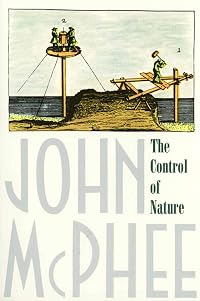
The control of nature
by John McPhee
On This Page
Description
"The Control of Nature" is John McPhee's bestselling account of places where people are locked in combat with nature. Taking us deep into these contested territories, McPhee details the strageties and tactics through which people attempt to control nature. Most striking is his depiction of the main contestants: nature in complex and awesome guises, and those attempting to wrest control from her - stubborn, sometimes foolhardy, more often ingenious, and always arresting characters.Tags
Recommendations




















Member Reviews
As far as I'm concerned Encounters With the Archdruid will always be my favorite work of his, because of the fascinating interaction between the characters in that book. McPhee really let their personalities take center stage there, and while The Control of Nature features excellent writing as usual, the focus is more on geological features than people. Since people are on the whole more interesting than rocks, this book suffered a little in comparison, though thanks to McPhee's tremendous talents he's still able to bring his locations to life. The Control of Nature is divided into 3 sections, and the overriding theme can be summed up as "people dealing with the consequences of building things where they shouldn't". Humans have tried to show more force rigid order on restless nature with dams, basins, and barriers since the beginning of recorded history, of course, but the stakes have only gotten higher over time, and our collective efforts to impose our will on the elements is plenty fascinating here even if the characters within the book are not.
The first, longest, and best section recounts the history of the Army Corps of Engineers' struggles to tame the mighty Mississippi, with particular concern for the mounting danger posed by the Atchafalaya River and its increasingly attractive drainage basin. Over the centuries, people have built quite a civilization in one of the most frequently flooded swamps in the world, and it is the Corps' thankless task to protect that civilization, building ever-higher levees, locks, and dams in what frequently looks like a self-defeating enterprise. It seems almost impossible to balance the often-incompatible needs of the various interest groups of farmers, fishermen, and city dwellers as the Mississippi tries to flood and shift the way it's been doing since time immemorial. The inherent drama and hubris in the idea of containing a river like that from going where it wants is masterfully explored, and these lessons of the limits of simply piling up earthworks are more relevant than ever in the post-Katrina era.
The second section is about Iceland's and Hawaii's struggles with volcanoes. While both island groups are essentially at the complete mercy of the lava gods, Iceland's more defiant attitude towards its eruptions makes for the bigger share of the section. The main action of the story is the struggle to save the harbor of Heimaey, a fishing village, from a lava flow via the high-tech method of pointing a bunch of water hoses at the lava to cool it down, plus building channeling barriers. It works. Iceland is right over the Mid-Atlantic Ridge, which guarantees it plenty of exposure to eruptions, and residents are constantly faced with the paradoxes inherent in residing on land that suffers from constant threat of immolation. I was surprised by how effective their "pour water on the lava" tactics were in the small scale, but sometimes there's only so much about millions of cubic meters of lava you can do. Hawaii has a much more fatalistic attitude, the reasons for which are not fully explored.
The third section focused on Los Angeles' debris flows, which I hadn't realized was among the major hazards they had (at least compared to things like earthquakes), but it seems that the gradual elimination of natural fires in the chaparral scrub of the hills has generated an unhealthy cycle of brush accumulation --> incredible fires --> heavy rains --> mudslides. I found the people in this section the least sympathetic for some reason - somehow I can understand poor shrimpers living in Louisiana swamps despite the hurricanes and floods, or fishermen building on volcanic islands regardless of the occasional eruption, but a bunch of rich people building expensive houses in vulnerable arroyos and canyons leaves me feeling like they should know better, especially when the city governments have to build a bunch of catchment dams that the same people complain about constantly. Either live in the city or live in the woods, but that kind of halfway "naturish" development is a big drain on civic resources and is begging for the kind of disasters on display here. Is it hubris, or just dumb? show less
The first, longest, and best section recounts the history of the Army Corps of Engineers' struggles to tame the mighty Mississippi, with particular concern for the mounting danger posed by the Atchafalaya River and its increasingly attractive drainage basin. Over the centuries, people have built quite a civilization in one of the most frequently flooded swamps in the world, and it is the Corps' thankless task to protect that civilization, building ever-higher levees, locks, and dams in what frequently looks like a self-defeating enterprise. It seems almost impossible to balance the often-incompatible needs of the various interest groups of farmers, fishermen, and city dwellers as the Mississippi tries to flood and shift the way it's been doing since time immemorial. The inherent drama and hubris in the idea of containing a river like that from going where it wants is masterfully explored, and these lessons of the limits of simply piling up earthworks are more relevant than ever in the post-Katrina era.
The second section is about Iceland's and Hawaii's struggles with volcanoes. While both island groups are essentially at the complete mercy of the lava gods, Iceland's more defiant attitude towards its eruptions makes for the bigger share of the section. The main action of the story is the struggle to save the harbor of Heimaey, a fishing village, from a lava flow via the high-tech method of pointing a bunch of water hoses at the lava to cool it down, plus building channeling barriers. It works. Iceland is right over the Mid-Atlantic Ridge, which guarantees it plenty of exposure to eruptions, and residents are constantly faced with the paradoxes inherent in residing on land that suffers from constant threat of immolation. I was surprised by how effective their "pour water on the lava" tactics were in the small scale, but sometimes there's only so much about millions of cubic meters of lava you can do. Hawaii has a much more fatalistic attitude, the reasons for which are not fully explored.
The third section focused on Los Angeles' debris flows, which I hadn't realized was among the major hazards they had (at least compared to things like earthquakes), but it seems that the gradual elimination of natural fires in the chaparral scrub of the hills has generated an unhealthy cycle of brush accumulation --> incredible fires --> heavy rains --> mudslides. I found the people in this section the least sympathetic for some reason - somehow I can understand poor shrimpers living in Louisiana swamps despite the hurricanes and floods, or fishermen building on volcanic islands regardless of the occasional eruption, but a bunch of rich people building expensive houses in vulnerable arroyos and canyons leaves me feeling like they should know better, especially when the city governments have to build a bunch of catchment dams that the same people complain about constantly. Either live in the city or live in the woods, but that kind of halfway "naturish" development is a big drain on civic resources and is begging for the kind of disasters on display here. Is it hubris, or just dumb? show less
I read this based on frequent recommendation on blogs after Hurricane Katrina.
It's interesting stuff, the discussion of three attempts by humanity to freeze geology into a certain shape:
* the flow of the Mississippi,
* the lava flow of some volcanoes in Iceland, and
* the flow of rocks down from the San Gabriel mountains in Los Angeles.
Unfortunately the book really could have done with tighter editing.
About a third of it is random filler, stuff he noticed while interviewing and walking around the relevant areas. (For example the description of a few days spent with the crew of a crawfish boat in the Louisiana bayou added
absolutely nothing to the description of the Mississippi control.)
Apart from the writing, I found the book show more ultimately deeply unsatisfying.
The author repeatedly throws his hands in the air and says "Silly people, how can you control nature", but what does he propose as an alternative?
In the first place people have to live somewhere, and there are precious few places to live that don't suffer from some natural disaster or other.
In the second place, the issue is not some sort of perpetual control till the end of time. A better interpretation would be that people are trying, on a case by case basis, to ameliorate the situation and the fact is that, in spite of his carping, they've largely succeeded.
Rather than simply saying that building near the Mississippi is dumb because the river is inevitably going to change its course, I'd prefer a cost-benefit analysis that runs the numbers. Of course there is a risk, and of course controlling the river costs money, but there are also benefits. It's not a priori obvious to me that the risks are so extreme and the benefits so marginal that the project makes no sense.
Finally I should add that I did find the section on rocks flowing into Los Angeles from the mountains very interesting. As someone who lives in the shadows of these mountains but who'd never heard of this before, I was naturally fascinated to learn about this. Any Angeleno should definitely read this essay, even if the other two are ignored. show less
It's interesting stuff, the discussion of three attempts by humanity to freeze geology into a certain shape:
* the flow of the Mississippi,
* the lava flow of some volcanoes in Iceland, and
* the flow of rocks down from the San Gabriel mountains in Los Angeles.
Unfortunately the book really could have done with tighter editing.
About a third of it is random filler, stuff he noticed while interviewing and walking around the relevant areas. (For example the description of a few days spent with the crew of a crawfish boat in the Louisiana bayou added
absolutely nothing to the description of the Mississippi control.)
Apart from the writing, I found the book show more ultimately deeply unsatisfying.
The author repeatedly throws his hands in the air and says "Silly people, how can you control nature", but what does he propose as an alternative?
In the first place people have to live somewhere, and there are precious few places to live that don't suffer from some natural disaster or other.
In the second place, the issue is not some sort of perpetual control till the end of time. A better interpretation would be that people are trying, on a case by case basis, to ameliorate the situation and the fact is that, in spite of his carping, they've largely succeeded.
Rather than simply saying that building near the Mississippi is dumb because the river is inevitably going to change its course, I'd prefer a cost-benefit analysis that runs the numbers. Of course there is a risk, and of course controlling the river costs money, but there are also benefits. It's not a priori obvious to me that the risks are so extreme and the benefits so marginal that the project makes no sense.
Finally I should add that I did find the section on rocks flowing into Los Angeles from the mountains very interesting. As someone who lives in the shadows of these mountains but who'd never heard of this before, I was naturally fascinated to learn about this. Any Angeleno should definitely read this essay, even if the other two are ignored. show less
McPhee is one of my favorite authors, and this set of three long essays is one of my very favorite works by him. "Atchafalaya" deals with the monumental efforts of the Army Corps of Engineers to keep the Mississippi River from changing course. "Cooling the Lava" is about a group of Icelanders who try to save their town from an oncoming lava flow by the seemingly outlandish scheme of pumping water onto it. "Los Angeles Against the Mountains" looks at the system of debris catch-basins designed to protect Angelenos' homes during landslide season. All three have McPhee's trademark blend of crystal-clear writing, detailed description of (often) very complex things, and portraits of fascinating people. McPhee's underlying theme (the show more simultaneous nobility and futility of human attempts to control nature) is artfully handled in all three essays. show less
This is the second book of McPhee's that I have read - the first was _The Curve of Binding Energy_. It's pretty clear that McPhee has a formula and sticks to it. The great thing is, the formula really works. Of course he has a consistent style too, and that is part of his well-deserved success. But the formula: reading these books, I learn an enormous amount about some facet of the world, and I learn it through a steady stream of factual narrative; a lot of that story is first person, McPhee's investigative trail.
My Mom grew up in Los Angeles and would go skiing and camping in the San Gabriel Mountains, back in the 1930s and 1940s. I read the third chapter of _Control_ staying with her, which gave us a lot to talk about. She pulled out show more her map of Los Angeles, which gave me a visual aid to understand the placement of all the towns McPhee mentions. The general shape of the area was just how I envisioned it from the book, but the order of towns wasn't made clear in the book - not that it really made a difference.
The first chapter, on the Lower Mississippi levees etc., is much the longest of the three. The second chapter is on the pumping of sea water onto a lava flow in Iceland, to save a key fishing harbor.
I love to learn. McPhee makes learning a great joy. What a gift! show less
My Mom grew up in Los Angeles and would go skiing and camping in the San Gabriel Mountains, back in the 1930s and 1940s. I read the third chapter of _Control_ staying with her, which gave us a lot to talk about. She pulled out show more her map of Los Angeles, which gave me a visual aid to understand the placement of all the towns McPhee mentions. The general shape of the area was just how I envisioned it from the book, but the order of towns wasn't made clear in the book - not that it really made a difference.
The first chapter, on the Lower Mississippi levees etc., is much the longest of the three. The second chapter is on the pumping of sea water onto a lava flow in Iceland, to save a key fishing harbor.
I love to learn. McPhee makes learning a great joy. What a gift! show less
Reading a 20 year old discussion of the lower Mississippi levees and the Atchafalaya flood basin as the crest of this year's flood slowly moved south along the Mississippi gave the first essay in this collection an eerie relevance. McPhee's second essay, about lava flows and eruptions in Iceland and Hawaii, also caught my attention, since we live in sight of Mt. Baker, an active volcano. The final essay explores erosion, ecology and Los Angeles. Very interesting reading.
This is an excellent and flabbergasting read. The lengths to which mankind will go to thwart nature, and the complacency with which we settle in the shadow of menace, are amazing. These three long essays are thought-provoking, clear and full of great details. Occasionally McPhee states something as geologic fact on which consensus has not occurred, but other than that this book could not be improved. Well, I guess I also wish I knew what further developments have occurred at the sites since its publication!
Control of Nature by John McPhee is a 272 page book that consists of three essays McPhee wrote on man's attempts to thwart Mother Nature. They were initially published as New Yorker essays and gathered into this book. Two of the essays seem to highlight the folly of such actions and the third applauds the heroism, foresight, and organization of man while pointing out the futility of these efforts. It is amazing how relevant this 30 year old book still is for the reader.
The first essay is about the Atchafalaya River in Louisiana. The first point in the essay is that this river is really the Mississippi River - or would be if man left nature to make the decision. The floods of the 20th century have all been about the river finding the show more path of least resistance to the Gulf of Mexico and man's attempts to keep that from happening in order to preserve the cities of New Orleans and Baton Rouge and the petrochemical corridor between the two. It is clear what McPhee and most of the residents of Louisiana think of this and they are at opposite ends of the scale. The Louisianans want to keep the river where it is so that they can continue to farm, fish, and carry on as close to what they think is natural as long as possible. In telling the story McPhee makes the folly of that line of thinking very visible.
The second essay is about a volcanic eruption in Iceland in 1973. This was a continuation of the eruptions in the late 1960's that saw the birth of several new islands in the North Atlantic that included the famous island of Surtsey. In this essay, written at some point in the 1980's, McPhee chronicles the attempts of the Icelanders to save the harbor of their town and keep it from filling up with lava. What they did was cool the lava enough to change its course a few miles and thus save the harbor. In exchange they sacrificed half of the town to the lava. McPhee juxtaposes this eruption with that found on the island of Hawaii and the result is fascinating reading. The Icelanders are a pragmatic bunch and they know that there is a high likelihood that there will be another eruption that will probably destroy the harbor and they know that nature has all the time on its side, but for now they are content.
The third essay is an examination of the fire and mudslide disasters that plague the area around Los Angeles, California. There is a detailed description of the climate and the rainfall patterns. Included in this is an explanation of the infamous Santa Ana Winds and the propensity for them to dump millions of gallons of water into the San Gabriel mountains. There is a geological description of the San Gabriels and why they are the fastest growing mountains in the continental U.S. and how this contributes to the problem of cycle of fire and mudslides. There is also a detailed description of the plants that grow in the semi-arid desert, called the Chaparral. These plants keep the loose soil in place and keep the mountains from sliding. However, they are very flammable. The properties that keep them alive are the ones that make them susceptible to fire. The mudslides are the main thrust of this essay and the descriptions of the events being examined are riveting and full of interesting characters and ecological positions and so very relevant to the events of this last month. show less
The first essay is about the Atchafalaya River in Louisiana. The first point in the essay is that this river is really the Mississippi River - or would be if man left nature to make the decision. The floods of the 20th century have all been about the river finding the show more path of least resistance to the Gulf of Mexico and man's attempts to keep that from happening in order to preserve the cities of New Orleans and Baton Rouge and the petrochemical corridor between the two. It is clear what McPhee and most of the residents of Louisiana think of this and they are at opposite ends of the scale. The Louisianans want to keep the river where it is so that they can continue to farm, fish, and carry on as close to what they think is natural as long as possible. In telling the story McPhee makes the folly of that line of thinking very visible.
The second essay is about a volcanic eruption in Iceland in 1973. This was a continuation of the eruptions in the late 1960's that saw the birth of several new islands in the North Atlantic that included the famous island of Surtsey. In this essay, written at some point in the 1980's, McPhee chronicles the attempts of the Icelanders to save the harbor of their town and keep it from filling up with lava. What they did was cool the lava enough to change its course a few miles and thus save the harbor. In exchange they sacrificed half of the town to the lava. McPhee juxtaposes this eruption with that found on the island of Hawaii and the result is fascinating reading. The Icelanders are a pragmatic bunch and they know that there is a high likelihood that there will be another eruption that will probably destroy the harbor and they know that nature has all the time on its side, but for now they are content.
The third essay is an examination of the fire and mudslide disasters that plague the area around Los Angeles, California. There is a detailed description of the climate and the rainfall patterns. Included in this is an explanation of the infamous Santa Ana Winds and the propensity for them to dump millions of gallons of water into the San Gabriel mountains. There is a geological description of the San Gabriels and why they are the fastest growing mountains in the continental U.S. and how this contributes to the problem of cycle of fire and mudslides. There is also a detailed description of the plants that grow in the semi-arid desert, called the Chaparral. These plants keep the loose soil in place and keep the mountains from sliding. However, they are very flammable. The properties that keep them alive are the ones that make them susceptible to fire. The mudslides are the main thrust of this essay and the descriptions of the events being examined are riveting and full of interesting characters and ecological positions and so very relevant to the events of this last month. show less
Members
- Recently Added By
Lists

Recommended Nature Writing
346 works; 180 members

Short Nonfiction Collections
51 works; 4 members

Terrapin's Deserted Island Ecology Reading List
13 works; 1 member
Author Information

59+ Works 21,095 Members
McPhee was born in Princeton, New Jersey, and educated at Princeton University and Cambridge University. His writing career began at Time magazine and led to his long association with the New Yorker, where he has been a staff writer since 1965. That same year he published his first book, A Sense of Where You Are, with FSG, and soon followed with show more The Headmaster (1966), Oranges (1967), The Pine Barrens (1968), A Roomful of Hovings and Other Profiles (collection, 1969), The Crofter and the Laird (1969), Levels of the Game (1970), Encounters with the Archdruid (1972), The Deltoid Pumpkin Seed (1973), The Curve of Binding Energy (1974), Pieces of the Frame (collection, 1975), and The Survival of the Bark Canoe (1975). Both Encounters with the Archdruid and The Curve of Binding Energy were nominated for National Book Awards in the category of science Since 1977, the year in which McPhee received the Award in Literature from the American Academy of Arts and Letters and The John McPhee Reader and the bestselling Coming into the Country appeared in print, Farrar, Straus and Giroux has published Giving Good Weight (collection, 1979), Basin and Range (1981), In Suspect Terrain (1983), La Place de la Concorde Suisse (1984), Table of Contents (collection, 1985), Rising from the Plains (1986), Heirs of General Practice (in a paperback edition, 1986), The Control of Nature (1989), Looking for a Ship (1990), Assembling California (1993), The Ransom of Russian Art (1994), The Second John McPhee Reader (1996), and Irons in the Fire (1997). Annals of the Former World was published in 1998 and was awarded the Pulitzer Prize in 1999. McPhee has taught at Princeton as Ferris Professor since 1975. (Bowker Author Biography) show less
Some Editions
Awards and Honors
Awards
Distinctions
Common Knowledge
- Canonical title
- The control of nature
- Original title
- The control of nature
- Original publication date
- 1989
- Important places
- Los Angeles, California, USA; Vestmannaey Jar, Iceland; Atchafalaya Basin, Louisiana, USA; Mississippi River, USA; San Gabriel Mountains, California, USA
- Dedication
- For Vanessa, Katherine, Andrew, and Cole
- First words
- Three hundred miles up the Mississippi River from its mouth -- many parishes above New Orleans and well north of Baton Rouge -- a navigation lock in the Mississippi's right bank allows ships to drop out of the river.
- Last words
- (Click to show. Warning: May contain spoilers.)For twenty million dollars, they had built in Burro Canyon an edifice ten times as large as the largest pyramid at Giza.
- Original language
- English
Classifications
- Genres
- Science & Nature, Nonfiction, General Nonfiction
- DDC/MDS
- 304.2 — Society, government, & culture Social sciences, sociology & anthropology Factors affecting social behavior Human ecology
- LCC
- TD170 .M36 — Technology Environmental technology. Sanitary engineering Environmental technology. Sanitary engineering Environmental protection
- BISAC
Statistics
- Members
- 1,556
- Popularity
- 14,715
- Reviews
- 20
- Rating
- (4.22)
- Languages
- English, Italian
- Media
- Paper, Audiobook, Ebook
- ISBNs
- 10
- ASINs
- 15