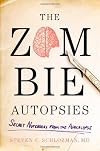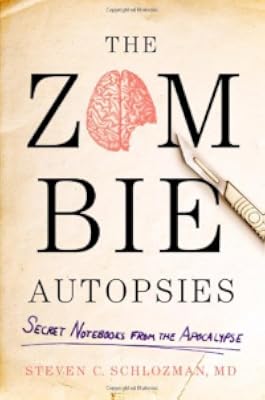
The Zombie Autopsies: Secret Notebooks from the Apocalypse
by Steven C. Schlozman
On This Page
Description
Based on the research of renowned zombie expert Dr. Stanley Blum, performed at a remote island where a crack medical team has been sent to explore a radical theory that may lead to a cure for the zombie epidemic, this notebook documents for the first time the unique biology of zombie organisms.Tags
Recommendations

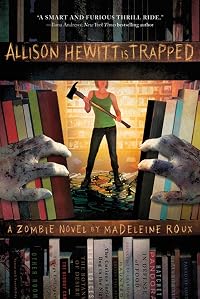
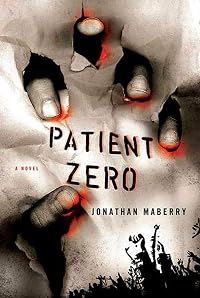
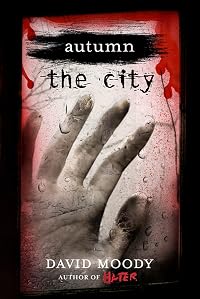
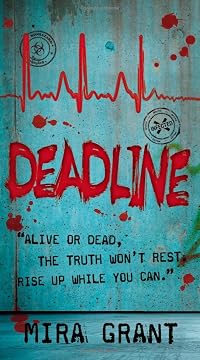
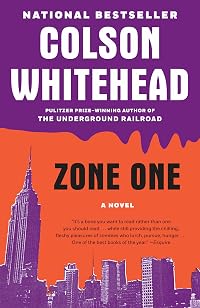

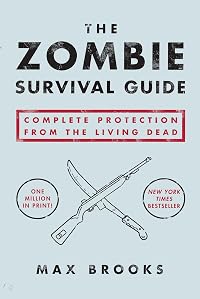
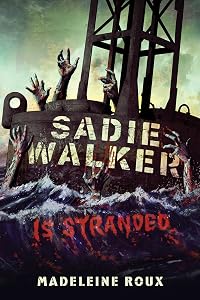

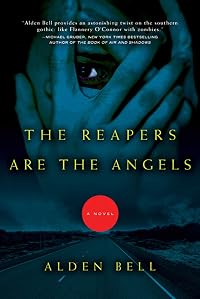


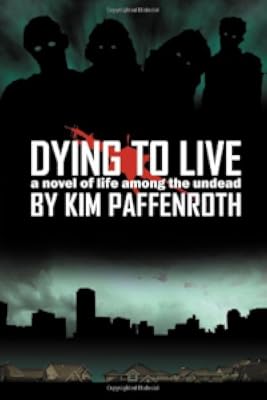

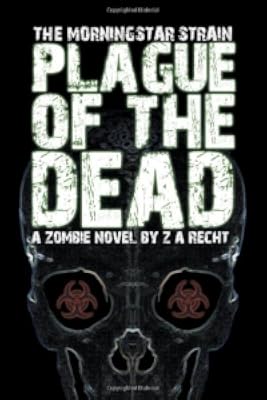
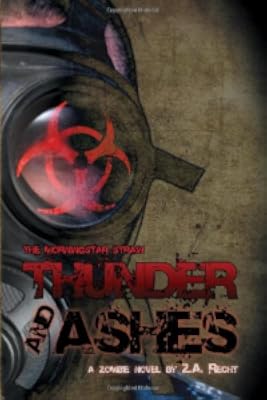
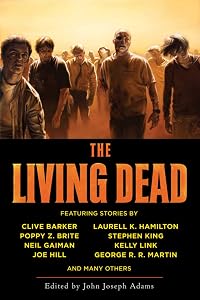
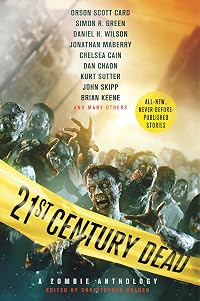
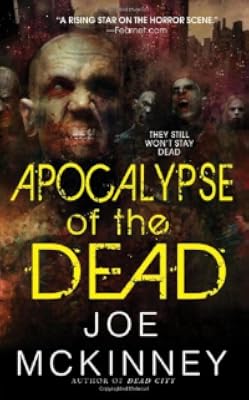

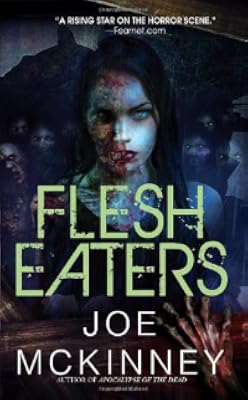
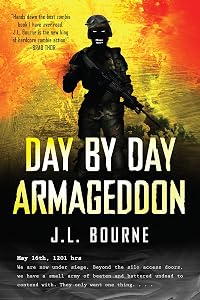

Member Recommendations
Member Reviews
Thank you to the Zombie Research Society for recommending The Zombie Autopsies by Steven Schlozman, M.D., as the March-April Book Club selection. What a fun and unique book. It seems as though lately we have been bombarded with zombies, AMC’s The Walking Dead, Jonathan Maberry’s Patient Zero and Dead of Night, and Max Brooks’ World War Z which is currently in film production with Brad Pitt. Believe me, I am not complaining, but we have definitely seen it done before. While most horror authors incorporate their own spin on the zombie apocalypse in the end the stories are undoubtedly the same; due to some virus/pathogen/nuclear accident the dead reanimate and walk the earth devouring everyone in site in order to satiate their never show more ending hunger. Most of the time the zombie apocalypse is started in a lab, perhaps by some mad scientist or money hungry bureaucrat hoping to cash in on the mayhem, only to be eaten or turned zombie in the end.
What Dr. Schlozman brings us is not a new take on the zombie narrative, but rather a new perspective on the story itself. He does not detail the rampage of the zombie hordes, or the decline of humanity (which is not to be confused with the question of what makes us human which is a recurring theme throughout), but rather forces readers to focus on the medical condition of zombie-ism through a series of firsthand accounts of zombie autopsies, including some wonderfully graphic sketches, as doctors attempt to find the cause of the disease and subsequently a cure. The story is written in first person, by Dr. Stanley Blum, and is a detailed account of the team’s research, observations, and eventual decline as they themselves begin to succumb to the disease. The addition of the seven appendixes after the ‘hand written’ journal, not to mention the official notations scattered throughout, give the story a very realistic feel as readers are thrown into the race to save humanity. A great read, and highly recommended for zombie enthusiasts. show less
What Dr. Schlozman brings us is not a new take on the zombie narrative, but rather a new perspective on the story itself. He does not detail the rampage of the zombie hordes, or the decline of humanity (which is not to be confused with the question of what makes us human which is a recurring theme throughout), but rather forces readers to focus on the medical condition of zombie-ism through a series of firsthand accounts of zombie autopsies, including some wonderfully graphic sketches, as doctors attempt to find the cause of the disease and subsequently a cure. The story is written in first person, by Dr. Stanley Blum, and is a detailed account of the team’s research, observations, and eventual decline as they themselves begin to succumb to the disease. The addition of the seven appendixes after the ‘hand written’ journal, not to mention the official notations scattered throughout, give the story a very realistic feel as readers are thrown into the race to save humanity. A great read, and highly recommended for zombie enthusiasts. show less
Since I do autopsies, it was only a matter of time before somebody gave me this book. I’m not a super big fan of horror, but zombies are a pretty good material. They turn their victims into one of them, which is interesting both literally and allegorically, because charcters who were once allies can turn on each other in short order. This undermines a sense of cooperation among the unafflicted, which can be isolating. Then there’s the whole metaphysical thing with zombies: asking questions about what’s really living and what’s really dead. Zombies are dead, but they're walking around, so what does it mean to be dead then?
So I can get into a good zombie story, if I see one. I had a blast once, watching a zombie moview marathon show more when I was locked on a hospital ward for a weekend. That seems like a weird piece of inforomation to drop without explanation, so I’ll put the details in a spoiler, for those who care:When I was a poor college student, I signed up to make some extra money by taking part in a pharmaceutical study. A drug that was supposed to lower lipid levels was in the human testing phase. To test it, all the participants were locked on a hospital ward for a long weekend (Friday night until Monday night). You couldn’t bring any food with you, and you had to eat what they gave you (mostly macaroni and cheese, as I remember). Then, every hour, on the hour, they’d have people come by and draw some blood. Every hour- even in the middle of the night, they’d wake us up and take a few cc’s of blood! That part was bad because… you know, seventy-two blood draws… my arms looked like I was a heroin addict. So anyhow, the people who signed up for such a thing were either (1) college students who needed money, or (2) very down-on-their-luck people, mostly homeless guys. To pass the time, we mostly played a lot of board games and watched movies. For some reason, the movie selection included a whole mess of zombie movies (as well as, oddly, the movie version of V.C. Andrews’ Flowers In the Attic). Zombies seemed to be a common theme that everybody could agree on.
I can appreciate a good zombie flick, but I didn’t enjoy this book, because it hit on a lot of my personal pet peeves. Before I get into all that, let’s get some things clear right from the start…
This is the part where I get all pedantic and nit-picky about science, and also tell a funny Neuroanatomy story
The zombies in this book aren’t reanimated undead corpses like in Night of the Living Dead; they’re people infected by a virus which attacks the brain, like in 28 Days Later. And the "autopsies" in this book aren’t autopsies (i.e. dissections of cadavers); they’re vivisections (i.e. dissection of functional tissue from a live subject). I’m not trying to be over-critical here, but that will be important to remember later on. The premise of the book is that it contains the notes of a scientist (Dr. Blum) performing studies in a secluded island compound, rushing to find a cure to the zombie plague, designated Ataxic Neurodegenerative Satiety Deficiency Syndrome (ANSD). As Karen and Ceridwen say in their reviews, The Zombie Autopsies (TZA) can be dry at times, describing various neuroanatomy structures, and all the ways the fictional ANSD virus alters healthy tissue. (Unrelated: I‘ll hide a funny Neuroanatomy story in the spoiler. In most medical schools, Neuroanatomy is generally taught as a separate course from the rest of Gross Anatomy. As a resident physician, I taught a part of that class once. I did brain cutting for the class, with brains preserved from autopsies at the nearby VA hospital, where I was working at the time. One afternoon I was running late, and got stopped for speeding, trying to make it to the class on time. I was basically agreeable with the cop, but made the mistake of telling him that I was in a hurry and that was why I was speeding. So I guess to “teach me a lesson” or to be passive-aggressive, he went extra slow with everything, and ran a check on my car, and started to ask me all these questions. I was getting kind of annoyed, and was going to say something, but then I realized I had three human brains in the trunk of my car, and I wasn’t really sure what he would do if he found them. I mean, eventually it would be shown that they were legally obtained, and I was really going to teach a class, but I just had this idea that he would freak out and maybe like wrestle me to the ground or handcuff me or something before he got the full story. I got lucky and he didn’t ask to open the trunk (although without probable cause I had a 4th Amendment Right to refuse, but I’m not sure I knew that back then). I’ve always wondered what would have happened if the police officer had found those brains. ) I think the author’s intent here was to create a very clinical and dispassionate experience, to heighten the sense of realism. Of course realism may not always be such a great thing... most autopsy reports are not exciting to read. Never mind that. Since author Steven Schlozman took such pains to be realistic, I feel justified in making two criticisms about scientific aspects of the book:
1) If the very fate of mankind depended on finding a cure to ANSD, I am sure researchers would be provided all the resources they needed; all the best equipment, etc. The stated reason for main character Dr. Blum performing vivisection was so he could visualize a functional infected zombie brain. This is exactly what Positron Emission Tomography (PET) was invented for. PET scans have the added advantage of not destroying the brain in the process of studying it, which is what Blum does in the book. There is also something new called functional MRI, which seems similar, but it’s fairly new, and I don’t know much about how you’re supposed to use it.
2) Schlozman goes out of his way to show how the ANSD virus spares only the parts of the brain it needs for zombies to move around and attack people. In the course of his dissection, Blum removes the top of the cranium and digs down to get at the hypothalamus. In his notes, he observes that the frontal lobe is virtually destroyed, and much of the remaining brain is severely distorted, implying extensive destruction:
I guess there can be such thing as a suspension of scientific disbelief in fiction. Science fiction stories often feature faster-than-light travel, which I'm told is impossible. Obviously the realism in this story has to break down somewhere, since the ANSD and humanoid zombies aren’t real. It’s just that Schlozman seemed so meticulous up to that point. In that regard, this book reminds me of things like blueprints to the U.S.S. Enterprise, or [book:The Atlas of Middle Earth|92003]. They’re like the infrastructure of a larger fictional world. I have no problem with that- it can be fun.
This is the part where I get all preachy and holier-than-thou
What bothers me about the world being created here is that Schlozman -a physician- seemed too easily accepting of the idea that the “zombies” of this book are not human, even though the premise is that they are just regular people infected with a virus (as opposed to something supernatural, like animated corpses). The narration explains that once ANSD progresses to a certain point, victims are designated “no longer human” (NLH), and lose all their rights. (e.g. (#291)
For as long as there have been healing arts, there have been temptations to discard the altruistic principles of medicine. It’s always a Faustian bargain, so I call bullshit on this yarn which glamorizes a Jack-Bauer-as-pathologist ethos of dehumanization of patients. That’s not what medicine is about; or at least not what it was about. Most of the history of medicine is one of extraordinary selflessness. For centuries, doctors risked their lives comforting patients afflicted with gruesome contagious diseases like leprosy, tuberculosis, and bubonic plague. Some of that altruism is harder to see these days. Physicians still work long hours and make a lot of sacrifices for their careers, but most of them (us) are also very well compensated. It isn’t outrageous to wonder whether the spirit of benevolence in medicine persists, now that risks are lower and pay is higher. Schlozman should know better than to play around with these perceptions.
Well, enough about that.
This is where I bitch about the police state and Apocalypse porn
The other aspect of TZA that disturbs me is the whole police state theme. Not only does this story feature a United Nations (who else?) declaring the infected “No Longer Human”, you’ve also got them outlawing zombie movies and books, because said materials “might upset the population”. At #34, we’re told “Most of the governed world is under martial law.“ Information about the spread of the plague is kept from the public “to avoid a panic”. Emergencies are a great opportunity to flex the muscles of authoritarianism, aren’t they? Unfortunately, this is by no means unique to The Zombie Autopsies. You’ll find some variation of paramilitary fetishism in most zombie/plague/meteor-hitting-the-Earth/ economic collapse/ World War III literature. I guess fans of Apocalypse porn get off on heavy-handed “continuity of government” shit. I suspect it’s a latent Submissive fixation, maybe tied in with guilt about our modern world having caused all these disasters in the first place.
So back to the book. What’s with this idea about withholding vital information from the public? I wish this was just in fiction, but it isn’t. Do a search and find out how much information the Japanese government is currently blocking from the public about radiation levels around Fukushima. Check this out. Or how about this? How about this?
Then there’s the issue of law enforcement during emergencies. Sure, looting does occur during periods of upheaval and desperation, but what is the correct response? Do your own search of United Nations troops being sent into unstable areas to provide some law and order. Here’s what I got in five minutes:
Sex abuse by U.N. troops in Sudan
U.N. Peacekeepers Raping Children in the Congo
Sex Abuse by U.N. troops in Haiti
Corruption and Cover-up by U.N. Forces
U.N. Troops involved with smuggling and arms dealing
Corruption within U.N. Peacekeeping Forces
My point is that a lot of fiction seem to assume that martial law will follow calamity, but a lot of real-life experience shows that even the limited martial law of U.N. peacekeeping isn't necessarily better than calamity. The desirability of martial law admidst upheaval is an assumption which should be questioned. If there’s a zombie plague apocalypse, seeing an armored troop carrier roll into town, bearing the big blue U.N. logo on its side won’t make me feel any better about things.
UPDATE: [March 9, 2012] THIS JUST IN: great link about Apocalypse Porn
Wrap-up
TZA is an okay, if bleak, story- provided you want to wade through a lot of clinical descriptions about a brain dissection, and you don’t mind a lot of predictive programming about how the police state will be your savior. My advice: skip this book and rent yourself George A. Romero’s 1968 classic Night of the Living Dead. show less
So I can get into a good zombie story, if I see one. I had a blast once, watching a zombie moview marathon show more when I was locked on a hospital ward for a weekend. That seems like a weird piece of inforomation to drop without explanation, so I’ll put the details in a spoiler, for those who care:
I can appreciate a good zombie flick, but I didn’t enjoy this book, because it hit on a lot of my personal pet peeves. Before I get into all that, let’s get some things clear right from the start…
This is the part where I get all pedantic and nit-picky about science, and also tell a funny Neuroanatomy story
The zombies in this book aren’t reanimated undead corpses like in Night of the Living Dead; they’re people infected by a virus which attacks the brain, like in 28 Days Later. And the "autopsies" in this book aren’t autopsies (i.e. dissections of cadavers); they’re vivisections (i.e. dissection of functional tissue from a live subject). I’m not trying to be over-critical here, but that will be important to remember later on. The premise of the book is that it contains the notes of a scientist (Dr. Blum) performing studies in a secluded island compound, rushing to find a cure to the zombie plague, designated Ataxic Neurodegenerative Satiety Deficiency Syndrome (ANSD). As Karen and Ceridwen say in their reviews, The Zombie Autopsies (TZA) can be dry at times, describing various neuroanatomy structures, and all the ways the fictional ANSD virus alters healthy tissue. (Unrelated: I‘ll hide a funny Neuroanatomy story in the spoiler.
1) If the very fate of mankind depended on finding a cure to ANSD, I am sure researchers would be provided all the resources they needed; all the best equipment, etc. The stated reason for main character Dr. Blum performing vivisection was so he could visualize a functional infected zombie brain. This is exactly what Positron Emission Tomography (PET) was invented for. PET scans have the added advantage of not destroying the brain in the process of studying it, which is what Blum does in the book. There is also something new called functional MRI, which seems similar, but it’s fairly new, and I don’t know much about how you’re supposed to use it.
2) Schlozman goes out of his way to show how the ANSD virus spares only the parts of the brain it needs for zombies to move around and attack people. In the course of his dissection, Blum removes the top of the cranium and digs down to get at the hypothalamus. In his notes, he observes that the frontal lobe is virtually destroyed, and much of the remaining brain is severely distorted, implying extensive destruction:
“the sulci are so wide that there is an absence of gyrations altogether. The fundamental architecture of the frontal lobe is gone, missing. It’s like soup.”Not to nitpick, but the Primary Motor Cortex (M1) is located in the frontal lobe. If that was destroyed, the zombies would not be motile; they’d be paralyzed. Actually, the frontal lobe is very important for motion (Reference).
I guess there can be such thing as a suspension of scientific disbelief in fiction. Science fiction stories often feature faster-than-light travel, which I'm told is impossible. Obviously the realism in this story has to break down somewhere, since the ANSD and humanoid zombies aren’t real. It’s just that Schlozman seemed so meticulous up to that point. In that regard, this book reminds me of things like blueprints to the U.S.S. Enterprise, or [book:The Atlas of Middle Earth|92003]. They’re like the infrastructure of a larger fictional world. I have no problem with that- it can be fun.
This is the part where I get all preachy and holier-than-thou
What bothers me about the world being created here is that Schlozman -a physician- seemed too easily accepting of the idea that the “zombies” of this book are not human, even though the premise is that they are just regular people infected with a virus (as opposed to something supernatural, like animated corpses). The narration explains that once ANSD progresses to a certain point, victims are designated “no longer human” (NLH), and lose all their rights. (e.g. (#291)
“We don’t even afford the same rights to zombies that we do to lab rats- not because we want to hurt them, but because time is short and enacting those rights and safeguards takes time.”) That’s why no family or guardian consent is discussed when subjecting the NLH zombies to vivisection. Don’t get all up in my grill about how this is fiction, and what an apocalyptic scenario the zombie plague is, and how "desperate situations call for desperate measures"; you aren’t going to convince me that doctors abandoning their humanity or the principle of “Above all, do no harm” could ever be a good thing. From the author’s bio, I see that Dr Schlozman is a psychiatrist, and so should be sensitive to the fact that it wasn’t so very long ago that the mentally ill were treated as something akin to “no longer human”. And, yes, Godwin’s Law-be-damned, I’m going to go there: Nazi doctors also practiced an alien and offensive medicine, when they allowed themselves to believe certain of their patients were “no longer human” (by virtue of being on the Third Reich’s list of undesirables). More recently, there is disturbing evidence in the 2004 CIA Inspector General’s report that American doctors may have also fallen for the “desperate situations call for desperate measures” line, and participated in waterboarding of detainees held in Guantanamo Bay.
For as long as there have been healing arts, there have been temptations to discard the altruistic principles of medicine. It’s always a Faustian bargain, so I call bullshit on this yarn which glamorizes a Jack-Bauer-as-pathologist ethos of dehumanization of patients. That’s not what medicine is about; or at least not what it was about. Most of the history of medicine is one of extraordinary selflessness. For centuries, doctors risked their lives comforting patients afflicted with gruesome contagious diseases like leprosy, tuberculosis, and bubonic plague. Some of that altruism is harder to see these days. Physicians still work long hours and make a lot of sacrifices for their careers, but most of them (us) are also very well compensated. It isn’t outrageous to wonder whether the spirit of benevolence in medicine persists, now that risks are lower and pay is higher. Schlozman should know better than to play around with these perceptions.
Well, enough about that.
This is where I bitch about the police state and Apocalypse porn
The other aspect of TZA that disturbs me is the whole police state theme. Not only does this story feature a United Nations (who else?) declaring the infected “No Longer Human”, you’ve also got them outlawing zombie movies and books, because said materials “might upset the population”. At #34, we’re told “Most of the governed world is under martial law.“ Information about the spread of the plague is kept from the public “to avoid a panic”. Emergencies are a great opportunity to flex the muscles of authoritarianism, aren’t they? Unfortunately, this is by no means unique to The Zombie Autopsies. You’ll find some variation of paramilitary fetishism in most zombie/plague/meteor-hitting-the-Earth/ economic collapse/ World War III literature. I guess fans of Apocalypse porn get off on heavy-handed “continuity of government” shit. I suspect it’s a latent Submissive fixation, maybe tied in with guilt about our modern world having caused all these disasters in the first place.
“That’s right… dominate us, we’ve been a bad public! Strip us down in the airport, and shove your hands down our pants! We deserve it! We made all this trouble happen! Humiliate us! Show us who’s boss! God! We can’t get enough! Scan our retinas! Put RFID chips under our skin! Mmmmm, just like that, baby! We’ve been baddddddd!“Sick fucks.
So back to the book. What’s with this idea about withholding vital information from the public? I wish this was just in fiction, but it isn’t. Do a search and find out how much information the Japanese government is currently blocking from the public about radiation levels around Fukushima. Check this out. Or how about this? How about this?
Then there’s the issue of law enforcement during emergencies. Sure, looting does occur during periods of upheaval and desperation, but what is the correct response? Do your own search of United Nations troops being sent into unstable areas to provide some law and order. Here’s what I got in five minutes:
Sex abuse by U.N. troops in Sudan
U.N. Peacekeepers Raping Children in the Congo
Sex Abuse by U.N. troops in Haiti
Corruption and Cover-up by U.N. Forces
U.N. Troops involved with smuggling and arms dealing
Corruption within U.N. Peacekeeping Forces
My point is that a lot of fiction seem to assume that martial law will follow calamity, but a lot of real-life experience shows that even the limited martial law of U.N. peacekeeping isn't necessarily better than calamity. The desirability of martial law admidst upheaval is an assumption which should be questioned. If there’s a zombie plague apocalypse, seeing an armored troop carrier roll into town, bearing the big blue U.N. logo on its side won’t make me feel any better about things.
UPDATE: [March 9, 2012] THIS JUST IN: great link about Apocalypse Porn
Wrap-up
TZA is an okay, if bleak, story- provided you want to wade through a lot of clinical descriptions about a brain dissection, and you don’t mind a lot of predictive programming about how the police state will be your savior. My advice: skip this book and rent yourself George A. Romero’s 1968 classic Night of the Living Dead. show less
As a big fan of "War Day" and "World War Z," I was primed to fall in love with this journal of the zombie apocalypse (with drawings!), but the over-focus on sleuthing out the medical cause behind the zombie plague, while a good set-up for a story, got in the way of building suspense. Three quarters of the way through, I began to skim just to see if the plot would move in an unexpected (and scary) direction, but the "action" in the book remains a detailed analysis of the disease by an increasingly ill scientist. The drawings reminded me of a less able version of the sketches by Stephen Gammell from the "Scary Stories to Tell in the Dark" series. Though gruesome, they actually ended up taking away from the horror of the story because show more nothing about the infected humans or the dissection room was left to the imagination. I've got a soft spot for most zombie books, and I love an author who takes the time to build an authentic-feeling set-up, but this book didn't send shivers up my spine. show less
The Zombie Autopsies is an unusual take on the zombie novel genre. It primarily takes the form of the hand-written notebook found with the body of a scientist at a facility where research on a pandemic of disease-induced zombiism is under study. The text can be repetetive when the narrative moves from scientific observation or research to the character's efforts to emotionally cope with the situation, but the scientific parts are somewhat interesting, provided the reader has an interest in reading a book which primarily seems devoted to theorizing how a zombie pandemic might actually occur. On the plus side, the theory of infection presented was something I hadn't read before... on the minus side, it was neither complete in its show more explanation nor particularly appealing as regards my "zombie apocalypse" preferences. I do give credit to the author for trying, but given that the story was almost entirely lacking in drama or action, an incomplete explanation of the biology of infection is a severe shortfall. In addition, the latter portion of the book is largely comprised of appendices of questionable interest... a glossary of terms, a brief history of the outbreak in sparse detail, a U.N. resolution regarding the outbreak, a few more pages of personal reflections of primary characters, and a flowchart of the "Gutierrez Protocol" for slowing the progression of infection. Mostly fluff. It's a shame, because it would seem that the author is knowledgable in the field of medicine, and I'd love to see more theories from medical professionals as to how a zombie apocalypse could actually take place, but this one I'd have to say is a letdown. To the author, keep trying, and better luck next time. show less
Written like the diary/notes of a scientist sent to a special lab to dissect zombie and find a cure. The diary part was interesting and entertaining but the rest that commented on the diary was kind of boring.
[July 24, 2012] "The Zombie Autopsies" is not going to be everyone's "cup of tea." Readers should be warned that the description of the autopsy procedures - along with accompanying illustrations - is quite graphic. But I found the book very engaging. Because the zombie pandemic has destroyed much of civilization, scientists anxious to learn more about what causes "zombiism" accept a no-return assignment on a remote island to conduct these autopsies under, you might say, less than ideal conditions. As a scientist I appreciated the author's use of technical detail; this lent the book a certain realism. As a human being I could appreciate the ethical dilemmas society encounters in how to move forward with zombie research. While the show more appendices to the book comprise a large fraction of the story, I believe they add to the overall story.
The book was not overlong, it was fun to read, and interesting. That's a pretty good formula if you ask me. show less
The book was not overlong, it was fun to read, and interesting. That's a pretty good formula if you ask me. show less
Zombie Autopsies (Secret Notebooks From the Apocalypse)
Steven C. Schlozman, M.D.
Illustrated by Andrea Sparacio
Hardcover
208 pages
Grand Central Publishing
Publication Date: March 25, 2011
ISBN: 978-0446564663
We've seen our share of zombie survival narratives, zombie war tales, zombie diaries , and even zombie romances, as well as various guides, manuals, and required weapons lists for combating the shambling-dead. Zombie Autopsies (Secret Notebooks From the Apocalypse), on the other hand, is a story that focuses on the clinical aspects of the coming zombie apocalypse. Drawn heavily on medical, scientific, and forensic jargon, exposition, and illustrations Zombie Autopsies relies too much on the quantifiable and too little on the show more speculative. By that I mean that this book fails to deliver a memorable piece of fiction beneath too much scientific research and medical rationalization.
At the onset I thought the premise of zombie forensics intriguing. It was, for instance, the first time I’d seen this particular living-dead trope and thought, if handled correctly, could be a unique and entertaining story. Most of you already know that I truly do enjoy a good post-apocalyptic zombie yarn but I really had difficulty with Zombie Autopsies. Mixed in with the analytical descriptions, autopsy reports, medical illustrations, and scientific journals is an interesting fictional account of the walking-dead but the plot gets overwhelmed by too much scientific exposition. This story would have been significantly better had the percentages of technical explanation and plot-driven narrative been reversed. In all honesty, the zombie tale itself, when it does surface, is really a pretty good one and the illustrations are interesting and quite graphic but, in my opinion, the story should have guided the medical reporting rather than the other way around. Mr. Schlozman would have had a much better story had he done so.
If you enjoy all the bloody, gory details of actual autopsies, like to view cross-sectioned diagrams of cancerous or diseased organs, or are curious about the anatomical changes that might occur during the process of zombification then this book is for you. Otherwise, I’d look for other, more narrative- and less clinical- driven zombie tales to read.
2 ½ stars out of 5
The Alternative
Southeast Wisconsin show less
Steven C. Schlozman, M.D.
Illustrated by Andrea Sparacio
Hardcover
208 pages
Grand Central Publishing
Publication Date: March 25, 2011
ISBN: 978-0446564663
We've seen our share of zombie survival narratives, zombie war tales, zombie diaries , and even zombie romances, as well as various guides, manuals, and required weapons lists for combating the shambling-dead. Zombie Autopsies (Secret Notebooks From the Apocalypse), on the other hand, is a story that focuses on the clinical aspects of the coming zombie apocalypse. Drawn heavily on medical, scientific, and forensic jargon, exposition, and illustrations Zombie Autopsies relies too much on the quantifiable and too little on the show more speculative. By that I mean that this book fails to deliver a memorable piece of fiction beneath too much scientific research and medical rationalization.
At the onset I thought the premise of zombie forensics intriguing. It was, for instance, the first time I’d seen this particular living-dead trope and thought, if handled correctly, could be a unique and entertaining story. Most of you already know that I truly do enjoy a good post-apocalyptic zombie yarn but I really had difficulty with Zombie Autopsies. Mixed in with the analytical descriptions, autopsy reports, medical illustrations, and scientific journals is an interesting fictional account of the walking-dead but the plot gets overwhelmed by too much scientific exposition. This story would have been significantly better had the percentages of technical explanation and plot-driven narrative been reversed. In all honesty, the zombie tale itself, when it does surface, is really a pretty good one and the illustrations are interesting and quite graphic but, in my opinion, the story should have guided the medical reporting rather than the other way around. Mr. Schlozman would have had a much better story had he done so.
If you enjoy all the bloody, gory details of actual autopsies, like to view cross-sectioned diagrams of cancerous or diseased organs, or are curious about the anatomical changes that might occur during the process of zombification then this book is for you. Otherwise, I’d look for other, more narrative- and less clinical- driven zombie tales to read.
2 ½ stars out of 5
The Alternative
Southeast Wisconsin show less
Members
- Recently Added By
Author Information
2 Works 204 Members
Common Knowledge
- Original publication date
- 2011
- Blurbers
- Brooks, Max; Romero, George A.; Palahniuk, Chuck; Grahame-Smith, Seth; Maberry, Jonathan
Classifications
Statistics
- Members
- 204
- Popularity
- 160,706
- Reviews
- 17
- Rating
- (3.11)
- Languages
- English, Spanish
- Media
- Paper, Audiobook, Ebook
- ISBNs
- 11
- ASINs
- 2