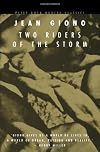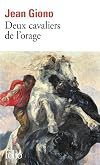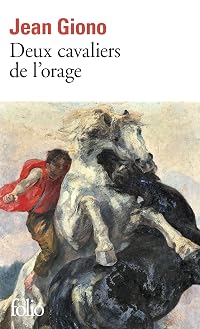
Two Riders of the Storm
by Jean Giono
On This Page
Description
Two brothers, Marceau and Ange Jason, are members of a family renowned and respected for its brutality and are therefore bound together with ties stronger than those of ordinary brotherly love. This affection soon turns to hatred after Marceau kills a wild horse with a single blow at a country fair, becoming the local wrestling champion. As his strength increases and his fame spreads, the younger sibling's jealousy causes this bond to snap. The end, when it comes, is a violent--and show more deadly--confrontation. Two Riders of the Storm is a story of a Cain-and-Abel-like struggle for supremacy in its most primitive form described with an intense and stark poetic beauty that transforms the brutal imagery into elemental forces of life death. show lessTags
Recommendations


















Member Reviews
A marvelous work; the writing is some of Giono’s best. This is not the gentle pre-war Giono of Second Harvest (Regain) or Joy of Man’s Desiring but the embittered postwar man, a man with good reason to have changed his view of the world. Unique image follows unique image, indelible lines in a paragraph. Giono’s delineation of his characters seems to me exceptional, in part for how he strikingly does it through conversation and in particular the words not said. As is often the case, Giono pays great attention to the natural world, partly for its own sake and partly for the way in which doing so illuminates the characters and the story. But Giono is also a master at drawing characters through their interactions with others.
The story show more takes place in the high plains of Provence, deep in the mountains. Villages are small and insular, personalities large and quirky and distinct, and the environment is inseparable from the daily life of its inhabitants. Strangers are viewed with distrust or suspicion. Appetites and behaviors of all kinds are outsized. Marceau Jason and his much-younger brother Ange are inseparable and Giono goes out of his way in the beginning to emphasize just how much Marceau worships his younger brother. A long early chapter defines the women around them—their mother, their wives, and an old widow in their village. The women are drawn almost exclusively through their interminable conversation, one that captures the nuances and idiosyncrasies of each woman. There is little overarching plot; the novel is mostly vignettes of the brothers’ lives. Ange has grown up watching Marceau perform feats of superhuman strength and he finally demands of him “recognition with honor.” Although Ange is a large and powerful man, Marceau is an enormous, almost unreal, giant of a man. Ange is still young and places too little value on the unmistakable love that Marceau has for him. His gauge of recognition—a wrestling match, a test of strength—is not a fight at all. It is, instead, the tale of an impatient young man and younger brother eager to test himself, to prove himself against his much older, stronger, brother…his idol. Tragically, neither Ange nor Marceau knows how to do anything except completely, with all their heart, and without any constraint. And so the wrestling match that Ange has demanded as his measure of his recognition becomes not a friendly contest but a life-and-death struggle of sickening violence. The match ends predictably but novel continue, with an ending which I leave to those who will read this remarkable book. The end is not quite predictable, not quite understandable, an ending not of jealousy or even of hatred but of a deep and abiding love. show less
The story show more takes place in the high plains of Provence, deep in the mountains. Villages are small and insular, personalities large and quirky and distinct, and the environment is inseparable from the daily life of its inhabitants. Strangers are viewed with distrust or suspicion. Appetites and behaviors of all kinds are outsized. Marceau Jason and his much-younger brother Ange are inseparable and Giono goes out of his way in the beginning to emphasize just how much Marceau worships his younger brother. A long early chapter defines the women around them—their mother, their wives, and an old widow in their village. The women are drawn almost exclusively through their interminable conversation, one that captures the nuances and idiosyncrasies of each woman. There is little overarching plot; the novel is mostly vignettes of the brothers’ lives. Ange has grown up watching Marceau perform feats of superhuman strength and he finally demands of him “recognition with honor.” Although Ange is a large and powerful man, Marceau is an enormous, almost unreal, giant of a man. Ange is still young and places too little value on the unmistakable love that Marceau has for him. His gauge of recognition—a wrestling match, a test of strength—is not a fight at all. It is, instead, the tale of an impatient young man and younger brother eager to test himself, to prove himself against his much older, stronger, brother…his idol. Tragically, neither Ange nor Marceau knows how to do anything except completely, with all their heart, and without any constraint. And so the wrestling match that Ange has demanded as his measure of his recognition becomes not a friendly contest but a life-and-death struggle of sickening violence. The match ends predictably but novel continue, with an ending which I leave to those who will read this remarkable book. The end is not quite predictable, not quite understandable, an ending not of jealousy or even of hatred but of a deep and abiding love. show less
Ratings
Members
- Recently Added By
Author Information

203+ Works 6,986 Members
Jean Giono was born in France on March 30, 1985. He was an author about whom Germaine Bree and M. Guiton have written, "When Giono's first novel, Colline (Hill of Destiny) appeared in 1929, it struck a fresh, new note. . . . After Proust and Gide, Duhamel and Romains, Cocteau and Giraudoux, what could be more restful than a world of wind and sun show more and simple men who apparently had never heard of psychological analysis, never confronted any social problems, never read any books. . ." (An Age of Fiction). Raised by his shoemaker father in a small town in the south of France, Giono's fiction has its roots in the peasant life of Provence. Horrified by his experiences in World War I, Giono returned to the world of his youth, which became the world of his imagination. After the shock of World War II, his novels seemed to gain in stature. One of his best is Horseman on the Roof (1951), his chronicle of the great cholera epidemic of 1838. Giono was honoured with the Prince Rainier of Monaco literary prize in 1953, awarded for his lifetime achievements, was elected to the Académie Goncourt in 1954, and became a member of the Conseil Littéraire of Monaco in 1963. Giono died of a heart attack in 1970. (Bowker Author Biography) show less
Series
Belongs to Publisher Series
Gallimard, Folio (198)
Common Knowledge
- Canonical title
- Two Riders of the Storm
- Original title
- Deux cavaliers de l'orage
Classifications
Statistics
- Members
- 60
- Popularity
- 515,840
- Reviews
- 1
- Rating
- (4.19)
- Languages
- English, French, Italian
- Media
- Paper, Ebook
- ISBNs
- 7
- ASINs
- 4