On This Page
Description
A James Bond thriller set in the present day finds the iconic British spy engaging a horrific modern villain in a cat-and-mouse chase that takes him from the Balkans and London to the African Continent.Tags
Recommendations



















Member Reviews
In the latest addition to the Bond canon, Jeffery Deaver takes our favourite thirty-something secret agent, uproots him from the 1960s and transplants him firmly into the twenty-first century, in the same way that the film of Casino Royale did a few years ago. The Bond I envisaged though wasn’t the gorgeous Daniel Craig, but the original and best, Sean Connery, and Deaver has succeeded in bringing Fleming’s original character up to date. All the trademarks were there – cars, quality booze, jet-setting, and women, including the superfluously named Felicity Willing! As far as women go though, this modern Bond has a very slight vulnerability – he is deeply attracted to his new secretary, Ophelia (Phillly) Maidenhead – a girl who show more rides a motorcycle. She does have a fiancé though, and Bond isn’t going to intrude.
The plot moves on at a cracking pace in typical Deaver style with, as he puts it, a surprise ending every few chapters. The surprises are not always cliff-hangers either – there is even the odd anti-climax or two which ups the ante for the next biggie. We start in Serbia, before moving to London and environs, then Dubai and Cape Town – all perfect locations for action.
The main baddie is a typical megalomaniac with a modern field of business – recycling – in all aspects you can think of. He is a nasty man who has a peccadillo – a lust for examining death and decay – from still alive but ageing, beauty queens to exhumed corpses. This fetish leads him to need fresh newly killed bodies to explore, and a partnership with an skilled Irishman who, throughout the book, remains almost unreadable. Together they have hatched the ‘Gehenna’ plot, and Bond will have to go undercover and use all the technology and personnel at his disposal to foil it. The moment I heard the word ‘Gehenna’ though, my alarm bells started ringing. Surely, using names such as a Jewish word for Hell for one’s dastardly plot, would similarly set klaxons off at GCHQ and other monitoring stations. Why don’t baddies choose fluffy names for their dastardly deeds?
Fleming may have been one of the first authors to use branding to highlight the lifestyle of his hero – Dom Peringnon and Aston Martins spring to mind, but Deaver takes that concept and slight overdid it for me. He also never forgets to let us know he’s updated the scenario – I found the constant reminders that we’re now in the 21st century were all too plentiful. Mentions of Top Gear, Guy Ritchie films, and the Two Ronnies(!), which are all so of their time, will date this book in a way that keeping it classic, as Fleming did, won’t. The one area of direct homage to Fleming is Deaver/Bond’s creation of a new cocktail – viz the ‘Vesper’ inCasino Royale. For info, a Carte Blanche is a double Crown Royal over ice (a Canadian Whisky I’m unfamiliar with), half a measure of triple sec, two dashes of bitters and a twist of orange peel.
On the whole, I thought Deaver’s Bond was well done – he’s obviously researched long and hard to make sure he got it right, going back to the original novels. The result is a good hybrid of Fleming’s Bond in a Deaver thriller. A few little Americanisms appeared to have got through – a woman is ‘keyboarding’ rather than typing at a computer for instance – but that is small beer. Deaver’s expertise in modern tradecraft is also admirable, but does require much explanation for all the new technology at Bond’s disposal. One nice thing was that Deaver has delved into Bond’s back-story to bring tantalising glimpses of growing up to life.
The supporting characters were great – especially Philly, and Percy Osborne-Smith, Bond’s counterpart in MI5. The love interests though were rather subdued, sublimated to the driving pace of the plot; (if this gets filmed, no doubt, they’ll be more prominent). The villains may have been rather one-dimensional as regards their personalities, but the detail they brought to the plot was impressive. The bickering between the government agencies made up for any deficiencies there though, and we get reminded of M’s first name … first revealed in Moonraker, but my lips are sealed.
In summary, this book is not perfect, but it was great fun, and a must for any Bond fan. (7.5/10) show less
The plot moves on at a cracking pace in typical Deaver style with, as he puts it, a surprise ending every few chapters. The surprises are not always cliff-hangers either – there is even the odd anti-climax or two which ups the ante for the next biggie. We start in Serbia, before moving to London and environs, then Dubai and Cape Town – all perfect locations for action.
The main baddie is a typical megalomaniac with a modern field of business – recycling – in all aspects you can think of. He is a nasty man who has a peccadillo – a lust for examining death and decay – from still alive but ageing, beauty queens to exhumed corpses. This fetish leads him to need fresh newly killed bodies to explore, and a partnership with an skilled Irishman who, throughout the book, remains almost unreadable. Together they have hatched the ‘Gehenna’ plot, and Bond will have to go undercover and use all the technology and personnel at his disposal to foil it. The moment I heard the word ‘Gehenna’ though, my alarm bells started ringing. Surely, using names such as a Jewish word for Hell for one’s dastardly plot, would similarly set klaxons off at GCHQ and other monitoring stations. Why don’t baddies choose fluffy names for their dastardly deeds?
Fleming may have been one of the first authors to use branding to highlight the lifestyle of his hero – Dom Peringnon and Aston Martins spring to mind, but Deaver takes that concept and slight overdid it for me. He also never forgets to let us know he’s updated the scenario – I found the constant reminders that we’re now in the 21st century were all too plentiful. Mentions of Top Gear, Guy Ritchie films, and the Two Ronnies(!), which are all so of their time, will date this book in a way that keeping it classic, as Fleming did, won’t. The one area of direct homage to Fleming is Deaver/Bond’s creation of a new cocktail – viz the ‘Vesper’ inCasino Royale. For info, a Carte Blanche is a double Crown Royal over ice (a Canadian Whisky I’m unfamiliar with), half a measure of triple sec, two dashes of bitters and a twist of orange peel.
On the whole, I thought Deaver’s Bond was well done – he’s obviously researched long and hard to make sure he got it right, going back to the original novels. The result is a good hybrid of Fleming’s Bond in a Deaver thriller. A few little Americanisms appeared to have got through – a woman is ‘keyboarding’ rather than typing at a computer for instance – but that is small beer. Deaver’s expertise in modern tradecraft is also admirable, but does require much explanation for all the new technology at Bond’s disposal. One nice thing was that Deaver has delved into Bond’s back-story to bring tantalising glimpses of growing up to life.
The supporting characters were great – especially Philly, and Percy Osborne-Smith, Bond’s counterpart in MI5. The love interests though were rather subdued, sublimated to the driving pace of the plot; (if this gets filmed, no doubt, they’ll be more prominent). The villains may have been rather one-dimensional as regards their personalities, but the detail they brought to the plot was impressive. The bickering between the government agencies made up for any deficiencies there though, and we get reminded of M’s first name … first revealed in Moonraker, but my lips are sealed.
In summary, this book is not perfect, but it was great fun, and a must for any Bond fan. (7.5/10) show less
James Bond: Organization Man? Say it ain’t so!
Yet this is exactly what Jeffery Deaver has given us in Carte Blanche, his reboot of the 007 franchise.
And the result is a pretty terrible book.
While Deaver is intent on reiterating Bond’s tastes in fast cars, sharp attire, and quality booze, he misses what originally made 007 such an iconic figure. Ian Fleming’s James Bond, arising from the conformism of the 1950s, carried the appeal of being an outsider within the system, someone who exercised the freedom of his “licensed-to-kill” status to create his own rules, bucking convention. Fleming’s Bond worked on very long tether from HQ as he pursued his quarries, as in his search for his nemeses from SPECTRE. He could be cold and show more arrogant, definitely not a team player. While a reader certainly roots for him, there are occasions that same reader might not be sure whether he likes him. Critics even came to characterize him an “anti-hero.” (In contrast to Deaver, the cinematic reboot casting Daniel Craig as 007 actually captures these character traits quite well.)
Deaver, on the other hand, wants to have a likeable James Bond, who loves his parents, cares about world hunger, only wounds his attackers if he doesn’t absolutely have to kill them, and is always “phoning home.” His relationships with all his colleagues at HQ are warm and chummy. His apartment decorations reflect sentimentality. Even in pursuit of a bad guy, Bond takes time to “smell the flowers,” noticing the beauty of his surroundings. At one point, Deaver has Bond asked himself, “What would M do in this situation?”—something Fleming’s Bond would never be caught doing. This is a sanitized Boy’s Life version of James Bond (an appropriate metaphor in more ways than one, since the book feels like it was written at a sixth-grade level).
As for the central villain, he’s a cipher, nothing more than a cardboard cut-out. Again, one of things that Deaver neglects is that Ian Fleming created villains who were memorable because they were even matches with Bond. 007’s confrontations with Le Chiffre, Drax, Goldfinger, and Blofeld held tension because they were resolved through a battle of wits, not gadgets. Over and over again in Carte Blanche, Bond proves he’s at least one step ahead of his adversaries, having outthought them at every step. In every one of these instances, the reader feels cheated because even when it seems Bond in danger, it is later revealed he wasn’t in danger at all because 007 had taken all the options into account and already taken countermeasures to keep the upper hand.
Fleming's 007 was a character who would probably be pretty insufferable if you had him as a friend, but he made for some pretty riveting adventures. Deaver's Bond is someone who would probably prove to be a good friend, but all in all, that makes him pretty boring. show less
Yet this is exactly what Jeffery Deaver has given us in Carte Blanche, his reboot of the 007 franchise.
And the result is a pretty terrible book.
While Deaver is intent on reiterating Bond’s tastes in fast cars, sharp attire, and quality booze, he misses what originally made 007 such an iconic figure. Ian Fleming’s James Bond, arising from the conformism of the 1950s, carried the appeal of being an outsider within the system, someone who exercised the freedom of his “licensed-to-kill” status to create his own rules, bucking convention. Fleming’s Bond worked on very long tether from HQ as he pursued his quarries, as in his search for his nemeses from SPECTRE. He could be cold and show more arrogant, definitely not a team player. While a reader certainly roots for him, there are occasions that same reader might not be sure whether he likes him. Critics even came to characterize him an “anti-hero.” (In contrast to Deaver, the cinematic reboot casting Daniel Craig as 007 actually captures these character traits quite well.)
Deaver, on the other hand, wants to have a likeable James Bond, who loves his parents, cares about world hunger, only wounds his attackers if he doesn’t absolutely have to kill them, and is always “phoning home.” His relationships with all his colleagues at HQ are warm and chummy. His apartment decorations reflect sentimentality. Even in pursuit of a bad guy, Bond takes time to “smell the flowers,” noticing the beauty of his surroundings. At one point, Deaver has Bond asked himself, “What would M do in this situation?”—something Fleming’s Bond would never be caught doing. This is a sanitized Boy’s Life version of James Bond (an appropriate metaphor in more ways than one, since the book feels like it was written at a sixth-grade level).
As for the central villain, he’s a cipher, nothing more than a cardboard cut-out. Again, one of things that Deaver neglects is that Ian Fleming created villains who were memorable because they were even matches with Bond. 007’s confrontations with Le Chiffre, Drax, Goldfinger, and Blofeld held tension because they were resolved through a battle of wits, not gadgets. Over and over again in Carte Blanche, Bond proves he’s at least one step ahead of his adversaries, having outthought them at every step. In every one of these instances, the reader feels cheated because even when it seems Bond in danger, it is later revealed he wasn’t in danger at all because 007 had taken all the options into account and already taken countermeasures to keep the upper hand.
Fleming's 007 was a character who would probably be pretty insufferable if you had him as a friend, but he made for some pretty riveting adventures. Deaver's Bond is someone who would probably prove to be a good friend, but all in all, that makes him pretty boring. show less
It gets off to a great start and might even make you believe that literary Bond has been properly rebooted like the films. Unfortunately, it's too long by seriously half and tries to do too much. Fleming's novels were as smooth as a well-mixed Vesper martini - and this novel has significantly more bitterness. Bond isn't quite Bond, there are several double and triple crosses, and before long you realize that you just don't altogether care. It's a decent spy novel - but it isn't quite a James Bond novel and so on that count it has to be counted as something less than success. Thanks for playing, though, Mr. Deaver.
More about it at RB: http://wp.me/pGVzJ-pv
More about it at RB: http://wp.me/pGVzJ-pv
The Good Stuff
* This is my first James Bond book ever and I was seriously impressed. I love spy movies but have never been a fan of spy books, usually way too much detail and bored with all the spy stuff. But this was fabulous
* Fast paced plot with lots of twists and turns to keep you guessing
* The right blend of action and intrigue for both the spy novel fan and those who usually are not keen on this sort of thing
* Stays true to the James Bond mythology but at the same time brings him into the modern age. Done without losing what makes you love Bond, fabulous cars, great gadgets, excitement and hot bond girls
* Great character names
* After reading this I am off to pick up some more Jeffery Deaver books, I really enjoy the way he show more writes
* Lots of intrigue and on the edge of your seat scenes - sort of like watching a Bond flick
* Writes a good Bond, sort of pictured him as a mix of Daniel Craig and Timothy Dalton with a little bit of Connery thrown in - would totally want to wake up in bed with him
* Nicely multicultural and not as misogynistic
* Interesting back history on James Bond's parents
The Not so Good Stuff
* M is a man -- I know historically he has been a Man, but I have loved that in the movies M is now a women
* Some boring spy descriptions -- now for true spy novel fans this point should go in above section, but hey I am being honest about MY particular enjoyment of the book
Favorite Quotes/Passages
"He shaved with a heavy, double-bladed safety razor, its handle of light buffalo horn. He used this fine accessory not because it was greener to the environment than the plastic disposables that most men employed but simply because it gave a better shave - and required some skill to wield; James Bond found comfort even in small challenges."
"Evil, James Bond had learned, can be tirelessly patient."
"And don't worry. My second favorite way to wake up is to the sound of champagne opening."
She responded to this with a subtle smile."
Who should/shouldn't read
* Perfect for James Bond purists and those new to the genre
* Great for fans of intrigue and spy stories
4 Dewey's
My Blog Post from the Jeffery Deaver signing
I received this from Bookalicious at the Yummy Mummy Club. Plus I bought my own copy to be signed for my hubby and me show less
* This is my first James Bond book ever and I was seriously impressed. I love spy movies but have never been a fan of spy books, usually way too much detail and bored with all the spy stuff. But this was fabulous
* Fast paced plot with lots of twists and turns to keep you guessing
* The right blend of action and intrigue for both the spy novel fan and those who usually are not keen on this sort of thing
* Stays true to the James Bond mythology but at the same time brings him into the modern age. Done without losing what makes you love Bond, fabulous cars, great gadgets, excitement and hot bond girls
* Great character names
* After reading this I am off to pick up some more Jeffery Deaver books, I really enjoy the way he show more writes
* Lots of intrigue and on the edge of your seat scenes - sort of like watching a Bond flick
* Writes a good Bond, sort of pictured him as a mix of Daniel Craig and Timothy Dalton with a little bit of Connery thrown in - would totally want to wake up in bed with him
* Nicely multicultural and not as misogynistic
* Interesting back history on James Bond's parents
The Not so Good Stuff
* M is a man -- I know historically he has been a Man, but I have loved that in the movies M is now a women
* Some boring spy descriptions -- now for true spy novel fans this point should go in above section, but hey I am being honest about MY particular enjoyment of the book
Favorite Quotes/Passages
"He shaved with a heavy, double-bladed safety razor, its handle of light buffalo horn. He used this fine accessory not because it was greener to the environment than the plastic disposables that most men employed but simply because it gave a better shave - and required some skill to wield; James Bond found comfort even in small challenges."
"Evil, James Bond had learned, can be tirelessly patient."
"And don't worry. My second favorite way to wake up is to the sound of champagne opening."
She responded to this with a subtle smile."
Who should/shouldn't read
* Perfect for James Bond purists and those new to the genre
* Great for fans of intrigue and spy stories
4 Dewey's
My Blog Post from the Jeffery Deaver signing
I received this from Bookalicious at the Yummy Mummy Club. Plus I bought my own copy to be signed for my hubby and me show less
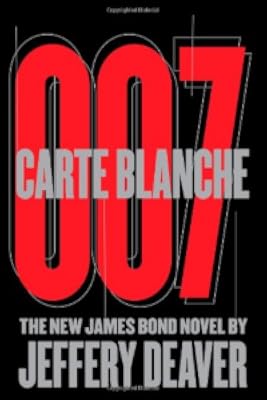
Carte Blanche, published in 2011 is a rendition of James Bond by Jeffery Deaver in which he has captured the essence of Ian Fleming. Deaver’s experience as a thriller writer sets Bond firmly in the twenty-first century.
Bond is under the auspices of the Special Operations Executive: Overseas Development Group and headed by M. This is a deniable organisation of the British Foreign and Commonwealth Office and Mi6. Bond is in Serbia following an Irishman who is intent on setting a bomb off but Bond is able to foil that attempt even though there is collateral damage.
There is chatter about an upcoming event where there are going to be a lot of deaths and M wants the best person for the job and that means Bond. The only problem for Bond is show more that he has been instructed to play nicely with the others who are assisting. While all the politics are saying the problems are going to be in the Middle East, Bond is not so sure. While Bond seems to be chasing shadows as he is interested in a recycling entrepreneur as he recognised there is far more to this story. Others think that Bond is on the wrong track even when the evidence is proving him to be heading in the right direction.
A brilliant story and a brilliant Bond. show less
Bond is under the auspices of the Special Operations Executive: Overseas Development Group and headed by M. This is a deniable organisation of the British Foreign and Commonwealth Office and Mi6. Bond is in Serbia following an Irishman who is intent on setting a bomb off but Bond is able to foil that attempt even though there is collateral damage.
There is chatter about an upcoming event where there are going to be a lot of deaths and M wants the best person for the job and that means Bond. The only problem for Bond is show more that he has been instructed to play nicely with the others who are assisting. While all the politics are saying the problems are going to be in the Middle East, Bond is not so sure. While Bond seems to be chasing shadows as he is interested in a recycling entrepreneur as he recognised there is far more to this story. Others think that Bond is on the wrong track even when the evidence is proving him to be heading in the right direction.
A brilliant story and a brilliant Bond. show less
Spoilers Ahead. Both shaken and stirred, Deaver offers the most potent reinterpretation of 007 since Gardner’s License Renewed. With Carte Blanche, Deaver starts from scratch with a Bond barely three years into his 00 career in a story that manages to bring Bond into the modern day. Traditional characters like ‘M’, Mary Goodnight, and Felix Leiter are all on display, as well as some new additions; a new Q and a new potential romantic interest in Philly Maidenstone. The plot is kept tense with a ticking clock of only a few days before disaster strikes, but Deaver doesn’t lose the investigative part of the character, as Bond uses his wits to crack open the mystery of creepy Severan Hyd. The plot has a quite a few twists, as Deaver show more teases us throughout the story with a chapter cliffhangers that play with our expectations of what Bond would do, followed fast with unexpected reversals. One in particular, Bond shooting an unarmed man in cold blood as a test from the villains stands out in particular, although I think the Fleming Bond would likely have done things differently. Deaver’s Bond is a different character in many ways to the original, lacking the brooding and introspection of the Fleming creation. But the book is written I believe to drag in the fans of the films, especially the current ones with Daniel Craig and I think Deaver does a good job of it. One of the most important elements of any Bond story is the main villain and Hydt fills the oddity quotient well, recalling Drax from Moonraker with his strange rags to riches tale and fetish for age and dying. Having said that, its a shame he’s not the sole master villain here. Not wishing to ruin too much, but the book does offer a final twist that steals some of the thunder from Hydt, and it just doesn’t work that well for me. Its here where Deaver shows his mystery writer pedigree to give his audience one last twist, but really for the Bond faithful, one is not necessary. The final complication of a whole other plot that explodes in the last 80 pages or so the novel was one that didn’t hold my attention as strongly as the rest of the read. Most intriguing is the subplot involving Bond's parents and a possible spying past. The thread established here is certainly worth exploring and once the book is done, is probably the bit that makes the most impression for long time fans. The ending notwithstanding, the book offers plenty for 007 fans to enjoy. The decision to return Bond to the present day makes all the difference and puts it far superior to the last Bond book. What the chances are that someone will return to this reboot of Bond, I am not sure, but I would love to see more 007 adventures spinning off from this book. show less
It was great to read a James Bond (who will forever be Sean Connery in my head) book again. I think Jeffery Deaver did it justice. The action was non-stop and the creepy villain, Severan Hydt, with his long, yellow fingernails and perversion for all things dead was captivating. I loved the sexy girl's name too - Felicity Willing. She didn't fool James though. Very entertaining.
Members
- Recently Added By
Lists

Biggest Disappointments
606 works; 163 members

Best Spy Fiction
153 works; 102 members
Author Information

253+ Works 66,189 Members
Jeffery Deaver was born on May 6, 1950 in Chicago, Illinois. He received a degree in journalism from the University of Missouri and a law degree from Fordham University. Before attending law school, he worked as a business writer. After law school, he worked for a Wall Street law firm practicing corporate law. In 1990, he decided to stop show more practicing law and become a full-time writer. His first novel was a horror story entitled Voodoo. He is the author of more than 25 novels and has written some of those stories under the pseudonym William Jeffries. He writes the Lincoln Rhyme series and the Kathryn Dance series. A Maiden's Grave was adapted into a film by HBO called Dead Silence and The Bone Collector was adapted into a feature film starring Denzel Washington and Angelina Jolie. He received the Steel Dagger and Short Story Dagger from the British Crime Writers' Association, the Ellery Queen Reader's Award for Best Short Story of the Year three times, and the British Thumping Good Read Award. (Bowker Author Biography) show less
Some Editions
Awards and Honors
Distinctions
Series


Belongs to Publisher Series
Common Knowledge
- Canonical title*
- Carte Blanche
- Original title
- Carte Blanche
- Original publication date
- 2011-05-28
- People/Characters
- James Bond; M; Miss Moneypenny; Ophelia Maidenstone; Niall Dunne; Severan Hydt (show all 15); Bheka Jordaan; Percy Osborne-Smith; Felicity Willing; Nicholas Rathko; Gregory Lamb; Sanu Hirani; Mary Goodnight; May Maxwell; Felix Leiter
- Important places
- Serbia; London, England, UK; Dubai, United Arab Emirates; Cape Town, Western Cape, South Africa
- Dedication
- To the man who taught us we could still believe in heroes, Ian Fleming
- First words
- His hand on the dead-man throttle, the driver of the Serbian Rail diesel felt the thrill he always did on this particular stretch of railway, heading north from Belgrade and approaching Novi Sad.
- Quotations
- Our mission is simple. We protect the Realm...by any means necessary.
- Last words
- (Click to show. Warning: May contain spoilers.)And, if he correctly recalled the poem Philly Maidenstone had so elegantly quoted, travelling fast meant travelling forever alone.
*Some information comes from Common Knowledge in other languages. Click "Edit" for more information.
Classifications
Statistics
- Members
- 1,290
- Popularity
- 18,886
- Reviews
- 40
- Rating
- (3.40)
- Languages
- 15 — Danish, Dutch, English, Estonian, Finnish, French, German, Hungarian, Italian, Japanese, Latvian, Polish, Portuguese, Serbian, Spanish
- Media
- Paper, Audiobook, Ebook
- ISBNs
- 59
- ASINs
- 9