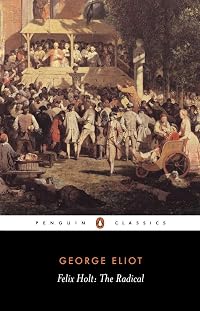
Felix Holt, the Radical
by George Eliot
On This Page
Description
In the novel Felix Holt, the Radical, George Eliot (the pseudonym of Mary Anne Evans) turns her attention to political affairs. However, although the Reform movement of the early 1800s is an important plot point in the novel, the tale focuses more on the intersection between politics and society, and the myriad ways in which changes in the law can and do affect family and intimate relationships..
Tags
Recommendations














Member Reviews
*5 writing; maybe *4 plotline, which is a tale of love, politics, religion, unexpected heirs and illegitimacy.
In North Loamshire, the election (a violent affair, full of bribery and threats) is about to take place. Harold Transome, newly returned to the family estate is standing as a Radical (to the distaste of his Tory relatives.) But why is the estate so diminished, and what does lawyer Jermyn have over his mother?
Meanwhile the eponymous Holt, a principled young watch maker, with a yen for social reform, is on the scene. As he discourses with the dissenting minister, Mr Lyon, he meets his lovely- but shallow? - daughter Esther...
Many twists and turns; gives a good insight into life in 1832. Dodgy elections have long been a show more thing!
However where George Eliot shines is in her very 3D characters, who are all, good and bad, believable. We understand their motivations and reasoning:
"Fancy what a game of chess would be if all the chessmen had passions and intellects, more or less small and cunning: if you were not only uncertain about your adversary's men, but a little uncertain also about your own; "
Brilliant writing. show less
In North Loamshire, the election (a violent affair, full of bribery and threats) is about to take place. Harold Transome, newly returned to the family estate is standing as a Radical (to the distaste of his Tory relatives.) But why is the estate so diminished, and what does lawyer Jermyn have over his mother?
Meanwhile the eponymous Holt, a principled young watch maker, with a yen for social reform, is on the scene. As he discourses with the dissenting minister, Mr Lyon, he meets his lovely- but shallow? - daughter Esther...
Many twists and turns; gives a good insight into life in 1832. Dodgy elections have long been a show more thing!
However where George Eliot shines is in her very 3D characters, who are all, good and bad, believable. We understand their motivations and reasoning:
"Fancy what a game of chess would be if all the chessmen had passions and intellects, more or less small and cunning: if you were not only uncertain about your adversary's men, but a little uncertain also about your own; "
Brilliant writing. show less
[Felix Holt, The Radical] by [George Eliot] A rabid fan of Eliot, but not so much in this case. The story takes place in the mid 19th century in a fictional industrial town in England, Treby Magna. Felix is an idealistic radical young man seeking changes, yet he is often disillusioned by politics. Felix is tempered by Esther, a more moderate (needs be a woman in that day!) whose moral integrity and personal growth is another side of social reform. I think Eliot was trying to show that idealism without practical wisdom can lead to failure. I got the feeling that Ms. Eliot was not a fan of radicalism, which surprised me with her being a female at this time in history. This was my least favorite of all the Eliot's I have read (which are show more most of them). I felt this was hardcore politics. While most of Eliot's work contains politics of some sort, this was just too detailed and too drawn out. 578 pages 99 cents on Kindle (US) show less
Felix Holt is a surprising triumph for Eliot. For the first time, she engages fully with some of the deeper socio-political issues of her day and age. The plot is almost Dickensian in the amount of intrigue, scandal, and romance, which is a good thing for the sometimes achingly slow Eliot. Despite the (comparatively) racing plot, it is the emotional and psychological moments of the novel that are the strongest. Lady Transome is the best character I've read from Eliot yet. Felix Holt gets passed over due to its political and legal nuances that don't translate well to today's audience, but it also matters more in a social sense than many of her other works do.
A wonderful book, a classic, an easy five stars. The audio version is flawlessly read by Nadia May, who both vanishes into the text and is highly expressive. Then there is George Eliot. Is there a better writer? Is there a writer who uses the English language to better effect, ranging across the spectrum of both vocabulary and grammar? Then there is her utter mastery of human nature which she treats with insight, humor, and generosity. The plot! Yes, there is a happy ending, but the getting there had some surprises and was great fun. It is a 19th Century novel so there is a pacing and some conventions that are of the era—they are also part of the pleasure of the reading. But it is Eliot’s unerring grasp of our humanity and the show more values she expresses that make her works so timeless and rewarding to read. show less
The background to this novel is the 1832 Reform Act and the turmoil in local elections, as the novel was a historical one - published in 1866 it looks back to an earlier period when the vote was held only by landowners etc and was denied to all women and to working men. Of course, the reform that eventually did take place only extended the vote to categories of working men, women being denied it until well into the 20th century.
Despite the title, the novel does not focus totally on Felix Holt, a thirty-something man who gives up training to be a doctor, and also spurns an easier life of selling quack medicines originally pedalled by his deceased father, to instead become a watchmaker and live a fairly poor life. It is mainly the story show more of Esther, a young woman who is faced with the choice of Felix as husband or a more prosperous life, possibly as the wife of a local rich man who tries to enter politics as a candidate in the election. For Esther's true antecdents are gradually revealed in the novel and could lead her to becoming an heiress.
Meanwhile, Esther is torn between the two men. Felix's moral standards drive her to emulate him and abandon her superficial concerns with having a fine appearance etc. In the process, she becomes more caring to her father, the Dissenting minister.
I found this a slog in places partly because the style of writing is occasionally very convoluted and hard to follow. I also wasn't convinced by Felix's moral superiority. The refrain of women's inferiority (in a book written by a woman) did grate rather especially as Esther internalises it. Overall I would rate the book at 3 stars. show less
Despite the title, the novel does not focus totally on Felix Holt, a thirty-something man who gives up training to be a doctor, and also spurns an easier life of selling quack medicines originally pedalled by his deceased father, to instead become a watchmaker and live a fairly poor life. It is mainly the story show more of Esther, a young woman who is faced with the choice of Felix as husband or a more prosperous life, possibly as the wife of a local rich man who tries to enter politics as a candidate in the election. For Esther's true antecdents are gradually revealed in the novel and could lead her to becoming an heiress.
Meanwhile, Esther is torn between the two men. Felix's moral standards drive her to emulate him and abandon her superficial concerns with having a fine appearance etc. In the process, she becomes more caring to her father, the Dissenting minister.
I found this a slog in places partly because the style of writing is occasionally very convoluted and hard to follow. I also wasn't convinced by Felix's moral superiority. The refrain of women's inferiority (in a book written by a woman) did grate rather especially as Esther internalises it. Overall I would rate the book at 3 stars. show less
The first book I have finished in 2011 is a classic written by the estimable George Eliot, whose novel Middlemarch I fell completely in love with. I found Felix Holt to be an inferior work, but still entertaining and quite gripping toward the end of the book. The Transome estate is in neglect when we first enter the scene, and the stately lady of the house is eagerly awaiting the arrival of her second-born son who has recently become the inheritor of everything. Lady Transome has many high hopes for this, her favourite child, and is in a state of eager anticipation when he arrives. Thus the story starts briefly with hope, but delves quickly into a twisted labyrinth of secrets and politics, immorality and goodness, love and hatred. We show more meet Esther and her father Mr. Lyon, a Radical minister, Mr. Jermyn who is a lawyer and has managed Transome in lieu of a mentally incapacitated Lord and his gambling eldest son, and the man the book is named after, Felix Holt who is of high moral character and, even more impressive, practices what he preaches.
Felix Holt was slow to get into and slow to introduce characters, but once all that was out of the way it developed into a lovely little morality tale complete with romance and politics. I give it seven bookmarks out of ten.
http://toomanybooknotenoughtime.blogspot.com/2011/01/felix-holt-radical.html show less
Felix Holt was slow to get into and slow to introduce characters, but once all that was out of the way it developed into a lovely little morality tale complete with romance and politics. I give it seven bookmarks out of ten.
http://toomanybooknotenoughtime.blogspot.com/2011/01/felix-holt-radical.html show less
This novel about class conflict in an English county town at the time of the Great Reform Act had some quirky and quite interesting characters. It also had a few great moments of speeches about political reform and class prejudice. However, these were quite few and far between and in essence it was a standard slow-moving 19th century novel about property and inheritance issues. Finished it, but it dragged a bit in the middle.
Members
- Recently Added By
Lists

Recommend the 20 best books you've read in the last five years
2,168 works; 607 members

Favourite 19th century fiction
257 works; 62 members

Favorite Long Books
330 works; 41 members

1860s
25 works; 4 members

Good, Smart, Clean Fiction
46 works; 4 members

Fiction with Men's Given Names in the Title
302 works; 11 members

Works Cited in The Life and Death of Democracy by John Keane
278 works; 1 member
Author Information

381+ Works 62,146 Members
George Eliot was born Mary Ann Evans on a Warwickshire farm in England, where she spent almost all of her early life. She received a modest local education and was particularly influenced by one of her teachers, an extremely religious woman whom the novelist would later use as a model for various characters. Eliot read extensively, and was show more particularly drawn to the romantic poets and German literature. In 1849, after the death of her father, she went to London and became assistant editor of the Westminster Review, a radical magazine. She soon began publishing sketches of country life in London magazines. At about his time Eliot began her lifelong relationship with George Henry Lewes. A married man, Lewes could not marry Eliot, but they lived together until Lewes's death. Eliot's sketches were well received, and soon after she followed with her first novel, Adam Bede (1859). She took the pen name "George Eliot" because she believed the public would take a male author more seriously. Like all of Eliot's best work, The Mill on the Floss (1860), is based in large part on her own life and her relationship with her brother. In it she begins to explore male-female relations and the way people's personalities determine their relationships with others. She returns to this theme in Silas Mariner (1861), in which she examines the changes brought about in life and personality of a miser through the love of a little girl. In 1863, Eliot published Romola. Set against the political intrigue of Florence, Italy, of the 1490's, the book chronicles the spiritual journey of a passionate young woman. Eliot's greatest achievement is almost certainly Middlemarch (1871). Here she paints her most detailed picture of English country life, and explores most deeply the frustrations of an intelligent woman with no outlet for her aspirations. This novel is now regarded as one of the major works of the Victorian era and one of the greatest works of fiction in English. Eliot's last work was Daniel Deronda. In that work, Daniel, the adopted son of an aristocratic Englishman, gradually becomes interested in Jewish culture and then discovers his own Jewish heritage. He eventually goes to live in Palestine. Because of the way in which she explored character and extended the range of subject matter to include simple country life, Eliot is now considered to be a major figure in the development of the novel. She is buried in Highgate Cemetery, North London, England, next to her common-law husband, George Henry Lewes. (Bowker Author Biography) show less
Some Editions
Awards and Honors
Series
Belongs to Publisher Series
Work Relationships
Is contained in
George Eliot's Works: Adam Bede/Daniel Deronda/Felix Holt and Clerical Life/Middlemarch/Mill on the Floss/Romola (6 vols) by George Eliot
Novels of George Eliot in Five Volumes with Illustrations: Adam Bede; The Mill in the Floss; Silas Marner; Clerical Life; Felix Holt; Middlemarch by George Eliot
George Elliot Works: 7 books - Middlemarch, Adam Bede, Daniel Deronda, Romola, Impressions of Theophrastus Such..., Silas Marner, Felix Holt, the Radical (George Elliot Works, 7 of ? in set) by George Elliot
George Eliot Collection: The Complete Novels, Short Stories, Poems and Essays (Middlemarch, Daniel Deronda, Scenes of Clerical Life, Adam Bede, The Lifted Veil...) by George Eliot
The Spanish Gypsy and Other Poems. Scenes of Clerical Life, Adam Bede, Romola, Felix Holt The Radical., Daniel Deronda, Miscellaneous Essays: Impressions of Theophrastus Such, The Lifted Veil, and Brother Jacob by George Eliot
George Eliot's Works (Six Volumes): Adam Bede, Scenes of Clerical Life, Middlemarch, The Mill On the Floss, Daniel Deronda, Felix Holt (The Radical), The Spanish Gypsy, Jubal and Other Poems, Romola, Theophrastus Such by George Eliot
The Complete Novels of George Eliot - All 9 Novels in One Edition: Adam Bede, The Lifted Veil, The Mill on the Floss, Silas Marner, Romola, Brother Jacob, ... the Radical, Middlemarch & Daniel Deronda by George Eliot
The Works of George Eliot: Vol. I - Adam Bede, The Mill on the Floss, Romola; Vol. II -- Middlemarch: A Study of Provincial life, Daniel Deronda; Vol. III -- Felix Holt, The Radical, Silas Marner, The Lifted Veil, Brother Jacob,Scenes from Clerical Life by George Eliot (indirect)
The Works of George Eliot Volume III: Felix Holt, the Radical; Silas Marner; The Lifted Veil; Brother Jacob; Scenes from Clerical Life; Impressions of Theophrastus Such; The Legend of Jubal; The Spanish Gypsy, and Other Poems by George Eilot
Contains
Has as a commentary on the text
Common Knowledge
- Canonical title
- Felix Holt, the Radical
- Original publication date
- 1866
- People/Characters
- Harold Transome; Matthew Jermyn; Felix Holt; Rev. Rufus Lyon; John Johnson; Rev. Augustus Debarry (show all 10); Esther Lyon; Maurice Christian; Sir Maximus Debarry; Thomas Trounsem
- Important places
- Little Treby, England, UK (fictional); Treby Magna, England, UK (fictional); Sproxton, England, UK (fictional)
- Important events
- 19th century; 1830s; 1832
- Related movies
- Falix Holt (1915 | IMDb)
- First words
- Five-and-thirty years ago the glory had not yet departed from the old coach-roads: the great roadside inns were still brilliant with well-polished tankards, the smiling glances of pretty barmaids, and the repartees of jocose ... (show all)ostlers; the hedge-cutter or the rick-thatcher might still know the exact hour by the unfailing yet otherwise meteoric apparition of the pea-green Tally-ho or the yellow Independent; and elderly gentlemen in pony-chaises, quartering nervously to make way for the rolling swinging swiftness, had not ceased to remark that times were finely changed since they used to see the pack-horses and hear the tinkling of their bells on the this very highway. (Introduction)
On the 1st of September, in the memorable year 1832, some one was expected at Transome Court. - Last words
- (Click to show. Warning: May contain spoilers.)There is a young Felix, who has a great deal more science than his father, but not much more money.
THE END
Classifications
Statistics
- Members
- 1,184
- Popularity
- 21,171
- Reviews
- 9
- Rating
- (3.56)
- Languages
- English, French, Norwegian
- Media
- Paper, Audiobook, Ebook
- ISBNs
- 87
- ASINs
- 53