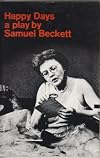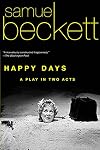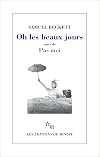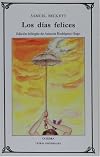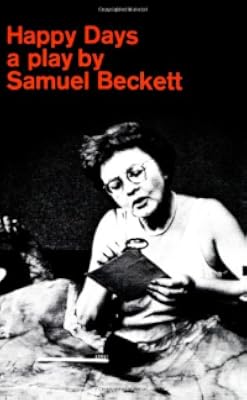
Happy Days
by Samuel Beckett
On This Page
Description
In 'Happy Days, ' Beckett pursues his relentless search for the meaning of existence, probing the tenuous relationships that bind one person to another, and each to the universe, to time past and time present.Tags
Recommendations





































Member Reviews
Happy Days presents a bleak landscape that is severed from anything like the real world. A woman, Winnie, is buried up to her waist in a mound at center stage. There is one other character, Willie, who for most of the play is hidden behind the mound, burrowing head first into it. However unrealistic this sounds there is a certain realism from her handbag that contains some of the detritus of everyday life that plays an important role for Winnie. She is a seemingly irrepressibly cheerful woman whose incessant optimistic prattle provides a counterpoint to her situation. She tells a story of a man and woman (Shower or Cooker) who, passing by, speculate as to why she is there and why Willie does not dig her out. This emphasizes the oddness show more of her situation but does not explain it. The situation is particularly perplexing because the cause of her confinement is indeterminate. It is just as indeterminate as the situation of Vladimir and Estragon in Waiting for Godot. In fact this indeterminacy is one of the overriding themes in the plays of Beckett.
The second act begins with her buried further up to her neck and, combined with her memories that suggest a previous life when she was not buried, present a degenerative condition that is inevitable.
The play is one of contrasts with the chief one being that between Winnie's optimism and the gravity of her situation. In other plays Beckett's characters have recognised the bleakness of their situation and while they do not always strive to face their existence they do not deny its awfulness. Winnie's cheerfulness includes maintaining normal daily rituals like brushing her teeth and cleaning her glasses. The contrast with these rituals and the abnormality of her situation may represent the essence of her need to distract herself from her terminal helplessness. In the second act she has even less to be cheerful about yet still refers to life as "a mercy". She says to Willie, who is trying to crawl up to her level, "Have another go, Willie, I'll cheer you on." (63) It reminds me of the famous quote from the end of Beckett's novel, The Unnamable, "You must go on, I can't go on, I'll go on," show less
The second act begins with her buried further up to her neck and, combined with her memories that suggest a previous life when she was not buried, present a degenerative condition that is inevitable.
The play is one of contrasts with the chief one being that between Winnie's optimism and the gravity of her situation. In other plays Beckett's characters have recognised the bleakness of their situation and while they do not always strive to face their existence they do not deny its awfulness. Winnie's cheerfulness includes maintaining normal daily rituals like brushing her teeth and cleaning her glasses. The contrast with these rituals and the abnormality of her situation may represent the essence of her need to distract herself from her terminal helplessness. In the second act she has even less to be cheerful about yet still refers to life as "a mercy". She says to Willie, who is trying to crawl up to her level, "Have another go, Willie, I'll cheer you on." (63) It reminds me of the famous quote from the end of Beckett's novel, The Unnamable, "You must go on, I can't go on, I'll go on," show less
Just to know that in theory you hear me, even though in fact you don't, is all I need.: When this 1961 play opens, a woman is buried waist deep in a pile of sand, a large bag on her left, and a deep tunnel behind and below her on her right. The environment is treeless and bleak, and we have no idea where the woman (Winnie) is or why and how she came to be in her present predicament. Throughout the first act, Winnie shares the minutiae of her life, pulling out her glasses, a parasol, a gun, a music box, and her hat from her bag and blathering on about brushing her teeth, while questioning if she has brushed her hair. Occasionally, she looks toward the tunnel, where she addresses an unseen "Willie," who does not respond. When he emerges show more from the tunnel briefly, humming, Winnie gaily announces "Another happy day," before he disappears again.
The only changes that occur in the play are the result of time--there is no plot. In the second act, Winnie appears older, she has sunk into the sand so that only her head shows, and she is unable to move it. Though she is not sure Willie is alive and calls to him repeatedly, he ignores her, until he suddenly emerges, dressed in tuxedo and top hat and tries to crawl upward toward Winnie. End of play.
In this classic example of the Theatre of the Absurd, the characters are out of sync with the world as the audience knows it, living in some universe with which we are unfamiliar. Their lives are meaningless, undirected, and irrational, yet, during the play, they somehow survive the passage of time, the lack of connection with each other, and their purposeless existence. Willie seems to be trying, futilely, to connect with Winnie at the end, but, absurdly, Winnie cannot see him and he cannot reach her.
Author Samuel Beckett once said, "Nothing is funnier than unhappiness...it's the most comical thing in the world." In that sense this is a funny play, but there were few laughs from the audience when I saw it recently. The production starred one of New England's most brilliant actresses in one of her most extraordinary performances, the lighting provided visual interest, and the direction was first-rate. Yet despite the fact that this was an audience of theatre-goers accustomed to serious drama, most of the audience was yawning by intermission, and about one-third had fallen asleep. If Beckett's intention was to show the meaninglessness of life through the monotony of this play, he succeeded brilliantly--putting the audience to sleep is the ultimate absurdity. n Mary Whipple show less
The only changes that occur in the play are the result of time--there is no plot. In the second act, Winnie appears older, she has sunk into the sand so that only her head shows, and she is unable to move it. Though she is not sure Willie is alive and calls to him repeatedly, he ignores her, until he suddenly emerges, dressed in tuxedo and top hat and tries to crawl upward toward Winnie. End of play.
In this classic example of the Theatre of the Absurd, the characters are out of sync with the world as the audience knows it, living in some universe with which we are unfamiliar. Their lives are meaningless, undirected, and irrational, yet, during the play, they somehow survive the passage of time, the lack of connection with each other, and their purposeless existence. Willie seems to be trying, futilely, to connect with Winnie at the end, but, absurdly, Winnie cannot see him and he cannot reach her.
Author Samuel Beckett once said, "Nothing is funnier than unhappiness...it's the most comical thing in the world." In that sense this is a funny play, but there were few laughs from the audience when I saw it recently. The production starred one of New England's most brilliant actresses in one of her most extraordinary performances, the lighting provided visual interest, and the direction was first-rate. Yet despite the fact that this was an audience of theatre-goers accustomed to serious drama, most of the audience was yawning by intermission, and about one-third had fallen asleep. If Beckett's intention was to show the meaninglessness of life through the monotony of this play, he succeeded brilliantly--putting the audience to sleep is the ultimate absurdity. n Mary Whipple show less
Happy Days was a further move in the direction of absolute stillness, of a kind of motionless dance in which the internal agitation and its shaping control are descried, through language primarily and through the spaces between words. On an otherwise bare stage, under ferocious light, the woman Winnie sits buried to her waist in a mound of earth throughout the first act, and to her neck throughout the second. Behind the mound we occasionally see the man Willie's head or hand. Near the end, however, Willie crawls round and at last comes fully into the sight of the audience in the play's only major physical movement.
In Happy Days Willie's presence serves Winnie as one of the poles of her address and the distant source of her sorrow and show more joy. One could say that the theme of the play is their relationship (we know them to be married) and that Beckett is commenting on the abyss between them. Yet in his theatre, relationships are never explored for their own sakes, not even as archetypes; what is explored is the nature of a reality where everything, including every relationship, is in doubt and tension. show less
In Happy Days Willie's presence serves Winnie as one of the poles of her address and the distant source of her sorrow and show more joy. One could say that the theme of the play is their relationship (we know them to be married) and that Beckett is commenting on the abyss between them. Yet in his theatre, relationships are never explored for their own sakes, not even as archetypes; what is explored is the nature of a reality where everything, including every relationship, is in doubt and tension. show less
This was a highly experimental play by Beckett. It is focused on a singular female character and her reactions to the world around her and to Willie, her only other source of intimacy in the play. Through a one-sided dialogue, Beckett is able to master the art of intimacy towards a character and delve into the deepest regions of her consciousness and psyche to create something beyond what she merely says, it becomes indicative of who she is and how she is. This is quite an interesting play and I thought that Beckett's style and usage of words here was especially well put. The play, overall, is impressive when you consider what it is reaching for and what it accomplishes.
4.25 stars- well worth the read!
4.25 stars- well worth the read!
روايه محطمه للاعصاب...تدفعك فى اى لحظه الى اغلاقها و انقاذ نفسك من حجيم الاشئ و لكنها تشير لك فى نفس الوقت و بلا مبرر باكمالها بلا دافع او اجبار
انه صامويل بيكت عندما يمنحك كل شئ و لا شئ فى نفس اللحظه..فيها شبه من "فى انتظار جودو" فلا وسط او بدايه او نهايه و لا صراع او عقده و حل ولا صراع مع عناصر خارجيه فالصراع نفسى اولا و اخيرا و قبل اى شئ
Vi essa peça no Palácio das Artes, representada pela Adriana Asti e Giovanni Batista Storti, com montagem de Joel-Peter Witkin e direção de Robert Wilson. A peça é praticamente um monólogo de Winnie (Asti), que está enterrada até a cintura, e, posteriormente, até o pescoço. Além disso, Winnie tem apenas alguns objetos à mão, e fala obsessivamente de alguns temas. Asti deu uma atuação incrível, não perdeu a platéia por um segundo.
Tenho vontade de ler o livro.
Tenho vontade de ler o livro.
I think you need to see or hear it rather than read it...
Members
- Recently Added By
Lists

Favourite Theatre of the Absurd
30 works; 4 members

Modernism
140 works; 9 members

Favourite Books
1,820 works; 316 members
1960s, Best books published therein
254 works; 22 members

20th Century Literature
1,161 works; 55 members
Author Information

532+ Works 43,240 Members
Nobel Prize winner (1969) Samuel Beckett was born on April 13, 1906 near Dublin, Ireland into a middle-class Protestant family. As a boy, he studied French and enjoyed cricket, tennis, and boxing. At Trinity College he continued his studies in French and Italian and became interested in theater and film, including American film. After graduation, show more Beckett taught English in Paris and traveled through France and Germany. While in Paris Beckett met Suzanne Deschevaus-Dusmesnil. During World War II when Paris was invaded, they joined the Resistance. They were later forced to flee Paris after being betrayed to the Gestapo, but returned in 1945. Beckett and Deschevaus-Dusmesnil married in 1961. Samuel Beckett's first novel was Dream of Fair to Middling Women. Among his many works are Murphy; Malone Dies; and The Unnameable. His plays include Endgame, Happy Days, Not I, That Time, and Krapp's Last Tape. In 1953, the production of Waiting For Godot in Paris by director and actor Roger Blin earned Beckett international fame. Beckett was awarded the Nobel Prize in Literature in 1969. His style was postmodern minimalist and some of his major themes were imprisonment in one's self, the failure of language, and moral conduct in a godless world. Despite his fame, Samuel Beckett led a secluded life. In his later years he suffered from cataracts and emphysema. His wife Suzanne died on July 17, 1989 and Beckett died on December 22nd of the same year. (Bowker Author Biography) show less
Series
Belongs to Publisher Series
Work Relationships
Is contained in
The Dramatic Works of Samuel Beckett: Volume III of The Grove Centenary Editions (Works of Samuel Beckett the Grove Centenary Editions) by Samuel Beckett
Has the adaptation
Common Knowledge
- Canonical title
- Happy Days
- Original title
- Happy Days
- Original publication date
- 1961
- People/Characters
- Winnie; Willie
- Related movies
- Great Performances: Happy Days (1980 | IMDb)
- Original language
- English
Classifications
Statistics
- Members
- 982
- Popularity
- 26,913
- Reviews
- 9
- Rating
- (3.79)
- Languages
- 12 — Catalan, Danish, Dutch, English, French, German, Italian, Norwegian, Portuguese, Russian, Spanish, Swedish
- Media
- Paper, Ebook
- ISBNs
- 28
- UPCs
- 1
- ASINs
- 18