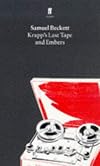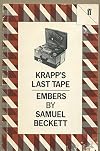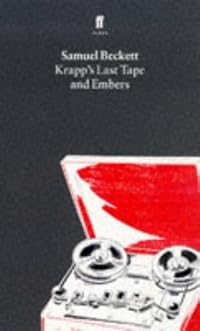
Krapp’s Last Tape & Embers
by Samuel Beckett
On This Page
Description
Samuel Beckett, one of the great avant-garde Irish dramatists and writers of the second half of the twentieth century, was born on 13 April 1906. His centenary was celebrated throughout 2006 with performances of his major plays, including Waiting for Godot. Here are the two most famous plays for solo voice. Krapp's Last Tape finds an old man, with his tape recorder, musing over the past and future. Not I is a remarkable tour de force for a single actress, as a woman emits memories and fears. show more Also included are two other singular short dramas for single voice, That Time read by John Moffatt and A Piece of Monologue read by Peter Marinker. It follows the highly acclaimed recordings of Beckett's Trilogy, Molloy, Malone Dies, and The Unnamable published by Naxos AudioBooks. show lessTags
Recommendations
















Member Reviews
Beauty by the master: This play represents Beckett at what is without doubt his most accessible and possibly his most beautiful. Beckett adores using human memory and the pain of nostalgia in his works, and both of these themes are put to astonishing use in this play.
In 'Krapp's Last Tape', our protagonist Krapp, now in his late 60s, plays back tapes that he has recorded on previous birthdays. Every year this task becomes a more and more onerous one, and every year he is more and more embarassed by "that stupid b**tard I took myself for thirty years ago". The pain of reconstructing the past is a pain that Beckett uses to dolourous effect throughout his prose and dramatic works and its use is particularly powerful here.
Although this show more play is in fact a monologue, it would appear to take the form of a conversation between a past and present Krapp. This allows the spectator to witness a striking decline in the morale and optimism of the play's protagonist in the intervening thirty years. One is left to assume that the mental attitude of the character will continue to rot over the miserable years that are left to him.
This beautiful rendering of sadness and human pain, is typical of one of the most astonishing and talented writers of the modern era. show less
In 'Krapp's Last Tape', our protagonist Krapp, now in his late 60s, plays back tapes that he has recorded on previous birthdays. Every year this task becomes a more and more onerous one, and every year he is more and more embarassed by "that stupid b**tard I took myself for thirty years ago". The pain of reconstructing the past is a pain that Beckett uses to dolourous effect throughout his prose and dramatic works and its use is particularly powerful here.
Although this show more play is in fact a monologue, it would appear to take the form of a conversation between a past and present Krapp. This allows the spectator to witness a striking decline in the morale and optimism of the play's protagonist in the intervening thirty years. One is left to assume that the mental attitude of the character will continue to rot over the miserable years that are left to him.
This beautiful rendering of sadness and human pain, is typical of one of the most astonishing and talented writers of the modern era. show less
Embers was written by Beckett in 1959, being commissioned by The Third Programme. (Has Radio 3 commissioned any plays recently?) It is a short play lasting about half an hour. Most of it is a monologue by the main character Henry, who sits alone (or is he?) on a shingle beach, talking to the spirit of his deceased father. When he doesn’t reply he calls up his wife Ada, who appears as a distant voice, her movements make no sound. Presumably she is dead too. They talk about their child Addie, a miserable, lonely, demanding thing whose life training (such as playing the piano or riding) always ends in tears: “she must learn, she will learn.” Is Addie dead too? It is never clear what happened to her or Ada. Nor is it clear how his show more father died – apparently drowned: “we never found your body, you know. That held up probate an unconscionable time. They said there was nothing to prove you hadn’t run away and were alive and well somewhere in the Argentine for example. That grieved mother greatly.” Towards the end of the play an incident is recalled from Henry and Ada’s courting days, just before the father’s death, when there was a fracas in the family home. Nothing is clearly stated, but could Henry have played a part in the death of his father (if it happened), or was it suicide?
Meanwhile there is another play within this play, made up by Henry’s imagination: Bolton, an old man who has called Holloway, his doctor, out on a freezing snowy night. It is never stated what Bolton wants, but a vivid scene is painted of Bolton, “standing there in his old red dressing gown... no light, just the light of the fire… dying glow… embers…” pleading desperately with Holloway: “please, please.” The doctor refuses the request (whatever it is): “call a man out, an old friend, in the cold and dark, an old friend, urgent need, bring the bag, then not a word, no explanation, no heat, no light…” …ghastly scene, wishes to God he hadn't come, no good, fire out, bitter cold, great trouble, white world, not a sound, no good… No good.
The writing is vivid but vague. There are long pauses, also odd sounds called up by Henry: the drip of a tap, the gallop of hooves. And all the while there is the sound of the sea in the background. show less
Meanwhile there is another play within this play, made up by Henry’s imagination: Bolton, an old man who has called Holloway, his doctor, out on a freezing snowy night. It is never stated what Bolton wants, but a vivid scene is painted of Bolton, “standing there in his old red dressing gown... no light, just the light of the fire… dying glow… embers…” pleading desperately with Holloway: “please, please.” The doctor refuses the request (whatever it is): “call a man out, an old friend, in the cold and dark, an old friend, urgent need, bring the bag, then not a word, no explanation, no heat, no light…” …ghastly scene, wishes to God he hadn't come, no good, fire out, bitter cold, great trouble, white world, not a sound, no good… No good.
The writing is vivid but vague. There are long pauses, also odd sounds called up by Henry: the drip of a tap, the gallop of hooves. And all the while there is the sound of the sea in the background. show less
لعل اجمل ايامى قد انتهت ...الايام التى ممكن ان احقق فيها السعاده و لكنى لو استطعت تحقيقها ما اردتها ليس و ما فى داخلى من نار
ينهى كرامب المسرحيه او لعلها حياته بتلك الجمله الموجعه بعد سماعه لشرائط حياته عام بعد عام
ممتعه , فلسفيه , مركزه بلا ملل....هى الشريط الاخير للمبدع صامويل بيكت
من بين اعمال بيكت السابعه التى قرأتها تحتل الشريط الاخير المركز الاول حتى قبل فى انتظار جودو الملحميه
painful to watch but captivating on the page.
Ratings
Members
- Recently Added By
Lists

Plays I Like
230 works; 31 members

Books Read in 2024
4,623 works; 126 members
Author Information

528+ Works 42,983 Members
Nobel Prize winner (1969) Samuel Beckett was born on April 13, 1906 near Dublin, Ireland into a middle-class Protestant family. As a boy, he studied French and enjoyed cricket, tennis, and boxing. At Trinity College he continued his studies in French and Italian and became interested in theater and film, including American film. After graduation, show more Beckett taught English in Paris and traveled through France and Germany. While in Paris Beckett met Suzanne Deschevaus-Dusmesnil. During World War II when Paris was invaded, they joined the Resistance. They were later forced to flee Paris after being betrayed to the Gestapo, but returned in 1945. Beckett and Deschevaus-Dusmesnil married in 1961. Samuel Beckett's first novel was Dream of Fair to Middling Women. Among his many works are Murphy; Malone Dies; and The Unnameable. His plays include Endgame, Happy Days, Not I, That Time, and Krapp's Last Tape. In 1953, the production of Waiting For Godot in Paris by director and actor Roger Blin earned Beckett international fame. Beckett was awarded the Nobel Prize in Literature in 1969. His style was postmodern minimalist and some of his major themes were imprisonment in one's self, the failure of language, and moral conduct in a godless world. Despite his fame, Samuel Beckett led a secluded life. In his later years he suffered from cataracts and emphysema. His wife Suzanne died on July 17, 1989 and Beckett died on December 22nd of the same year. (Bowker Author Biography) show less
Some Editions
Awards and Honors
Notable Lists
Work Relationships
Is contained in
The Dramatic Works of Samuel Beckett: Volume III of The Grove Centenary Editions (Works of Samuel Beckett the Grove Centenary Editions) by Samuel Beckett
Contains
Common Knowledge
- Canonical title
- Krapp’s Last Tape & Embers
- Original title
- Krapp’s last tape and Embers
- Original publication date
- 1958
- People/Characters
- Krapp
- First words
- A late evening in the future.
- Last words
- (Click to show. Warning: May contain spoilers.)A crawls out of sack, halts, broods, prays. Curtain
- Original language
- English
- Disambiguation notice
- This work contains Beckett's short plays Krapp's last tape and Embers. Do not combine this with anything that contains only one of the two, or anything else besides the two.
Classifications
Statistics
- Members
- 396
- Popularity
- 78,303
- Reviews
- 4
- Rating
- (3.81)
- Languages
- 5 — Dutch, English, French, German, Italian
- Media
- Paper, Audiobook, Ebook
- ISBNs
- 9
- ASINs
- 12