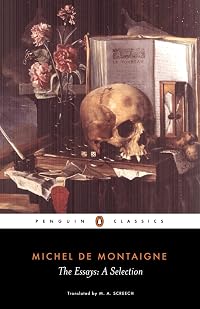
The Essays: A Selection
by Michel de Montaigne 
On This Page
Description
One of France's great Renaissance thinkers, Michel de Montaigne (1533-92) invented the essay as a literary form. This compilation features the best of his brief, highly readable reflections on poetry, philosophy, theology, law, literature, education, and world exploration. Remarkably modern in their views, the essays continue to resonate with readers as their author bemoans his failing memory, criticizes his culture's obsession with celebrity, and attempts to pursue a more spiritual life. show more Abounding in aphorisms and anecdotes, enlivened by wordplay and a delightful folksiness, Montaigne's writi show lessTags
Recommendations

















Member Reviews
A quite extraordinary book that has stayed relevant for 400 years.
This is beautifully written albeit with a fair bit more Latin than I expected.
Although it inevitably has some jarring opinions and discourses that reflect the changes in values over time, these are more than offset by Montaigne's extraordinary erudition that is still relevant today.
I think I may by a physical copy to dip in and out of over the coming years.
This is beautifully written albeit with a fair bit more Latin than I expected.
Although it inevitably has some jarring opinions and discourses that reflect the changes in values over time, these are more than offset by Montaigne's extraordinary erudition that is still relevant today.
I think I may by a physical copy to dip in and out of over the coming years.
In this collection of essays, Montaigne established the essay form in the modern way that we still recognize today. From this collection I would like to focus on one of the most famous essays; namely, "To philosophize is to learn how to die". Montaigne begins by referencing Cicero (who himself was paraphrasing Socrates as he was presented by Plato in his dialogue, Phaedo). He quickly concludes that the purpose of philosophy "is to teach not to be afraid of dying." (p 17) This, however, he immediately modifies this to say that "the labor of reason must be to make us live well, and at our ease," with a target of happiness (quoting scripture rather than Aristotle).
The essay could have ended here, but Montaigne goes on at length about the show more nature of virtue and how it abhors death. He also references common opinions about death but comes around to his own recommendations that death is part of the human condition. The answer, it seems, is to always have our death in mind so that we become used to it, and as such prepared for it. He provides quotes from his predecessors including the following, from Plutarch, that sounds just a bit fatalistic:
"Believe that each day is the last to shine on you. If it comes, time not hoped for will be welcome indeed."(p 24)
He even invokes religion and its contempt for life: "why should we fear to lose something which, once lost, cannot be regretted? Death is inevitable, does it matter when it comes?" (p 30) This would seem to be an end to the discussion.
However, he turns to the works of Lucretius in the closing pages of the essay and lets Nature speak about how one should view death: "Leave this world,' she says, 'just as you entered it. The same journey from death to life, which you once mad without suffering or fear, make it again from life to death. Your death is a part of the order of the universe; it is a part of the life of the world'"(p 31)
Thus he suggests living is like a project and one should not regret the unfinished project in anticipation of death. This view is not dissimilar from that later thinker and essayist, David Hume, that puts forth a sense of benevolence for life and death as a natural part of human existence.
Montaigne concludes his essay with an exhortation to seek happiness in the most natural way possible. This will dispel any interest in immortality; even as Nature claims that a life that lasted forever would be unbearable. We should be aware rather of the advantages of death and recognize that what bits of anguish this life may contain only serve to make death more palatable and our acceptance of it more reasonable. Lucretius painted a poetic vision of how natural death is for humans in his great poem, On the Nature of Things. In this essay Montaigne reasons with himself and with us as fellow humans toward that same end in his own philosophical way as an essayist. show less
The essay could have ended here, but Montaigne goes on at length about the show more nature of virtue and how it abhors death. He also references common opinions about death but comes around to his own recommendations that death is part of the human condition. The answer, it seems, is to always have our death in mind so that we become used to it, and as such prepared for it. He provides quotes from his predecessors including the following, from Plutarch, that sounds just a bit fatalistic:
"Believe that each day is the last to shine on you. If it comes, time not hoped for will be welcome indeed."(p 24)
He even invokes religion and its contempt for life: "why should we fear to lose something which, once lost, cannot be regretted? Death is inevitable, does it matter when it comes?" (p 30) This would seem to be an end to the discussion.
However, he turns to the works of Lucretius in the closing pages of the essay and lets Nature speak about how one should view death: "Leave this world,' she says, 'just as you entered it. The same journey from death to life, which you once mad without suffering or fear, make it again from life to death. Your death is a part of the order of the universe; it is a part of the life of the world'"(p 31)
Thus he suggests living is like a project and one should not regret the unfinished project in anticipation of death. This view is not dissimilar from that later thinker and essayist, David Hume, that puts forth a sense of benevolence for life and death as a natural part of human existence.
Montaigne concludes his essay with an exhortation to seek happiness in the most natural way possible. This will dispel any interest in immortality; even as Nature claims that a life that lasted forever would be unbearable. We should be aware rather of the advantages of death and recognize that what bits of anguish this life may contain only serve to make death more palatable and our acceptance of it more reasonable. Lucretius painted a poetic vision of how natural death is for humans in his great poem, On the Nature of Things. In this essay Montaigne reasons with himself and with us as fellow humans toward that same end in his own philosophical way as an essayist. show less
If he had a more manageable name, there should be an equivalent to "Shakespearean" for Michel de Montaigne, and the label to refer to essayists of his level. As with Shakespearean, you have to pay attention lest the dense, meaningful sentences fly past. And frankly, there are times, and moods, when he's too dense for me to appreciate, or I'm too dense and have to put him aside.
Like another wonderful essayist, William Hazlitt, Montaigne often takes a circuitous path, following the associations of his fertile, discursive mind, to touch upon all manner of things before coming back to his point(s) with new, expanded insights. Or to bring up other, entirely unexpected points. Again, he requires an attentive reader, and one not looking for a show more point, but patiently waiting for the next rewarding chunk of writing to come, as it always does.
In a frame of mind to focus and leave the world and its distractions behind, Montaigne is particularly sharp. Take, for example, this (among so many other passages), from the essay "On Cruelty":
"Virtue demands a rough and thorny road: she wants either external difficulties to struggle against ... by means of which Fortune is pleased to break up the directness of her course for her, or else inward difficulties furnished by the disordered passions and imperfections of our condition."
And this, from "On Repenting," capturing his straightforward honesty and self-assurance, without any self-aggrandizing pride:
"I have hardly cause to blame anyone but myself for my failures or misfortunes, for in practice I rarely ask anyone for advice save to honor them formally; the exception is when I need learned instruction or knowledge of the facts. But in matters where only my judgment is involved, the arguments of others rarely serve to deflect me, though they may well support me; I listen to them graciously and courteously--to all of them. But as far as I can recall, I have never yet trusted any but my own." show less
Like another wonderful essayist, William Hazlitt, Montaigne often takes a circuitous path, following the associations of his fertile, discursive mind, to touch upon all manner of things before coming back to his point(s) with new, expanded insights. Or to bring up other, entirely unexpected points. Again, he requires an attentive reader, and one not looking for a show more point, but patiently waiting for the next rewarding chunk of writing to come, as it always does.
In a frame of mind to focus and leave the world and its distractions behind, Montaigne is particularly sharp. Take, for example, this (among so many other passages), from the essay "On Cruelty":
"Virtue demands a rough and thorny road: she wants either external difficulties to struggle against ... by means of which Fortune is pleased to break up the directness of her course for her, or else inward difficulties furnished by the disordered passions and imperfections of our condition."
And this, from "On Repenting," capturing his straightforward honesty and self-assurance, without any self-aggrandizing pride:
"I have hardly cause to blame anyone but myself for my failures or misfortunes, for in practice I rarely ask anyone for advice save to honor them formally; the exception is when I need learned instruction or knowledge of the facts. But in matters where only my judgment is involved, the arguments of others rarely serve to deflect me, though they may well support me; I listen to them graciously and courteously--to all of them. But as far as I can recall, I have never yet trusted any but my own." show less
This book is translated into what I'd call King James English, so it is all "meseemeth" and "peradventure". However, no beauty comes through in this archaic tones, as it does with the excellent quotes he gleans, such as some quotes I like from what Montaigne has compiled here:
"A Man can never take good heed, Hourly what he may shun and speed."
- Horace
"That wise man I cannot abide, That for himself cannot privde."
- Euripedes
Now Montaigne himself came to loathe the focus on learning he gave many of his middle-aged years, too. And I find his gropings and gullible repeatings and Rumsfeld-like questions for answers painful, too. I'd think any wealthy, educated man locked away in a stocked library could accomplish this level of work in show more enough years, especially allowed liberal quoting.
I respect Montaigne giving us the essay as form and the idea of collecting them as tribute to intellect, but I think his famous work overrated. show less
"A Man can never take good heed, Hourly what he may shun and speed."
- Horace
"That wise man I cannot abide, That for himself cannot privde."
- Euripedes
Now Montaigne himself came to loathe the focus on learning he gave many of his middle-aged years, too. And I find his gropings and gullible repeatings and Rumsfeld-like questions for answers painful, too. I'd think any wealthy, educated man locked away in a stocked library could accomplish this level of work in show more enough years, especially allowed liberal quoting.
I respect Montaigne giving us the essay as form and the idea of collecting them as tribute to intellect, but I think his famous work overrated. show less
What a wonderful book to have on the bookshelf. It took me about a year and half to read it, as I would leisurely consume an essay or two while between books, or if I was just looking for a pleasant respite from my other reading. Montaigne is every bit as readable, fascinating and wise as the judgment of history has deemed him.
This review refers to Montaigne: Selected essay edited by Tilley and Boase, 3rd ed. 1954, Manchester University Press
This edition brings the original text in old French of a selection of 15 essays (7 of book I, 4 of book II, 4 of book III). The text is augmented by footnotes, Notes, Select Bibliography, a Glossary as well as a Preface and Introduction. Short historical introductions supplement each essay. The editions of 1580, 1588 and the Bordeaux copy are distinguished by marginal signs (as has been done in my German edition of selected essays).In short: editing has been exemplary!
It is perhaps surprising that the 16th century French does not present an insurmountable obstacle - given the help by footnotes with translations of more show more unusual words and those that have changed their meaning since then - for me whose knowledge of French is far from fluent.
(II-12) 5* for this edition because of the excellent editing. show less
This edition brings the original text in old French of a selection of 15 essays (7 of book I, 4 of book II, 4 of book III). The text is augmented by footnotes, Notes, Select Bibliography, a Glossary as well as a Preface and Introduction. Short historical introductions supplement each essay. The editions of 1580, 1588 and the Bordeaux copy are distinguished by marginal signs (as has been done in my German edition of selected essays).In short: editing has been exemplary!
It is perhaps surprising that the 16th century French does not present an insurmountable obstacle - given the help by footnotes with translations of more show more unusual words and those that have changed their meaning since then - for me whose knowledge of French is far from fluent.
(II-12) 5* for this edition because of the excellent editing. show less
If I had only one book, this would be it.
Members
- Recently Added By
Lists

100 Most Recommended Works
100 works; 11 members

New Lifetime Reading Plan by Fadiman and Major
225 works; 5 members

Ryan Holiday's Books To Base Your Life On
97 works; 2 members
Author Information

586+ Works 14,904 Members
Michel de Montaigne was born in Chateau de Montaigne, near Bordeaux, France, on February 28, 1533. He received his early education at the College de Guyenne in Bordeaux and studied law at Bordeaux and Toulouse, becoming a counselor of the Court des Aides of Perigueaux, the Bordeaux Parliament and, in 1561, at the court of Charles IX. In 1565, show more Montaigne married Francoise de la Chassaigne. They raised one daughter, with four other children dying in infancy. He lived the life as a country gentleman and traveled extensively through Switzerland, Germany, and Italy. Montaigne was a moderate Roman Catholic and an advocate of toleration, acting as an intermediary between Henry of Navarre and the court party. As a result, in 1588, he was arrested by members of the Protestant League and thrown into the Bastille for several hours. His work Essais established the essay as a new literary form and influenced both French and English writers; it was quoted by William Shakespeare and imitated by Francis Bacon. Michel de Montaigne died on September 13, 1592 at his chateau in France. (Bowker Author Biography) show less
Michel de Montaigne has a Legacy Library. Legacy libraries are the personal libraries of famous readers, entered by LibraryThing members from the Legacy Libraries group.
Some Editions
Awards and Honors
Notable Lists
Series
Belongs to Publisher Series
Work Relationships
Is contained in
Common Knowledge
- Canonical title
- The Essays: A Selection
- Original publication date
- 1580
- People/Characters
- Michel de Montaigne
- First words
- Reader, thou hast here an honest book; it doth at the outset forewarn thee that, in contriving the same I have proposed to myself no other than a domestic and private end: I have had no consideration at all either to t... (show all)hy service or to my glory.
- Last words
- (Click to show. Warning: May contain spoilers.)Old age stands a little in need of a more gentle treatment. Let us recommend it to God, the protector of health and wisdom, but withal, let it be gay and sociable.
[Grant it to me, Apollo, that I may enjoy what I have in good health; let me be sound in body and in mind; let me live in honor when old, nor let music be wanting.] - Original language
- French
Classifications
Statistics
- Members
- 1,442
- Popularity
- 16,280
- Reviews
- 12
- Rating
- (3.98)
- Languages
- 5 — English, French, Lithuanian, Russian, Spanish
- Media
- Paper, Audiobook, Ebook
- ISBNs
- 29
- UPCs
- 2
- ASINs
- 40