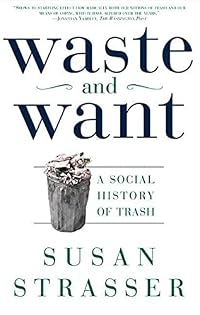
Waste and Want: A Social History of Trash
by Susan Strasser
On This Page
Description
An unprecedented look at that most commonplace act of everyday life--throwing things out--and how it has transformed American society. Susan Strasser's pathbreaking histories of housework and the rise of the mass market have become classics in the literature of consumer culture. Here she turns to an essential but neglected part of that culture--the trash it produces--and finds in it an unexpected wealth of meaning. Before the twentieth century, streets and bodies stank, but trash was nearly show more nonexistent. With goods and money scarce, almost everything was reused. Strasser paints a vivid picture of an America where scavenger pigs roamed the streets, swill children collected kitchen garbage, and itinerant peddlers traded manufactured goods for rags and bones. Over the last hundred years, however, Americans have become hooked on convenience, disposability, fashion, and constant technological change--the rise of mass consumption has led to waste on a previously unimaginable scale. Lively and colorful, Waste and Want recaptures a hidden part of our social history, vividly illustrating that what counts as trash depends on who's counting, and that what we throw away defines us as much as what we keep. show lessTags
Recommendations





























Member Recommendations

Member Reviews
First off, despite claiming the be "A Social History of Trash", the book (despite of brief mention of the garbage-strewn streets of Knossos and Pompei) is just a history of American trash. Next, although she isn't too blatant about it, the author is clearly in the "consumerism is evil - we throw too much away - advertising makes us buy".
That being acknowledged, the book is pretty interesting - possibly in a way the author didn't intend. A account of nineteenth century farm wives saving their large stitch sewing - patches and such - for last, so they could sew in the dark and not waste candles - was profoundly moving to me. Not as an account of domestic virtue, mind you, but as horrible waste of human resources.
The collection of fat show more drippings and fireplace ashes to make soap, old rags to make paper, bones for bone black, and dog waste to using in leather tanning is all well and good - if your time is worth less than rancid fat, ash, rags, old bones and dog turds. It's common to point out that the USA "wastes" more resources than whole continents full of third world countries; nobody ever discusses the flip side - that the US saves more human time this way.
One thing I liked is the author recognizes that recycling away from the home requires a collection and distribution system and notes that that system was in place for much of the eighteenth and nineteenth centuries. Peddlars moved through the countryside, bartering housewares for old rags, shoes, and so on. They could then resell or rebarter these these to dealers. Some "junk" dealers had whole networks of peddlars that they moved around the country by telegraph, keeping them up to date on prices and what was needed.
The author's take on consumerism - how it became "fashionable" to discard things - focuses on something I never would have considered - menstrual pads. I suspect this is an attempt - a successful attempt - to be evenhanded about the whole consumerism thing. While the greens - especially the "ecohippy" branch - are big on returning to "the ways of our forefathers" (or in the case of the native-American-wannabe subtribe, the ways of somebody else's forefathers), I suspect even the most Earth-mother types draw the line at washing out rags for reuse. Susan Strasser's fair and pointed discussion of the topic emphasizes just how liberating some consumer products are compared to the alternative.
I have no objection to recycling and pay my trash hauler an extra fee to pick up sorted cans, bottles and plastics. But there's a very real question about whether there's actually a net gain in anything - energy, resource use, etc. - from current recycling practices. If you stack up newspapers and cardboard and drive them to a recycling center only to have them landfilled anyway because there's no market for recycled paper, have you actually gained anything?
Recycling seems to make sense for most metals. I think better than 90% of the lead used in the US is recycled, and and good percentage of copper, steel and aluminum. These things are easy to collect, easy to separate from other debris, and easy to melt down. It's routine to see homeless scavenging for cans; you don't seem them with bottles and newspaper very much. Alas, this is the trap that a lot of recycling advocates fall into. Yes, waste glass can easily be melted down at a glass factory. Unfortunately, the empty pickle jar has to make it from your house to the glass factory. This is always where recycling schemes collapse. Things like glass and paper are inherently low value and the cost - whether measured in dollars or energy consumption - of transporting them around for recycling is almost always more than any value they might have as raw material.
It's different in the Third World (is there a Second World any more?). I remember tossing an empty plastic water bottle into a trash container at Saqqara. Immediately a small group - maybe 4 or 5 - of Egyptian boys who had been hanging around ran full tilt toward the trash can; the leader dived in head first to recover the bottle. How much can one plastic water bottle be worth for recycling? Apparently enough to hang around all day waiting for tourists to throw them out.
Recycling real estate has, of course, been done since somebody evicted a bear from a cave and took over. I note that this is another place where well intentioned environmental laws have been counterproductive. Strict liability provisions, which make a current landowner responsible for things that were done by a previous tenant (and were probably legal at that time anyway) makes developers very reluctant to reuse industrial buildings, gas stations, any building with a significant amount of asbestos, etc. Various "brownfields" programs have helped with this but it's still very dicey to try and redevelop or reuse land in industrial areas. show less
That being acknowledged, the book is pretty interesting - possibly in a way the author didn't intend. A account of nineteenth century farm wives saving their large stitch sewing - patches and such - for last, so they could sew in the dark and not waste candles - was profoundly moving to me. Not as an account of domestic virtue, mind you, but as horrible waste of human resources.
The collection of fat show more drippings and fireplace ashes to make soap, old rags to make paper, bones for bone black, and dog waste to using in leather tanning is all well and good - if your time is worth less than rancid fat, ash, rags, old bones and dog turds. It's common to point out that the USA "wastes" more resources than whole continents full of third world countries; nobody ever discusses the flip side - that the US saves more human time this way.
One thing I liked is the author recognizes that recycling away from the home requires a collection and distribution system and notes that that system was in place for much of the eighteenth and nineteenth centuries. Peddlars moved through the countryside, bartering housewares for old rags, shoes, and so on. They could then resell or rebarter these these to dealers. Some "junk" dealers had whole networks of peddlars that they moved around the country by telegraph, keeping them up to date on prices and what was needed.
The author's take on consumerism - how it became "fashionable" to discard things - focuses on something I never would have considered - menstrual pads. I suspect this is an attempt - a successful attempt - to be evenhanded about the whole consumerism thing. While the greens - especially the "ecohippy" branch - are big on returning to "the ways of our forefathers" (or in the case of the native-American-wannabe subtribe, the ways of somebody else's forefathers), I suspect even the most Earth-mother types draw the line at washing out rags for reuse. Susan Strasser's fair and pointed discussion of the topic emphasizes just how liberating some consumer products are compared to the alternative.
I have no objection to recycling and pay my trash hauler an extra fee to pick up sorted cans, bottles and plastics. But there's a very real question about whether there's actually a net gain in anything - energy, resource use, etc. - from current recycling practices. If you stack up newspapers and cardboard and drive them to a recycling center only to have them landfilled anyway because there's no market for recycled paper, have you actually gained anything?
Recycling seems to make sense for most metals. I think better than 90% of the lead used in the US is recycled, and and good percentage of copper, steel and aluminum. These things are easy to collect, easy to separate from other debris, and easy to melt down. It's routine to see homeless scavenging for cans; you don't seem them with bottles and newspaper very much. Alas, this is the trap that a lot of recycling advocates fall into. Yes, waste glass can easily be melted down at a glass factory. Unfortunately, the empty pickle jar has to make it from your house to the glass factory. This is always where recycling schemes collapse. Things like glass and paper are inherently low value and the cost - whether measured in dollars or energy consumption - of transporting them around for recycling is almost always more than any value they might have as raw material.
It's different in the Third World (is there a Second World any more?). I remember tossing an empty plastic water bottle into a trash container at Saqqara. Immediately a small group - maybe 4 or 5 - of Egyptian boys who had been hanging around ran full tilt toward the trash can; the leader dived in head first to recover the bottle. How much can one plastic water bottle be worth for recycling? Apparently enough to hang around all day waiting for tourists to throw them out.
Recycling real estate has, of course, been done since somebody evicted a bear from a cave and took over. I note that this is another place where well intentioned environmental laws have been counterproductive. Strict liability provisions, which make a current landowner responsible for things that were done by a previous tenant (and were probably legal at that time anyway) makes developers very reluctant to reuse industrial buildings, gas stations, any building with a significant amount of asbestos, etc. Various "brownfields" programs have helped with this but it's still very dicey to try and redevelop or reuse land in industrial areas. show less
The first chapter, I was giddy. I loved the topic, the tone the everything - and I was excited about diving into it all. The reality did not quite live up to those expectations. It was a lot more detail than I wanted about subjects that were kinda tangent to the trash itself (like the history of quilts). I suspect that if the book were more recent it would be able to keep much more focused on trash itself - if only because so much has happened in the last twenty years (landfills closing...), so many attitudes and practices have changed, and all that would make for fascinating reading. A nice reward for finishing: the closing three pages went back to the philosophical and matched the excitement and promise of the first...
Ratings
Members
- Recently Added By
Talk Discussions
Past Discussions
Book Discussion - "Waste and Want" in Non-Fiction Readers (August 2010)
Author Information

6+ Works 671 Members
Susan Strasser is the author of the award winning "Never Done" & "Satisfaction Guaranteed: The Making of the American Mass Market." Her articles have appeared in "The New York Times," "The Washington Post," & "The Nation." A professor of history at the University of Delaware, she lives near Washington, D.C. (Bowker Author Biography)
Some Editions
Awards and Honors
Common Knowledge
- Original publication date
- 1999
Classifications
- Genres
- Nonfiction, History, Science & Nature, General Nonfiction, Sociology, Teen
- DDC/MDS
- 363.72 — Society, Government, and Culture Social problems and social services Public Safety - Police, Crime Investigation Environmental Issues - Pollution, Recycling, Global Warming Sanitation - Waste control, recycling
- LCC
- HD4482 .S77 — Social sciences Industries. Land use. Labor Industries. Land use. Labor Industry Industrial policy. The state and industrial
- BISAC
Statistics
- Members
- 265
- Popularity
- 121,170
- Reviews
- 2
- Rating
- (3.84)
- Languages
- English
- Media
- Paper, Ebook
- ISBNs
- 4
- ASINs
- 2