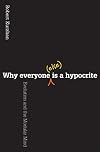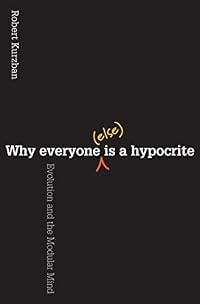
Why everyone (else) is a hypocrite: evolution and the modular mind
by Robert Kurzban
On This Page
Description
We're all hypocrites. Why? Hypocrisy is the natural state of the human mind. Robert Kurzban shows us that the key to understanding our behavioral inconsistencies lies in understanding the mind's design. The human mind consists of many specialized units designed by the process of evolution by natural selection. While these modules sometimes work together seamlessly, they don't always, resulting in impossibly contradictory beliefs, vacillations between patience and impulsiveness, violations of show more our supposed moral principles, and overinflated views of ourselves. This modular, evolutionary psychological view of the mind undermines deeply held intuitions about ourselves, as well as a range of scientific theories that require a "self" with consistent beliefs and preferences. Modularity suggests that there is no "I." Instead, each of us is a contentious "we"--a collection of discrete but interacting systems whose constant conflicts shape our interactions with one another and our experience of the world. In clear language, full of wit and rich in examples, Kurzban explains the roots and implications of our inconsistent minds, and why it is perfectly natural to believe that everyone else is a hypocrite. show lessTags
Recommendations



































Member Reviews
This book reminds me a famous quote from Isaac Asimov: "The most exciting phrase to hear in science, the one that heralds new discoveries, is not 'Eureka' but 'That's funny...'". Kuzban takes the reader on a fantastic tour and explains how the theory of modularity of mind explains lots of mysteries (such as "why do people lock their refrigerators?") related to human cognition. This is a funny book, funny in the Asimov's sense, of course, and yet it does not refrain from strongly arguing for clarification of why modularity of mind makes sense especially from the evolutionary point of view (which is the only scientific point of view when it comes understanding biology).
Sometimes the author overuses humor and asks wrong questions such as show more "Can you beat MS Word in chess?" (this is especially disturbing because a few sentences ago he warns the reader that questions such as "Did you stop beating your wife?" is wrong due to wrong assumptions). Nevertheless his style keeps this very important (and controversial for most of the philosophers as well as laymen) topic alive and pulsating through every page.
This book will probably one of the best references I'm going to use when it comes to the mechanisms of mind as well discussions regarding self, illusion of self and consciousness. It is written as a popular science book but it also includes enough pointers to scientific articles with more details and depth. I can assure you that your view of 'being a human and having a single, unified notion of self' will radically change (or at least you'll start to ask some questions) after this scientific gem. show less
Sometimes the author overuses humor and asks wrong questions such as show more "Can you beat MS Word in chess?" (this is especially disturbing because a few sentences ago he warns the reader that questions such as "Did you stop beating your wife?" is wrong due to wrong assumptions). Nevertheless his style keeps this very important (and controversial for most of the philosophers as well as laymen) topic alive and pulsating through every page.
This book will probably one of the best references I'm going to use when it comes to the mechanisms of mind as well discussions regarding self, illusion of self and consciousness. It is written as a popular science book but it also includes enough pointers to scientific articles with more details and depth. I can assure you that your view of 'being a human and having a single, unified notion of self' will radically change (or at least you'll start to ask some questions) after this scientific gem. show less
Interesting book about the modular mind concept, very clear and sometimes quite funny look at our "mind" and just who is in actually in control. Before reading the book the idea just seems absurd, but by the books end I must say that I'm pretty firmly convinced. The author shows through numerous studies that not only is a mind made up of modules pauible but really quite probable.
Good explanation of the idea of modularity within the mind. But I don't think Kurzban's quite as witty as he thinks he is, and he goes off on ranty tangents defending evolutionary biology against critics.
Excellent book. Explains a lot about me (but not why I'm a hypocrite!). Loads of interesting science and information in this book. Recommended for anyone interested in psychology. Economists should read it too. I like the bit where the author explains that the economist's idea of the mind is rational with some wrinkles, but the psychologists view is as a coherent whole which has evolved the way it has for good reasons.
This is an excellent book on the modular view of the mind. I particular enjoyed the chapters on deception and self-deception.
If you're interested in evolutionary psychology, this is a great book to start an investigation of the subject.
If you're interested in evolutionary psychology, this is a great book to start an investigation of the subject.
rec' by Haidt 2012
Ratings
Members
- Recently Added By
Author Information

3 Works 216 Members
Robert Kurzban is associate professor of psychology and founder of the Pennsylvania Laboratory for Experimental Evolutionary Psychology at the University of Pennsylvania.
Work Relationships
Common Knowledge
- Canonical title
- Why everyone (else) is a hypocrite: evolution and the modular mind (else)
- Original publication date
- 2010
- Dedication
- Dedicated to all those denied liberty for pursuing happiness.
- Blurbers
- Fowler, James H; Pinker, Steven; Smith, Vernon
Classifications
Statistics
- Members
- 162
- Popularity
- 201,147
- Reviews
- 6
- Rating
- (4.00)
- Languages
- English, Polish
- Media
- Paper, Ebook
- ISBNs
- 4
- ASINs
- 1