
Matt Ridley
Author of Genome: The Autobiography of a Species in 23 Chapters
About the Author
Matt Ridley is the author of several award-winning books, including Genome, The Agile Gene, and The Red Queen, which have sold more than 800,000 copies in twenty-seven languages worldwide. He lives in England.
Image credit: © 2005 Matt Ridley
Works by Matt Ridley
The Origins of Virtue: Human Instincts and the Evolution of Cooperation (1996) 1,171 copies, 14 reviews
Birds, Sex and Beauty: The Extraordinary Implications of Charles Darwin's Strangest Idea (2025) 25 copies
Down to Earth: A Contrarian View of Environmental Problems (Studies on the Environment) (1995) 4 copies
TheRedQueen 1 copy
O otimista racional 1 copy
Эволюция всего 1 copy
WHEN IDEAS HAVE SEX 1 copy
Associated Works
This Will Make You Smarter: New Scientific Concepts to Improve Your Thinking (Edge Question Series) (2012) — Contributor — 904 copies, 17 reviews
What Is Your Dangerous Idea? Today's Leading Thinkers on the Unthinkable (2007) — Contributor — 668 copies, 8 reviews
Tagged
Common Knowledge
- Canonical name
- Ridley, Matt
- Legal name
- Ridley, Matthew White, 5th Viscount
- Other names
- Ридли, Мэтт
- Birthdate
- 1958-02-07
- Gender
- male
- Education
- Eton College
Magdalen College, University of Oxford (BA|1978|Ph.D|1983 - Zoology) - Occupations
- journalist
business executive
science writer
Member of the House of Lords - Organizations
- House of Lords
The Economist
Daily Telegraph
Sunday Telegraph
The Times
Conservative Party - Awards and honors
- National Academies Book Award (2004)
Glaxo science writer's award for best science article (1983)
Royal Society of Literature (Fellow, 1999)
Academy of Medical Sciences (Fellow, 2004)
Deputy Lieutenant (2007)
Bledisloe Gold Medal (2015) (show all 9)
Hayek Prize (2011)
American Academy of Arts and Sciences (2013)
Julian L. Simon award (2012) - Relationships
- Hurlbert, Anya (wife)
- Nationality
- UK
- Birthplace
- Northumberland, England, UK
- Places of residence
- Newcastle upon Tyne, England, UK
Blagdon Hall, Northumberland, England, UK - Map Location
- England, UK
Members
Reviews
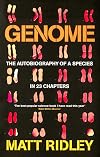
Like 'The Periodic Table' by Primo Levi, where the italian author used the periodic table to tell his life Matt Ridley uses here our genome to tell us, the human specie. In fact, he's taking one gene in particular on each chromosome and, chromosome after chromosome leads us from chapter to chapter in a powerful displaying of what make us human. Such structure could have been shaky or, worst, fall right into the pits of reductionism or determinism. Well, far from that this book is actually a show more great success!
He manages not only to explain the basics of genetics but, also dares attacking the misunderstandings surrounding it -biological and social determinism alike. Partisan of the selfish gene hypothesis, the passages about cancerous cells are riveting. He even makes nature and nurture dances in a beautiful waltz, so as to bring the right questions from genetic engineering to eugenism. Impossible to put down, it's a marvel from beginning to end.
Not familiar with statistics, I just felt a bit overwhelmed by the use of a lot of them in order to illustrate some hypothesis. Without that, as far as I am concerned it would have been a five stars.
Highly recommended. show less
He manages not only to explain the basics of genetics but, also dares attacking the misunderstandings surrounding it -biological and social determinism alike. Partisan of the selfish gene hypothesis, the passages about cancerous cells are riveting. He even makes nature and nurture dances in a beautiful waltz, so as to bring the right questions from genetic engineering to eugenism. Impossible to put down, it's a marvel from beginning to end.
Not familiar with statistics, I just felt a bit overwhelmed by the use of a lot of them in order to illustrate some hypothesis. Without that, as far as I am concerned it would have been a five stars.
Highly recommended. show less
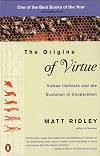
This book is like being run over by a steam-roller. It's a very polite steam-roller that goes forward; then backs off a bit and says sorry before trundling forward further than it went last time. And its roller is covered in cashmere, so the steel of the meaning feels softer because of the gentleness of the language.
At the end, of course, you have been considerably transformed in your outlook (that reminds me, I must read 'Flatland' sometime), but it's hard to pin down exactly what it was show more that you were like before, but aren't now. I think the proof will come when I hear someone blathering on about how human nature is purely formed by society, and I spot it for the utter bollocks that it is.
Suffice to say that I delighted in this book. show less
At the end, of course, you have been considerably transformed in your outlook (that reminds me, I must read 'Flatland' sometime), but it's hard to pin down exactly what it was show more that you were like before, but aren't now. I think the proof will come when I hear someone blathering on about how human nature is purely formed by society, and I spot it for the utter bollocks that it is.
Suffice to say that I delighted in this book. show less
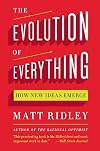
I was very excited when I read the introduction to this book: finally someone who sheds light on that history is not only driven top-down, but rather is the result of thousands of small decisions and behaviors, and thus always 'emergent'. But when I started reading the different chapters, that enthusiasm gradually died down, sometimes even turning into outright annoyance. Ridley seems to have written a political pamphlet in which he systematically downplays everything that has to do with show more government, design or planning. Of course, he is right that many government decisions, or “steering decisions” in general, have negative or adverse effects. But to then vehemently throw the baby out with the bathwater, that is clearly a bridge too far.
His previous book, The Rational Optimist, did contain some hints in that direction, but I still liked that book quite well. Here the libertarian-conservative that Ridley is (until recently he sat in the British House of Lords) clearly goes over the moon. Beware, he regularly offers interesting arguments, but his evidence usually rests on a very narrow basis; in most cases he seems to have only consulted 1 study about a certain problem, cherry picking his way through. And in some cases his argument is downright wrong or he contradicts himself. Take his analysis of what went wrong in the 2008 financial crisis: according to him, this was not the result of too far-reaching liberalization of the financial markets, but, on the contrary, of just too much government control and influence. At times Ridley's views are tantalizing, but regularly he misses the mark completely, out of ideological blindness. No, this is a turn off. More in my History account on Goodreads: https://www.goodreads.com/review/show/4422761323 show less
His previous book, The Rational Optimist, did contain some hints in that direction, but I still liked that book quite well. Here the libertarian-conservative that Ridley is (until recently he sat in the British House of Lords) clearly goes over the moon. Beware, he regularly offers interesting arguments, but his evidence usually rests on a very narrow basis; in most cases he seems to have only consulted 1 study about a certain problem, cherry picking his way through. And in some cases his argument is downright wrong or he contradicts himself. Take his analysis of what went wrong in the 2008 financial crisis: according to him, this was not the result of too far-reaching liberalization of the financial markets, but, on the contrary, of just too much government control and influence. At times Ridley's views are tantalizing, but regularly he misses the mark completely, out of ideological blindness. No, this is a turn off. More in my History account on Goodreads: https://www.goodreads.com/review/show/4422761323 show less
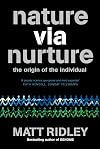
Matt Ridley doesn't disappoint. Similar to Genome: the Autobiography of a Species in 23 Chapters or The Red Queen: Sex and the Evolution of Human Nature, both highly engrossing reads where he managed to be both accessible yet detailed enough to please lay readers willing to delve deeper than your usual pop science book, here's another masterpiece set to become a classic. Please note the telling title -it's not about nature vs nurture, but a view which seems to flip our understanding of human show more nature completely upside-down. Well, of course, we all know that what shapes our behaviours and capabilities are both a matter of genes and environment... or do we? The traps of determinism (be it biological or environmental) seem to loom large indeed, and reading around in the mass medias or the pop culture it still seem to be either/ or. Is the debate between the geneticists against the empiricists really over?
'Nature via Nurture' is wide encompassing, and as such it can be intimidating. As much as I love Matt Ridley, it's undeniable that he here gives his readers a lot to chew upon! It will be enthralling, engrossing, and fascinating as usual, but it will also requires some more efforts too. In fact, he structured his book by building a whole argument starting around an imaginary picture featuring crucial scientist and their theories -Darwin, Galton, James, Kraepelin, Freud, Boas, Durkheim, Piaget, Lorenz, De Vries, Pavlov, and Watson. Needless to say, from biology to anthropology and psychology and psychiatry and even linguistics, here's a multi-tentacles monster! Nevertheless, this is probably the best window offered into the fascinating interaction between genes and environment, a great lecture about the never ending feedbacks shaping us all as unique individuals.
Absolutely brilliant. show less
'Nature via Nurture' is wide encompassing, and as such it can be intimidating. As much as I love Matt Ridley, it's undeniable that he here gives his readers a lot to chew upon! It will be enthralling, engrossing, and fascinating as usual, but it will also requires some more efforts too. In fact, he structured his book by building a whole argument starting around an imaginary picture featuring crucial scientist and their theories -Darwin, Galton, James, Kraepelin, Freud, Boas, Durkheim, Piaget, Lorenz, De Vries, Pavlov, and Watson. Needless to say, from biology to anthropology and psychology and psychiatry and even linguistics, here's a multi-tentacles monster! Nevertheless, this is probably the best window offered into the fascinating interaction between genes and environment, a great lecture about the never ending feedbacks shaping us all as unique individuals.
Absolutely brilliant. show less
Lists
Awards


You May Also Like


Associated Authors
Statistics
- Works
- 37
- Also by
- 6
- Members
- 11,601
- Popularity
- #2,025
- Rating
- 4.0
- Reviews
- 156
- ISBNs
- 224
- Languages
- 23
- Favorited
- 30
