The Invention of Heterosexuality
by Jonathan Ned Katz
On This Page
Description
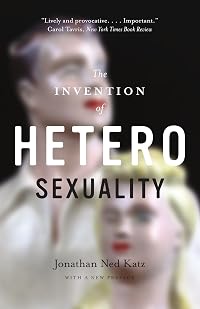
"Heterosexuality," assumed to denote a universal sexual and cultural norm, has been largely exempt from critical scrutiny. In this boldly original work, Jonathan Ned Katz challenges the common notion that the distinction between heterosexuality and homosexuality has been a timeless one. Building on the history of medical terminology, he reveals that as late as 1923, the term "heterosexuality" referred to a "morbid sexual passion," and that its current usage emerged to legitimate men and show more women having sex for pleasure. Drawing on the works of Sigmund Freud, James Baldwin, Betty Friedan, and Michel Foucault, The Invention of Heterosexuality considers the effects of heterosexuality's recently forged primacy on both scientific literature and popular culture. "Lively and provocative."-Carol Tavris, New York Times Book Review "A valuable primer . . . misses no significant twists in sexual politics."-Gary Indiana, Village Voice Literary Supplement "One of the most important-if not outright subversive-works to emerge from gay and lesbian studies in years."-Mark Thompson, The Advocate. show lessTags
Recommendations













Member Reviews
I was originally drawn to this book by its title. History from the dominant identity (e.g. heterosexuality) is so often treated as the default and not examined in the same way as other identities (e.g. queer people) so I was curious what this would be about. As the title suggests, the author dives into heterosexuality, looking at the way it has been perceived in the past (including past meanings, including a meaning as a sexual "disorder") and sometimes comparing this to discussions about homosexuality.
The author notes in the preface how much easier it has become to access information about heterosexuality now than it was when he wrote it. Despite that, this still makes for an interesting read. I enjoyed the earlier chapters the most show more as the historical aspects were fascinating, including the way that heterosexuality was originally used as a way to distinguish people from the then "normal" and expected attitudes towards sex. I really enjoyed how use of the term and the history of being straight are intertwined with queer history as opposed to just being the unexplored default (which has its own interesting nuances) it is usually propped up against.
Although I did overall enjoy this work, I didn't always agree with some of the arguments being made, especially in the later chapters. They were still interesting to read of course, but I do wish some ideas had been expanded on to give more nuance/criticism. At times some of the lines of thinking were a little dismissive or simplified (even when one considers this limited to a western perspective) or just felt a bit uncomfortable. Although not badly intentioned, the "everyone's a bit bi" attitude of some of the arguments (some not by the author but these could have been criticised more, especially the quoted line about women choosing to become a lesbian and leaving husbands). I don't know how much of this stems from me being asexual (the existence of which is briefly alluded to but not included in discussions) and therefore not fitting on the gay-straight spectrum and not feeling like I fit into the blurring of homosexuality and heterosexuality - I remain an outlier. This is not a criticism of the author of course! Especially given the time it was written vs when asexuality started gaining traction. But sexuality is more complicated than it is sometimes depicted. show less
The author notes in the preface how much easier it has become to access information about heterosexuality now than it was when he wrote it. Despite that, this still makes for an interesting read. I enjoyed the earlier chapters the most show more as the historical aspects were fascinating, including the way that heterosexuality was originally used as a way to distinguish people from the then "normal" and expected attitudes towards sex. I really enjoyed how use of the term and the history of being straight are intertwined with queer history as opposed to just being the unexplored default (which has its own interesting nuances) it is usually propped up against.
Although I did overall enjoy this work, I didn't always agree with some of the arguments being made, especially in the later chapters. They were still interesting to read of course, but I do wish some ideas had been expanded on to give more nuance/criticism. At times some of the lines of thinking were a little dismissive or simplified (even when one considers this limited to a western perspective) or just felt a bit uncomfortable. Although not badly intentioned, the "everyone's a bit bi" attitude of some of the arguments (some not by the author but these could have been criticised more, especially the quoted line about women choosing to become a lesbian and leaving husbands). I don't know how much of this stems from me being asexual (the existence of which is briefly alluded to but not included in discussions) and therefore not fitting on the gay-straight spectrum and not feeling like I fit into the blurring of homosexuality and heterosexuality - I remain an outlier. This is not a criticism of the author of course! Especially given the time it was written vs when asexuality started gaining traction. But sexuality is more complicated than it is sometimes depicted. show less
Reviewed here.
Ratings
Members
- Recently Added By
Lists

LQW Research Reading List
75 works; 1 member
Author Information

16+ Works 1,357 Members
Awards and Honors
Awards
Classifications
- Genres
- Nonfiction, Sexuality and Gender Studies, LGBTQ+, General Nonfiction, History, Sociology
- DDC/MDS
- 306.760918210904 — Society, government, & culture Social sciences, sociology & anthropology Social Behavior - Dating, Marriage, Divorce Sexual relations Sexual orientation, transgender identity, intersexuality History, geographic treatment, biography
- LCC
- HQ23 .K315 — Social sciences The family. Marriage, Women and Sexuality The Family. Marriage. Women Sexual life Sexual behavior and attitudes. Sexuality
- BISAC
Statistics
- Members
- 365
- Popularity
- 86,151
- Reviews
- 2
- Rating
- (3.71)
- Languages
- English
- Media
- Paper, Ebook
- ISBNs
- 4
- ASINs
- 2