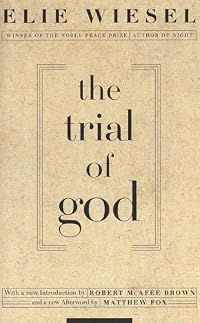
The Trial of God: (as it was held on February 25, 1649, in Shamgorod)
by Elie Wiesel
On This Page
Description
A drama set in a medieval village where three itinerant Jewish actors put God on trial to answer for his silence during a pogrom considers post-Holocaust issues.Tags
Recommendations






















Member Reviews
A compelling drama in which a Jewish man who has lost his entire family to a pogrom places God on trial for crimes against humanity. Whilst set in 1649, it is clearly inspired by Wiesel's own experiences in the Holocaust; he explicitly admits that it was based on one of his experiences in Auschwitz, when as a 15-year-old boy he witnessed three senior rabbis reluctantly place their God on trial, and found Him guilty. The play itself, of course, deals with a lot of heavy issues – leaving aside the theology for now, it still deals with some horrific stuff. The characters indicting God have suffered the anti-Semitic-motivated murder and gang rape of loved ones, and the ending of the play is chilling. That said, the play is also show more surprisingly humorous in parts, albeit in a very cynical way (for example, on page 70, as the characters are preparing for the mock trial: "But someone is missing."/"Who is that? The defendant? He's used to it.").
Wiesel covers the weighty theological and philosophical arguments with commendable even-handedness; he has no atheistic or religious agenda. If anything, his message – as affirmed by Robert McAfee Brown and Matthew Fox in their Introduction and Afterword respectively – is a humanist one. Whilst a simplistic summary of the play would be: 'Why does God let bad things happen to good people?', a more nuanced summary would be the one identified by Brown and Fox: that if we cannot get justice from God, we must ensure we strive for it ourselves. God, perhaps, cannot be excused his culpability – and The Trial of God ends agreeably open-ended about this – but if faith cannot mollify us in dark times we must seek a more intelligent and independent response to the struggles and evils of our world. It is a mature and life-affirming message in a play about the bleakest of topics. show less
Wiesel covers the weighty theological and philosophical arguments with commendable even-handedness; he has no atheistic or religious agenda. If anything, his message – as affirmed by Robert McAfee Brown and Matthew Fox in their Introduction and Afterword respectively – is a humanist one. Whilst a simplistic summary of the play would be: 'Why does God let bad things happen to good people?', a more nuanced summary would be the one identified by Brown and Fox: that if we cannot get justice from God, we must ensure we strive for it ourselves. God, perhaps, cannot be excused his culpability – and The Trial of God ends agreeably open-ended about this – but if faith cannot mollify us in dark times we must seek a more intelligent and independent response to the struggles and evils of our world. It is a mature and life-affirming message in a play about the bleakest of topics. show less
Elie Wiesel as a 12 year old at Auschwitz witnessed three renowned Rabbi's hold a 'trial of God'. They found God guilty, guilty for the crimes committed on the Jews in the holocaust, guilty for allowing his chosen people to suffer (inhumanely), and for allowing his creation to commit these atrocities - sometimes even in His name.
I've previously read Night (autobiographical of his time in the camp) and Twilight (a novel about a post-Holocaust survivor). Elie is a fantastic writer who cuts down to the bone on what is real about the horrors of things such as this.
The Trial of God is done as a play, and set during the pogroms, rather than during the Holocaust. It's set on the holiday of Purim. It's a terrific play that cuts into how can show more God allow things like suffering, especially to his chosen people, as well as how can he sit back and allow people to kill, rape, pillage, destroy in his name. In many ways its more a retrospect of ourselves than just of God. The characters are not so much putting God on trial, but themselves, and at the end of the play, though the trial of God continues, the trial of Men ends. show less
I've previously read Night (autobiographical of his time in the camp) and Twilight (a novel about a post-Holocaust survivor). Elie is a fantastic writer who cuts down to the bone on what is real about the horrors of things such as this.
The Trial of God is done as a play, and set during the pogroms, rather than during the Holocaust. It's set on the holiday of Purim. It's a terrific play that cuts into how can show more God allow things like suffering, especially to his chosen people, as well as how can he sit back and allow people to kill, rape, pillage, destroy in his name. In many ways its more a retrospect of ourselves than just of God. The characters are not so much putting God on trial, but themselves, and at the end of the play, though the trial of God continues, the trial of Men ends. show less
There have been a number of seemingly audacious trials of God that have taken place, beginning with the book of Job and sustained by the problem of theodicy through the present day. Wiesel's Trial of God, inspired by a similar event he witnessed in the Holocaust, is set in the aftermath of a pogrom in Ukraine in the 1600s. The only Jewish father left in the village of Shamgorod asks a band of traveling actors to stage a trial to justify what God allowed to happen.
Berish struggles with the unbreakable silence of God, and resists the suggestion that tragedy cannot be understood from the limited perspective of humanity: "I want the truth to be told. Whose truth? Mine! But if mine is not His as well, then He's worse than I thought. Then it show more would mean that he He gave us the taste, the passion of truth without telling us that this truth is not true!" Berish believes in God fervently, if only so he can have some reason and target for his anger. Otherwise, what is there? The alternative to believing that God has allowed tragedy to happen is that there is no reason for tragedy nor any possibility of salvation from suffering. So his faith and his anger are both steadfast, upholding one another in an odd sense. Faith is shown not to be peace, but an unending struggle with God, thereby leaving the verdict in deliberation, "for the trial will continue - without us." show less
Berish struggles with the unbreakable silence of God, and resists the suggestion that tragedy cannot be understood from the limited perspective of humanity: "I want the truth to be told. Whose truth? Mine! But if mine is not His as well, then He's worse than I thought. Then it show more would mean that he He gave us the taste, the passion of truth without telling us that this truth is not true!" Berish believes in God fervently, if only so he can have some reason and target for his anger. Otherwise, what is there? The alternative to believing that God has allowed tragedy to happen is that there is no reason for tragedy nor any possibility of salvation from suffering. So his faith and his anger are both steadfast, upholding one another in an odd sense. Faith is shown not to be peace, but an unending struggle with God, thereby leaving the verdict in deliberation, "for the trial will continue - without us." show less
This book is a complex play, surveying many of the theological arguments questioning God's existence in the face of catastrophic human suffering - set in 1649, it describes a Purim play occurring in a Jewish community recently decimated by a pogrom, although it is loosely based on real-life events which happened in the concentration camps. I got an enormous amount out of this, and found it much more readable than most of his other works (with the exception, possibly, of the iconic 'Night'). A must-read if you're interested in how Jewish theology has struggled with suffering in the wake of the Holocaust.
This book is a play that Wiesel has placed back in the year 1640 in the aftermath of a pogrom in Ukraine. There are two Jews left alive in the city, the innkeeper and his daughter, and another three traveling minstrels come into town in time for Purim. It is the tradition to put on a play (so really the book is a play within a play) and they decide to put God on trial for the fact that he has stayed silent in the face of evil. The problem is that no one was to play the part of God’s lawyer until a stranger comes into town and volunteers for the part.
This book is not only a reflection of a real trial that supposedly took place in the death camps of the Holocaust, but also parallels the book of Job in the Hebrew bible. I thought it was show more really good (but I do also love everything Wiesel writes). I just found out last week that I will be reading this book again with Elie Wiesel as my actual teacher in my class this fall, so if I have some real insight into the book I will let you know. I don’t want to write too much and give away the ending, which is quite profound. show less
This book is not only a reflection of a real trial that supposedly took place in the death camps of the Holocaust, but also parallels the book of Job in the Hebrew bible. I thought it was show more really good (but I do also love everything Wiesel writes). I just found out last week that I will be reading this book again with Elie Wiesel as my actual teacher in my class this fall, so if I have some real insight into the book I will let you know. I don’t want to write too much and give away the ending, which is quite profound. show less
play about rabbis trial of God
Gezerot tah? ve-tat, 1648-1649--Drama.
Members
- Recently Added By
Lists

Top Five Books of 2018
802 works; 264 members
Author Information

Eliezer "Elie" Wiesel was born in Sighet, Romania on September 30, 1928. In 1944, he and his family were deported along with other Jews to the Nazi death camp Auschwitz. His mother and his younger sister died there. He loaded stones onto railway cars in a labor camp called Buna before being sent to Buchenwald, where his father died. He was show more liberated by the United States Third Army on April 11, 1945. After the war ended, he learned that his two older sisters had also survived. He was placed on a train of 400 orphans that was headed to France, where he was assigned to a home in Normandy under the care of a Jewish organization. He was educated at the Sorbonne and supported himself as a tutor, a Hebrew teacher and a translator. He started writing for the French newspaper L'Arche. In 1948, L'Arche sent him to Israel to report on that newly founded state. He also became the Paris correspondent for the daily Yediot Ahronot. In this capacity, he interviewed the novelist Francois Mauriac, who urged him to write about his war experiences. The result was La Nuit (Night). After the publication of Night, Wiesel became a writer, literary critic, and journalist. His other books include Dawn, The Accident, The Gates of the Forest, The Jews of Silence: A Personal Report on Soviet Jewry, and Twilight. He received a numerous awards and honors for his literary work including the William and Janice Epstein Fiction Award in 1965, the Jewish Heritage Award in 1966, the Prix Medicis in 1969, and the Prix Livre-International in 1980. He received the Nobel Peace Prize in 1986 for his work in combating human cruelty and in advocating justice. He had a leading role in the creation of the United States Holocaust Memorial Museum in Washington, D. C. He died on July 2, 2016 at the age of 87. (Bowker Author Biography) show less
Awards and Honors
Notable Lists
Common Knowledge
- Canonical title*
- Le procès de Shamgorod tel qu'il se déroula le 25 février 1649
- Original publication date
- 1979
- Important places*
- Oekraïne
- Related movies
- Le procès de Shamgorod (1982 | IMDb)
*Some information comes from Common Knowledge in other languages. Click "Edit" for more information.
Classifications
Statistics
- Members
- 413
- Popularity
- 74,304
- Reviews
- 7
- Rating
- (4.31)
- Languages
- English, French, German, Italian
- Media
- Paper, Ebook
- ISBNs
- 8
- ASINs
- 1