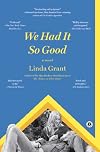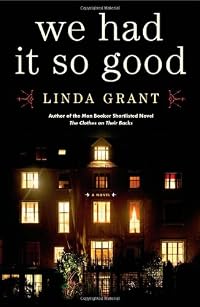
We Had It So Good
by Linda Grant
On This Page
Description
In 1968 Stephen Newman arrives in England from California. Sent down from Oxford, he hurriedly marries his English girlfriend Andrea to avoid returning to America and the draft board. Over the next forty years they and their friends build lives of middle-class success until the events of late middle-age and the new century force them to realise that their fortunate generation has always lived in a fool's paradise.Tags
Recommendations

























Member Reviews
Stephen Newman is getting older and is finding it difficult to come to terms with the way his life has turned out. What happened to his hopes and ambitions, to the generation that was going to change the world?
We Had It So Good follows the story of Stephen and his family over several decades during the second half of the twentieth century and the beginning of the twenty-first. At times reading this book was almost like watching one of those nostalgic television documentaries that show us snapshots of life in previous decades. As the years go by we see how Stephen and Andrea change over time and have had to abandon some of their dreams - but with Stephen in particular there's always that feeling of regret, that he's settled for show more second-best, and he does at one point decide that "that was what life was, perennially settling for less".
The book doesn't have much of a plot, concentrating instead on painting a detailed and realistic portrait of the Newman family. Despite the lack of action though, there are still some moments of drama - mainly the types of small dramas that most people will experience in their lifetime - and there were even a few surprises and revelations that I didn't see coming.
Linda Grant's writing is of a high quality and she develops her characters in great detail from their appearance and the clothes they wear, to their likes and dislikes, hopes and fears. And yet throughout the first half of the book I didn't feel any personal involvement in their story and always felt slightly detached from what was going on. Although the Newmans and their friends felt believable and real to me, I didn't think I liked them enough to want to spend 340 pages reading about their everyday lives. But halfway through the book I started to warm to some of the characters and as a result, the story became more compelling. And once I had settled into the pace of the writing, I started to enjoy it.
It was interesting to see how Stephen as an American (with a Polish immigrant father and a Cuban mother) adapted to life in England, first at Oxford and then in London. I also liked reading about the relationship between Stephen and his father, Si. Stephen and Andrea's daughter, Marianne, is another intriguing character. And this review wouldn't be complete without mentioning Andrea's best friend, Grace, who is quite a sad and solitary figure, trying to run away from her past. Although she's not the most pleasant of people, with a hard, prickly personality, I was far more interested in Grace than in the Newmans.
I should point out that I'm probably not really the target audience for this book and although I did end up enjoying it, I can see that it would probably be appreciated more by readers of Stephen and Andrea's generation. However, the book still left me with a lot of things to think about, from bigger issues such as immigration, family relationships and generational differences to the smaller ones, such as the principles behind the advertising of washing powder! show less
We Had It So Good follows the story of Stephen and his family over several decades during the second half of the twentieth century and the beginning of the twenty-first. At times reading this book was almost like watching one of those nostalgic television documentaries that show us snapshots of life in previous decades. As the years go by we see how Stephen and Andrea change over time and have had to abandon some of their dreams - but with Stephen in particular there's always that feeling of regret, that he's settled for show more second-best, and he does at one point decide that "that was what life was, perennially settling for less".
The book doesn't have much of a plot, concentrating instead on painting a detailed and realistic portrait of the Newman family. Despite the lack of action though, there are still some moments of drama - mainly the types of small dramas that most people will experience in their lifetime - and there were even a few surprises and revelations that I didn't see coming.
Linda Grant's writing is of a high quality and she develops her characters in great detail from their appearance and the clothes they wear, to their likes and dislikes, hopes and fears. And yet throughout the first half of the book I didn't feel any personal involvement in their story and always felt slightly detached from what was going on. Although the Newmans and their friends felt believable and real to me, I didn't think I liked them enough to want to spend 340 pages reading about their everyday lives. But halfway through the book I started to warm to some of the characters and as a result, the story became more compelling. And once I had settled into the pace of the writing, I started to enjoy it.
It was interesting to see how Stephen as an American (with a Polish immigrant father and a Cuban mother) adapted to life in England, first at Oxford and then in London. I also liked reading about the relationship between Stephen and his father, Si. Stephen and Andrea's daughter, Marianne, is another intriguing character. And this review wouldn't be complete without mentioning Andrea's best friend, Grace, who is quite a sad and solitary figure, trying to run away from her past. Although she's not the most pleasant of people, with a hard, prickly personality, I was far more interested in Grace than in the Newmans.
I should point out that I'm probably not really the target audience for this book and although I did end up enjoying it, I can see that it would probably be appreciated more by readers of Stephen and Andrea's generation. However, the book still left me with a lot of things to think about, from bigger issues such as immigration, family relationships and generational differences to the smaller ones, such as the principles behind the advertising of washing powder! show less
From the start, I thought this was to be a novel about an American in London, and my heart sank when a young Bill Clinton made a cameo appearance.
But this turned into a novel about the gulf between generations in the 20th and 21st centuries, lost idealism and lives passed without noticing.
The children barely tolerate their parents' stories about living in a squat in 1970s London, almost despising their parents while admiring their college friend Grace, who wanders the globe apparently refusing to settle.
My favourite strand of the book is about how we age without noticing, and don't realise what we've lost until it's too late.
"I keep thinking of all the people I've known in London, all these years of living here. They pass through show more your life and ....if you saw them, you'd cry , because you'd understand for the first time how old you are, and that it's all long gone and we didn't treasure it. We thought there was no way it would not last for ever, together with our hair." show less
But this turned into a novel about the gulf between generations in the 20th and 21st centuries, lost idealism and lives passed without noticing.
The children barely tolerate their parents' stories about living in a squat in 1970s London, almost despising their parents while admiring their college friend Grace, who wanders the globe apparently refusing to settle.
My favourite strand of the book is about how we age without noticing, and don't realise what we've lost until it's too late.
"I keep thinking of all the people I've known in London, all these years of living here. They pass through show more your life and ....if you saw them, you'd cry , because you'd understand for the first time how old you are, and that it's all long gone and we didn't treasure it. We thought there was no way it would not last for ever, together with our hair." show less
We Had It So Good is on one level a multigenerational family tale. There’s a sense, though, in which this family represents the passage of time between generations, with a focus on the generation that came of age in the sixties.
Oxford and London of the 1960s are presented as places of big ideas, where people talk about defying “the man” and creating a different kind of society. It’s no surprise that most of the ideas thrown in the air don’t actually fly. Eventually main characters Stephen and Andrea become the picture of convention, perhaps even of selling out. The only person who stays true to the sixties life is Andrea’s friend Grace; her wanderings—all recounted in the first person, as if to therapist Andrea—represent show more the alternative to the conventional life that Stephen, Andrea, and Ivan have chosen. But she’s also a cautionary tale, as her life is never a happy one.
The sixties generation at the core of the book influences and is influenced by the generations before and behind them, but that influence only extends so far. Every generation must assert its own independence. But the choice to rebel or merely to step back still means letting the past have a say, even if the past’s message is one of what not to do. And as it turns out, the one character who makes almost a complete break with the preceding generation is, in his old age, haunted by the world of his birth.
I was especially intrigued by the cultural differences between the US and UK that come up several times in the book. Frequently, these moments are played for comedy. What interests me more, however, is whether the idea embedded in the title of the novel applies to the US in the same way that it does to the UK. Young adults in the sixties in the US faced the specter of the Vietnam draft, which Stephen neatly escapes and hardly thinks of again. The idea of this being the luckiest generation doesn't quite resonate in the same way. I don't think this difference should prevent the book from being interesting to US audiences. The generational tensions explored in the book are certainly universal, and even if those elements weren't present, there's pleasure to be had in reading about different nation's experiences of similar eras.
See my complete review at Shelf Love. show less
Oxford and London of the 1960s are presented as places of big ideas, where people talk about defying “the man” and creating a different kind of society. It’s no surprise that most of the ideas thrown in the air don’t actually fly. Eventually main characters Stephen and Andrea become the picture of convention, perhaps even of selling out. The only person who stays true to the sixties life is Andrea’s friend Grace; her wanderings—all recounted in the first person, as if to therapist Andrea—represent show more the alternative to the conventional life that Stephen, Andrea, and Ivan have chosen. But she’s also a cautionary tale, as her life is never a happy one.
The sixties generation at the core of the book influences and is influenced by the generations before and behind them, but that influence only extends so far. Every generation must assert its own independence. But the choice to rebel or merely to step back still means letting the past have a say, even if the past’s message is one of what not to do. And as it turns out, the one character who makes almost a complete break with the preceding generation is, in his old age, haunted by the world of his birth.
I was especially intrigued by the cultural differences between the US and UK that come up several times in the book. Frequently, these moments are played for comedy. What interests me more, however, is whether the idea embedded in the title of the novel applies to the US in the same way that it does to the UK. Young adults in the sixties in the US faced the specter of the Vietnam draft, which Stephen neatly escapes and hardly thinks of again. The idea of this being the luckiest generation doesn't quite resonate in the same way. I don't think this difference should prevent the book from being interesting to US audiences. The generational tensions explored in the book are certainly universal, and even if those elements weren't present, there's pleasure to be had in reading about different nation's experiences of similar eras.
See my complete review at Shelf Love. show less
I liked this book very much. Linda Grant seems to me to have a perceptive and interesting take on the era and events that have dominated my life. She writes about the larger society - the war in the former Yugoslavia, 9/11 and the impact of terrorist activity in London - which was made especially relevant as I read the book as the London Bridge terrorist incident of June 2017 occurred. But more than that, she focuses on individuals as members of families and the role of truth and deception in family relationships. Especially relevant to me was her treatment of the end stages of life - people dying suddenly and others dying slowly, and how we look back on our lives.
A captivating and wholly absorbing novel that spans the times from the late 1960s to the late 2000s. It traces the life of Stephen Newman a she leaves America to begin studying at Oxford University. Gradually his ambition of making a substantial contribution to changing society is whittled away and he settles for what he sees as a less fulfilling life. His disappointment is contrasted to the approach by his wife Andrea, who he marries so that he can settle in Britain and thus avoid the draft for the Vietnam War. Stephen’s discomfort is the greatest of his family and friends from his Oxford days, but by the end of the period with the death of his father and wife, he reflects that he has reached a new understanding of how to take show more positives from one’s achievements. This lesson is also true to the other main characters, although they realised this earlier in their lives. Linda Grant has written a rich, scintillating and entertaining novel about how we live our lives and how we are never too old to learn or change, although there are hints of problems to come for Stephen’s descendants. show less
This was an interesting reading about a couple, their families and friends during 50 years. It starts out in 1968 and the young couple feels being a part of the big family who wants to change the social conventions. While society changes remain some of the protagonists in this time stuck while others adapt to the changes. Because most live under the same roof is the coexistence not always easy, as many emotions are not expressed and the majority feels misunderstood. It always needs a dramatic experience as a farewell, a separation or the death of that individual characters are open to others.
Grant writes with a great love and a lot of understanding for her characters. As a reader you get great understanding of their actions.
Grant writes with a great love and a lot of understanding for her characters. As a reader you get great understanding of their actions.
A pretty boring book to be honest. Can't see why it was shortlisted for the Booker prize. A family saga based around an Oxford student couple from the 60s. Linda Grant ties it all together by linking various family members and friends to events culled from the news headlines. The Holocaust, 9/11, 7/7, the Bosnian War - they are all there. The characters are uninvolving, the writing is flat and one-paced. With the book as with the family at the heart of it the reaction at the end is 'Who cares?'.
Members
- Recently Added By
Published Reviews
ThingScore 75
Los Angeles and London, men and women, parents and children, friends and enemies, war and peace, all cohabit here, none more or less important or any less mysterious than any other. Everyone here feels real, sometimes more real than they might feel to themselves — and that also feels true. Grant offers the melancholy pleasure of tolling the bells for a generation that is gradually fading show more away. Their bright colors, however fleeting or illusory, will be missed. show less
added by LiteraryFiction
This is at once an attack on the 1960s generation, painting them as smug, hypocritical hippie capitalists, and also a defence, showing that they, like everyone, just did their best. Like the best novels, it makes you examine your own moral compass alongside that of its characters.
added by LiteraryFiction
Author Information

14+ Works 2,503 Members
Linda Grant is a novelist and journalist. She won the Orange Prize for Fiction in 2000 and the Lettre Ulysses Prize for the Art of Reportage in 2006. Her most recent novel, The Clothes on Their Back, was shortlisted for the Man Booker Prize in 2008. She writes for The Guardian, the Telegraph, and Vogue.
Some Editions
Common Knowledge
- Canonical title
- We Had It So Good
- Original publication date
- 2011-01-20 [2011]; 2011-04-26 [2011]
- People/Characters
- Stephen Newman; Andrea Newman; Grace
- Important places
- London, England, UK
- Epigraph
- He had like many another been born in full sunlight and lived to see night fall.
- Evelyn Waugh, Men at Arms - Dedication
- Nigel Pike
- First words
- Aged nine, Stephen standing outside the fur storage depot where his father works, his sturdy legs in shorts planted on California ground.
- Last words
- (Click to show. Warning: May contain spoilers.)The rain passed, the bonfire waited for the match.
Classifications
Statistics
- Members
- 200
- Popularity
- 163,019
- Reviews
- 15
- Rating
- (3.84)
- Languages
- English, French
- Media
- Paper, Audiobook, Ebook
- ISBNs
- 12
- ASINs
- 4