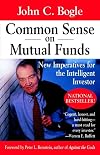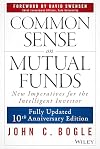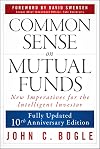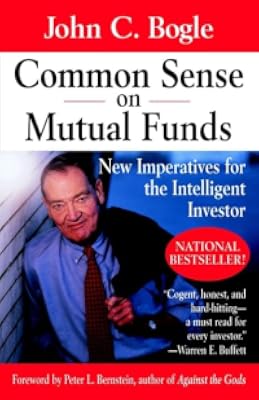
Common Sense on Mutual Funds: New Imperatives for the Intelligent Investor
by Jack Bogle
On This Page
Description
John C. Bogle shares his extensive insights on investing in mutual funds Since the first edition of Common Sense on Mutual Funds was published in 1999, much has changed, and no one is more aware of this than mutual fund pioneer John Bogle. Now, in this completely updated Second Edition, Bogle returns to take another critical look at the mutual fund industry and help investors navigate their way through the staggering array of investment alternatives that are available to them. Written in a show more straightforward and accessible style, this reliable resource examines the fundamentals of mutual fund investing in today's turbulent market environment and offers timeless advice in building an investment portfolio. Along the way, Bogle shows you how simplicity and common sense invariably trump costly complexity, and how a low cost, broadly diversified portfolio is virtually assured of outperforming the vast majority of Wall Street professionals over the long-term. - Written by respected mutual fund industry legend John C. Bogle - Discusses the timeless fundamentals of investing that apply in any type of market - Reflects on the structural and regulatory changes in the mutual fund industry - Other titles by Bogle: The Little Book of Common Sense Investing and Enough. Securing your financial future has never seemed more difficult, but you'll be a better investor for having read the Second Edition of Common Sense on Mutual Funds. show lessTags
Recommendations

Member Reviews
John C. Bogle, the author, may be retired (86 years old so well deserved) but what he created (Vanguard) has not stepped down, rather the opposite. This book's message better live on as well because it is something that needs to be repeated over and over again to avoid the trap financial institutes create for normal people (and their retirement money).
The message is this: If you want to save in the stock market (something that has historically been a good thing in the long run), then prioritize low cost because otherwise you will love 30-40% of your growth before you retire.
The background here is the active mutual funds that banks and other financial institutes create for almost everything. They more or less promise (or hint) at better show more return than other options, but as Bogle shows here, those promises are nothing but empty words. There are a few actively managed mutual funds that do really well when they are small (luck or skill - who knows) but once a fund becomes well known, well marketed and large it's practically impossible for it to grow faster than the average. Despite that, fund owners will typically charge 1.5 to 2% of your money every year.
1.5-2%, is that something to worry about? It is. Unfortunately the noise in a single year 20% or -30% that 1.5-2% can seem small, but over time this will add up to 30-40% of your money since long term growth of stocks is around 6-8%.
So what is the solution? Low cost (both visible fees and hidden transaction costs) and the only funds able to give that are pure index funds. There exist some in Sweden with 0.0 to 0.2% fee, and typically low transaction costs since they are index funds, but they are rarely marketed by the big institutions since they compete with their cash cows.
The book repeats this statement over and over again from every conceivable angle. That makes it a rather tedious book to read but it also means that it really doesn't leave much room for counter arguments. If anything I'd like some more concrete examples. Bogle avoids naming specific funds in many cases. Maybe to not market his own funds, maybe to not shame specific companies that might be just as good as others, just a bit unlucky.
Is Bogle right? Without a doubt. Is the book worth reading? Well, if you plan to put all your savings into a high cost fund that can make you rich, then yes, absolutely. Otherwise, I think there might be more readable books with the same message. Maybe.
One interesting detail with the edition I read was that it was from 1999 but updated 2009 with the hind sight of the IT bubble and the 2008 financial crash. The author is rather proud that his statements from 1999 are more or less correct (some percentages wrong every here and there but the main message was right, 1999 stocks were very expensive so nobody could reasonably expect much growth in the next decade). He didn't predict the crash but he saw that the market was overpriced so that it couldn't increase much in price for a long time. I guess we have a similar situation now, though less extreme. Whether this ends with a crash or just ultra slow growth remains to be seen.
With low growth expected, low cost becomes even more important. I hope people understand that. If not, read this book (tedious or not). show less
The message is this: If you want to save in the stock market (something that has historically been a good thing in the long run), then prioritize low cost because otherwise you will love 30-40% of your growth before you retire.
The background here is the active mutual funds that banks and other financial institutes create for almost everything. They more or less promise (or hint) at better show more return than other options, but as Bogle shows here, those promises are nothing but empty words. There are a few actively managed mutual funds that do really well when they are small (luck or skill - who knows) but once a fund becomes well known, well marketed and large it's practically impossible for it to grow faster than the average. Despite that, fund owners will typically charge 1.5 to 2% of your money every year.
1.5-2%, is that something to worry about? It is. Unfortunately the noise in a single year 20% or -30% that 1.5-2% can seem small, but over time this will add up to 30-40% of your money since long term growth of stocks is around 6-8%.
So what is the solution? Low cost (both visible fees and hidden transaction costs) and the only funds able to give that are pure index funds. There exist some in Sweden with 0.0 to 0.2% fee, and typically low transaction costs since they are index funds, but they are rarely marketed by the big institutions since they compete with their cash cows.
The book repeats this statement over and over again from every conceivable angle. That makes it a rather tedious book to read but it also means that it really doesn't leave much room for counter arguments. If anything I'd like some more concrete examples. Bogle avoids naming specific funds in many cases. Maybe to not market his own funds, maybe to not shame specific companies that might be just as good as others, just a bit unlucky.
Is Bogle right? Without a doubt. Is the book worth reading? Well, if you plan to put all your savings into a high cost fund that can make you rich, then yes, absolutely. Otherwise, I think there might be more readable books with the same message. Maybe.
One interesting detail with the edition I read was that it was from 1999 but updated 2009 with the hind sight of the IT bubble and the 2008 financial crash. The author is rather proud that his statements from 1999 are more or less correct (some percentages wrong every here and there but the main message was right, 1999 stocks were very expensive so nobody could reasonably expect much growth in the next decade). He didn't predict the crash but he saw that the market was overpriced so that it couldn't increase much in price for a long time. I guess we have a similar situation now, though less extreme. Whether this ends with a crash or just ultra slow growth remains to be seen.
With low growth expected, low cost becomes even more important. I hope people understand that. If not, read this book (tedious or not). show less
Sadly, I think the audiobook was abridged, but I think that this really is 'common sense.' You might not hit the moon with Bogle's advice, but I feel fairly certain that you willl get a pretty average, solid return... and have a lot less to worry about. I should probably read this in hard copy!
If there is only one book you read about mutual fund investing this is the one. Bogle pioneered the low cost, no load, mutual fund, and they are still the best investment.
uitgeleend Antoine MAhieu
Ratings
Members
- Recently Added By
Author Information

17+ Works 2,774 Members
John Clifton Bogle was born in Montclair, New Jersey on May 8, 1929. He received a bachelor's degree in economics from Princeton University in 1951. After graduation, he was hired by the Wellington Fund, a Philadelphia-based fund management company. He was named president of Wellington in 1967. He founded the Vanguard Group of Investment Companies show more in 1974. In 1976, he founded the Vanguard Index Trust, the first index fund for individual investors. In 1977, he started selling mutual funds directly to investors rather than through brokers, thus eliminating the sales fees. He officially stepped down as chief executive of Vanguard in January 1996 and remained as chairman until the end of 1999. He wrote several books including Bogle on Mutual Funds, Common Sense on Mutual Funds, and The Clash of the Cultures: Investment vs. Speculation. He died from esophageal cancer on January 16, 2019 at the age of 89. (Bowker Author Biography) show less
Some Editions
Classifications
- Genres
- Business, Nonfiction, General Nonfiction
- DDC/MDS
- 332.6327 — Society, government, & culture Economics Banking & Money Investing Personal Investing Types Of Investments And Other Topics Funds
- LCC
- HG4530 .B633 — Social sciences Finance Finance Investment, capital formation, speculation Investment companies. Investment trusts.
- BISAC
Statistics
- Members
- 454
- Popularity
- 67,644
- Reviews
- 4
- Rating
- (4.06)
- Languages
- Chinese, English
- Media
- Paper, Audiobook, Ebook
- ISBNs
- 13
- ASINs
- 11