
Peter L. Bernstein (1919–2009)
Author of Against the Gods: The Remarkable Story of Risk
About the Author
Peter L. Bernstein graduated magna cum laude from Harvard College with a degree in economics. After serving as a member of the research staff at the Federal Reserve Bank of New York and at the Office of Strategic Services in Washington, Bernstein joined the the Air Force, attaining the rank of show more captain serving in World War II, and assigned to the Office of Strategic Services. After the war, Bernstein taught economics for many years as an adjunct professor on the Graduate Faculty of the New School for Social Research in New York. In 1951, after teaching economics at Williams College and spending five years in commercial banking, Bernstein became Chief Executive of a nationally known investment counsel firm He retired in 1973 to launch Peter L. Bernstein, Inc. Bernstein was the first Editor of The Journal of Portfolio Management in 1974,and is now Consulting Editor of the Journal. He served on the Visiting Committee to the Economics Department at Harvard University, as a Trustee and member of the Finance Committee of the College Retirement Equities Fund, and as a Trustee of the Investment Management Workshop sponsored by the Association for Investment Management & Research. Bernstein is the author of nine books in economics and finance and he has also written articles in professional journals such as The Harvard Business Review and the Financial Analysts Journal, and in the press, including The New York Times, The Wall Street Journal, Worth Magazine, and Bloomberg publications. He has contributed to collections of articles published by Perseus and FT Mastering. He is also a lecturer on risk management, asset allocation, portfolio strategy, and market history. Bernstein has received three major awards from the Association for Investment Management & Research, which include; The Award for Professional Excellence, The Graham & Dodd Award, given annually for the outstanding article in the Financial Analysts Journal for the previous year, and The James R. Vertin Award, recognizing individuals who have produced a body of research notable for its relevance and enduring value to investment professionals. (Bowker Author Biography) show less
Works by Peter L. Bernstein
Wedding of the Waters: The Erie Canal and the Making of a Great Nation (2005) 537 copies, 10 reviews
Peter L. Bernstein Classics Boxed Set : Capital Ideas, Against the Gods, The Power of Gold (2005) 30 copies
The Price of Prosperity: A Realistic Appraisal of the Future of Our National Economy (Peter L. Bernstein's Finance Classics) (2008) 18 copies
Associated Works
Common Sense on Mutual Funds: New Imperatives for the Intelligent Investor (1999) — Foreword, some editions — 454 copies, 4 reviews
Expectations Investing: Reading Stock Prices for Better Returns (2001) — Foreword — 81 copies, 1 review
Tagged
Common Knowledge
- Birthdate
- 1919-01-22
- Date of death
- 2009-06-05
- Gender
- male
- Education
- Harvard College (BA | Economics | 1941)
- Occupations
- economic historian
college professor
businessman - Organizations
- Peter L. Bernstein Inc. [founder]
- Nationality
- USA
- Associated Place (for map)
- USA
Members
Reviews
http://elenburg.blogspot.com/2010/01/book-review-against-gods.html
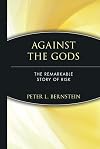
Against the Gods: The Remarkable Story of Risk by Peter L. Bernstein is the third book I've read in the book swaps I do with my fee only financial advisor. I never would have picked this up to read myself, but I'm much better informed on the topic of risk having read it. Berstein's book is primarily historical, somewhat biographical, and minimally technical in his comprehensive treatment of risk.
The sections and chapters show more progress historically from the earliest notion of numbers and risk quantification in ancient times to the present day--or at least 1996 when the book came out. The earlier chapters deal with historical developments in the mathematics of probability and statistical theories. The later chapters focus more on risk in modern financial markets. In the concluding chapter titled "Awaiting the Wildness" Bernstein writes:
"As we look ahead toward the new millennium, what are the prospects that we can ... hope to bring more risks under control and make progress at the same time? ... despite the many ingenious tools ... created to attack the puzzle, much remains unsolved. Discontinuities, irregularities, and volatilities seem to be proliferating rather than diminishing." (p.329)
Yes, it is a wild and risky world out there! I wonder what the author would say today as we're digging out of the recent implosion in our global financial system? Overall, I enjoyed the book, particularly the biographical sketches of the many intellectual luminaries who contributed to the body of knowledge on risk and probability. I particularly enjoyed the chapter on Prospect Theory which was a core part of Predictably Irrational, another book Brent loaned me. Recognizing the classical view of rationality was wrong and that human "logic" is not so logical leads to some fascinating conclusions about the human condition.
"Prospect Theory discovered behavior patterns that had never been recognized by proponents of rational decision-making. Kahneman and Tversky ascribe these patterns to two human shortcomings. First, emotion often destroys the self-control that is essential to rational decision-making. Second, people are often unable to understand fully what they are dealing with. They experience what psychologists call cognitive difficulties." (p. 271)
Prospect Theory discovered asymmetry in human decisions involving gains vs. decisions involving losses. People are more risk averse about winning than losing, i.e. we take more risks to avoid loss than to achieve gains. Adding this discovery to the observation that loss remaining unresolved, such as the loss of a loved one, can provoke intense, irrational, and abiding risk-aversion is a profound insight that explains a lot of human behavior. It also got me thinking more deeply about why I make some of the decisions I do. In addition to the insights on human behavior, this book also confirmed and solidified my thoughts on money management and investing. show less
Against the Gods: The Remarkable Story of Risk by Peter L. Bernstein is the third book I've read in the book swaps I do with my fee only financial advisor. I never would have picked this up to read myself, but I'm much better informed on the topic of risk having read it. Berstein's book is primarily historical, somewhat biographical, and minimally technical in his comprehensive treatment of risk.
The sections and chapters show more progress historically from the earliest notion of numbers and risk quantification in ancient times to the present day--or at least 1996 when the book came out. The earlier chapters deal with historical developments in the mathematics of probability and statistical theories. The later chapters focus more on risk in modern financial markets. In the concluding chapter titled "Awaiting the Wildness" Bernstein writes:
"As we look ahead toward the new millennium, what are the prospects that we can ... hope to bring more risks under control and make progress at the same time? ... despite the many ingenious tools ... created to attack the puzzle, much remains unsolved. Discontinuities, irregularities, and volatilities seem to be proliferating rather than diminishing." (p.329)
Yes, it is a wild and risky world out there! I wonder what the author would say today as we're digging out of the recent implosion in our global financial system? Overall, I enjoyed the book, particularly the biographical sketches of the many intellectual luminaries who contributed to the body of knowledge on risk and probability. I particularly enjoyed the chapter on Prospect Theory which was a core part of Predictably Irrational, another book Brent loaned me. Recognizing the classical view of rationality was wrong and that human "logic" is not so logical leads to some fascinating conclusions about the human condition.
"Prospect Theory discovered behavior patterns that had never been recognized by proponents of rational decision-making. Kahneman and Tversky ascribe these patterns to two human shortcomings. First, emotion often destroys the self-control that is essential to rational decision-making. Second, people are often unable to understand fully what they are dealing with. They experience what psychologists call cognitive difficulties." (p. 271)
Prospect Theory discovered asymmetry in human decisions involving gains vs. decisions involving losses. People are more risk averse about winning than losing, i.e. we take more risks to avoid loss than to achieve gains. Adding this discovery to the observation that loss remaining unresolved, such as the loss of a loved one, can provoke intense, irrational, and abiding risk-aversion is a profound insight that explains a lot of human behavior. It also got me thinking more deeply about why I make some of the decisions I do. In addition to the insights on human behavior, this book also confirmed and solidified my thoughts on money management and investing. show less
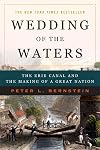
At first this book was a little disappointing. I was expecting something more on the lines McCullogh’s book about the Panama Canal, The Path Between the Seas, with details of the difficulties and methods involved in construction of the Erie Canal. However, the author of Wedding of the Waters is an economist, not an engineer or historian, and it shows. The technical problems involved in building the Erie Canal are either glossed over or explained in a way that shows the author was out of show more his depth (for example, Mr. Bernstein thinks it’s necessary to explain to his readers what a “lever” is, and his description of a stump-pulling machine leaves out some crucial details necessary to operation that are quickly visible from a contemporary illustration on one of the plates).
However, Mr. Bernstein’s presentation grows on you. His central thesis is that the Erie Canal was vital to the development and unification of the United States, by providing a way for the states and territories west of the Appalachians to get their agricultural produce to the east, and thence across the Atlantic. A telling statistic is that is cost about 21 times as much to move flour by wagon as it did by canal barge; by wagon, flour from Ohio couldn’t make it across the mountains before it cost more to transport than you could sell it for; by barge and then by ship it was profitable to ship it to and sell it in Liverpool. The influence of the Canal on the development of the Midwest was profound; Rochester, Buffalo, Cleveland and Chicago went from isolated villages to cities within a few years of the Canal’s completion. Bernstein builds on these numbers to suggest that if the canal hadn’t been built, the trans-Appalachian west might have become as secessionist as the South; with no connection to the eastern seaboard it might have sided with the South (with which it had transport connections by way of the Mississippi and tributaries) or remained neutral. (There were, of course, eventually rail connections but they may have been too little and too late).
Economic, political and social factors are emphasized throughout. The struggles to finance the Canal are presented in detail, which can get heavy if you’re not sympathetic to the general theme. Byzantine New York State politics, especially the career of De Witt Clinton, are also covered at length. (De Witt evoked the same sort of love-him or hate-him dichotomy among his contemporaries as Bill; I wonder if there’s a distant relationship?) The social aspect of canal travel, with descriptions of the less-than-luxurious accommodations, is a nice reminder to people who yearn for the good old days.
I think I have to give this one four and a half stars. I would have liked a little more engineering details, but it’s already a pretty thick book and you can’t have everything. Where would you put it? show less
However, Mr. Bernstein’s presentation grows on you. His central thesis is that the Erie Canal was vital to the development and unification of the United States, by providing a way for the states and territories west of the Appalachians to get their agricultural produce to the east, and thence across the Atlantic. A telling statistic is that is cost about 21 times as much to move flour by wagon as it did by canal barge; by wagon, flour from Ohio couldn’t make it across the mountains before it cost more to transport than you could sell it for; by barge and then by ship it was profitable to ship it to and sell it in Liverpool. The influence of the Canal on the development of the Midwest was profound; Rochester, Buffalo, Cleveland and Chicago went from isolated villages to cities within a few years of the Canal’s completion. Bernstein builds on these numbers to suggest that if the canal hadn’t been built, the trans-Appalachian west might have become as secessionist as the South; with no connection to the eastern seaboard it might have sided with the South (with which it had transport connections by way of the Mississippi and tributaries) or remained neutral. (There were, of course, eventually rail connections but they may have been too little and too late).
Economic, political and social factors are emphasized throughout. The struggles to finance the Canal are presented in detail, which can get heavy if you’re not sympathetic to the general theme. Byzantine New York State politics, especially the career of De Witt Clinton, are also covered at length. (De Witt evoked the same sort of love-him or hate-him dichotomy among his contemporaries as Bill; I wonder if there’s a distant relationship?) The social aspect of canal travel, with descriptions of the less-than-luxurious accommodations, is a nice reminder to people who yearn for the good old days.
I think I have to give this one four and a half stars. I would have liked a little more engineering details, but it’s already a pretty thick book and you can’t have everything. Where would you put it? show less
Your investment manager or stock broker probably believes he can beat the market-- ie: do a better job investing your money than simply putting your money in an index fund. And he is wrong. Anyone who says "I can beat the market" is a liar. "Buy and hold" is a better strategy for the investor than actively trading. As Nobel laureate Eugene Fama recently pointed out (again) using data from 1984-2006:
Even before expenses, the overall portfolio of active mutual funds shows no evidence that show more active managers can enhance returns. After costs, fund investors in aggregate simply lose the fees and expenses imposed on them.
As more players enter the capital markets, the markets become more strongly efficient. This is why I have a problem teaching finance-- I see too many students graduate who think they are somehow smarter than the market. Granted, one aspect of Efficient Markets Hypothesis may not hold to be true -- the underlying price may not always be right (and see my review of Taleb's Fooled by Randomness or Mandelbrot's The (Mis)Behavior of Markets) and risk may be grossly misassessed due to false assumptions of normality.
But people who are able to see mispriced assets or missassessed risk either don't exist or are too far and between. Bill Miller became a legend for managing a fund that beat the S&P 500 for 15 consecutive years (the only one to do so). Now his fund is the worst performing of its class and he's lost tens of billions of dollars.
This is also why I don't want to be an investment manager or try to sell someone the idea that I could pick the best mutual funds for them, because the data say that active management is ludicrous. All I could do is match their risk tolerance to the stated risk of the fund, like selling them the color car they want to drive.
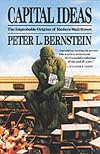
Capital Ideas: The Improbable Origins of Modern Wall Street by Peter L. Bernstein is a classic history of modern finance. How academic economists and mathematicians revolutionized finance, and how the investment services industry fiercely resists their ideas. From determining the fair price of an option to designing the optimally diversified portfolio, Bernstein tells the story of how it all took place from Bachelier to Rubinstein.
Last summer, I read Bernstein's Against the Gods (my review here), which told the history of risk and is a good prelude to this book. What Taleb and Mandelbrot argue is that the tools used in Bernstein's book are folly for risk management because of the models' underlying assumptions--the world is not normally distributed. 1987 is an "aberration" Bernstein glosses over, and 2008 made Taleb and Mandelbrot rock stars (Taleb calls for every Nobel economics winner in Capital Ideas to be stripped of their awards).
As far as comprehensive history, this book is tough to beat. It has been required for our Jan term class for the last several years, which is why I needed to read it (although I'm not requiring it). After the dot-com crash of the 1990s, Bernstein wrote a sequel "defense" of his "heroes" which I would like to read.
4 stars out of 5. show less
Even before expenses, the overall portfolio of active mutual funds shows no evidence that show more active managers can enhance returns. After costs, fund investors in aggregate simply lose the fees and expenses imposed on them.
As more players enter the capital markets, the markets become more strongly efficient. This is why I have a problem teaching finance-- I see too many students graduate who think they are somehow smarter than the market. Granted, one aspect of Efficient Markets Hypothesis may not hold to be true -- the underlying price may not always be right (and see my review of Taleb's Fooled by Randomness or Mandelbrot's The (Mis)Behavior of Markets) and risk may be grossly misassessed due to false assumptions of normality.
But people who are able to see mispriced assets or missassessed risk either don't exist or are too far and between. Bill Miller became a legend for managing a fund that beat the S&P 500 for 15 consecutive years (the only one to do so). Now his fund is the worst performing of its class and he's lost tens of billions of dollars.
This is also why I don't want to be an investment manager or try to sell someone the idea that I could pick the best mutual funds for them, because the data say that active management is ludicrous. All I could do is match their risk tolerance to the stated risk of the fund, like selling them the color car they want to drive.
Capital Ideas: The Improbable Origins of Modern Wall Street by Peter L. Bernstein is a classic history of modern finance. How academic economists and mathematicians revolutionized finance, and how the investment services industry fiercely resists their ideas. From determining the fair price of an option to designing the optimally diversified portfolio, Bernstein tells the story of how it all took place from Bachelier to Rubinstein.
Last summer, I read Bernstein's Against the Gods (my review here), which told the history of risk and is a good prelude to this book. What Taleb and Mandelbrot argue is that the tools used in Bernstein's book are folly for risk management because of the models' underlying assumptions--the world is not normally distributed. 1987 is an "aberration" Bernstein glosses over, and 2008 made Taleb and Mandelbrot rock stars (Taleb calls for every Nobel economics winner in Capital Ideas to be stripped of their awards).
As far as comprehensive history, this book is tough to beat. It has been required for our Jan term class for the last several years, which is why I needed to read it (although I'm not requiring it). After the dot-com crash of the 1990s, Bernstein wrote a sequel "defense" of his "heroes" which I would like to read.
4 stars out of 5. show less

A superb, comprehensive, well-detailed history of the planning and building of the Erie Canal. Begun at a time (1817) when there was not one professional civil engineer in the U.S., the canal's proponents overcame Washington's indifference, immense physical challenges, and roiling New York State politics to build their water highway. By cutting nine tenths of the time and expense of moving goods from the Midwest to Atlantic seaports, the Canal made the economic development of the Ohio and show more Mississippi valleys possible. It also catapulted New York State into an eminent position in the Union, having abjured federal help; pushed New York City into world-class status; made Chicago the second-most important city in the U.S.; served as a model for federal funding of the Civil War; and vaulted America into the limelight as a world power. Not bad for a serviceable little ditch.
Bernstein weaves a fascinating tale of the indomitable political will it took to even sell the idea to the bond-buying public. The story includes the stunning ingenuity of the men responsible for the work, and it's all placed perfectly in the context of the canal-crazy era. This is wonderful - not to be missed.
http://bassoprofundo1.blogspot.com/2010/06/wedding-of-waters-erie-canal-and-maki... show less
Bernstein weaves a fascinating tale of the indomitable political will it took to even sell the idea to the bond-buying public. The story includes the stunning ingenuity of the men responsible for the work, and it's all placed perfectly in the context of the canal-crazy era. This is wonderful - not to be missed.
http://bassoprofundo1.blogspot.com/2010/06/wedding-of-waters-erie-canal-and-maki... show less
Lists
Awards


You May Also Like


Associated Authors
Statistics
- Works
- 20
- Also by
- 4
- Members
- 4,570
- Popularity
- #5,498
- Rating
- 3.8
- Reviews
- 43
- ISBNs
- 84
- Languages
- 12
- Favorited
- 5
