

Nassim Nicholas Taleb
Author of The Black Swan: The Impact of the Highly Improbable
About the Author
Nassim Nicholas Taleb was born in 1960 in Amioun, Lebanon. He is a researcher, essayist, trader, epistemologist, and former practitioner of mathematical finance. Taleb received his bachelors and masters degree in science from the University of Paris. He holds an MBA from the Wharton School at the show more University of Pennsylvania, and a Ph.D. in Management Science from the University of Paris- Dauphine. Taleb began his financial mathematics career in several of New York City's Wall Street firms before becoming a scholar in the epistemology of chance events, randomness, and the unknown. Taleb's book, Fooled by Randomness, was translated into 23 languages. His book, The Black Swan, was translated into 27 languages and spent several months on the New York Times Bestseller list. Taleb is a Distinguished Professor of Risk Engineering at Polytechnic Institute of New York University and visiting professor of Marketing (Cognitive Science) at London Business School. Taleb has also taught at the University of Massachusetts in Amherst, Courant Institute of New York University, and the Wharton Business School Financial Institutions Center. His title Bed of Procrustes made the N.Y. Times Bestseller List for 2010 and his title Antifragile: Things That Gain from Disorder made The 2012 New York Times Bestseller List. show less
Series
Works by Nassim Nicholas Taleb
The Black Swan: The Impact of the Highly Improbable (2007) — Author; Postscript, some editions — 9,649 copies, 206 reviews
Fooled by Randomness: The Hidden Role of Chance in Life and in the Markets (2001) 4,781 copies, 71 reviews
Statistical Consequences of Fat Tails: Real World Preasymptotics, Epistemology, and Applications (Technical Incerto) (2020) 58 copies
The Calm Before the Storm: Why Volatility Signals Stability, and Vice Versa [journal article] 2 copies
The last few pages are quite interesting and would mirror the life anyone trying to lead a practical and well grounded life. A practical doer who is always humble and questioning… 2 copies, 2 reviews
Silent Risk 2 copies
Principia Politica 1 copy
Na wĹasne ryzyko. Ukryte asymetrie w codziennym Ĺzyciu - Nassim Nicholas Taleb [KSIÄĹťKA] (2019) 1 copy
Ο μαύρος κύκνος 1 copy
Fat Tales & Convexity 1 copy
Associated Works
Tagged
Common Knowledge
- Canonical name
- Taleb, Nassim Nicholas
- Other names
- نسيم نقولا طالب
- Birthdate
- 1960-09-11
- Gender
- male
- Education
- University of Paris (BS|MS)
University of Pennsylvania (MBA|1983)
Paris Dauphine University (Ph.D|1998) - Occupations
- statistician
university professor
economist - Organizations
- New York University (Polytechnic Institute)
Decision Research Laboratory
UBS
Credit Suisse First Boston
Canadian Imperial Bank of Commerce
Bankers Trust (show all 8)
BNP Paribas
Empirica - Awards and honors
- Derivatives Hall of Fame (2001)
Wolfram Innovator Award (2018) - Nationality
- Lebanon (birth)
USA - Birthplace
- Amioun, Lebanon
- Places of residence
- Amioun, Lebanon
New York, New York, USA - Associated Place (for map)
- New York, New York, USA
Members
Discussions
The Black Swan in Philosophy and Theory (June 2007)
Reviews
The Black Swan: Second Edition: The Impact of the Highly Improbable: With a new section: "On Robustness and Fragility" by Nassim Nicholas Taleb
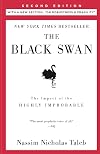
Consider the turkey. For day after day it gets all the food it can eat and lives in reasonable comfort with others of its own kind. There's even a fence to keep away predators. It's a pretty good life for a turkey, which has every reason to expect this good life to continue. But it has never heard of a certain American tradition known as Thanksgiving dinner. And so one fateful autumn day, the turkey experiences a Black Swan.
That is one of the more memorable illustrations Nassin Nicholas show more Taleb uses in his 2007 book "The Black Swan." The title comes from a common assumption that, because every swan one has ever seen has been white, all swans must be white. Taleb argues effectively in his book that past experience cannot be used to predict the future, because Black Swans happen. Whether it's Hurricane Katrina or the 1929 Wall Street collapse or airliners crashing into the World Trade Center, unexpected things happen, and these Black Swans can have a tremendous impact on all of us.
Not all Black Swans are bad. No one could have predicted the amazing success of J.K. Rowling's Harry Potter books. Some movies are unexpected box office smashes, while others that studios invested a lot of money in disappear from theaters very quickly. Almost every day somebody somewhere comes up with a million-dollar idea that improves many lives.
Taleb argues that what we don't know is more important than what we do know. We should expect the unexpected, because sooner or later it is going to happen.
The author makes a lot of sense, which is almost a disappointment because he is so arrogant about how smart he is and so contemptuous of anyone who thinks differently. In his book he lambastes, often by name, economists, planners, stock market analysts, journalists, bankers, social scientists and many others. Here's an example of his way of dealing with people he doesn't like: "We humans have the largest cortex, followed by bank executives, dolphins, and our cousins, the apes."
Taleb deliberately has little to suggest about planning for the future. His point, after all, is that you can't plan for the future because Black Swans happen and impact the future in unexpected ways. He does recommend, however, that you put most of your money in a safe, safe place. You may not make any money on it, but at least you won't lose it. Then invest a small percentage on some highly speculative stock that, if it ever pays off, will pay off big. If it doesn't, well, you haven't lost much.
In the meantime, ignore all economic forecasts by professional economists, especially those who have won Nobel Prizes, he says. They are always going to be wrong because they never take Black Swans into consideration.
Taleb ends his book on a high note, pointing out something I have thought about often over the years in different words: Each one of us is a Black Swan. The odds against any of us being born were astronomical. No one could have predicted, even knowing our parents, what we would be like. Yet here we are, each a Black Swan whose full impact on the world is yet to be realized. show less
That is one of the more memorable illustrations Nassin Nicholas show more Taleb uses in his 2007 book "The Black Swan." The title comes from a common assumption that, because every swan one has ever seen has been white, all swans must be white. Taleb argues effectively in his book that past experience cannot be used to predict the future, because Black Swans happen. Whether it's Hurricane Katrina or the 1929 Wall Street collapse or airliners crashing into the World Trade Center, unexpected things happen, and these Black Swans can have a tremendous impact on all of us.
Not all Black Swans are bad. No one could have predicted the amazing success of J.K. Rowling's Harry Potter books. Some movies are unexpected box office smashes, while others that studios invested a lot of money in disappear from theaters very quickly. Almost every day somebody somewhere comes up with a million-dollar idea that improves many lives.
Taleb argues that what we don't know is more important than what we do know. We should expect the unexpected, because sooner or later it is going to happen.
The author makes a lot of sense, which is almost a disappointment because he is so arrogant about how smart he is and so contemptuous of anyone who thinks differently. In his book he lambastes, often by name, economists, planners, stock market analysts, journalists, bankers, social scientists and many others. Here's an example of his way of dealing with people he doesn't like: "We humans have the largest cortex, followed by bank executives, dolphins, and our cousins, the apes."
Taleb deliberately has little to suggest about planning for the future. His point, after all, is that you can't plan for the future because Black Swans happen and impact the future in unexpected ways. He does recommend, however, that you put most of your money in a safe, safe place. You may not make any money on it, but at least you won't lose it. Then invest a small percentage on some highly speculative stock that, if it ever pays off, will pay off big. If it doesn't, well, you haven't lost much.
In the meantime, ignore all economic forecasts by professional economists, especially those who have won Nobel Prizes, he says. They are always going to be wrong because they never take Black Swans into consideration.
Taleb ends his book on a high note, pointing out something I have thought about often over the years in different words: Each one of us is a Black Swan. The odds against any of us being born were astronomical. No one could have predicted, even knowing our parents, what we would be like. Yet here we are, each a Black Swan whose full impact on the world is yet to be realized. show less
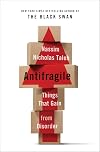
What is the opposite of fragile? We might come up with words like strong, stable or robust, but professional contrarian Nassim Nicholas Taleb disagrees. If what is fragile weakens under pressure, then the opposite would be something that becomes stronger under pressure. That which is strong, stable or robust merely withstands the pressure. So Taleb coins the word antifragile in his 2012 book “Antifragile: Things That Gain from Disorder.”
This book follows in the footsteps of his best show more known work “The Black Swan” in which he points out that unexpected things happen. Just because most swans are white doesn't mean some can't be black. Hurricane Florence, the 9-11 attacks and the 1929 stock market crash are examples of black swans. If “The Black Swan” was short on practical advice, “Antifragile” is loaded with it, covering what we should eat, when we should seek medical care, what we should read, how we should get an education and how we should make our living, among other topics.
Taleb has little use for economists, big business, college professors and other intellectuals, politicians, doctors and virtually anyone who claims to be only trying to help. "This is the tragedy of modernity: as with neurotically overprotective parents, those trying to help are often hurting us the most," he says. Thus he ignores modern advice, except to ridicule it, and consults the wisdom of the past, such as Seneca, Cato the Elder and the Bible. That such writings still exist and remain helpful proves to Taleb that they are antifragile.
One finds wisdom here too, but also a bit of hypocrisy. After all Taleb, like those he criticizes, is only trying to help. show less
This book follows in the footsteps of his best show more known work “The Black Swan” in which he points out that unexpected things happen. Just because most swans are white doesn't mean some can't be black. Hurricane Florence, the 9-11 attacks and the 1929 stock market crash are examples of black swans. If “The Black Swan” was short on practical advice, “Antifragile” is loaded with it, covering what we should eat, when we should seek medical care, what we should read, how we should get an education and how we should make our living, among other topics.
Taleb has little use for economists, big business, college professors and other intellectuals, politicians, doctors and virtually anyone who claims to be only trying to help. "This is the tragedy of modernity: as with neurotically overprotective parents, those trying to help are often hurting us the most," he says. Thus he ignores modern advice, except to ridicule it, and consults the wisdom of the past, such as Seneca, Cato the Elder and the Bible. That such writings still exist and remain helpful proves to Taleb that they are antifragile.
One finds wisdom here too, but also a bit of hypocrisy. After all Taleb, like those he criticizes, is only trying to help. show less
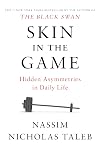
More Taleb wry and enlightening observations with belittling, crude attacks. (What is this about slamming someone as "low-testosterone"?) He-man risk assessor Taleb really takes aim at the worst aspects of the unfair American capitalism in this book, using as an example a former United States Secretary of the Treasury:
He also details real problems with the data analysis of others, including Steven Pinker which he explains in some convincing details, such as historical inflation of war casualties to undercut the arguments of The Better Angels of Our Nature: Why Violence Has Declined. show less
Robert Rubin, a former Secretary of the United States Treasury, one of those who sign their names on the banknote you just used to pay for coffee, collected more than $120show more
million in compensation from Citibank in the decade preceding the banking crash of 2008. When the bank, literally insolvent, was rescued by the taxpayer, he didn’t write any check—he invoked uncertainty as an excuse. Heads he wins, tails he shouts “Black Swan.” Nor did Rubin acknowledge that he transferred risk to taxpayers: Spanish grammar specialists, assistant schoolteachers, supervisors in tin can factories, vegetarian nutrition advisors, and clerks for assistant district attorneys were “stopping him out,” that is, taking his risks and paying for his losses. But the worst casualty has been free markets, as the public, already prone to hating financiers, started conflating free markets and higher order forms of corruption and cronyism, when in fact it is the exact opposite: it is government, not markets, that makes these things possible by the mechanisms of bailouts. It is not just bailouts: government interference in general tends to remove skin in the game.
The good news is that in spite of the efforts of a complicit Obama administration that wanted to protect the game and the rent-seeking bankers,*3 the risk-taking business started moving toward small independent structures known as hedge funds. The move took place mostly because of the overbureaucratization of the system as paper shufflers (who think work is mostly about paper shuffling) overburdened the banks with rules—but somehow, in the thousands of pages of additional regulations, they avoided considering skin in the game. In the decentralized hedge fund space, on the other hand, owner-operators have at least half of their net worth in the funds, making them relatively more exposed than any of their customers, and they personally go down with the ship.
He also details real problems with the data analysis of others, including Steven Pinker which he explains in some convincing details, such as historical inflation of war casualties to undercut the arguments of The Better Angels of Our Nature: Why Violence Has Declined. show less
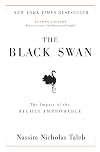
This is a tough book to review. It covers some of my favorite subjects, e.g. fat tails and critical point phenomena in statistical physics. That this book came out just before the great 2008 financial meltdown, and Taleb really sketches out the exact scenario that played out then... amazing, really! Plus Taleb frames all this in a deeper epistemological framework. There are many great insights in this book!
The problem I have with the book is that it's scattered, disjointed. Taleb admits as show more much at the start. It's a bit of a stream of consciousness. He's got a lot of stories and slogans, but never really spends enough time with one before racing on to the next. By the time the reader is at the end of the book, the whole system has been orbited enough times that the terrain is reasonably clear. show less
The problem I have with the book is that it's scattered, disjointed. Taleb admits as show more much at the start. It's a bit of a stream of consciousness. He's got a lot of stories and slogans, but never really spends enough time with one before racing on to the next. By the time the reader is at the end of the book, the whole system has been orbited enough times that the terrain is reasonably clear. show less
Lists
Awards


You May Also Like


Associated Authors
Statistics
- Works
- 26
- Also by
- 1
- Members
- 20,876
- Popularity
- #1,035
- Rating
- 3.8
- Reviews
- 417
- ISBNs
- 309
- Languages
- 25
- Favorited
- 45

