

Richard H. Thaler
Author of Nudge: Improving Decisions About Health, Wealth, and Happiness
About the Author
Richard H. Thaler a professor of behavioral science and economics at the University of Chicago Booth School of Business. He lives in Chicago.
Image credit: Photo courtesy the University of Chicago Experts Exchange (link)
Works by Richard H. Thaler
Associated Works
This Will Make You Smarter: New Scientific Concepts to Improve Your Thinking (Edge Question Series) (2012) — Contributor — 902 copies, 17 reviews
Tagged
Common Knowledge
- Birthdate
- 1945-09-12
- Gender
- male
- Education
- Case Western Reserve University (BA)
University of Rochester (M.Sc. ∙ PhD)
Newark Academy - Occupations
- professor (behavioral science ∙ economics)
economist - Organizations
- University of Chicago (Booth School of Business|Center for Decision Research)
- Awards and honors
- Nobel Prize (Economics, 2017, contributions to behavioral economics)
- Relationships
- Sunstein, Cass R. (friend, coauthor)
Kahneman, Daniel (collaborator, coauthor) - Nationality
- USA
- Birthplace
- East Orange, New Jersey, USA
- Places of residence
- Chicago, Illinois, USA
- Associated Place (for map)
- USA
Members
Reviews
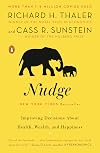
Drawing on current thinking in psychology and behavioral economics, trends which have helped us to refine our understanding of human behavior and decision-making, Sunstein and Thaler lay out their conception of choice architectures. The way that information is presented matters. As human beings, we are not the fabled homo economicus, the autonomous, self-owning, rationally-deciding agents that have dominated thinking on these matters in the United States.
Choice architecture means that there show more is no such thing as a neutral default, and thus the responsibility for providing thoughtful, and perhaps (as becomes important) helpful, layouts is placed on those who do the designing. This matters in a bewildering range of domains, although the authors (rightly in my thinking) point out that cases where feedback is not readily forthcoming and in which the long-term consequences truly matter (such as dietary and financial decisions as well as matters affecting health and the environment) are demanding of the most attention.
Sunstein and Thaler espouse (what they argue to be) a benevolent form of interventionism which they label 'libertarian paternalism'. As self-proclaimed libertarians, they are nervous about heavy-handed interference in the form of bans and prohibitions, giving their preference to the soft-gloved approach of incentives and the eponymous 'nudges' made possible by choice architectures. This well-intended 'hands-off' intervention without interfering means to push people into making 'better' choices. However, 'better' remains, as ever, ill-defined and subject to arbitrary definition. Additionally there is a strong case to be made that intervention is intervention no matter how you label it; these methods are less overt, to be sure, but this same property could serve to better conceal their use in the toolkit of unsavory interests.
The remainder of the book runs through various proposals for using 'nudges' in public policy matters, and they do offer a range of ideas worth consideration (although some are questionable, connecting back to a recurrent theme that I will clarify shortly).
As an 'idea book' I would highly recommend giving Nudge a look. Sunstein and Thaler make a persuasive case for the nudge concept, right down to the science and their own political leanings. I have my own reservations about their argument and their perspective in making it (which seems to be largely accepting of, if not quite espousing, a status quo of which I find myself increasingly cynical), but I need not bog down the review with those issues.
As a read, I found the later chapters repetitive and I skimmed healthy chunks of them. Once the argument for the nudge is made in the first part of the book, the examples, while interesting, didn't seem quite as captivating (and this may be in part due to my own above-mentioned reservations rather than any true flaw, so this, too, should not be considered off-putting).
My concerns aside, the ideas here are largely sound, interesting, and, in fairness, I even agree with their broadest scope. The soft approach of 'nudging' seems preferable to more overt forms of intervention, and it's hard to disagree that this is an underused method of moving people toward better life-choices (we just have to sit down for a long think about what justifies our conceptions of 'better', although this is no new problem). show less
Choice architecture means that there show more is no such thing as a neutral default, and thus the responsibility for providing thoughtful, and perhaps (as becomes important) helpful, layouts is placed on those who do the designing. This matters in a bewildering range of domains, although the authors (rightly in my thinking) point out that cases where feedback is not readily forthcoming and in which the long-term consequences truly matter (such as dietary and financial decisions as well as matters affecting health and the environment) are demanding of the most attention.
Sunstein and Thaler espouse (what they argue to be) a benevolent form of interventionism which they label 'libertarian paternalism'. As self-proclaimed libertarians, they are nervous about heavy-handed interference in the form of bans and prohibitions, giving their preference to the soft-gloved approach of incentives and the eponymous 'nudges' made possible by choice architectures. This well-intended 'hands-off' intervention without interfering means to push people into making 'better' choices. However, 'better' remains, as ever, ill-defined and subject to arbitrary definition. Additionally there is a strong case to be made that intervention is intervention no matter how you label it; these methods are less overt, to be sure, but this same property could serve to better conceal their use in the toolkit of unsavory interests.
The remainder of the book runs through various proposals for using 'nudges' in public policy matters, and they do offer a range of ideas worth consideration (although some are questionable, connecting back to a recurrent theme that I will clarify shortly).
As an 'idea book' I would highly recommend giving Nudge a look. Sunstein and Thaler make a persuasive case for the nudge concept, right down to the science and their own political leanings. I have my own reservations about their argument and their perspective in making it (which seems to be largely accepting of, if not quite espousing, a status quo of which I find myself increasingly cynical), but I need not bog down the review with those issues.
As a read, I found the later chapters repetitive and I skimmed healthy chunks of them. Once the argument for the nudge is made in the first part of the book, the examples, while interesting, didn't seem quite as captivating (and this may be in part due to my own above-mentioned reservations rather than any true flaw, so this, too, should not be considered off-putting).
My concerns aside, the ideas here are largely sound, interesting, and, in fairness, I even agree with their broadest scope. The soft approach of 'nudging' seems preferable to more overt forms of intervention, and it's hard to disagree that this is an underused method of moving people toward better life-choices (we just have to sit down for a long think about what justifies our conceptions of 'better', although this is no new problem). show less
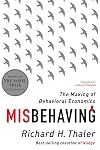
Misbehaving is a charming journey through behavioral economics, as told by one of its founding fathers recounting his academic career. Thaler co-authored Nudge with Cass Sunstein, and worked closely with Daniel Kahneman (Thinking Fast and Slow, Nobel Prize) and Amos Tversky. Thaler has a charming modesty given his esteemed company. His own Nobel came after this book was published.
The basic premise of behavioral economics is that economic theory is perfect--when applied to non-existent beings show more Thaler deems Econs who are perfectly rational. Real Humans make decisions based on a host of supposed irrelevant factors (SIFs), which cause divergence from the predictions of economic theory. Through subtle experiments and data analysis, behavioral economics can find these anomalies.
Loss aversion is one of the major supposedly irrational factors. We tend to want to hold on to what we want, as demonstrated in a rather elegant experiment that compared trading rates in a group of students between tokens which could be redeemed for money and coffee mugs. No one has an emotional attachment to tokens, and so trading was close to rational. But people value a university branded coffee mug ($5 at the campus bookstore) even if it was randomly given to them, and are loath to trade.
Loss aversion shows up in the "irrational" attachment of wine collectors to their bottles over cash, sunk costs of attending events that are already paid for, and riskier behavior in people who are ahead and see themselves as gambling with the house's money, or are behind and looking for any chance to end the day without a net loss.
Another SIF comes from discount rates. A hamburger today is worth more than one tomorrow. An Econ discounts at a consistent exponential rate, while Humans have a variable rate, for example 10% next year, 30% two years from now, 50% for everything past that, and varying discounts rates create unexpected patterns of behavior where preferences can change.
Even supposedly objective experts, like investment fund managers are vulnerable to SIFs. Thaler and his collaborators found cases where the exact same stock traded at nonsensical prices, like an effective negative number, or with trivially available arbitrage. While this may seem like free money, the market can remain irrational longer than you can remain solvent, and some arbitrage traders have gone broke. The best investment advice is to not look at your portfolio too often, about once a year is proper, and do value investing on stocks who's low price-earnings ratio indicate an eventual reversion to the mean.
Finally, nudges can have public policy benefits, in what Thaler deems "libertarian paternalism", where default choices are also good choices. Humans are lazy, unlike Econs, and will save more in retirement plans or be organ donors if those programs are opt out rather than opt in. No one's choices are being infringed, but better defaults create better publics.
For a dry topic, Thaler writes with humor and joy, gleefully explaining how a student who "didn't show much promise" helped to invent a new field and won the highest awards in his field. show less
The basic premise of behavioral economics is that economic theory is perfect--when applied to non-existent beings show more Thaler deems Econs who are perfectly rational. Real Humans make decisions based on a host of supposed irrelevant factors (SIFs), which cause divergence from the predictions of economic theory. Through subtle experiments and data analysis, behavioral economics can find these anomalies.
Loss aversion is one of the major supposedly irrational factors. We tend to want to hold on to what we want, as demonstrated in a rather elegant experiment that compared trading rates in a group of students between tokens which could be redeemed for money and coffee mugs. No one has an emotional attachment to tokens, and so trading was close to rational. But people value a university branded coffee mug ($5 at the campus bookstore) even if it was randomly given to them, and are loath to trade.
Loss aversion shows up in the "irrational" attachment of wine collectors to their bottles over cash, sunk costs of attending events that are already paid for, and riskier behavior in people who are ahead and see themselves as gambling with the house's money, or are behind and looking for any chance to end the day without a net loss.
Another SIF comes from discount rates. A hamburger today is worth more than one tomorrow. An Econ discounts at a consistent exponential rate, while Humans have a variable rate, for example 10% next year, 30% two years from now, 50% for everything past that, and varying discounts rates create unexpected patterns of behavior where preferences can change.
Even supposedly objective experts, like investment fund managers are vulnerable to SIFs. Thaler and his collaborators found cases where the exact same stock traded at nonsensical prices, like an effective negative number, or with trivially available arbitrage. While this may seem like free money, the market can remain irrational longer than you can remain solvent, and some arbitrage traders have gone broke. The best investment advice is to not look at your portfolio too often, about once a year is proper, and do value investing on stocks who's low price-earnings ratio indicate an eventual reversion to the mean.
Finally, nudges can have public policy benefits, in what Thaler deems "libertarian paternalism", where default choices are also good choices. Humans are lazy, unlike Econs, and will save more in retirement plans or be organ donors if those programs are opt out rather than opt in. No one's choices are being infringed, but better defaults create better publics.
For a dry topic, Thaler writes with humor and joy, gleefully explaining how a student who "didn't show much promise" helped to invent a new field and won the highest awards in his field. show less
Lots of disjointed thoughts here, collected:
They want to help the "least sophisticated" people make fewer mistakes with nudges in the right direction. Are (poor) people less sophisticated, or do they simply have fewer resources and less ability to make mistakes? (Or am I being touchy and is this saying the same thing?)
The RECAP idea made me laugh a little. The techno-optimism is rather extreme. Do you lose "Humans" when you present them with spreadsheets? With proof that financial education show more doesn't work (that they cite later on!), would requiring high schoolers to use these spreadsheets (as they suggest) be effective?
"Save More Tomorrow," increasing savings rates as people get regular pay increases, assumes that people's wages DO regularly increase, or that they even outpace inflation, which simply isn't the case for many workers anymore.
On school choice: In the end, if you aren't doing something to change how schools are funded (and the circumstances children grow up in), you are still choosing winners and losers. Even given spreadsheets or fact cards, parents with fewer resources will do less to act against inertia.
And as someone who has worked in nonprofits, the Charity Debit Card idea made me laugh. How many people give enough to itemize? Are they the people who need to benefit from an easier tax deduction? Are they motivated to give for that reason, and bookkeeping is what's holding them back? I'd like to find out more about how well FSA has worked -- I know for many people it's more trouble than it's worth. (Not to mention the logistics of billing a charity dinner where not all of your donation is tax-deductible, since part of the price is assumed to pay for your wine and chicken Parm.)
One thing that came up for me over and over was their idea that sunshine is the best disinfectant -- so much so that simply publishing the names of polluting firms or the financial backers of politicians will end the possibility of corruption. I think that there are industries that are too large and too powerful to be impacted by negative publicity (at least in a timely manner; see Monsanto, see Keystone, see even US policy on Guantanamo). There are also industries that can use their power to stop that sort of sunshine to begin with (see Ag Gag laws). It may be Pollyanna-ish of them to assume this won't happen; it may be doom-and-gloom of me to assume it will.
They also mention in passing that Social Security may be on the brink of insolvency, and that subprime loans were not all bad, which, no. show less
They want to help the "least sophisticated" people make fewer mistakes with nudges in the right direction. Are (poor) people less sophisticated, or do they simply have fewer resources and less ability to make mistakes? (Or am I being touchy and is this saying the same thing?)
The RECAP idea made me laugh a little. The techno-optimism is rather extreme. Do you lose "Humans" when you present them with spreadsheets? With proof that financial education show more doesn't work (that they cite later on!), would requiring high schoolers to use these spreadsheets (as they suggest) be effective?
"Save More Tomorrow," increasing savings rates as people get regular pay increases, assumes that people's wages DO regularly increase, or that they even outpace inflation, which simply isn't the case for many workers anymore.
On school choice: In the end, if you aren't doing something to change how schools are funded (and the circumstances children grow up in), you are still choosing winners and losers. Even given spreadsheets or fact cards, parents with fewer resources will do less to act against inertia.
And as someone who has worked in nonprofits, the Charity Debit Card idea made me laugh. How many people give enough to itemize? Are they the people who need to benefit from an easier tax deduction? Are they motivated to give for that reason, and bookkeeping is what's holding them back? I'd like to find out more about how well FSA has worked -- I know for many people it's more trouble than it's worth. (Not to mention the logistics of billing a charity dinner where not all of your donation is tax-deductible, since part of the price is assumed to pay for your wine and chicken Parm.)
One thing that came up for me over and over was their idea that sunshine is the best disinfectant -- so much so that simply publishing the names of polluting firms or the financial backers of politicians will end the possibility of corruption. I think that there are industries that are too large and too powerful to be impacted by negative publicity (at least in a timely manner; see Monsanto, see Keystone, see even US policy on Guantanamo). There are also industries that can use their power to stop that sort of sunshine to begin with (see Ag Gag laws). It may be Pollyanna-ish of them to assume this won't happen; it may be doom-and-gloom of me to assume it will.
They also mention in passing that Social Security may be on the brink of insolvency, and that subprime loans were not all bad, which, no. show less
Richard H. Thaler is one of the foremost proponents of a field of inquiry now known as “Behavioral Economics.” He achieved a degree of fame with the general public after his best-selling book Nudge, which he co-authored with Cass Sunstein. His latest book, Misbehaving, is part memoire, part history of academic economics, and thoroughly enjoyable and stimulating.
In Thaler’s view, the field of economics took a wrong turn in the mid 20th century when its practitioners attempted to make show more it more “scientific” than other social sciences by subjecting its precepts to rigorous mathematical models. The problem is that although mathematics is perfectly consistent, actual people aren’t.
Modern economists erected a mathematically elegant and consistent edifice of economic theory based on the assumption that people would act rationally in the sense that they would always maximize their economic well-being. Thaler calls the automaton-like individuals described by such theory “Econs” (as opposed to "Humans"), because early in his career he noticed that real people often did not behave like these theoretical beings. He began to collect anecdotes of situations in which most or at least many people did not act as if they rationally calculate their maximum economic benefit.
Among the “anomalies” he cites are:
•The “Sunk Cost Fallacy”--During a snowstorm, we might not drive to a concert if we had been given the tickets for free, but we tend to risk life and limb to go if we had paid for the tickets. The risk on the roads is the same, and we don't get the money back either way.
•"Endowment Effect"--People consistently assign greater value to things they possess than they might think was a reasonable price before they owned the object.
•"Mental Accounting”--People tend to put money into mental compartments and treat the money in each compartment differently, whereas Econs would make no such distinctions; the compartments are only mental constructs and are not real, but they help many Humans manage their money.
Thaler acknowledges a debt to Daniel Kahneman, the only psychologist to win a Nobel Prize in economics, for many insights into seemingly irrational behavior. He also crosses swords with, and names names, among today’s eminent economists, most of whom are members of the faculty at the University of Chicago, and with whom he has disagreed over the years. In particular, he contrasts his views with those of two Nobel laureates, Merton Miller and Eugene Fama, the high priests of efficient markets.
Misbehaving is a good introduction to behavioral economics because of Thaler’s lively wit and easy conversational style. A lay person is unlikely to get lost in the technical distinctions between Thaler’s theories and the “Chicago School” of economics. Ironically, Thaler also teaches at the University of Chicago. Persons interested in pursuing these ideas further should also read Nudge, mentioned above, and Kahneman’s Thinking, Fast and Slow.
(JAB) show less
In Thaler’s view, the field of economics took a wrong turn in the mid 20th century when its practitioners attempted to make show more it more “scientific” than other social sciences by subjecting its precepts to rigorous mathematical models. The problem is that although mathematics is perfectly consistent, actual people aren’t.
Modern economists erected a mathematically elegant and consistent edifice of economic theory based on the assumption that people would act rationally in the sense that they would always maximize their economic well-being. Thaler calls the automaton-like individuals described by such theory “Econs” (as opposed to "Humans"), because early in his career he noticed that real people often did not behave like these theoretical beings. He began to collect anecdotes of situations in which most or at least many people did not act as if they rationally calculate their maximum economic benefit.
Among the “anomalies” he cites are:
•The “Sunk Cost Fallacy”--During a snowstorm, we might not drive to a concert if we had been given the tickets for free, but we tend to risk life and limb to go if we had paid for the tickets. The risk on the roads is the same, and we don't get the money back either way.
•"Endowment Effect"--People consistently assign greater value to things they possess than they might think was a reasonable price before they owned the object.
•"Mental Accounting”--People tend to put money into mental compartments and treat the money in each compartment differently, whereas Econs would make no such distinctions; the compartments are only mental constructs and are not real, but they help many Humans manage their money.
Thaler acknowledges a debt to Daniel Kahneman, the only psychologist to win a Nobel Prize in economics, for many insights into seemingly irrational behavior. He also crosses swords with, and names names, among today’s eminent economists, most of whom are members of the faculty at the University of Chicago, and with whom he has disagreed over the years. In particular, he contrasts his views with those of two Nobel laureates, Merton Miller and Eugene Fama, the high priests of efficient markets.
Misbehaving is a good introduction to behavioral economics because of Thaler’s lively wit and easy conversational style. A lay person is unlikely to get lost in the technical distinctions between Thaler’s theories and the “Chicago School” of economics. Ironically, Thaler also teaches at the University of Chicago. Persons interested in pursuing these ideas further should also read Nudge, mentioned above, and Kahneman’s Thinking, Fast and Slow.
(JAB) show less
Lists
Awards


You May Also Like


Associated Authors
Statistics
- Works
- 12
- Also by
- 1
- Members
- 6,294
- Popularity
- #3,900
- Rating
- 3.6
- Reviews
- 98
- ISBNs
- 126
- Languages
- 18
- Favorited
- 4