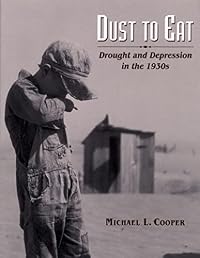
Dust to Eat: Drought and Depression in the 1930s
by Michael L. Cooper
On This Page
Description
The 1930s in America will always be remembered for twin disasters-the Great Depression and the Dust Bowl. Michael L. Cooper takes readers through this tumultuous period, beginning with the 1929 stock market crash that ushered in the Great Depression and continuing with the severe drought in the Midwest, known as the Dust Bowl. He chronicles the everyday struggle for survival by those who lost everything, as well as the mass exodus westward to California on fabled Route 66. The crisis also show more served as a turning point in American domestic policy, prompting the establishment of programs, such as welfare and Social Security, that revolutionized the role of the federal government. Vivid personal anecdotes from figures such as John Steinbeck and Woody Guthrie, and an extensive selection of photographs by Dorothea Lange and others, illuminate the individuals who faced poverty, illness, and despair as they coped with this extraordinary challenge. Endnotes, bibliography, Internet resources, index. show lessTags
Recommendations














Member Reviews
The book tells the history of the Dust Bowl and the drought that compelled desperate families to California to search for work. The focus of the narration is on the devastating tragedy of the Dust Bowl years. The narratives are drawn from letters by and interviews from those who lived through this ddistressing period. In addition, the narration is also based on the works of John Steinbeck and Woody Guthrie. Cooper focuses on 1) the desperate struggle to survive, and 2) the migrant camps' ruthless conditions that led many children, who labored alongside their parents in the field, to perish from disease and malnutrition. Cooper also focuses on the flight from the Great Plains to California along Route 66, fortifying the narrative with show more poems and song lyrics from the era. Furthermore, Cooper talks about the "grassroot effort" and the despair of the "Okies."
The book includes many primary sources, such as interviews and letters, including commments from Steinbeck and Guthrie, of those who had lived through the Dust Bowl, making the book authentic and worthy of reading. This is an excellent piece of historical work of an important time in American history. In addition, Cooper has included poems and song lyrics from the era to add authenticity to the book. Archival black-and-white photographs, mostly taken by Dorothea Lange, clearly portrays the desperation that the Dust Bowl had on human lives. For each chapter, well-documented source notes are provided. Cooper has brought history to life in this moving, genuine history of the Dust Bowl. Except for spelling errors in the bibliography, it is an astounding historical account. show less
The book includes many primary sources, such as interviews and letters, including commments from Steinbeck and Guthrie, of those who had lived through the Dust Bowl, making the book authentic and worthy of reading. This is an excellent piece of historical work of an important time in American history. In addition, Cooper has included poems and song lyrics from the era to add authenticity to the book. Archival black-and-white photographs, mostly taken by Dorothea Lange, clearly portrays the desperation that the Dust Bowl had on human lives. For each chapter, well-documented source notes are provided. Cooper has brought history to life in this moving, genuine history of the Dust Bowl. Except for spelling errors in the bibliography, it is an astounding historical account. show less
Cooper, M. L. (2004). Dust to eat: drought and depression in the 1930s. New York: Clarion Books.
Grades 4 through 7
After a period of great prosperity, the United States was hit with a succession of misfortunes that resulted in millions losing everything they had. The crash of the stock market in October of 1929 marked the beginning of a time of extreme poverty, unemployment, hunger, disease, intolerance, and discrimination in the US. Hit hard by the stock market crash, the Great Plains had to face yet another trial: a great dust storm that swallowed states whole, destroying everything in its path. Years of farming removed the protective layer of native grasses that held the soil into place; combined with a harsh drought, these conditions show more made the earth exposed. When the storm came, there was nothing to keep the soil from being carrying away. Thousands fled the area in search of more opportunities in California. There, they found that the dream of a job and a home gave way to the nightmare of the camps, hunger, disease, and many times death. It was only when the U.S. joined the allies during WW II that the Great Depression came to an end, having deeply changed the country, its people, and its politics.
Dust to eat is a well-researched and beautifully illustrated account of one of the darkest periods of American history. Drawing for numerous primary sources, Cooper paints a powerful picture of the plight of the Okies. Cooper’s writing is historically accurate, and his extensive research gives readers access to a very authentic recreation of that time period. The most powerful element of Cooper’s book is the human suffering portrayed in the many firsthand accounts and the black-and-white pictures, many of them by Dorothea Lange. The audience can hear and see human misery in the words and images Cooper chose to include in his book. Dust to eat is not an easy read but a very important one. Children may be shocked by the horrors others had to endure, many of them children themselves, but they will learn the importance of solidarity, tolerance, and compassion, and charity. show less
Grades 4 through 7
After a period of great prosperity, the United States was hit with a succession of misfortunes that resulted in millions losing everything they had. The crash of the stock market in October of 1929 marked the beginning of a time of extreme poverty, unemployment, hunger, disease, intolerance, and discrimination in the US. Hit hard by the stock market crash, the Great Plains had to face yet another trial: a great dust storm that swallowed states whole, destroying everything in its path. Years of farming removed the protective layer of native grasses that held the soil into place; combined with a harsh drought, these conditions show more made the earth exposed. When the storm came, there was nothing to keep the soil from being carrying away. Thousands fled the area in search of more opportunities in California. There, they found that the dream of a job and a home gave way to the nightmare of the camps, hunger, disease, and many times death. It was only when the U.S. joined the allies during WW II that the Great Depression came to an end, having deeply changed the country, its people, and its politics.
Dust to eat is a well-researched and beautifully illustrated account of one of the darkest periods of American history. Drawing for numerous primary sources, Cooper paints a powerful picture of the plight of the Okies. Cooper’s writing is historically accurate, and his extensive research gives readers access to a very authentic recreation of that time period. The most powerful element of Cooper’s book is the human suffering portrayed in the many firsthand accounts and the black-and-white pictures, many of them by Dorothea Lange. The audience can hear and see human misery in the words and images Cooper chose to include in his book. Dust to eat is not an easy read but a very important one. Children may be shocked by the horrors others had to endure, many of them children themselves, but they will learn the importance of solidarity, tolerance, and compassion, and charity. show less
The Great Depression was not the only disaster to hit the United States in the 1930s. There was also the drought that led to the dust bowl – dust storms that carpeted the Great Plains. Farmers lost everything, small towns emptied out, and a mass migration westward took place, along the famous Route 66. Entire families lived in their cars, or in shanties, or became migrant workers in California, struggling to survive. This book features anecdotes from famous people, and historical photographs, and tells how this pair of calamities changed the United States.
The 1930s in America will always be remembered for twin disasters-the Great Depression and the Dust Bowl. Michael L. Cooper takes readers through this tumultuous period, beginning with the 1929 stock market crash that ushered in the Great Depression and continuing with the severe drought in the Midwest, known as the Dust Bowl. He chronicles the everyday struggle for survival by those who lost everything, as well as the mass exodus westward to California on fabled Route 66. The crisis also served as a turning point in American domestic policy, prompting the establishment of programs, such as welfare and Social Security, that revolutionized the role of the federal government.
TCI LESSON 9: AGRICULTURAL CHANGES IN THE MIDWEST
TCI LESSON 9: AGRICULTURAL CHANGES IN THE MIDWEST
Part E Nonfiction-Specialized
Cooper, M. (2004). Dust to eat: drought and depression in the 1930s. New York: Clarion Books.
Life during the 1930s was difficult for many. Due to the crash of the stock market and the severe drought in the plains states, many families were left without work or food. Farmers that were once successful did what they could to keep their families alive; they moved west to California. Migrant workers from the plains states, also referred to as “Okies,” worked farms in the San Joaquin Valley. However, with such an influx of migrants, there were not enough jobs to go around. Homeless and starving, families struggled to survive. Then life changes when World War 2 begins and jobs become available.
The story of show more many families from the plains states is well-documented in this book. Many examples are supported with quotations and anecdotes from actual people that lived and experienced the hardships, such as Woody Guthrie, Caroline Henderson, and John Steinbeck. The book is also supported with many photographs, some by Dorothea Lange and many that are provided by Library of Congress. Ages 10-15. show less
Cooper, M. (2004). Dust to eat: drought and depression in the 1930s. New York: Clarion Books.
Life during the 1930s was difficult for many. Due to the crash of the stock market and the severe drought in the plains states, many families were left without work or food. Farmers that were once successful did what they could to keep their families alive; they moved west to California. Migrant workers from the plains states, also referred to as “Okies,” worked farms in the San Joaquin Valley. However, with such an influx of migrants, there were not enough jobs to go around. Homeless and starving, families struggled to survive. Then life changes when World War 2 begins and jobs become available.
The story of show more many families from the plains states is well-documented in this book. Many examples are supported with quotations and anecdotes from actual people that lived and experienced the hardships, such as Woody Guthrie, Caroline Henderson, and John Steinbeck. The book is also supported with many photographs, some by Dorothea Lange and many that are provided by Library of Congress. Ages 10-15. show less
Non-fiction book that is a good resource for integrating content areas. Science, social studies and math can all be the focus using this book. Economics, culture, drought, soil errosion.
Ratings
Members
- Recently Added By
Author Information
17+ Works 610 Members
Michael L. Cooper has written a number of books for young adults on various aspects of American history, including a companion book, Fighting for Honor: Japanese Americans and World War II, which was named a 2002 Best Book for Young Adults. He lives in Washington, D.C.
Awards and Honors
Awards
Notable Lists
Common Knowledge
- Original publication date
- 2001
- Dedication
- To Doc and Rozina Thomas, benevolent hosts of sailing adventures, beach excursions, long dinners, and good conversations.
- First words
- "Thousands of them are crossing the borders in ancient rattlign automobiles, destitute and hungry and homeless, ready to accept any pay so that they may eat and feed their children," John Steinbeck wrote in a 1936 article for... (show all) the San Francisco News.
- Last words
- (Click to show. Warning: May contain spoilers.)No one ever again wanted to see the suffering that John Steinbeck and so many other people witnessed in the 1930s.
Classifications
- Genre
- Nonfiction
- DDC/MDS
- 973.917 — History & geography History of North America United States 1901- World Wars and Depression Era (1901-1953) Franklin Delano Roosevelt (1933-1937) New Deal, Social Security Act
- LCC
- E806 .C63 — History of the United States United States Twentieth century Franklin Delano Roosevelt's administrations,
- BISAC
Statistics
- Members
- 92
- Popularity
- 347,958
- Reviews
- 6
- Rating
- (4.25)
- Languages
- English
- Media
- Paper
- ISBNs
- 2
- UPCs
- 1