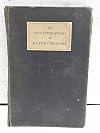
The Collected Poems of Rupert Brooke
by Rupert Brooke
On This Page
Description
And laughter and music and among the flowers The gay child-hearts of men and the child-facesO heart in the great dawn!Tags
Recommendations
















Member Reviews
It’s easy to dismiss these poems without due consideration that they are the early efforts of someone who died at 27: Brooke died on St. George’s Day in April 1915 on a naval ship bound for Gallipoli. He never had the opportunity to either fulfill his promise or to prove his critics right. As the forward to this edition of 1915 notes, this is a book of youth. While I did not respond to most of the poems, I admired a few and could see the early promise. Anyone who cannot relate to a single poem or even a few sentences and turns of phrase has never been young.
‘Pine Trees and the Sky’ re a moment’s bliss that follows a good wallow; lines from Second Best: “Clear-visioned, though it break you; far apart from the dead best, the show more dear and old delight;” and “And the light, Returning, shall give back the golden hours,” on the futility of wanting to recapture a youthful passion; ‘The Song of the Beasts’ reminds me of sneaking out on a hot summer night: “Come away! Come away! Ye are sober and dull through the common day, But now it is night. It is shameful night, and God is asleep!” and simply the allure of duality; ‘The Wayfarer’ speaks to the desire to find that far border town, the desert’s edge, where we could slip away from reality; and the wry maturity of ‘The One Before the Last’ shows a humour about oneself. Brooke is mostly famous for the so-called War Sonnets: the two best, for me, are ‘Safety’ (“We have found safety with all things undying”) embracing what one loved in life amid stoicism, and the very famous ‘The Soldier’ which resonates if you know you will die far from where you were born and/or if you know the loss of someone who gave their life in military service. show less
‘Pine Trees and the Sky’ re a moment’s bliss that follows a good wallow; lines from Second Best: “Clear-visioned, though it break you; far apart from the dead best, the show more dear and old delight;” and “And the light, Returning, shall give back the golden hours,” on the futility of wanting to recapture a youthful passion; ‘The Song of the Beasts’ reminds me of sneaking out on a hot summer night: “Come away! Come away! Ye are sober and dull through the common day, But now it is night. It is shameful night, and God is asleep!” and simply the allure of duality; ‘The Wayfarer’ speaks to the desire to find that far border town, the desert’s edge, where we could slip away from reality; and the wry maturity of ‘The One Before the Last’ shows a humour about oneself. Brooke is mostly famous for the so-called War Sonnets: the two best, for me, are ‘Safety’ (“We have found safety with all things undying”) embracing what one loved in life amid stoicism, and the very famous ‘The Soldier’ which resonates if you know you will die far from where you were born and/or if you know the loss of someone who gave their life in military service. show less
While known as a war poet most of Brooke's poetry was written prior to the Great War. When war was declared in 1914 he had his first experience of war on the disastrous expedition to Antwerp, spending a few days and nights being shelled in trenches. Early in 1915 he sailed with the Expeditionary Force to the Dardanelles, but died of blood poisoning on a French hospital ship at Scyros, Greece on April 23rd, Saint George's Day. He was buried at night, by torchlight, in an olive grove.
I found much of his words pompous by modern standards, generally glorifying war although he had so little experience of it, yet his voice called to mind the generation of young men who were lost. Although his most famous lines are in "The Soldier", I found show more this poem particularly appealing:
I found much of his words pompous by modern standards, generally glorifying war although he had so little experience of it, yet his voice called to mind the generation of young men who were lost. Although his most famous lines are in "The Soldier", I found show more this poem particularly appealing:
Songshow less
All suddenly the wind comes soft,
And Spring is here again;
And the hawthorn quickens with buds of green,
And my heart with buds of pain.
My heart all Winter lay so numb,
The earth so dead and frore,
That I never thought the Spring would come,
Or my heart wake any more.
But Winter's broken and earth has woken,
And the small birds cry again;
And the hawthorn hedge puts forth its buds,
And my heart puts forth its pain.”
The stars are more for the memoir than the poetry which is all wild-eyed and rhapshodic. The Soldier is remarkable but stands alone.
The memoir, by Marsh, is fascinating. Again, the impression one gets of Brooke is of someone who couldn't move without having a life changing, mind altering experience. But what lingers is the death, not only of Brooke, but of so many of his circle. You have a real impression of the scale of loss produced by World War One.
The memoir, by Marsh, is fascinating. Again, the impression one gets of Brooke is of someone who couldn't move without having a life changing, mind altering experience. But what lingers is the death, not only of Brooke, but of so many of his circle. You have a real impression of the scale of loss produced by World War One.
Not my taste but there are some renowned poems in this collection from the English poet Rupert Brooke (born 1887 - died 1914) - most known are the poems in Sonnet Sequence '1914' so he is known as a war poet, although he died early on during the conflict.
Most famous is this sonnet “The Soldier” and one month after it achieved acclaim for the optimistic and patriotic sentiments, Brooke died at age 27 of an infected mosquito bite.
If I should die, think only this of me:
That there’s some corner of a foreign field
That is for ever England. There shall be
In that rich earth a richer dust concealed;
A dust whom England bore, shaped, made aware,
Gave, once, her flowers to love, her ways to roam,
A body of England’s, breathing English show more air,
Washed by the rivers, blest by suns of home.
And think, this heart, all evil shed away,
A pulse in the eternal mind, no less
Gives somewhere back the thoughts of England given;
Her sights and sounds; dreams happy as her day;
And laughter, learnt of friends; and gentleness,
In hearts at peace, under an English heaven.
https://soundcloud.com/user-115260978/108-the-soldier-by-rupert-brooke-read-by-p.... show less
Most famous is this sonnet “The Soldier” and one month after it achieved acclaim for the optimistic and patriotic sentiments, Brooke died at age 27 of an infected mosquito bite.
If I should die, think only this of me:
That there’s some corner of a foreign field
That is for ever England. There shall be
In that rich earth a richer dust concealed;
A dust whom England bore, shaped, made aware,
Gave, once, her flowers to love, her ways to roam,
A body of England’s, breathing English show more air,
Washed by the rivers, blest by suns of home.
And think, this heart, all evil shed away,
A pulse in the eternal mind, no less
Gives somewhere back the thoughts of England given;
Her sights and sounds; dreams happy as her day;
And laughter, learnt of friends; and gentleness,
In hearts at peace, under an English heaven.
https://soundcloud.com/user-115260978/108-the-soldier-by-rupert-brooke-read-by-p.... show less
641. The Collected Poems of Rupert Brooke (read 24 Feb 1961) Brooke is a fascinating figure, and some of his poems really resonate with me. I long ago memorized the poem beginning: "If I should die, think only this of me..."
Ratings
Members
- Recently Added By
Lists

Poetry Corner
187 works; 15 members

First published in 1915
87 works; 11 members

Best 20th Century Books as of 1924
100 works; 6 members
Author Information

51+ Works 1,554 Members
Rupert Brooke was a poet who took a patriotic, somewhat idealized, view of World War I. He was born in Rugby, where his father was headmaster of a house at the elite Rugby School. Blond, athletic, and intelligent, Brooke embodied the English stereotype of the golden youth. After he had studied at the Rugby School, Brooke went on to King's College, show more where he joined the Apostles, a venerable intellectual club, which counted Alfred Lord Tennyson among its earlier members. In 1911, Brooke published his first collection of poetry titled Poems. His verse moved from fashionably decadent to nearly Georgian, often with a quiet pastoralism that now seems conventional. Brooke joined the Royal Navy Volunteer Reserve in August 1914, served in Belgium, and was sent to Gallipoli with the Hood Battalion but died of blood poisoning en route in the Aegean. He is best remembered for his war sonnets, which idealize both combat and patriotic feelings in a way that other war poets would later react against sharply. (Bowker Author Biography) show less
Some Editions
Work Relationships
Common Knowledge
- Original publication date
- 1915
- Disambiguation notice
- My copy of this has ISBN 039607894X on the CIP page, but ISBN 0396078990 on the back cover; the back cover ISBN is for The Wizard's Daughter, by Barbara Michaels
Classifications
Statistics
- Members
- 321
- Popularity
- 99,663
- Reviews
- 5
- Rating
- (3.35)
- Languages
- English
- Media
- Paper, Ebook
- ISBNs
- 43
- ASINs
- 29