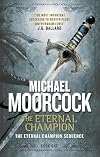
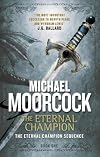
The Eternal Champion
by Michael Moorcock
Erekose (1), La Quête d'Erekosë (1), The Eternal Champion (Erekosë novel 1)
On This Page
Description
John Daker dreams of other worlds, and a name: Erekosë. He finds the strength to answer the call, travelling to a strange land ruled by the aging King Rigenos of Necranal. Humanity is united in a desperate fight against the inhuman Eldren, and he must fight with them. But the actions of his brethren turns his loyalties, and as Erekosë he will take a terrible revenge..
Tags
Recommendations
















Member Reviews
It is hard to tell when and where Moorcocks's Eternal Champion archetype emerges and that is wholly fitting given the nature of his multiverse. There is an argument that this book represents the quintessence of the concept or at least a clue to its personal and 'philosophical' origins.
Erekose never achieved the fan allegiance that other manifestations of the archetype achieved, most notably Elric of Melnibone, Jerry Cornelius, Duke Hawkmoon, Corum Jhaelen Irsei, Pyat or Graf von Bek but then we might expect that from an early experimental run.
The novel was published in 1970 but it owes its origin to a Novella of 1962 written when Moorcock was only 23 years old and already drawing the lineaments of what many genre writers offer us - a show more private obsession with a universe (here a multiverse) and a particular narrative approach.
Elric and Hawkmoon, even Cornelius, would precede Erekose in the canon but Erekose feels as if it contains the authentic origin of all subsequent iterations and it has been unjustly neglected perhaps because of its relative simplicity. There are traces evidently of work from as far back as 1956.
The work starts with a fantasy cliche of the man drawn from his mundane world into the fantastic. Erekose's alter ego is a shadowy ordinary man of the twentieth century, John Daker, and he emerges as the Eternal Champion much as John Carter emerges in Barsoom.
Similarly, the archetype involves derivative complications of chivalry and advanced weaponry as the book draws to its close with the Jungian love triangle that most men will understand between Erekose and two women who represent different appreciations of noble love.
The core of the book, however, owes a great deal to what we might call the 'Nietzsche Mythos' - the eternal return, man caught between animal and divine, the price of looking into the abyss, man as blonde beast (though the hero is black), the aristocratic ethics of choice and honour.
The writing is clear and, for once in fantasy, Moorcock takes us away from the William Morris of thees and thous and archaisms and presents us with a brutal aristocratic society and relations between persons that are surprisingly realistic within the constraints of an alternative world.
The subject of the novel, is, frankly genocide and duty and it might be seen as a reflection on the 'morality' of national socialist ideology without mentioning it once. It is about the struggle for survival and perception of threat from the 'other'.
In this case, the human race shares Earth with the Eldren, a stoical alien human-like species that is positioned by humanity as loathsome and dangerous and which humanity must extirpate if it is tself to survive. The Eldren appear to lack the will to power of humanity.
The Eternal Champion emerges by sorcery to lead Humanity's genocidal destiny and the dynamic between the faint remaining traces of John Daker and the aristocratic-warrior ruthlessness of Erekose drive the plot to a possibly expected but tragic conclusion.
The reasoning here is that war is intrinsic to Humanity which is not the case for the Eldren who are perhaps only a few stages removed from Tolkien's Elves and who are, in fact, more advanced in many ways than their enemy, defensive by nature and preferring death to dishonour and crime.
Humanity talks of honour but is brutal and Machiavellian while claiming it is the Eldren that are the very things that they are - vicious, proud, self-deluding, paranoiac, filled with blood-lust and murderous. Aristocratic forms are just intruments of power rather than expressions of value.
The realisation dawns that the human condition is one of eternal strife and that Humanity needs an enemy to hate in order to be united. If it does not have such an enemy, then it will war on itself. It is a grim and pessimistic view of our species that may be disturbingly accurate.
Erekose sloughs off his John Daker personality but can only do so by adopting the role of Erekose as Humanity's champion, a role which requires him to become a cold genocidal figure almost to the end. Millions die to allow him to discover what is right and what is wrong.
The process could be seen as an existentialist tension between the man who is destined to become a role by the pressure of his species (or society in our world) and the man who learns that he can eventually have a choice and cease to be nothing more than his role.
The love triangle is also intriguing in this context. His first love is a creature of the social - a magnificent queen but one whose love is given or not given according to whether he delivers what society needs or not. If he retains his genocidal role, he gets the queen as wife.
His second love is a Eldren princess who may be a manipulator (the claims of Humans may prove to be right in the end) but also represents an unconditional love apparently resigned to loss and destruction rather than betray its moral condition.
Jung's argument that alpha men need two women which may be unpalatable to many has its truth. In this case, we have woman as social order but conditional in her love or unconditional romance although Moorcock allows one to win and one to lose which is not in the spirit of Jung's insight.
The psychological core of the Eternal Champion, written in accessible language yet demonstrated in an alien world, the classic genre thought experiment, is an appreciation of male yearning to be hero, to have meaning, to make choices from strength and to have unconditional love.
The grim and probably justifiable pessimism about our species is balanced by a coded analogical suggestion that all these things that are yearned for may not be impossible for the individual (even though, in the real world, they probably are or at least only partially achievable).
A fine book that helps set the parameters for the huge corpus of Moorcock's eternal champion stories under other names and not a bad place to start even before Elric, Cornelius and Hawkmoon. It should settle on the mind in dreams and perhaps quietly weave its magic on the ordinary. show less
Erekose never achieved the fan allegiance that other manifestations of the archetype achieved, most notably Elric of Melnibone, Jerry Cornelius, Duke Hawkmoon, Corum Jhaelen Irsei, Pyat or Graf von Bek but then we might expect that from an early experimental run.
The novel was published in 1970 but it owes its origin to a Novella of 1962 written when Moorcock was only 23 years old and already drawing the lineaments of what many genre writers offer us - a show more private obsession with a universe (here a multiverse) and a particular narrative approach.
Elric and Hawkmoon, even Cornelius, would precede Erekose in the canon but Erekose feels as if it contains the authentic origin of all subsequent iterations and it has been unjustly neglected perhaps because of its relative simplicity. There are traces evidently of work from as far back as 1956.
The work starts with a fantasy cliche of the man drawn from his mundane world into the fantastic. Erekose's alter ego is a shadowy ordinary man of the twentieth century, John Daker, and he emerges as the Eternal Champion much as John Carter emerges in Barsoom.
Similarly, the archetype involves derivative complications of chivalry and advanced weaponry as the book draws to its close with the Jungian love triangle that most men will understand between Erekose and two women who represent different appreciations of noble love.
The core of the book, however, owes a great deal to what we might call the 'Nietzsche Mythos' - the eternal return, man caught between animal and divine, the price of looking into the abyss, man as blonde beast (though the hero is black), the aristocratic ethics of choice and honour.
The writing is clear and, for once in fantasy, Moorcock takes us away from the William Morris of thees and thous and archaisms and presents us with a brutal aristocratic society and relations between persons that are surprisingly realistic within the constraints of an alternative world.
The subject of the novel, is, frankly genocide and duty and it might be seen as a reflection on the 'morality' of national socialist ideology without mentioning it once. It is about the struggle for survival and perception of threat from the 'other'.
In this case, the human race shares Earth with the Eldren, a stoical alien human-like species that is positioned by humanity as loathsome and dangerous and which humanity must extirpate if it is tself to survive. The Eldren appear to lack the will to power of humanity.
The Eternal Champion emerges by sorcery to lead Humanity's genocidal destiny and the dynamic between the faint remaining traces of John Daker and the aristocratic-warrior ruthlessness of Erekose drive the plot to a possibly expected but tragic conclusion.
The reasoning here is that war is intrinsic to Humanity which is not the case for the Eldren who are perhaps only a few stages removed from Tolkien's Elves and who are, in fact, more advanced in many ways than their enemy, defensive by nature and preferring death to dishonour and crime.
Humanity talks of honour but is brutal and Machiavellian while claiming it is the Eldren that are the very things that they are - vicious, proud, self-deluding, paranoiac, filled with blood-lust and murderous. Aristocratic forms are just intruments of power rather than expressions of value.
The realisation dawns that the human condition is one of eternal strife and that Humanity needs an enemy to hate in order to be united. If it does not have such an enemy, then it will war on itself. It is a grim and pessimistic view of our species that may be disturbingly accurate.
Erekose sloughs off his John Daker personality but can only do so by adopting the role of Erekose as Humanity's champion, a role which requires him to become a cold genocidal figure almost to the end. Millions die to allow him to discover what is right and what is wrong.
The process could be seen as an existentialist tension between the man who is destined to become a role by the pressure of his species (or society in our world) and the man who learns that he can eventually have a choice and cease to be nothing more than his role.
The love triangle is also intriguing in this context. His first love is a creature of the social - a magnificent queen but one whose love is given or not given according to whether he delivers what society needs or not. If he retains his genocidal role, he gets the queen as wife.
His second love is a Eldren princess who may be a manipulator (the claims of Humans may prove to be right in the end) but also represents an unconditional love apparently resigned to loss and destruction rather than betray its moral condition.
Jung's argument that alpha men need two women which may be unpalatable to many has its truth. In this case, we have woman as social order but conditional in her love or unconditional romance although Moorcock allows one to win and one to lose which is not in the spirit of Jung's insight.
The psychological core of the Eternal Champion, written in accessible language yet demonstrated in an alien world, the classic genre thought experiment, is an appreciation of male yearning to be hero, to have meaning, to make choices from strength and to have unconditional love.
The grim and probably justifiable pessimism about our species is balanced by a coded analogical suggestion that all these things that are yearned for may not be impossible for the individual (even though, in the real world, they probably are or at least only partially achievable).
A fine book that helps set the parameters for the huge corpus of Moorcock's eternal champion stories under other names and not a bad place to start even before Elric, Cornelius and Hawkmoon. It should settle on the mind in dreams and perhaps quietly weave its magic on the ordinary. show less
It's getting on for 50 years now since my first read of THE ETERNAL CHAMPION, but I enjoyed it as much this time through as I did back then.
It's the pulpiest of Moorcock's Eternal Champion cycle, and the story that really kicks the whole thing off, with John Daker called from a life on Earth to be Erekose, champion of humanity, once and future hero, and wielder of a bloody huge sword of power.
It's all a bit Arthurian, with similar motifs of betrayal and doom, but Moorcock's energy carries the whole thing along at a rollicking speed. There's a wonderful set piece sea battle, we get glimpses of te Eternal Champion's inner conflict that will drive the whole series, and there are battles and mass slaughter aplenty.
Moorcock's sense of a show more striking visual is much in evidence, even in the somewhat pulpy prose on show here, but it's a great starter for the epic adventures in the multiverse to come, and I'm looking forward to the rest of it with the same passion I used to have while waiting impatiently for him to write the next installment way back in the day.
At least all I have to do now is walk to the bookcase to take the next book down. show less
It's the pulpiest of Moorcock's Eternal Champion cycle, and the story that really kicks the whole thing off, with John Daker called from a life on Earth to be Erekose, champion of humanity, once and future hero, and wielder of a bloody huge sword of power.
It's all a bit Arthurian, with similar motifs of betrayal and doom, but Moorcock's energy carries the whole thing along at a rollicking speed. There's a wonderful set piece sea battle, we get glimpses of te Eternal Champion's inner conflict that will drive the whole series, and there are battles and mass slaughter aplenty.
Moorcock's sense of a show more striking visual is much in evidence, even in the somewhat pulpy prose on show here, but it's a great starter for the epic adventures in the multiverse to come, and I'm looking forward to the rest of it with the same passion I used to have while waiting impatiently for him to write the next installment way back in the day.
At least all I have to do now is walk to the bookcase to take the next book down. show less
Michael Moorcock has been dishing out pulpy fantasy since the 1960's. Perhaps his most famous brand is his skein of adventures from "The" Eternal Champion--which actually refers to many heroes (Elric, Corum, Hawkmoon, Erekose, etc.) not just this book; the anti-Conan hero called Elric is arguably the most recognizable. The champion mashup is huge, although many are short stories or collections of them, the bibliography has >100 entries. Despite the huge popularity of these, there is a dearth of film/movie adaptions (however the BBC is taking on a TV version of the Runestaff/Hawkmoon stories this yr (2019).
Moorcock's books read at the same blistering pace he writes. He blends metaphysical ideas (time travel, coexisting multiverses...) show more with epic adventure. In just ~180pages, you'll be whisked across continents and decades of history. This can be fun, but there always seems to be a loss of realized potential and strings of inconsistency.
Cover: My paperback of The Eternal Champion from 1970 has a splendid Frank Frazetta depiction of a heavily armored knight on horse wielding an ax...under the title "Eternal Champion." The art is awesome, but Erekose has a sword (and occasionally a lance).
Sword Kanajana: Speaking of that sword, it is magical and can only be wielded by Erekose; however, it doesn't play a huge role in the book beyond that; and, late in the book when awesome weaponry of ancient days are needed, this sword is not used.... but an unnecessary/genre bending sci-fi element is introduced from out of nowhere. The climax of the book would have been awesome if Moorcock stuck to his sword (rather than his figurative "guns).
Multiverse weirdness: This serves as John Daker's initial awakening as "the Eternal Champion." Our protagonist doesn't seem to care that he is/was married. His mental struggles to comes to terms with his predicament do not resonate since we get near zero information of his real life.
Love?: Several romantic relations are introduced, but are seeping with shallow masculine perspectives. I was reminded of Moorcock's stunningly misogynistic entry into the Ghor, Kin Slayer: The Saga Of Genseric's Fifth Born Son (which soured the whole collection for me).
Pacing and consistency: The first 60 out of 180 pages are a drag; for a warrior called from another world to do battle, there is surprisingly no action for the initial third. This is a strange setup for an ambitious take on war... and that theme I found enjoyable to explore (depressing to read).
Supposedly, the Humans are threatened so much that their king calls upon Erekose via sorcery to help them against the evil (sorcerer) Eldren. However, we are not shown any instance of threat or attack. This approach reinforces the idea that the threatened Humans may actually be the aggressors in the war; that's okay, but we are not shown any indication that the Eldren are even in contact with the Humans. Why would the king stoop so low to use sorcery (which he loathed)?
In short, the first third of the book really needed to show some Eldren vs Human conflict, even it was to be misinterpreted by readers, the Humans, and Erekose.
Not Cliche: Despite the execution, I do admire the idea of an Eternal Champion and the approach to blurring the lines of good-vs-evil, especially in war. Trope fantasy usually has evil wraiths/orcs vs. good human knights. I suppose the current Grimdark genre would like this tone.
In summary, fans of the Eternal Champion with think this is ok. New to the Eternal Champion? I would not start here. Starting with Corum, Elric, or Hawkmoon may be better. show less
Moorcock's books read at the same blistering pace he writes. He blends metaphysical ideas (time travel, coexisting multiverses...) show more with epic adventure. In just ~180pages, you'll be whisked across continents and decades of history. This can be fun, but there always seems to be a loss of realized potential and strings of inconsistency.
Cover: My paperback of The Eternal Champion from 1970 has a splendid Frank Frazetta depiction of a heavily armored knight on horse wielding an ax...under the title "Eternal Champion." The art is awesome, but Erekose has a sword (and occasionally a lance).
Sword Kanajana: Speaking of that sword, it is magical and can only be wielded by Erekose; however, it doesn't play a huge role in the book beyond that; and, late in the book when awesome weaponry of ancient days are needed, this sword is not used.... but an unnecessary/genre bending sci-fi element is introduced from out of nowhere. The climax of the book would have been awesome if Moorcock stuck to his sword (rather than his figurative "guns).
Multiverse weirdness: This serves as John Daker's initial awakening as "the Eternal Champion." Our protagonist doesn't seem to care that he is/was married. His mental struggles to comes to terms with his predicament do not resonate since we get near zero information of his real life.
Love?: Several romantic relations are introduced, but are seeping with shallow masculine perspectives. I was reminded of Moorcock's stunningly misogynistic entry into the Ghor, Kin Slayer: The Saga Of Genseric's Fifth Born Son (which soured the whole collection for me).
Pacing and consistency: The first 60 out of 180 pages are a drag; for a warrior called from another world to do battle, there is surprisingly no action for the initial third. This is a strange setup for an ambitious take on war... and that theme I found enjoyable to explore (depressing to read).
Supposedly, the Humans are threatened so much that their king calls upon Erekose via sorcery to help them against the evil (sorcerer) Eldren. However, we are not shown any instance of threat or attack. This approach reinforces the idea that the threatened Humans may actually be the aggressors in the war; that's okay, but we are not shown any indication that the Eldren are even in contact with the Humans. Why would the king stoop so low to use sorcery (which he loathed)?
In short, the first third of the book really needed to show some Eldren vs Human conflict, even it was to be misinterpreted by readers, the Humans, and Erekose.
Not Cliche: Despite the execution, I do admire the idea of an Eternal Champion and the approach to blurring the lines of good-vs-evil, especially in war. Trope fantasy usually has evil wraiths/orcs vs. good human knights. I suppose the current Grimdark genre would like this tone.
In summary, fans of the Eternal Champion with think this is ok. New to the Eternal Champion? I would not start here. Starting with Corum, Elric, or Hawkmoon may be better. show less
The first in the loose 'Eternal Champion' trilogy. John Daker finds himself pulled to a world where humans claim to be under threat from the Eldren and only Erekose, the Eternal Champion, armed with his deadly sword (kills at a touch, at one point the implication is that it is radioactive). Erekose becomes enamored of the King's daughter and at her behest, takes on the quest - only to find that this is a propaganda war, the humans are not under threat from the Eldren. A well wrought tale, not classic hero defeats all fantasy. Very short by today's standards.
Underrated book with a very satisfying conclusion. Moorcock's "Eternal Champion" (in a temporal sense), Erekosë, has been fighting for millennia across multiple incarnations until he is thrust into the world where this story takes place.
I thought that the introduction of John Daker / Erekosë was a bit weak but this does get better as you read further. The ending is cathartic (still satisfying, although you could see it from a mile away) and I believe there is a underlying message beneath it to take home. The entire plot (starting from Erekosë's summoning) could be seen as an allegory for the self-destructive nature of humanity, and the painful/drastic measures needed to overcome it (symbolized by Erekosë).
I thought that the introduction of John Daker / Erekosë was a bit weak but this does get better as you read further. The ending is cathartic (still satisfying, although you could see it from a mile away) and I believe there is a underlying message beneath it to take home. The entire plot (starting from Erekosë's summoning) could be seen as an allegory for the self-destructive nature of humanity, and the painful/drastic measures needed to overcome it (symbolized by Erekosë).
Read as part of the Eternal Champion Omnibus Edition #1.
John Daker is an average man with an average life. Until he dreams. In his dream he is called Erekose and he is summoned and he becomes Erekose. Erekose - the Eternal Champion; the savior of humanity. Mankind summons him and asks him to lead them against the hated Eldren. And lead them, he does. Destroying the Eldren civilization until only one small city remains. Even then, though, mankind refuses to give quarter or mercy and Erekose questions whose side he should be on: the humane, gracious, honorable Eldren, or the cowardly, vindictive, hateful humans.
John Daker is an average man with an average life. Until he dreams. In his dream he is called Erekose and he is summoned and he becomes Erekose. Erekose - the Eternal Champion; the savior of humanity. Mankind summons him and asks him to lead them against the hated Eldren. And lead them, he does. Destroying the Eldren civilization until only one small city remains. Even then, though, mankind refuses to give quarter or mercy and Erekose questions whose side he should be on: the humane, gracious, honorable Eldren, or the cowardly, vindictive, hateful humans.
A twentieth century human, John Daker, is transported to another world and becomes Erekose, the Eternal Champion, who is tasked with fighting for humanity in a war against an elf-like race called the Eldren. This is an early Moorcock work, and it shows. The writing and story are very basic and pulpish, but the book is still fairly entertaining. This version has been modified to serve as something of an intoduction to the Eternal Champion concept, and now has a number of references to later Moorcock works included.
Members
- Recently Added By
Author Information

657+ Works 64,989 Members
Michael Moorcock, 1939 - Writer Michael Moorcock was born December 18, 1939 in Mitcham, Surrey, England. Moorcock was the editor of the juvenile magazine Tarzan Adventures from 1956-58, an editor and writer for the Sexton Blake Library and for comic strips and children's annuals from 1959-61, an editor and pamphleteer for Liberal Party in 1962, show more and became editor and publisher for the science fiction magazine New Worlds in 1964. He has worked as a singer-guitarist, has worked with the rock bands Hawkwind and Blue Oyster Cult and is a member of the rock band Michael Moorcock and the Deep Fix. Moorcock's writing covers a wide range of science fiction and fantasy genres. "The Chronicles of Castle Brass" was a sword and sorcery novel, and "Breakfast in the Ruins: A Novel of Inhumanity" uses the character Karl Glogauer as a different person in different times. Karl participates in the political violence of the French Revolution, the Paris Commune, and a Nazi concentration camp. Moorcock also wrote books and stories that featured the character Jerry Cornelius, who had no consistent character or appearance. "The Condition of Muzak" completed the initial Jerry Cornelius tetralogy and won Guardian Literary Prize in 1977. "Byzantium Endures" and "The Laughter of Carthage" are two autobiographical novels of the Russian emigre Colonel Pyat and were the closest Moorcock came to conventional literary fiction. "Byzantium Endures" focuses on the first twenty years of Pyat's life and tells of his role in the Russian revolution. Pyat survives the revolution and the subsequent civil war by working first for one side and then another. "The Laughter of Carthage" covers Pyat's life from 1920-1924 telling of his escape from Communist Russia and his travels in Europe and America. It's a sweeping picture of the world during the 1920's because it takes the character from living in Constantinople to Hollywood. Moorcock returned to the New Wave style in "Blood: A Southern Fantasy" (1994) and combined mainstream fiction with fantasy in "The Brothel of Rosenstrasse," which is set in the imaginary city of Mirenburg. MoorCock won the 1967 Nebula Award for Behold the Man and the 1979 World Fantasy Award for his novel, Gloriana. (Bowker Author Biography) show less
Some Editions
Series


Belongs to Publisher Series
Bastei Lübbe Fantasy (20043)
Work Relationships
Common Knowledge
- Canonical title
- The Eternal Champion
- Original title
- The Eternal Champion
- Original publication date
- 1970-04
- People/Characters
- Erekosë; Ulrich von Bek; Jephraim Tallow; Nick Allard; Konrad Arflane; Asquiol (show all 56); Aubec; Jherek Carnelian; Corom Bannan Flurrun; Ermizhad; John Daker; Hallner; Clovis Marca; Jordan Mennell; Muldoon; C. Ryan; Lee Seward; Traven; Dietrich; Pepin Hunchback; Michael Kane; Rackhir; Simon; Scar face Brooder; Eternal Champion; Renark von Bek; Jerry Cornell; Corum Jhaelen Irsei; Jerry Cornelius; Elric of Melniboné; Jermays the Crooked; Lady of the Chalice; Alan Powys; Urlik Skarsol; Dorian Hawkmoon; Artos; The Knight in Black and Yellow; Roland; Sojan; Bishop Belphig; Lord Shanosfane; Brut of Lashmar; Lamsar the Hermit; Zarozinia; Timeras; Narjhan; Eequor; Hionhurn the Executioner; Uroch of Nieva; Zas the One-handed; Sorana; Vezhan; Yerleroo; Friagho; Kyrenee; Loheb Bakra
- Important places
- Tanelorn; Elwher; Karlaak; Weeping Waste; Bakshaan; Sighing Desert (show all 15); Vilmir; Forest of Troos, Org; Org; Yeshpotoom-Kahlai; Jadmar; Kaleef; Sea of Peace; Mountain of Severity; Domain of the Grey Lords
- Dedication
- This book is dedicated to the memory of Douglas Fairbanks, the greatest hero of them all.
For Mike Harrison - an entertainment - First words
- This book was the first I ever planned to write.
- Last words
- (Click to show. Warning: May contain spoilers.)Oh, how long can it last?
- Original language*
- Englisch
- Disambiguation notice
- "The Eternal Champion" is a title frequently used by Michael Moorcock. It appears first as a short story in 1962. Then as a book in 1970. The title is also used for a series of stories (To Rescue Tanelorn (1962); the Eternal ... (show all)Champion (1970); Phoenix in Obsidian (aka. The Silver Wariors)(1970) and The Dragon in the Sword (1986). The title is also used for a larger collection of books including Corum, Elric, Runestaff etc.. At least two publishers (White Wolf and Millennium) have produced series called "The Tale of the Eternal Champion" containing most or all of this larger collection in omnibus editions. Both these series include a volume called The Eternal Champion. The Millennium version contains The Eternal Champion, Phoenix in Osidian and The Dragon in the Sword. The White wolf version contains The Eternal Champion, The Sundered Worlds (aka The Blood red Game)(1965), Phoenix in Obsidian, and To Rescue Tanelorn. The Sundered worlds is also the title of a 1962 short story. See http://www.isfdb.org/cgi-bin/ea.cgi?M...
Note: The White Wolf and Millennium omnibus editions have been separated out from this work to the best of this member's ability, and are now listed as separate works.
*Some information comes from Common Knowledge in other languages. Click "Edit" for more information.
Classifications
Statistics
- Members
- 715
- Popularity
- 39,549
- Reviews
- 9
- Rating
- (3.66)
- Languages
- 5 — English, French, German, Hungarian, Spanish
- Media
- Paper, Ebook
- ISBNs
- 11
- ASINs
- 15