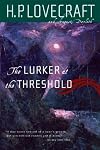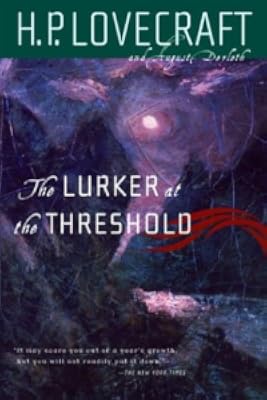
The Lurker at the Threshold
by August Derleth, H. P. Lovecraft (Contributor)
Les papiers du Lovecraft Club (3)
On This Page
Description
He is not to open the door which leads to the strange time and place, nor to invite Him Who lurks at the threshold ..." went the warning in the old family manuscript that Ambrose Dewart discovered when he returned to his ancestral home in the deep woods of rural Massachusetts. Dewart's investigations into his family's sinister past eventually lead to the unspeakable revelations of The Great Old Ones who wait on the boundaries of space and time for someone to summon them to earth. Acclaimed show more cult horror writer H. P. Lovecraft's notes and outlines for this tale of uncanny terror were completed by August Derleth, his friend and future publisher. Of the many Lovecraft-Derleth "posthumous collaborations," The Lurker at the Threshold remains the most popular, having sold 50,000 copies in its previous edition alone. show lessTags
Recommendations












Member Reviews
I'd heard some bad things about Derleth's posthumous collaborations with Lovecraft, how he had a tendency to over-categorise the Mythos and apply a simplistic Christian morality on creatures whose very power to chill stemmed from the fact that they were utterly beyond human notions of good or evil. Despite that, I found this quite an effective and well written work, and Derleth's vision, if not entirely in keeping with Lovecraft's own, was not wholly incompatible either. There's a lot of good, if derivative, stuff in here and a nice sense of sustained menace running throughout the piece. Derleth might not have "got" Lovecraft entirely, but he understood enough about what made him an effective horror writer as regards the basics of tone, show more imagery, characterisation, and plot not to drop the ball. Only the last act really lets the piece down, leaving the reader on a distinctly "that's it? moment. A pity considering all the good work leading up to it. show less
I'd heard some bad things about Derleth's posthumous collaborations with Lovecraft, how he had a tendency to over-categorise the Mythos and apply a simplistic Christian morality on creatures whose very power to chill stemmed from the fact that they were utterly beyond human notions of good or evil. Despite that, I found this quite an effective and well written work, and Derleth's vision, if not entirely in keeping with Lovecraft's own, was not wholly incompatible either. There's a lot of good, if derivative, stuff in here and a nice sense of sustained menace running throughout the piece. Derleth might not have "got" Lovecraft entirely, but he understood enough about what made him an effective horror writer as regards the basics of tone, show more imagery, characterisation, and plot not to drop the ball. Only the last act really lets the piece down, leaving the reader on a distinctly "that's it? moment. A pity considering all the good work leading up to it. show less
There are two important things about this book. Firstly, despite the covers, this is NOT by HP Lovecraft. It's entirely by August Derleth, with only a couple of small details inspired by notes left by Lovecraft. This is a Derleth novel and nothing more. Secondly, it's really not very good.
The book has three distinct phases with specific narrators. The first does a reasonable job of seeming Lovecraftesque, though the words don't flow as smoothly and the story seems somehow congested. However, the protagonist is okay, and the area and house are portrayed quite evocatively at times. I liked some of the details, like the significance of the frogs. On the downside, Derleth seems to mash elements of Lovecraft Country together carelessly, show more portraying Dunwich as very much like Innsmouth when this doesn't seem to fit the original story, where its stolid inhabitants were horrified and mystified by supernatural forces.
The second shows up a lot of Derleth's bad habits: substantial quotes that are supposed to add atmosphere but just bog things down, and a repetitiveness that makes it frustrating. The narrator seems perversely obtuse; the idea may be that he's influenced by sinister powers, but if so it wasn't convincing, and he mostly seems to bumble around like an idiot. The Mythos elements previously laid down are jumbled and conflated with other scraps of ideas, losing any sense of distinctiveness they had established.
Finally, there's an incredibly compressed, rushed bodge of an ending. Here Derleth tosses out most of what's previously been accomplished. A stock detective character takes over, with an encyclopaedic knowledge of the supernatural and entirely unfazed by the information he receives. Our narrator is a pedantic, tiresome bore of an idiot who seems to have very little interest in any of it. Vast amounts of information are recycled, others are retconned (the entirety of the Mythos explanation, for a start) and everything is told at great length and in contortedly dull prose. The story is concluded offstage in the least interesting way possible.
Despite this agonisingly lengthy word vomit, I didn't locate a clear explanation. I don't mean a real explanation of what's going on; that's common enough in weird fiction. I mean, it's never very clear to me what Derleth thought was going on, between the various bits of plot he seems to try and set up at various stages and his contradictory explanations.
The characterisation is minimal, the plot very much the same as he's used in various short stories but padded to novel length.
I read this one for general interest in the genre and its history, but that's the only circumstance in which I could recommend doing so. show less
The book has three distinct phases with specific narrators. The first does a reasonable job of seeming Lovecraftesque, though the words don't flow as smoothly and the story seems somehow congested. However, the protagonist is okay, and the area and house are portrayed quite evocatively at times. I liked some of the details, like the significance of the frogs. On the downside, Derleth seems to mash elements of Lovecraft Country together carelessly, show more portraying Dunwich as very much like Innsmouth when this doesn't seem to fit the original story, where its stolid inhabitants were horrified and mystified by supernatural forces.
The second shows up a lot of Derleth's bad habits: substantial quotes that are supposed to add atmosphere but just bog things down, and a repetitiveness that makes it frustrating. The narrator seems perversely obtuse; the idea may be that he's influenced by sinister powers, but if so it wasn't convincing, and he mostly seems to bumble around like an idiot. The Mythos elements previously laid down are jumbled and conflated with other scraps of ideas, losing any sense of distinctiveness they had established.
Finally, there's an incredibly compressed, rushed bodge of an ending. Here Derleth tosses out most of what's previously been accomplished. A stock detective character takes over, with an encyclopaedic knowledge of the supernatural and entirely unfazed by the information he receives. Our narrator is a pedantic, tiresome bore of an idiot who seems to have very little interest in any of it. Vast amounts of information are recycled, others are retconned (the entirety of the Mythos explanation, for a start) and everything is told at great length and in contortedly dull prose. The story is concluded offstage in the least interesting way possible.
Despite this agonisingly lengthy word vomit, I didn't locate a clear explanation. I don't mean a real explanation of what's going on; that's common enough in weird fiction. I mean, it's never very clear to me what Derleth thought was going on, between the various bits of plot he seems to try and set up at various stages and his contradictory explanations.
The characterisation is minimal, the plot very much the same as he's used in various short stories but padded to novel length.
I read this one for general interest in the genre and its history, but that's the only circumstance in which I could recommend doing so. show less
This is the longest 'collaboration' I've read between August Derleth and HP Lovecraft and turns out to be almost wholly Derleth based on a few short fragments of HPL's. It does read that way, although seems better than most of Derleth's efforts until the last third where it degenerates into his usual tendency of throwing in everything including the kitchen sink in his efforts to name check all the Old Ones, their minions and the various forbidden books about them. The main issue though is the rushed conclusion which for me spoils what should be a great scene of enormous suspense and scariness. So definitely going back to HPL for the real deal, although this effort is not awful and there are some novel elements - the old tower, stone show more circles, Native American beliefs etc - that I haven't so far encountered in the other collaborations. show less
You can't really be on the internet, and miss the influence H. P. Lovecraft has on the shared conscious. Cthulu is being referenced everywhere, from being woken by Gangham Style or being crafted into a cut amigurumi. So, anytime I find a Lovecraft novel cheap, I pick it up, familiarizing myself with the mythos. This is one of those books, although the main writer seems to be August Derleth, Lovecraft's publishing partner at Arkham House, for me it is still a nice addition to my reading of the Cthulhu Mythos.
It is the story of a long abandoned house, a returning heir doing it up, and strange sounds and stories. Ambrose Dewart is the man who is intrigued by the house of his ancestors, and cannot help but ignore the warnings telling him show more to not disturb anything. When he investigates the strange history of the earlier inhabitants, his ancestors, and the house itself, he is drawn into a horrific repeating history.
The story was a pretty quick read, which I enjoyed very much. It is another small chapter dealing with the Elder Gods, and I cannot wait to read more about them. Four out of five stars. show less
It is the story of a long abandoned house, a returning heir doing it up, and strange sounds and stories. Ambrose Dewart is the man who is intrigued by the house of his ancestors, and cannot help but ignore the warnings telling him show more to not disturb anything. When he investigates the strange history of the earlier inhabitants, his ancestors, and the house itself, he is drawn into a horrific repeating history.
The story was a pretty quick read, which I enjoyed very much. It is another small chapter dealing with the Elder Gods, and I cannot wait to read more about them. Four out of five stars. show less
Derleth's posthumous "collaborations" weren't bad as short stories. Despite being derivative of Lovecraft and resorting to turgid writing, most of them managed to maintain some goofy charm. Not "The Lurker at the Threshold," whose writing is so terrible it becomes some sort of endurance test. Worse, Derleth fills the final third of the book with pointless exposition, thereby destroying what meager sense of suspense or urgency managed to remain from the previous two-thirds of the story.
This is the first H.P. Lovecraft (or August Derleth) I've read and I was a little baffled by it. I had heard so much about Lovecraft and the Chthulhu mythos, so I expected something truly eerie and unusual, but this story didn't quite live up to the hype. It turns out that this story is a "collaboration" between Lovecraft and Derleth, but is disputed (according to Wikipedia). Nothing really tells you this on the cover or inside pages of the book, except for the copyright which, it seems, is owned by the Derleth family. I feel that this was kind of deceptive, and that I have not really read any Lovecraft.
The story itself is intriguing (a mystery going back generations, weird noises, disappearances and murders), but the author(s) use the show more technique of telling the same tale from various points of view -- something Stephen King is extremely good at, I can see where he gets it -- in such a long-winded way, that it detracts from the story. It becomes a bit boring. I think it would have been better as a short story. show less
The story itself is intriguing (a mystery going back generations, weird noises, disappearances and murders), but the author(s) use the show more technique of telling the same tale from various points of view -- something Stephen King is extremely good at, I can see where he gets it -- in such a long-winded way, that it detracts from the story. It becomes a bit boring. I think it would have been better as a short story. show less
Members
- Recently Added By
Lists

Best Horror Mega-List
342 works; 6 members

To Read - Horror
137 works; 14 members

Books Read in 2026
1,954 works; 66 members

Jones and Newman's Horror: The 100 Best Books
100 works; 4 members
Author Information

374+ Works 8,023 Members
August Derleth was born on February 24, 1909 in Sauk City, Wisconsin. He sold his first story to Weird Tales at the age of 16. He received a Bachelor's of Arts degree from the University of Wisconsin. After college, he went to work for Fawcett Publications as an editor for Mystic Magazine. In 1932, the first of his Sac Prairie stories was show more published in various local papers. In 1935, his first book, a collection of related novellas entitled Place of Hawks, was published. In 1937, his first Sac Prairie novel, Still is the Summer Night, was published. He was awarded a Guggenheim fellowship in 1938 to help him continue the Sac Prairie saga. During his lifetime, he wrote more than 90 books including The Milwaukee Road, Still Small Voice, H.P.L.: A Memoir, Restless Is the River, The Hills Stand Watch, Sweet Genevieve, Evening in Spring, The Moon Tenders, The Captive Island, and Father Marquette and the Great River. He had upward of 3,000 works published in over 350 magazines including The Catholic World, The Yale Review, The New Republic, Redbook, The New Yorker, Good Housekeeping, and The American Mercury. He died on June 6, 1971. (Bowker Author Biography) show less

Howard Phillips Lovecraft, 1890 - 1937 H. P. Lovecraft was born on August 20, 1890 in Providence, Rhode Island. His mother was Sarah Susan Phillips Lovecraft and his father was Winfield Scott Lovecraft, a traveling salesman for Gorham & Co. Silversmtihs. Lovecraft was reciting poetry at the age of two and when he was three years old, his father show more suffered a mental breakdown and was admitted to Butler Hospital. He spent five years there before dying on July 19, 1898 of paresis, a form of neurosyphillis. During those five years, Lovecraft was told that his father was paralyzed and in a coma, which was not the case. His mother, two aunts and grandfather were now bringing up Lovecraft. He suffered from frequent illnesses as a boy, many of which were psychological. He began writing between the ages of six and seven and, at about the age of eight, he discovered science. He began to produce the hectographed journals, "The Scientific Gazette" (1899-1907) and "The Rhode Island Journal of Astronomy" (1903-07). His first appearance in print happened, in 1906, when he wrote a letter on an astronomical matter to The Providence Sunday Journal. A short time later, he began writing a monthly astronomy column for The Pawtuxet Valley Gleaner - a rural paper. He also wrote columns for The Providence Tribune (1906-08), The Providence Evening News (1914-18), The Asheville (N.C.) Gazette-News (1915). In 1904, his grandfather died and the family suffered severe financial difficulties, which forced him and his mother to move out of their Victorian home. Devastated by this, he apparently contemplated suicide. In 1908, before graduating from high school, he suffered a nervous breakdown. He didn't receive a diploma and failed to get into Brown University, both of which caused him great shame. Lovecraft was not heard from for five years, re-emerging because of a letter he wrote in protest to Fred Jackson's love story in The Argosy. His letter was published in 1913 and caused great controversy, which was noted by Edward F. Daas, President of the United Amateur Press Association (UAPA). Daas invited Lovecraft to join the UAPA, which he did in early 1914. He eventually became President and Official Editor of the UAPA and served briefly as President of the rival National Amateur Press Association (NAPA). He published thirteen issues of his own paper, The Conservative (1915-23) and contributed poetry and essays to other journals. He also wrote some fiction which titles include "The Beast in the Cave" (1905), "The Alchemist" (1908), "The Tomb" and "Dagon" (1917). In 1919, Lovecraft's mother was deteriorating, mentally and physically, and was admitted to Butler Hospital. On May 24, 1921, his mother died from a gall bladder operation. While attending an amateur journalism convention in Boston, Lovecraft met his future wife Sonia Haft Greene, a Russian Jew. They were married on March 3, 1924 and Lovecraft moved to her apartment in Brooklyn. Sonia had a shop on Fifth Avenue that went bankrupt. In 1925, Sonia went to Cleveland for a job and Lovecraft moved to a smaller apartment in the Red Hook district of Brooklyn. In 1926, he decided to move back to Providence. Lovecraft had his aunts bar his wife, Sonia, from going to Providence to start a business because he couldn't have the stigma of a tradeswoman wife. They were divorced in 1929. After his return to Providence, he wrote his greatest fiction, which included the titles "The Call of Cthulhu" (1926), "At the Mountains of Madness" (1931), and "The Shadow Out of Time" (1934-35). In 1932, his aunt, Mrs. Clark, died; and he moved in with his other aunt, Mrs. Gamwell, in 1933. Suffering from cancer of the intestine, Lovecraft was admitted to Jane Brown Memorial Hospital and on March 15, 1937 he died. (Bowker Author Biography) show less
Some Editions
Awards and Honors
Notable Lists
Series

Belongs to Publisher Series
Work Relationships
Common Knowledge
- Canonical title
- The Lurker at the Threshold
- Original title
- The Lurker at the Threshold
- Alternate titles*
- Das Tor des Verderbens
- Original publication date
- 1945
- People/Characters
- Ambrose Dewart; Alijah Billington (Old Billington); Laban Billington; Quamis; Stephen Bates; Richard Billington (show all 22); Misquamacus; John Druven; Ward Phillips; Luther; Seth; Mrs. Bishop; Mrs. Giles; Jonathan Bishop; Wilbur Corey; Jedediah Tyndal; Armitage Harper; Lem Whateley; Winfield Phillips; Seneca Lapham; Yog-Sothoth; Nyarlathotep
- Important places
- Arkham, Massachusetts, USA; Billington's Wood, Arkham, Massachusetts, USA; Billington House, Billington's Wood, Arkham, Massachusetts, USA; Innsmouth, Massachusetts, USA; French Hill, Arkham, Massachusetts, USA; Dunwich, Massachusetts, USA (show all 8); Miskatonic University, Arkham, Massachusetts, USA; Aylesbury Pike, Arkham, Massachusetts, USA
- First words
- North of Arkham the hills rise dark, wild and wooded, and much overgrown, an area through which the Miskatonic flows seaward, almost at one boundary of the wooded tract.
- Last words*
- (Click to show. Warning: May contain spoilers.)Es bedurfte große physischer und geistiger Energie, nach Arkham hineinzufahren und den Brief an Stephen Bates aufzugeben, und zwar unwiderruflich in der Post, deren altes, spitzgiebliges Dach und die mit Läden verschlossenen Fenster ihn in geisterhafter Kameraderie anzuschielen schienen.
(Click to show. Warning: May contain spoilers.)»Übrigens - ein komischer Zufall, der dir bestimmt gefällt: Er heißt Quamis.«
(Click to show. Warning: May contain spoilers.)Jener entsetzliche Yog-Sothoth, der sich aus dem gräßlichen Urschleim in jenem nuklearen Chaos weit, weit hinter den Grenzen von Zeit und Raum formt. - Publisher's editor*
- Görden, Michael
- Original language
- English
- Canonical DDC/MDS
- 813.087340
- Disambiguation notice
- This work is correctly attributed to August Derleth as the primary author, he having written the 50,000 word novel from 1,500 words of Lovecraft's fragmentary notes.
*Some information comes from Common Knowledge in other languages. Click "Edit" for more information.
Classifications
- Genres
- Horror, Fiction and Literature, Fantasy
- DDC/MDS
- 813.087340 — Literature & rhetoric American literature in English American fiction in English By type Genre fiction Adventure fiction Horror fiction; Ghost fiction Weird fiction Cosmic horror
- LCC
- PS3523 .O833 .L9 — Language and Literature American literature American literature Individual authors 1900-1960
- BISAC
Statistics
- Members
- 875
- Popularity
- 31,025
- Reviews
- 15
- Rating
- (3.50)
- Languages
- 7 — English, Finnish, French, German, Polish, Portuguese, Spanish
- Media
- Paper, Ebook
- ISBNs
- 20
- ASINs
- 23