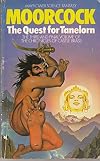
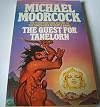
The Quest for Tanelorn
by Michael Moorcock
Chronicles of Count Brass (3), Hawkmoon (7), The Eternal Champion (Hawkmoon novel 7)
On This Page
Description
Dorian Hawkmoon's dangerous quests through the multiverse have been successful and he has finally been reunited with his true love Yisselda, although his two children are still missing. Hawkmoon would move Heaven and Earth to find them - no idle boast when dealing with the multiverse - and soon finds himself on another quest. If he is to finally reunite his family, Hawkmoon must first find his way to the fabled city of Tanelorn ...Tags
Recommendations


















Member Reviews
In this final volume in the Chronicles of Castle Brass, Dorian and his wife Yisselda have returned to Castle Brass where a month or so has passed. Yisselda's father, Count Brass, is still finding it hard to believe that his two grandchildren really existed, although he has accepted the return of his daughter who was believed killed at the battle of Londra, five years previously. Both Dorian and Yisselda pine for their children and decide to visit Queen Flana in Londra, in case her scientists can help them in their quest to find the children.
They set off, but when they reach the Silver Bridge which joins their version of Calais to the coast of Granbretan, as it is known in this dimension, Dorian is snatched into another existence where show more he is confronted by a strange and threatening being. He falls into the sea, but is rescued by Jhary-a-Conel, one of the incarnations of the Companion to the Eternal Champion (as he is an incarnation of the Champion himself). Jhary rows him to the shore of a misty, seemingly deserted, land. They are accosted by the menacing being who abducted Dorian, whose ramblings don't make much sense. Afterwards, they find a group of people they recognise, who have been brought from different realities to advise them, and on their directive, return to the shore where a mysterious ship arrives.
On the ship are warriors taken from different realities, and two other incarnations of the Eternal Champion, Erekose and Corum. Soon afterwards, a third is taken onboard: Elric of Melnibone. The mysterious blind Captain tells them their mission: the Conjunction of the Million Spheres is about to take place when the whole multiverse is subject to change, and this has allowed the intrusion of two powerful sorcerors from a different reality who intend to suck all the energy out of the multiverse and kill everything. They must somehow kill them and burn the building in which they reside, in the ruins of Tanelorn the fabled city which both Dorian and Erekose have been seeking: Dorian, because he hopes his lost children are there, and Erekose because his wife whom he has been trying to find for aeons, might be there.
I won't say any more about the plot at this point only than to say that, in effect, the book has two climaxes, as the final third concerns events of even greater momentum for not only the hundreds of incarnations of the Champion, but also the multiverse itself, and provides an explanation for, among other things, the precise nature of the Black Sword which Elric and other heroes have carried, and the Black Jewel which Hawkmoon once had forcibly inserted into his head to control him (in the previous Runestaff books).
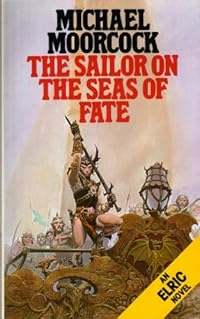
In one sense, this book provides a wrapping up of the whole saga of connected stories about Hawkmoon, Erekose, Elric and Corum, though I believe some aspects of it are revisited in other books written later, such as The Sailor on the Seas of Fate in the Elric series which I have yet to re-read.
The aspect which figured more strongly in the previous books in this trilogy, but is lost here, is characterisation. There are a lot of minor characters - the other soldiers aboard the ship who help the four Champions, for a start - and characters who have appeared in other series which I read too long ago to recall, such as Orland Fank, servant of the Runestaff - and none of them are more than ciphers. The important thing in this book is the concept of the multiverse, the nature of gods, whether there should be an imposed balance between order and chaos, and the nature of humanity and whether we create our own gods and can dispense with them as easily, and can create our own paradise. So there is quite a strong philosophical component driving the narrative, rather than straightforward action as in the previous volumes. It was interesting, but also rather mind-boggling at times. show less
They set off, but when they reach the Silver Bridge which joins their version of Calais to the coast of Granbretan, as it is known in this dimension, Dorian is snatched into another existence where show more he is confronted by a strange and threatening being. He falls into the sea, but is rescued by Jhary-a-Conel, one of the incarnations of the Companion to the Eternal Champion (as he is an incarnation of the Champion himself). Jhary rows him to the shore of a misty, seemingly deserted, land. They are accosted by the menacing being who abducted Dorian, whose ramblings don't make much sense. Afterwards, they find a group of people they recognise, who have been brought from different realities to advise them, and on their directive, return to the shore where a mysterious ship arrives.
On the ship are warriors taken from different realities, and two other incarnations of the Eternal Champion, Erekose and Corum. Soon afterwards, a third is taken onboard: Elric of Melnibone. The mysterious blind Captain tells them their mission: the Conjunction of the Million Spheres is about to take place when the whole multiverse is subject to change, and this has allowed the intrusion of two powerful sorcerors from a different reality who intend to suck all the energy out of the multiverse and kill everything. They must somehow kill them and burn the building in which they reside, in the ruins of Tanelorn the fabled city which both Dorian and Erekose have been seeking: Dorian, because he hopes his lost children are there, and Erekose because his wife whom he has been trying to find for aeons, might be there.
I won't say any more about the plot at this point only than to say that, in effect, the book has two climaxes, as the final third concerns events of even greater momentum for not only the hundreds of incarnations of the Champion, but also the multiverse itself, and provides an explanation for, among other things, the precise nature of the Black Sword which Elric and other heroes have carried, and the Black Jewel which Hawkmoon once had forcibly inserted into his head to control him (in the previous Runestaff books).
In one sense, this book provides a wrapping up of the whole saga of connected stories about Hawkmoon, Erekose, Elric and Corum, though I believe some aspects of it are revisited in other books written later, such as The Sailor on the Seas of Fate in the Elric series which I have yet to re-read.
The aspect which figured more strongly in the previous books in this trilogy, but is lost here, is characterisation. There are a lot of minor characters - the other soldiers aboard the ship who help the four Champions, for a start - and characters who have appeared in other series which I read too long ago to recall, such as Orland Fank, servant of the Runestaff - and none of them are more than ciphers. The important thing in this book is the concept of the multiverse, the nature of gods, whether there should be an imposed balance between order and chaos, and the nature of humanity and whether we create our own gods and can dispense with them as easily, and can create our own paradise. So there is quite a strong philosophical component driving the narrative, rather than straightforward action as in the previous volumes. It was interesting, but also rather mind-boggling at times. show less
I just reread “The Quest for Tanelorn” by Michael Moorcock for the first time in nearly 40 years and found it pretty dull, actually. I’d read it once as a teenager, but at that time just didn’t get into the “Chronicles of Castle Brass” trilogy, despite reading and rereading the first Hawkmoon series multiple times.
In each of the two previous books of the Castle Brass trilogy the main character, Hawkmoon, experiences changes in time and space that begin to restore his friends and family that he lost in battle at the end of the first Hawkmoon series. This one continues that process as now his children are missing.
The first third of the book sets things up for him to head out on an adventure. There’s little action there, just show more talk, planning and preparation, with a little uneventful travel. The characters’ goals are to get to Tanelorn, a city in Moorcock’s mythology where warriors can find peace. But the city changes in different dimensions and different times and sort of moves around, making it a difficult destination.
The second third of the book, where all the action is, is a repeat. For anyone who’s read other Moorcock stories about the Champion Eternal, this adventure will be familiar as he uses it multiple times. The tale is the same, just that he writes it from a different character’s perspective depending which series of books you’re reading. That’s not a bad idea, but when that’s the main action in the book there’s no tension, because we already know how it ends. And honestly, the villains in this adventure aren’t all that interesting.
The final third of the book has little action, just talking and philosophizing. Hawkmoon also gets to witness the endings of the two other Champion Eternal characters, Elric and Corum, copied from the final pages of those respective series.
Overall, it’s not a great book. It’s not terrible. It’s just sort of “meh”. It’s not a bad conclusion for Hawkmoon, just not an exciting way for a reader to arrive there. show less
In each of the two previous books of the Castle Brass trilogy the main character, Hawkmoon, experiences changes in time and space that begin to restore his friends and family that he lost in battle at the end of the first Hawkmoon series. This one continues that process as now his children are missing.
The first third of the book sets things up for him to head out on an adventure. There’s little action there, just show more talk, planning and preparation, with a little uneventful travel. The characters’ goals are to get to Tanelorn, a city in Moorcock’s mythology where warriors can find peace. But the city changes in different dimensions and different times and sort of moves around, making it a difficult destination.
The second third of the book, where all the action is, is a repeat. For anyone who’s read other Moorcock stories about the Champion Eternal, this adventure will be familiar as he uses it multiple times. The tale is the same, just that he writes it from a different character’s perspective depending which series of books you’re reading. That’s not a bad idea, but when that’s the main action in the book there’s no tension, because we already know how it ends. And honestly, the villains in this adventure aren’t all that interesting.
The final third of the book has little action, just talking and philosophizing. Hawkmoon also gets to witness the endings of the two other Champion Eternal characters, Elric and Corum, copied from the final pages of those respective series.
Overall, it’s not a great book. It’s not terrible. It’s just sort of “meh”. It’s not a bad conclusion for Hawkmoon, just not an exciting way for a reader to arrive there. show less
Chronologically the last of the Eternal Champion multi-series saga. This does a decent job of bringing multiple strands of the story together but I wish it had ended with more of a "bang". It's apparent that Moorcock had become bored with his creation.
I have read the stories of Hawkmoon, Elric and Corum and after reading this, am tempted to go find out Erekose's show more story. A good ending to this universe of Moorcock's. show less
I really liked the Count Brass series. They had a different flavor than the Elric books and added to the world of the Runestaff. Excellent short fantasy.
Reunited with both Count Brass and Yisselda, there's only one more thing left to do - find his children. So Hawkmoon and Yisselda head for Londra in an effort to talk with the magicians and scientists of Granbretan to learn if any of them know anything about Tanelorn and how to get there. Hawkmoon firmly believes that if his children are anywhere, they can be found in Tanelorn. Unfortunately, Hawkmoon is confronted by a physical manifestation of the spirit of the Black Sword and ends up on the strange magical ship so often frequented by Erekose, Elric and others of the Champion's aspects. This time, there are four aspects of the Champion and they go to rescue Tanelorn, and in fact, all of the many realms of the multiverse from Garak and show more Arak. This event triggers the end of the current cycle of gods and is, in fact, the end of the curse of the Eternal Champion - and only Hawkmoon is the only one to see it and live through it. Hawkmoon and all of the Heroes of Londra and his children.
I was very happy to see Erekose finally reunited with Ermizhad - brief though it was. I was also interested to see the fight with Garak and Arak again - this time from Hawkmoon's point of view. I think I've read it from Elric's point of view, but I'll have to check on that. show less
I was very happy to see Erekose finally reunited with Ermizhad - brief though it was. I was also interested to see the fight with Garak and Arak again - this time from Hawkmoon's point of view. I think I've read it from Elric's point of view, but I'll have to check on that. show less
This is another book in the CE series. Concerning Elric and his journeys into Tanerlon to find the answers. A good read and better if you have the rest of the books.
Members
- Recently Added By
Author Information

657+ Works 64,816 Members
Michael Moorcock, 1939 - Writer Michael Moorcock was born December 18, 1939 in Mitcham, Surrey, England. Moorcock was the editor of the juvenile magazine Tarzan Adventures from 1956-58, an editor and writer for the Sexton Blake Library and for comic strips and children's annuals from 1959-61, an editor and pamphleteer for Liberal Party in 1962, show more and became editor and publisher for the science fiction magazine New Worlds in 1964. He has worked as a singer-guitarist, has worked with the rock bands Hawkwind and Blue Oyster Cult and is a member of the rock band Michael Moorcock and the Deep Fix. Moorcock's writing covers a wide range of science fiction and fantasy genres. "The Chronicles of Castle Brass" was a sword and sorcery novel, and "Breakfast in the Ruins: A Novel of Inhumanity" uses the character Karl Glogauer as a different person in different times. Karl participates in the political violence of the French Revolution, the Paris Commune, and a Nazi concentration camp. Moorcock also wrote books and stories that featured the character Jerry Cornelius, who had no consistent character or appearance. "The Condition of Muzak" completed the initial Jerry Cornelius tetralogy and won Guardian Literary Prize in 1977. "Byzantium Endures" and "The Laughter of Carthage" are two autobiographical novels of the Russian emigre Colonel Pyat and were the closest Moorcock came to conventional literary fiction. "Byzantium Endures" focuses on the first twenty years of Pyat's life and tells of his role in the Russian revolution. Pyat survives the revolution and the subsequent civil war by working first for one side and then another. "The Laughter of Carthage" covers Pyat's life from 1920-1924 telling of his escape from Communist Russia and his travels in Europe and America. It's a sweeping picture of the world during the 1920's because it takes the character from living in Constantinople to Hollywood. Moorcock returned to the New Wave style in "Blood: A Southern Fantasy" (1994) and combined mainstream fiction with fantasy in "The Brothel of Rosenstrasse," which is set in the imaginary city of Mirenburg. MoorCock won the 1967 Nebula Award for Behold the Man and the 1979 World Fantasy Award for his novel, Gloriana. (Bowker Author Biography) show less
Some Editions
Series


The Eternal Champion (Hawkmoon novel 7)
Belongs to Publisher Series
Bastei Lübbe Taschenbuch (13074)
Work Relationships
Is contained in
Common Knowledge
- Canonical title
- The Quest for Tanelorn
- Original title
- The Quest for Tanelorn
- Alternate titles*
- Die Suche nach Tanelorn
- Original publication date
- 1975
- People/Characters
- Agak; Dorian Hawkmoon; Count Brass; Captain Josef Vedla; Orland Fank; Elric of Melniboné (show all 11); Erekosë; Yisselda; Brut of Lashmar; Jehemiah Cohnahlias; Jhary-a-Conel
- Important places
- Tanelorn
- Dedication
- For Bob Weir, Jerry Garcia et al.... ...and for all the many readers who wrote and asked for this particular book and to whom I shall be, of course, eternally grateful.
- First words
- 'Lost?'
- Original language
- English
*Some information comes from Common Knowledge in other languages. Click "Edit" for more information.
Classifications
Statistics
- Members
- 581
- Popularity
- 50,273
- Reviews
- 8
- Rating
- (3.61)
- Languages
- English, French, German
- Media
- Paper, Ebook
- ISBNs
- 10
- ASINs
- 19