
E. R. Eddison (1882–1945)
Author of The Worm Ouroboros
About the Author
Series
Works by E. R. Eddison
In Valhalla 1 copy
Associated Works
Tagged
Common Knowledge
- Legal name
- Eddison, Eric Rücker
- Birthdate
- 1882-11-24
- Date of death
- 1945-08-18
- Gender
- male
- Education
- Eton College
University of Oxford (Trinity College) - Occupations
- civil servant
novelist - Organizations
- Board of Trade
- Awards and honors
- Order of St Michael and St George (Companion, 1924)
Order of the Bath (Companion, 1929) - Relationships
- Ransome, Arthur (friend)
- Nationality
- UK
- Birthplace
- St Helens, Adel, Yorkshire, England, UK
- Places of residence
- Leeds, England, UK
St. Helens, Adel, Yorkshire, England (birth) - Place of death
- Marlborough, Wiltshire, England, UK
- Map Location
- England, UK
Members
Reviews
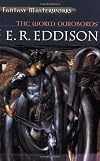
I‘d first read it when I was around 13 and picked it up again now. At the first chapter in “Demonland”, I was sure I wouldn’t get through it and didn’t understand how my younger self had managed. Then, with the wrestling match, I was captured, and read on in sheer delight. This time round, what’s outstanding is the way the sexual relations implied are consensual and very discreet as would be standard in most literature of the time. There is a stronger sensuality in these books show more which evokes the atmosphere of sex, rather than references or allusions to the act itself.
You might like to consider E. R. Eddison, unfortunately almost forgotten these days, but in his time counted among one of the premier fantasy writers -- the man who Tolkien's publisher asked for a blurb for “The Lord of the Rings”. His novel “The Worm Ourobouros” and the three novels of the Zimiamvian series deserve to be rediscovered. They're not easy reads, and maybe not for a contemporary reader of SF. But for lovers of language, they're a must-read.
“The Worm Ourobouros” is a fine example of a feudal fantasy not in decline, where the heroes are thoroughly heroic and entirely human, where magic is real and as deadly to its practitioners as to those who suffer its effects, where sex is vitally important, omnipresent but not explicit, where violence is conducted on a massive, monstrous scale, but is again not explicit in its descriptions.
After reading this, I don’t look forward to another sloppily paced contemporary Fantasy novel, full of characters (who will disappear for 4-5 episode stretches) making frustrating decisions and being treated along the way to pages worth of exposition, some of which will be be delivered during sex scenes, just because. And when some Fantasy novels are afraid your attention may be waning, it will jolt you back with some extreme violence. Thank God we still have stuff like “The Worm Ourobouros” to get back to when we want to treat ourselves to something good SF-wise.
NB: This blog is mainly is for the books that slipped through the net of full-length “reviews” and normally one or maybe two people read them, grumbling that there's fantasy in what was a fantasy-horror-SF grab-bag…This time, because it's the Post-Summer doldrums, this review might become a bit more noticeable (or not).
SF = Speculative Fiction. show less
You might like to consider E. R. Eddison, unfortunately almost forgotten these days, but in his time counted among one of the premier fantasy writers -- the man who Tolkien's publisher asked for a blurb for “The Lord of the Rings”. His novel “The Worm Ourobouros” and the three novels of the Zimiamvian series deserve to be rediscovered. They're not easy reads, and maybe not for a contemporary reader of SF. But for lovers of language, they're a must-read.
“The Worm Ourobouros” is a fine example of a feudal fantasy not in decline, where the heroes are thoroughly heroic and entirely human, where magic is real and as deadly to its practitioners as to those who suffer its effects, where sex is vitally important, omnipresent but not explicit, where violence is conducted on a massive, monstrous scale, but is again not explicit in its descriptions.
After reading this, I don’t look forward to another sloppily paced contemporary Fantasy novel, full of characters (who will disappear for 4-5 episode stretches) making frustrating decisions and being treated along the way to pages worth of exposition, some of which will be be delivered during sex scenes, just because. And when some Fantasy novels are afraid your attention may be waning, it will jolt you back with some extreme violence. Thank God we still have stuff like “The Worm Ourobouros” to get back to when we want to treat ourselves to something good SF-wise.
NB: This blog is mainly is for the books that slipped through the net of full-length “reviews” and normally one or maybe two people read them, grumbling that there's fantasy in what was a fantasy-horror-SF grab-bag…This time, because it's the Post-Summer doldrums, this review might become a bit more noticeable (or not).
SF = Speculative Fiction. show less

The Worm Ouroboros might be called world-building fantasy in the tradition of The Lord of the Rings but for two details: it was published 22 years before Tolkien's trilog, and it is much darker. In fact, though Tolkien himself called Eddison "the greatest and most convincing writer of 'invented worlds' that I have read," he also said Eddison "was certainly not an 'influence.'" The Worm Ouroboros definitely deserves its place in Moorcock's Fantasy: The 100 Best Books, and there were moments show more in the book that really captivated me, but overall it took quite an effort to finish the book.
Part of the problem for me was the Elizabethan prose Eddison employed, and part of it was the fact that I could not get used to the names of the characters and the lands. It's not that I couldn't pronounce the names, but rather that they seemed so arbitrary and disconnected, invented with little thought: Juss, Spitfire, Goldry Bluszco, Gro, and Gorice, for example. And none of them interested me as people. Most of them seemed small-minded and petty.
The names of the lands, too, seemed to be arbitrary. They certainly had little to do with the inhabitants. Demons do not dwell in Eddison's Demonland, nor do witches dwell in Witchland, imps in Impland, or pixies in Pixyland.
Still, all criticism aside, I'm glad I read The Worm Ouroboros, and not just for historical or academic reasons. It was adventurous, imaginative, and well-told. It is a flawed fantasy classic, but still a classic. Here is what Tolkien himself had to say about it, in a letter to Caroline Everette, dated June 24, 1957:
I read the works of Eddison, long after they appeared; and I once met him. I heard him in Mr. Lewis's room in Magdalen College read aloud some of his works--from the Mistress of Mistresses, as far as I remember. He did it extremely well. I read his works with great enjoyment for their sheer literary merit. My opinion of them is almost the same as that expressed by Mr. Lewis on p. 104 of the Essays presented to Charles Williams. Except that I disliked his characters (always excepting the Lord Gro) and despised what he appeared to admire more intensely than Mr. Lewis at any rate saw fit to say of himself. Eddison thought what I admire 'soft' (his word: one of complete condemnation, I gathered); I thought that, corrupted by an evil and indeed silly 'philosophy', he was coming to admire, more and more, arrogance and cruelty. Incidentally, I thought his nomenclature slipshod and often inept. In spite of all of which, I still think of him as the greatest and most convincing writer of 'invented worlds' that I have read. But he was certainly not an 'influence'.
Eddison may not have influenced Tolkien, but I think you can certainly see his mark on dark fantasy characters like Conan the Barbarian, Fafhrd and the Gray Mouser, and Elric of Melniboné, not to mention more modern works of dark fantasy like Martin's Game of Thrones or King's Dark Tower series. If you're a fan of any of those characters or works, then The Worm Ouroboros is a must read. show less
Part of the problem for me was the Elizabethan prose Eddison employed, and part of it was the fact that I could not get used to the names of the characters and the lands. It's not that I couldn't pronounce the names, but rather that they seemed so arbitrary and disconnected, invented with little thought: Juss, Spitfire, Goldry Bluszco, Gro, and Gorice, for example. And none of them interested me as people. Most of them seemed small-minded and petty.
The names of the lands, too, seemed to be arbitrary. They certainly had little to do with the inhabitants. Demons do not dwell in Eddison's Demonland, nor do witches dwell in Witchland, imps in Impland, or pixies in Pixyland.
Still, all criticism aside, I'm glad I read The Worm Ouroboros, and not just for historical or academic reasons. It was adventurous, imaginative, and well-told. It is a flawed fantasy classic, but still a classic. Here is what Tolkien himself had to say about it, in a letter to Caroline Everette, dated June 24, 1957:
I read the works of Eddison, long after they appeared; and I once met him. I heard him in Mr. Lewis's room in Magdalen College read aloud some of his works--from the Mistress of Mistresses, as far as I remember. He did it extremely well. I read his works with great enjoyment for their sheer literary merit. My opinion of them is almost the same as that expressed by Mr. Lewis on p. 104 of the Essays presented to Charles Williams. Except that I disliked his characters (always excepting the Lord Gro) and despised what he appeared to admire more intensely than Mr. Lewis at any rate saw fit to say of himself. Eddison thought what I admire 'soft' (his word: one of complete condemnation, I gathered); I thought that, corrupted by an evil and indeed silly 'philosophy', he was coming to admire, more and more, arrogance and cruelty. Incidentally, I thought his nomenclature slipshod and often inept. In spite of all of which, I still think of him as the greatest and most convincing writer of 'invented worlds' that I have read. But he was certainly not an 'influence'.
Eddison may not have influenced Tolkien, but I think you can certainly see his mark on dark fantasy characters like Conan the Barbarian, Fafhrd and the Gray Mouser, and Elric of Melniboné, not to mention more modern works of dark fantasy like Martin's Game of Thrones or King's Dark Tower series. If you're a fan of any of those characters or works, then The Worm Ouroboros is a must read. show less

Well, it took me 15 months and a stack of dictionaries, but I've finally finished this epic! I feel as much a sense of accomplishment in the reading as Eddison might have felt in the writing of it!
I don't recall it having been so laborious from my first time of reading back in my teenage years, but I guess without internet reference rabbit-holes to fall down, it would be faster, though somewhat more archaic and obscure.
Anyway, the plot takes precedence over character, and there's barely any show more plot to speak of, so what you are left with is a framework over which Eddison drapes his sumptuous language, weaving moods and reveries, sometimes loud, brash and theatrical, at othertimes delicate fretworks of bejewelled, gilded traceries. It's definitely a love/hate book, and I've needed my own mood to be right to enter into Eddison's world, but I was happy to take my time and approach it as a feast of many courses, rather than a fast food binge. show less
I don't recall it having been so laborious from my first time of reading back in my teenage years, but I guess without internet reference rabbit-holes to fall down, it would be faster, though somewhat more archaic and obscure.
Anyway, the plot takes precedence over character, and there's barely any show more plot to speak of, so what you are left with is a framework over which Eddison drapes his sumptuous language, weaving moods and reveries, sometimes loud, brash and theatrical, at othertimes delicate fretworks of bejewelled, gilded traceries. It's definitely a love/hate book, and I've needed my own mood to be right to enter into Eddison's world, but I was happy to take my time and approach it as a feast of many courses, rather than a fast food binge. show less
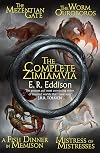
This thick volume collects four works of fiction by a British civil servant who spent his free time inventing and exploring worlds vastly different from that of his day job. He was a passionate student of the ancient Scandinavian sagas and transposed their values, along with a strong admixture of Homer, Sappho, and a bit of potted Spinoza, to imagine worlds where gods take flesh. The results have led Eddison to be called one of the first writers of fantasy literature. One of his early fans, show more the American aficionado of lost, aristocratic worlds, James Branch Cabell, used the term “romance,” however, to distinguish these books from what he called disparagingly “novels.”
I read this in the Kindle version, which was good enough, but it would have been better to have a print copy to make it easier to consult the maps or the charts of the intricate and confusing cast of characters.
The first book in the collection, The Worm Ouroboros, is set in a world the author calls Mercury. It is similar to our world but also different. The various lands are inhabited by beings motivated by recognizable human qualities but called Goblins, Ghouls, and Imps. The two leading nations are the Demons and the Witches. Despite their name, the Demons are the good guys. But while the Witches have many traits usually associated with the villains—they never make a treaty they don’t intend to break at the first opportunity—, Eddison is careful to impart to them a certain nobility. In fact, the greatest tragedy that could befall the Demons would be to not have an adversary as strong as the Witches. For then they “must turn shepherds and hunters, lest we become mere mountebanks and fops,” as their monarch, King Juss, laments. This is not the morality of the Biblical prophets; the thought of turning swords to plowshares is foreign to this world. A sword is nothing more than forged metal unless its glory is found in testing its mettle against another, wielded by a powerful foe.
Fittingly, there are many battles, and I enjoyed the way the author varied his descriptive technique. Some are told as straightforward narratives, another from the viewpoint of an observer watching from the ramparts, while others are recounted after the fact by surviving participants.
The other three books form a cycle set in a land only glimpsed from afar in Worm, Zimiamvia. They are printed here in the order they were published, although the first of them, Mistress of Mistresses, is the last narratively. I read them in the order they appear in this collection. This works because Mistress of Mistresses is the most fully realized. Eddison employs two plots in parallel, one in Zimiamvia, the other on our earth, with the action shifting back and forth. It soon becomes clear that the protagonist on earth, Lessingham, is (as is his wife) an incarnation of a figure who also lives in Zimiamvia, a more rarified plane of existence (this is also a feature of the subsequent book).
The remaining two books fill in the history of Zimiamvia and its rival dynasties. One, A Fish Dinner in Memison, has a high ratio of talk to action. Even more so than in Mistress, Eddison’s mix of intricate description and complex philosophy veers to incoherence. Overall, I found it the weakest of the four, although the dinner involves a marvelous conceit.
The final book, The Mezentian Gate, is the most ambitious in scope but was left unfinished at Eddison’s death. He left behind a plot outline, however. This, along with notes for some of the unwritten chapters, stitch together the finished chapters so that one gets the picture. Fortunately, the portion Eddison wrote includes the closing chapters. In particular, the lengthy final chapter is a fitting conclusion to the entire cycle.
It’s jarring, however, that the plot of Gate surrounds that of Fish Dinner, the events of which are crucial for the unfolding of the denouement in the final book. It seems as if Eddison did not start out with the entire trilogy in mind but added to it as new plot elements came to him.
Eddison’s style, like his values, is that of the Scandinavian sagas. It’s interesting that, on the one hand, he is an adept of philosophy, with its insistence on viewing life Sub specie aeternitatis, as the mephistophelean Vandermast is fond of saying, yet on the other, he (like the characters he creates) is in love with sensual world. Eddison spends pages describing a castle and its halls, for instance, as well as the fantastical landscapes in which it is set. Readers of modern fantasy might grow impatient, wondering when the action might begin. At first, I found the prose slow-going, but my enjoyment rose once I slowed down to savor the luxuriant, archaic prose.
Perhaps the key to this duality of philosophy and sensuality is the basic theme of these books. Eddison has the temperament of an aristocrat and is a devotee of the pantheon, whether in its Greek or Nordic guise. His heroes (all brave and manly) and his heroines (all beautiful—voluptuous, even) are, to one degree or another, incarnations of the divine two, one of whom, Zeus, creates worlds to delight the other (Aphrodite). show less
I read this in the Kindle version, which was good enough, but it would have been better to have a print copy to make it easier to consult the maps or the charts of the intricate and confusing cast of characters.
The first book in the collection, The Worm Ouroboros, is set in a world the author calls Mercury. It is similar to our world but also different. The various lands are inhabited by beings motivated by recognizable human qualities but called Goblins, Ghouls, and Imps. The two leading nations are the Demons and the Witches. Despite their name, the Demons are the good guys. But while the Witches have many traits usually associated with the villains—they never make a treaty they don’t intend to break at the first opportunity—, Eddison is careful to impart to them a certain nobility. In fact, the greatest tragedy that could befall the Demons would be to not have an adversary as strong as the Witches. For then they “must turn shepherds and hunters, lest we become mere mountebanks and fops,” as their monarch, King Juss, laments. This is not the morality of the Biblical prophets; the thought of turning swords to plowshares is foreign to this world. A sword is nothing more than forged metal unless its glory is found in testing its mettle against another, wielded by a powerful foe.
Fittingly, there are many battles, and I enjoyed the way the author varied his descriptive technique. Some are told as straightforward narratives, another from the viewpoint of an observer watching from the ramparts, while others are recounted after the fact by surviving participants.
The other three books form a cycle set in a land only glimpsed from afar in Worm, Zimiamvia. They are printed here in the order they were published, although the first of them, Mistress of Mistresses, is the last narratively. I read them in the order they appear in this collection. This works because Mistress of Mistresses is the most fully realized. Eddison employs two plots in parallel, one in Zimiamvia, the other on our earth, with the action shifting back and forth. It soon becomes clear that the protagonist on earth, Lessingham, is (as is his wife) an incarnation of a figure who also lives in Zimiamvia, a more rarified plane of existence (this is also a feature of the subsequent book).
The remaining two books fill in the history of Zimiamvia and its rival dynasties. One, A Fish Dinner in Memison, has a high ratio of talk to action. Even more so than in Mistress, Eddison’s mix of intricate description and complex philosophy veers to incoherence. Overall, I found it the weakest of the four, although the dinner involves a marvelous conceit.
The final book, The Mezentian Gate, is the most ambitious in scope but was left unfinished at Eddison’s death. He left behind a plot outline, however. This, along with notes for some of the unwritten chapters, stitch together the finished chapters so that one gets the picture. Fortunately, the portion Eddison wrote includes the closing chapters. In particular, the lengthy final chapter is a fitting conclusion to the entire cycle.
It’s jarring, however, that the plot of Gate surrounds that of Fish Dinner, the events of which are crucial for the unfolding of the denouement in the final book. It seems as if Eddison did not start out with the entire trilogy in mind but added to it as new plot elements came to him.
Eddison’s style, like his values, is that of the Scandinavian sagas. It’s interesting that, on the one hand, he is an adept of philosophy, with its insistence on viewing life Sub specie aeternitatis, as the mephistophelean Vandermast is fond of saying, yet on the other, he (like the characters he creates) is in love with sensual world. Eddison spends pages describing a castle and its halls, for instance, as well as the fantastical landscapes in which it is set. Readers of modern fantasy might grow impatient, wondering when the action might begin. At first, I found the prose slow-going, but my enjoyment rose once I slowed down to savor the luxuriant, archaic prose.
Perhaps the key to this duality of philosophy and sensuality is the basic theme of these books. Eddison has the temperament of an aristocrat and is a devotee of the pantheon, whether in its Greek or Nordic guise. His heroes (all brave and manly) and his heroines (all beautiful—voluptuous, even) are, to one degree or another, incarnations of the divine two, one of whom, Zeus, creates worlds to delight the other (Aphrodite). show less
Lists
Read These Too (1)
Unread books (1)
Awards


You May Also Like


Associated Authors
Statistics
- Works
- 13
- Also by
- 7
- Members
- 4,494
- Popularity
- #5,574
- Rating
- 3.7
- Reviews
- 67
- ISBNs
- 118
- Languages
- 7
- Favorited
- 13

