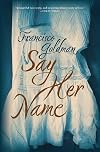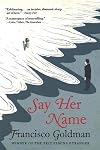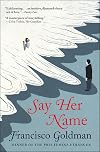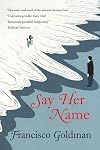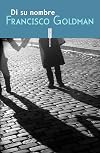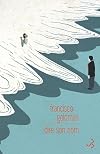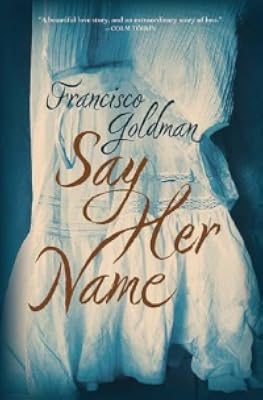
Say Her Name
by Francisco Goldman
On This Page
Description
In a novel based on the author's real-life tragedy, Goldman, consumed with grief and guilt over the accidental death of his wife just before their second anniversary, obsessively collects every memory of her, especially her writings, with the hope of keeping her alive in his mind.Tags
Recommendations



























Member Reviews
Until I finished the book and looked at the library cataloguing on the spine, I did not realize it was a novel. It was such a painfully beautiful tribute to the author's wife and his love for her, I was sure it was biography. I can't put it any better than Annie Proulx: "We may feel we know something about love's burn, the scorching heat of loss, but reading this book is to stand in front of a blowtorch, to take a farrier's rasp to raw ends ... Wrenching funny, powerful, beautiful."
Truth be told, I finished this book some time ago, but it's taken me awhile just to wade through all of the feelings it brought to the surface for me - I don't know that I've been so affected by a book since Atonement, and I honestly don't know if that says more about Francisco Goldman, about the book, or about myself. As with Ian McEwan's Atonement, the narrator has an overwhelming amount of survivor's guilt, though Goldman's approach is significantly more transparent than McEwan's fictional narrator.
I remember reading the New York Times review back in 2011 and feeling so compelled by Goldman's loss - his young wife died tragically only two years into their marriage in what authorities would call a freak accident - that I stopped into show more the Grand Central Posman Books (now gone) the next day to buy it. I couldn't remember the name of it (a fact which I acknowledge to be incredibly ironic) but I was able to summarize it (no response from the employees) and describe the cover - the guy helping me located the sea-blue hardcover with the shapelessly-draped wedding gown floating beneath the title, and looked at me kind of dubiously as if he either had no idea what I was about, or as if he was judging my choice of book.
Perhaps that's in part because this tremendous story of tragedy doesn't make for a great best-seller, or even a highly-recommended mass market beach read (actually, in the interest of taste, please maybe don't read this at the beach). It feels so much more niche and complex than that - not something the casual reader would or should pick up.
Honestly, I'm not sure I was at a point in my life in 2011 where I could have been prepared for it; now that I'm past 30 and have had my share of loss, I know that I appreciate it more than I could have then.
It's a commitment - truly, I think any memoir or biography or autobiography worth its weight requires more attention than most readers can give, but then I hate to call this novel any of those; it is without question biographical - but the way that Goldman breaks up the tragic tale of his short-lived ardent love and builds it strategically is much more like a fictional novel and, in that aspect, exceeds even McEwan in sparking my emotions. Goldman has even said this is not a memoir - certainly, these events happened, but the telling is him emotionally...not the real him - he cites Faulker to this point: "A novel is a writer's secret self, a dark twin of a man" and so that is how he proceeded with telling his story but also removing himself to a degree and allowing the catharsis to take on a life almost of its own.
By design (I imagine), their story arrives like waves as high tide approaches - you can see them in the distance as they surge and recede back and forth until the reader is completely saturated, drowning in stimuli. The Times reviewer called this oscillation "restless...the pacing of the grief-struck," which is terribly accurate in this case.
Goldman, who does not always present himself (or, shall we say, his fictionalish self) in the best light,
shames himself for his humanity in a way that makes it clear that he is (or, was, at least at the time of writing) still working though his grief. We see the denial, the anger, the bargaining and the depression and it seems, only when he begins to imagine Aura as a spirit in her tree, that he has begun to approach acceptance.
How can one explain death? How can one begin to understand it? And how can we move beyond it? Perhaps we never do or - as Goldman says - perhaps grief is eternal like a person's name - "Say her name. It will always be her name. Not even death can steal it. Same alive as dead, always."
www.theliterarygothamite.com show less
I remember reading the New York Times review back in 2011 and feeling so compelled by Goldman's loss - his young wife died tragically only two years into their marriage in what authorities would call a freak accident - that I stopped into show more the Grand Central Posman Books (now gone) the next day to buy it. I couldn't remember the name of it (a fact which I acknowledge to be incredibly ironic) but I was able to summarize it (no response from the employees) and describe the cover - the guy helping me located the sea-blue hardcover with the shapelessly-draped wedding gown floating beneath the title, and looked at me kind of dubiously as if he either had no idea what I was about, or as if he was judging my choice of book.
Perhaps that's in part because this tremendous story of tragedy doesn't make for a great best-seller, or even a highly-recommended mass market beach read (actually, in the interest of taste, please maybe don't read this at the beach). It feels so much more niche and complex than that - not something the casual reader would or should pick up.
Honestly, I'm not sure I was at a point in my life in 2011 where I could have been prepared for it; now that I'm past 30 and have had my share of loss, I know that I appreciate it more than I could have then.
It's a commitment - truly, I think any memoir or biography or autobiography worth its weight requires more attention than most readers can give, but then I hate to call this novel any of those; it is without question biographical - but the way that Goldman breaks up the tragic tale of his short-lived ardent love and builds it strategically is much more like a fictional novel and, in that aspect, exceeds even McEwan in sparking my emotions. Goldman has even said this is not a memoir - certainly, these events happened, but the telling is him emotionally...not the real him - he cites Faulker to this point: "A novel is a writer's secret self, a dark twin of a man" and so that is how he proceeded with telling his story but also removing himself to a degree and allowing the catharsis to take on a life almost of its own.
By design (I imagine), their story arrives like waves as high tide approaches - you can see them in the distance as they surge and recede back and forth until the reader is completely saturated, drowning in stimuli. The Times reviewer called this oscillation "restless...the pacing of the grief-struck," which is terribly accurate in this case.
Goldman, who does not always present himself (or, shall we say, his fictionalish self) in the best light,
shames himself for his humanity in a way that makes it clear that he is (or, was, at least at the time of writing) still working though his grief. We see the denial, the anger, the bargaining and the depression and it seems, only when he begins to imagine Aura as a spirit in her tree, that he has begun to approach acceptance.
How can one explain death? How can one begin to understand it? And how can we move beyond it? Perhaps we never do or - as Goldman says - perhaps grief is eternal like a person's name - "Say her name. It will always be her name. Not even death can steal it. Same alive as dead, always."
www.theliterarygothamite.com show less
Until I finished the book and looked at the library cataloguing on the spine, I did not realize it was a novel. It was such a painfully beautiful tribute to the author's wife and his love for her, I was sure it was biography. I can't put it any better than Annie Proulx: "We may feel we know something about love's burn, the scorching heat of loss, but reading this book is to stand in front of a blowtorch, to take a farrier's rasp to raw ends ... Wrenching funny, powerful, beautiful."
This novel is breathtaking and heartbreaking. Reading it is like being inside the writer's head and emotions during the emotionally turbulent years as he remembers his life with Aura, his much younger wife, and mourns for her. While a lovely elegy, it also brings to life the complex person that Aura was, humanizing her by bringing to the fore her talent and good traits as well as her insecurities, occasional cruelty, impatience and other personal defects. In other words, he loves her entirely, with the good and the bad and makes us care for her too. At times it feels somewhat claustrophobic, for there is little in this book that is not about Aura. Even the narrative of the years of his life prior to meeting her are written in view of show more the day he will meet her and come into her life. A bit of fresh air would have come into the book if he had contextualized it by letting us know what other things were going on in his life and the world around him during those years. Nevertheless, it is what is is: A book about Aura, his paean and elegy to her, and a map of what it is to survive the brutal blow of losing a deeply loved one. show less
Francisco Goldman fell in love with the much younger Aura, a graduate student from Mexico, studying literature at Columbia University. To his surprise, she agreed to marry him and they lived a very happy life. He recounts their short life together in his fictional memoir Say Her Name.
On vacation in Mexico, Aura has a surfing accident and dies. Goldman is devastated, and his pain is made more unbearable by his mother-in-law who blames him for her daughter's death, and vows that he will pay for what he has done. She implies that there was foul play, and not only does he have to deal with his loss, he has to worry about being arrested for Aura's death.
Goldman's grief is palpable and visceral. He was
"no longer him. No longer a husband. No show more longer a man who goes to the fish store to buy dinner for himself and his wife. In less than a year I would be no longer a husband than I was a husband."
Not written as a traditional memoir, Goldman tells Aura's story, using her own writings and diaries to do so. Aura is a poet, and this book has a very poetic, almost dreamy feel to it. He delves into her childhood, her close relationship with her mother, and her insecurities. Although we know that Aura dies, she comes to vivid life on the pages of this book. It is a loving tribute from a husband to his wife.
Goldman lays his grief out on the page for all to see, and it is hard to read at times. He cannot bear to pass by the restaurants and other places they used to go to together. He builds a shrine to her in their apartment, complete with her wedding dress hanging on the mirror.
Say Her Name takes the reader on an honest, emotional journey. We get to know Aura so that her death has an effect on us. There is an element of mystery as well; how did Aura die and did her husband have any responsibility?
Aura and Goldman both studied Mexican and South American literature; if I knew more about it, that would have deepened my appreciation of the book even more.
Readers who liked Calvin Trillin's About Alice and Joan Didion's The Year of Magical Thinking will be moved by this story as well. show less
On vacation in Mexico, Aura has a surfing accident and dies. Goldman is devastated, and his pain is made more unbearable by his mother-in-law who blames him for her daughter's death, and vows that he will pay for what he has done. She implies that there was foul play, and not only does he have to deal with his loss, he has to worry about being arrested for Aura's death.
Goldman's grief is palpable and visceral. He was
"no longer him. No longer a husband. No show more longer a man who goes to the fish store to buy dinner for himself and his wife. In less than a year I would be no longer a husband than I was a husband."
Not written as a traditional memoir, Goldman tells Aura's story, using her own writings and diaries to do so. Aura is a poet, and this book has a very poetic, almost dreamy feel to it. He delves into her childhood, her close relationship with her mother, and her insecurities. Although we know that Aura dies, she comes to vivid life on the pages of this book. It is a loving tribute from a husband to his wife.
Goldman lays his grief out on the page for all to see, and it is hard to read at times. He cannot bear to pass by the restaurants and other places they used to go to together. He builds a shrine to her in their apartment, complete with her wedding dress hanging on the mirror.
Say Her Name takes the reader on an honest, emotional journey. We get to know Aura so that her death has an effect on us. There is an element of mystery as well; how did Aura die and did her husband have any responsibility?
Aura and Goldman both studied Mexican and South American literature; if I knew more about it, that would have deepened my appreciation of the book even more.
Readers who liked Calvin Trillin's About Alice and Joan Didion's The Year of Magical Thinking will be moved by this story as well. show less
I want to accuse this book of not rising above being a ridiculously sentimental love note to/about a dead wife, and it doesn't, but it doesn't try to. In that definition, it is a success, it is beautiful and it is worth reading. It's sad without being dark. I have to admit it's too depressing for me.
This was one of those books I wish I could have rated with a 4.5 - it wasn't quite a five star for me, simply because it took me 100 pages to really feel involved with the story. Partly that was because the confusion between memoir and novel, what was real and what was fiction, kept interrupting my involvement in the story. Goldman's prose was magical, so I kept reading, and eventually I didn't care what was "real" - since it all felt so real and vital.
I took this book with me to read in Mexico, not knowing that much of the story was set in Guanajuato and San Miguel de Allende, where I was staying. What a delicious coincidence that was.
Despite being a slow start, this is a heartbreaking yet inspiring story, beautifully told. Read it.
I took this book with me to read in Mexico, not knowing that much of the story was set in Guanajuato and San Miguel de Allende, where I was staying. What a delicious coincidence that was.
Despite being a slow start, this is a heartbreaking yet inspiring story, beautifully told. Read it.
Members
- Recently Added By
Published Reviews
ThingScore 100
The feeling, the memorial incarnation that this book creates, is monumental. Essential for all libraries. This book about tragic death is a gift for the living
added by sduff222
Lists

Jewish Books
367 works; 24 members

rest, peace, fiction
16 works; 4 members

2008-2012 Notable Books for Adults
127 works; 10 members

Indie Next Picks
196 works; 4 members
Author Information

16+ Works 1,401 Members
Awards and Honors
Awards
Distinctions
Notable Lists
Common Knowledge
- Canonical title
- Say Her Name
- Original title
- Say Her Name
- First words
- Aura died on July 25, 2007.
- Blurbers
- Toibin, Colm; Proulx, Annie; Galchen, Rivka; Desai, Kiran; Lahiri, Jhumpa; Shteyngart, Gary (show all 7); Choi, Susan
Classifications
Statistics
- Members
- 363
- Popularity
- 86,696
- Reviews
- 21
- Rating
- (3.84)
- Languages
- 8 — Dutch, English, French, German, Italian, Portuguese, Russian, Spanish
- Media
- Paper, Audiobook, Ebook
- ISBNs
- 22
- ASINs
- 4